Examine the impact of the Mexican-American War on national politics.
The Mexican-American War
The Mexican-American War
On March 6, 1845, two days after James K. Polk became president, the Mexican government broke off relations with the United States to protest the annexation of Texas. Polk was willing to wage war against Mexico to acquire California, but he did not want Americans to fire the first shot. So he dispatched several thousand troops under General Zachary Taylor to the Rio Grande. That was some 150 miles south of the Nueces River, which both sides had earlier recognized as Texas’s southern border. The U.S. troops were knowingly in territory that Mexico legitimately claimed as its own. The Mexican government recognized neither the American annexation of Texas nor Polk’s ridiculous claim that Texas’s southern border extended to the Rio Grande.
On the evening of May 9, 1845, President Polk learned that Mexican troops had attacked U.S. soldiers along the Rio Grande. Eleven Americans were killed. The president now had the pretext for war that he had been seeking. Polk asked Congress for a declaration of war, only to have a Delaware senator insist that sending troops to the Rio Grande had been “as much an act of aggression on our part as is a man pointing a pistol at another’s heart.”
Despite such concerns, Congress complied with Polk’s request and authorized the recruitment of 50,000 soldiers. The outbreak of fighting thrilled many Americans. In the South, where expansion fever ran high, the war was immensely popular. So many men rushed to volunteer that thousands had to be turned back. Eventually, 112,000 Whites served in the war (Blacks were banned).
The United States had formidable advantages in the war. America’s population was 20 million compared with Mexico’s 7 million. The Mexican economy was essentially bankrupt, while America prospered. The U.S. forces had better weapons, training, resources, and leadership. The main Mexican advantage was fighting on its own territory.
Opposition to the War
In New England, however, there was much less enthusiasm for “Mr. Polk’s War.” Congressman John Quincy Adams, the former president, called it “a most unrighteous war.” He intended to extend slavery into new territories taken from Mexico. The fiery Boston abolitionist William Lloyd Garrison charged that the war was one of American “aggression, of invasion, of conquest.”
Most Whigs across the North, including a young Illinois congressman named Abraham Lincoln, also opposed the war, stressing that President Polk had maneuvered the Mexicans to attack. The United States, they argued, had no reason for placing its army in the disputed border region between Texas and Mexico.
Preparing for Battle
Regardless of the conflict’s legitimacy, the United States was again ill-prepared for a major war. At the outset, the regular army numbered barely 7,000, in contrast to the Mexican force of 32,000. Before the war ended, the U.S. military had grown to almost 79,000 troops, including frontier toughs who lacked uniforms, equipment, and discipline.
Many U.S. soldiers abused and slaughtered Mexicans wherever they found them—men, women, and children. George Gordon Meade, who would become a celebrated Union general during the Civil War, noted that the undisciplined Americans murdered Mexicans simply “for their amusement.” General Winfield Scott also admitted that his troops had committed numerous atrocities, including “murder, robbery, and rape of [Mexican] mothers and daughters.”
The Mexican-American War, from March 1846 to April 1848, was fought on four fronts: southern Texas, central Mexico, New Mexico, and California. Early in the fighting, General Zachary Taylor’s army scored two victories north of the Rio Grande, at Palo Alto (May 8) and Resaca de la Palma (May 9).
On May 18, Taylor’s army crossed the Rio Grande and occupied Matamoros. These quick victories brought Taylor, a Whig, instant popularity, and Polk grudgingly agreed to public demands that Taylor be named the overall commander.
The Annexation of California
Of all the Mexican territories President Polk coveted, California was the grand prize, for he saw it as the commercial gateway to the riches of Asia. Accordingly, Polk fashioned an elaborate scheme to seize Mexico’s westernmost province.
Polk’s plan centered on using John C. Frémont, a self-promoting army officer famous for having helped map the Oregon Trail. Near the end of 1845, Frémont recruited sixty-two frontiersmen, scientists, soldiers, marksmen, and hunters for a secret mission. After equipping his men with the finest weapons and supplies, Frémont led them into California’s Sacramento Valley. His official purpose was to find the best route for immigrants; his actual goal was to conquer Mexican California.
Frémont was a free-spirited adventurer who disobeyed orders, violated promises, and never acknowledged mistakes. Once in California, he and his troops abandoned their exploration and research mission and focused on organizing a rebellion against the Mexican officials. The Mexican governor quickly ordered Frémont and his “band of robbers” to leave.
They grudgingly did so, traveling north to Oregon, only to return after receiving secret messages from President Polk. The messages revealed that the United States would soon be at war with Mexico and that Frémont should seize control of California. Frémont’s men then joined other Americans in capturing Sonoma, the largest settlement in northern California, on June 14, 1846. They proclaimed the Republic of California and hoisted a flag featuring a grizzly bear and star, a version of which would later become the state flag.
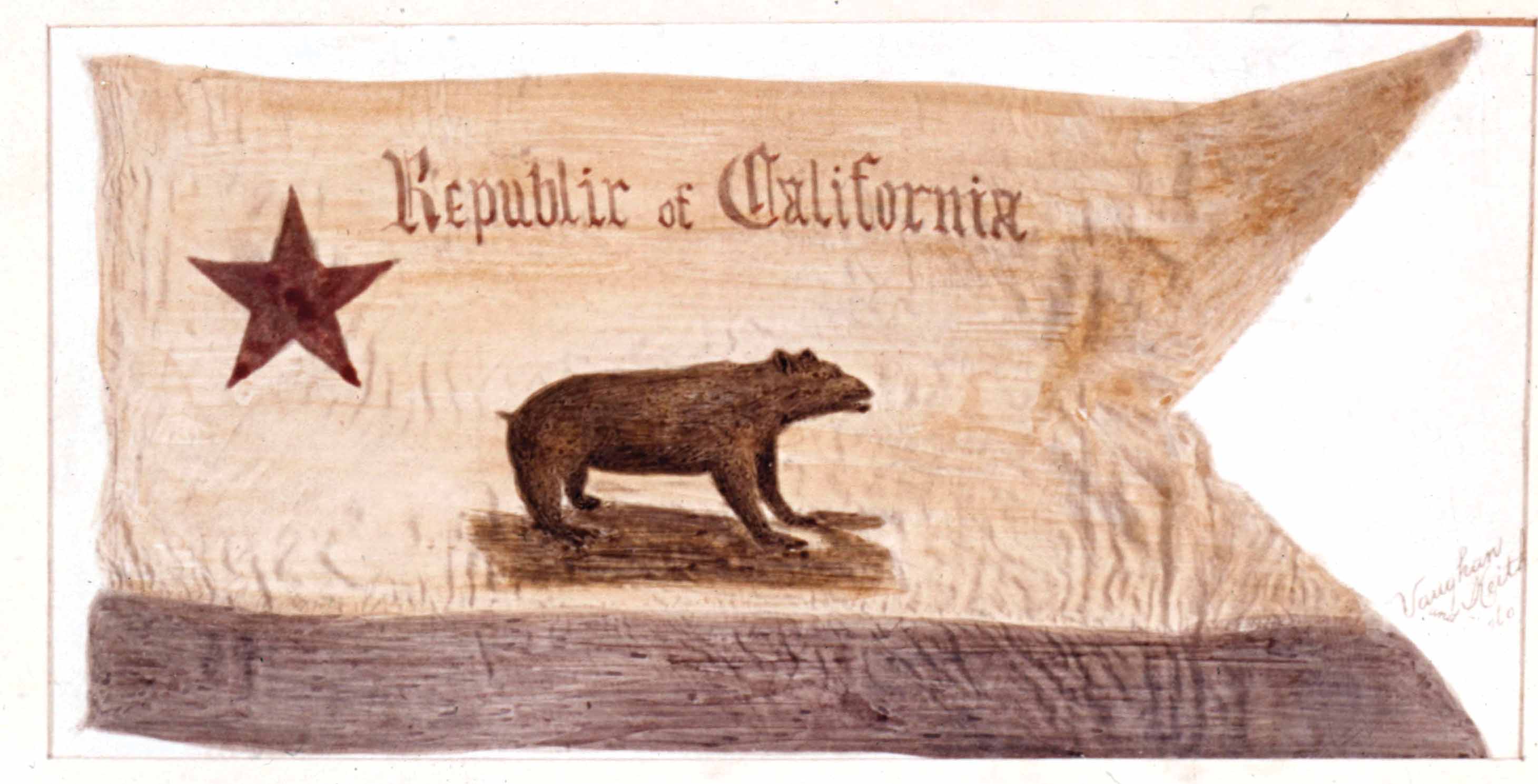
The Bear Flag Republic lasted only a month, however. In July, the commander of the U.S. Pacific Fleet, having heard of the outbreak of hostilities with Mexico, sent troops ashore at Monterey to raise the American flag and claim California as part of the United States.
Before the end of July, another navy officer, Robert F. Stockton, led the American occupation of Santa Barbara and Los Angeles, on the southern California coast. By mid-August 1846, Mexican resistance in California had evaporated. On August 17, Stockton declared himself governor, with Frémont as military governor in the north.
At the same time, another U.S. military expedition headed for New Mexico. On August 18, General Stephen Kearny and a small army entered Santa Fe. Kearny then led 300 men westward toward southern California, where they joined Stockton’s forces at San Diego. They took control of Los Angeles on January 10, 1847, and the remaining Mexican forces surrendered.
War in Northern Mexico
Both California and New Mexico had been taken from Mexican control before General Zachary Taylor fought his first major battle in northern Mexico. In September 1846, Taylor’s army assaulted the fortified city of Monterrey, which surrendered after a five-day siege. The dictator General Antonio López de Santa Anna, forced out of power in 1845, got word to Polk from his exile in Cuba that he would end the war if allowed to return.
In August 1846, on Polk’s orders, Santa Anna was permitted to return to Mexico on the condition that he stay out of politics and the military. The treacherous Mexican leader had lied, however. Soon he was again president of Mexico and in command of the Mexican army. In October 1846, he prepared to attack. When the Mexican general invited the outnumbered Americans to surrender, Zachary Taylor responded, “Tell him to go to hell.”
That launched the hard-fought Battle of Buena Vista (February 22–23, 1847). Both sides claimed victory, but the Mexicans suffered five times as many casualties as the Americans. One of the U.S. soldiers killed was Henry Clay, Jr., whose famous father had lost to Polk in the 1844 presidential campaign. The elder Clay, devastated by his son’s death, condemned Polk’s “unnecessary” war of “offensive aggression” and opposed any effort to use the war as a means of acquiring Mexican territory “for the purpose of introducing slavery into it.”
In August, General Winfield Scott’s outnumbered invasion force marched from Veracruz on the eastern coast toward heavily defended Mexico City, the national capital some 200 miles away. After four battles in which they overwhelmed the Mexican defenders and needlessly killed hundreds of civilians, U.S. forces arrived at the gates of Mexico City in early September 1847.
The Saint Patrick’s Battalion
General Winfield Scott’s triumphant assault on Mexico City was not without problems. Since the start of the war, some 7,000 American soldiers had deserted. Several hundred of them, mostly poor Catholic Irish and German immigrants, changed sides and formed the Saint Patrick’s Battalion in the Mexican army.
The American soldiers, called San Patricios in Spanish, switched sides because they resented the abuse they received from Protestant officers and the atrocities they saw committed against Catholic Mexicans. An Ohio volunteer, for example, yearned to destroy Catholic churches and “put the greasy priests, monks, friars, and other officials at work on the public highways.”
The Mexican army circulated leaflets to American soldiers, offering higher pay, land grants, and citizenship, and urging the foreign born to switch sides and fight for their shared “sacred imperiled religion. If you are Catholic, the same as we, if you follow the doctrines of Our Savior, why are you murdering your brethren? Why are you antagonistic to those who defend their country and your own God?”
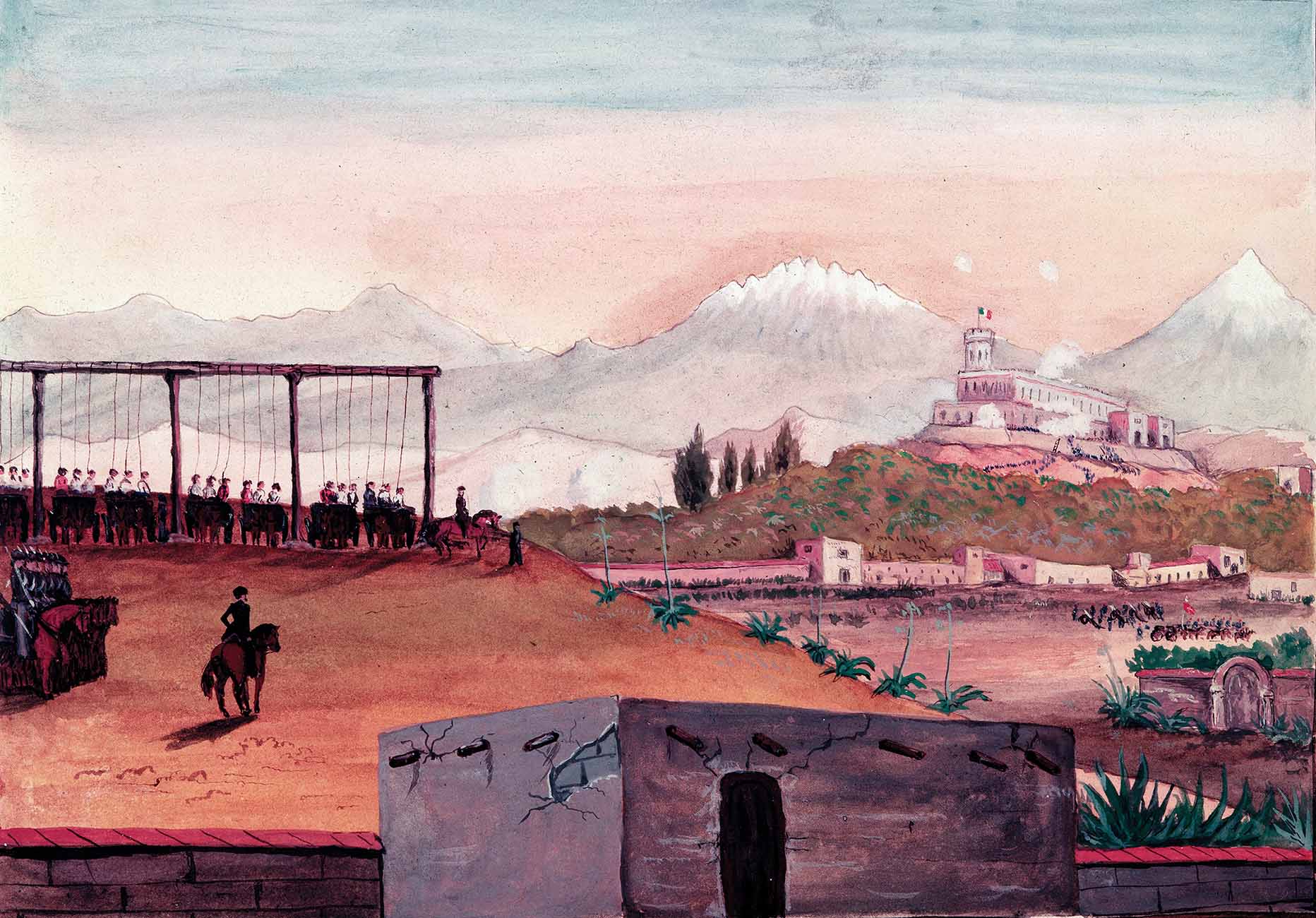
Whatever their motives, the San Patricios fought tenaciously. During one of the battles for Mexico City, the Americans captured seventy-two of the Catholic defectors, most of whom were sentenced to death.
At dawn on September 13, 1847, the San Patricios, their hands and feet bound, were made to stand in the hot sun in sight of Chapultepec, the last Mexican fortress protecting Mexico City. They were forced to watch the battle unfold. When the American troops scaled the walls of the fortress and raised the U.S. flag, the San Patricios were all hanged simultaneously.
The Treaty of Guadalupe Hidalgo (1848)
After the fall of Mexico City, Mexican leader Santa Anna resigned and fled the country. Peace talks began on January 2, 1848. News of the victory thrilled American expansionists. The editor John O’Sullivan, who had coined the phrase “manifest destiny,” shouted, “More, More, More! Why not take all of Mexico?”
By the Treaty of Guadalupe Hidalgo, signed on February 2, a humiliated Mexico gave up half its entire territory: all of Texas north of the Rio Grande, the territories that would become the states of California, Arizona, New Mexico, and significant parts of Colorado, Utah, Wyoming, and Nevada.
The treaty guaranteed the 150,000 Native Americans and the 80,000 Mexicans living in the ceded territories that they could keep their property, receive U.S. citizenship, and retain their Catholic religion. About 90 percent of them chose to stay in the new American territories.
Over time, however, as Americans streamed in, the ruthless among them—and there were many—scorned, cheated, and killed Mexican-born residents and Native Americans. Mexican Americans were forced to accept the lowest-paying jobs under the worst working conditions. Most of them were manual laborers, vaqueros (cowboys), miners, railroad workers, or cartmen, transporting food and supplies.
Americans also found ways to cheat Mexicans out of their lands. By the Land Act of 1851, Congress required that all landowners whose property was granted earlier by Spanish or Mexican authorities had to have documented titles. Those who did not have such land titles had their property confiscated.
Except for a small addition made by the Gadsden Purchase of 1853, the annexations of Mexican territory rounded out the continental United States and nearly doubled its size. In return for what President Polk called “an immense empire,” the United States paid Mexico $15 million. The disgraced Mexican leader Santa Anna spoke for most Mexicans when he said the treaty would always be a source of “eternal shame and bitter regret for every Mexican.”
The War’s Legacies
The Mexican-American War marked the first time that U.S. military forces had defeated and occupied another country. More than 13,000 Americans died in the conflict, 11,550 of them from disease. The war remains the deadliest in American history in terms of the percentage of soldiers killed. Of every 1,000 U.S. soldiers in Mexico, some 110 died.
The U.S. victory helped end the prolonged economic depression. As the years passed, however, critics charged that the conflict was a shameful war of conquest and imperialistic plunder directed by a president to grab more territory for slavery. Ulysses S. Grant, who fought in the war, later called it “one of the most unjust wars ever waged by a stronger against a weaker nation.”
The revolutionary republic of 1776 devoted to liberty from colonial rule had become a continental empire built upon the conquest and exploitation of native peoples. (There are no grand statues in Washington, D.C., celebrating the Mexican-American War.)
The annexation of so much Mexican territory worried some prominent Americans determined to defend their notions of racial superiority. “More than half the Mexicans are Indians,” South Carolina’s John C. Calhoun harrumphed, “and the other half is composed chiefly of mixed tribes. I protest against such a union as that! Ours, sir, is the government of a white race.”
Glossary
- Treaty of Guadalupe hidalgo
- Treaty between United States and Mexico that ended the Mexican-American War.