Describe the factors that motivated America’s new imperialism after the Civil War.
Toward the New Imperialism
American Imperialism
In 1902, the British economist J. A. Hobson announced that imperialism was “the most powerful factor in the current politics of the Western world.” The United States was a latecomer to the imperialism long practiced by European nations. Beginning in the 1880s, the British, French, Belgians, Italians, Dutch, Spanish, and Germans had conquered most of Africa and Asia. Often competing with one another for territories, they had established colonial governments to rule over the native populations and exploited the colonies economically. Each of the imperial nations, including the United States, dispatched Christian missionaries to convert conquered peoples.
During the late nineteenth century, a small yet influential group of officials aggressively encouraged expansion beyond North America. They included powerful senators Albert J. Beveridge of Indiana and Henry Cabot Lodge of Massachusetts as well as the assistant secretary of the navy Theodore Roosevelt and naval captain Alfred Thayer Mahan, president of the U.S. Naval War College in Rhode Island.
In 1890, Mahan published The Influence of Sea Power upon History, 1660–1783, in which he argued that Great Britain had demonstrated that national greatness flowed from naval power. Mahan insisted that modern economic development required a powerful navy centered on huge battleships, foreign commerce, colonies to provide raw materials and new markets for American products, and global naval bases. A self-described imperialist, he urged Americans to “look outward” beyond the continental United States.
Mahan championed America’s “destiny” to control the Caribbean Sea, build a Central American canal to connect the Atlantic and Pacific Oceans, and spread Christian civilization across the Pacific. His ideas were widely circulated within political and military circles in the United States as well as Great Britain and Germany, and by 1896 the United States had built eleven new steel battleships, making America’s navy the third most powerful in the world behind the navies of Great Britain and Germany.
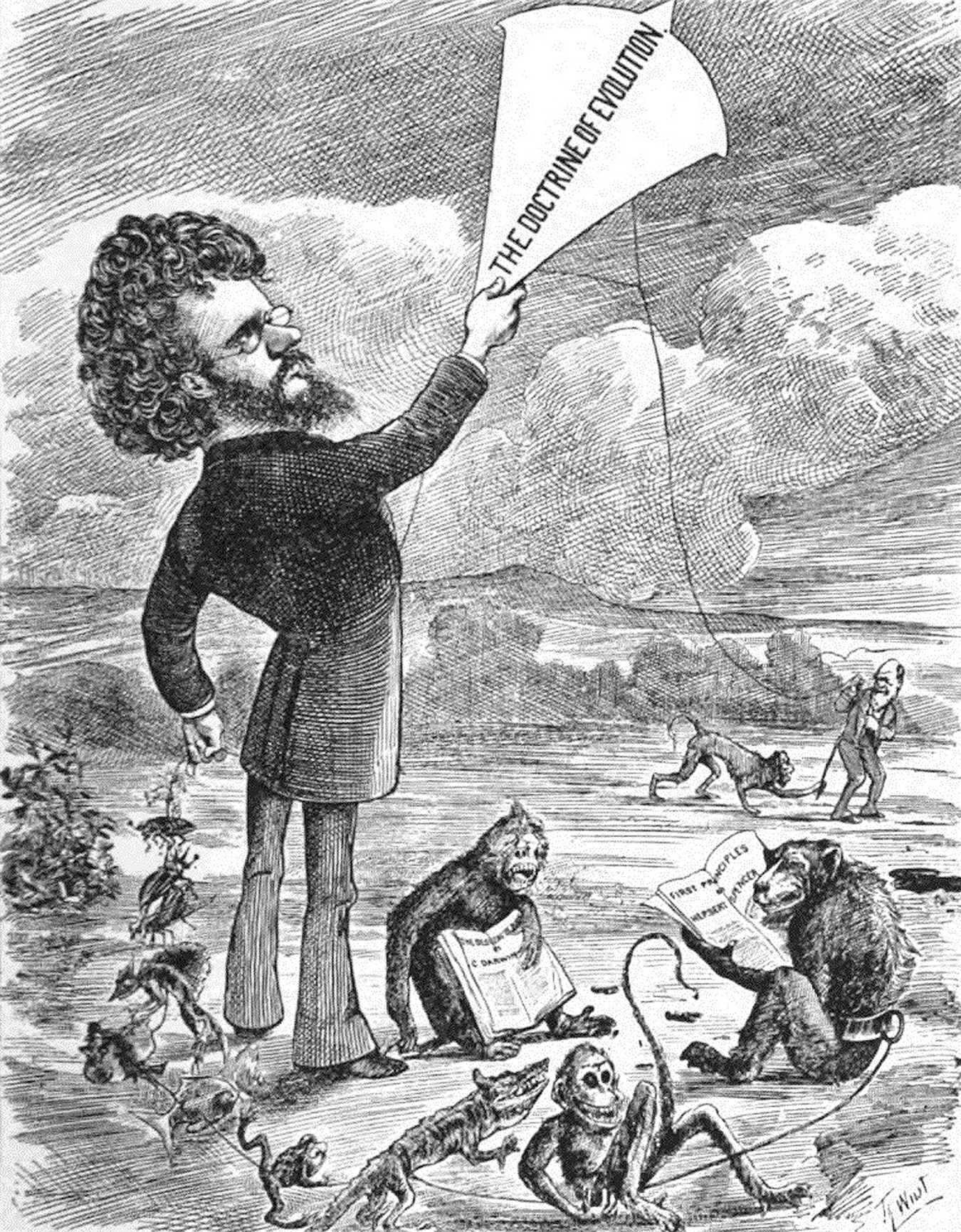
Claims of racial superiority reinforced the new imperialist spirit. During the late nineteenth century, many Americans assumed that the Anglo-Saxon race was dominant and others (Native Americans, Africans) were clearly inferior. Such traditional notions justifying racism were given new “scientific” authority by researchers at universities throughout Europe and America. At the Johns Hopkins University in Baltimore, Professor James K. Hosmer claimed that “the primacy of the world will lie with us” because of the superior qualities of the Anglo-Saxon civilization.
Prominent Americans used the arguments of social Darwinism to justify economic exploitation and territorial conquest abroad and racial segregation at home. Among nations as among individuals, they claimed, only the strongest survive. John Fiske, a Harvard historian and popular lecturer on Darwinism, proclaimed in 1885 the superior character of “Anglo-Saxon” institutions and peoples. The English-speaking “race,” he asserted, was destined to dominate the globe and transform the institutions, traditions, language—even the blood—of the world’s “backward” races.
All these factors helped excite imperialist fervor in the United States during the late nineteenth century. As a Kentucky newspaper editor proclaimed in 1893, the United States was “the most advanced and powerful” nation in the world, an “imperial Republic” destined to shape the “future of the world.” The Washington Post agreed, revealing that “the taste of Empire is in the mouth of the people.”
Glossary
- imperialism
- The use of diplomatic or military force to extend a nation’s power and enhance its economic interests, often by acquiring territory or colonies and justifying such behavior with assumptions of racial superiority.
- The Influence of Sea Power upon History, 1660–1783
- Historical work in which Rear Admiral Alfred Thayer Mahan argued that a nation’s greatness and prosperity come from the power of its navy; the book helped bolster imperialist sentiment in the United States in the late nineteenth century.