Identify the causes of the Spanish-American War and its major events.
The Spanish-American War
The Spanish-American War
The annexation of Hawaii set in motion efforts to create a much larger American presence in Asia. Ironically, this imperialist push originated in Cuba, a Spanish colony ninety miles southeast of Florida. Even more ironically, the chief motive for intervention in Cuba was outrage at Spain’s brutal imperialism.
The Cuban Independence Movement
Causes of the War of 1898
Throughout the second half of the nineteenth century, Cubans had repeatedly revolted against Spanish rule, only to be ruthlessly suppressed. As one of Spain’s oldest colonies, Cuba was a major export market for Spanish goods. American sugar and mining companies had also invested heavily in Cuba. In fact, the United States traded more with Cuba than Spain did, and American companies owning sugar plantations in Cuba had grown increasingly concerned about the security of their investments.
On February 24, 1895, Cubans again rebelled against Spanish troops. During what became the Cuban War for Independence (1895–1898), 95,000 Cuban peasants died of combat wounds as well as disease and starvation in Spanish detention camps.
Americans followed the conflict each day through the newspapers. Two of the largest newspapers, William Randolph Hearst’s New York Journal and Joseph Pulitzer’s New York World, were then locked in a fierce competition for readers. Each strove to outdo the other with sensational headlines about every Spanish atrocity in Cuba, real or invented.
Hearst believed that newspapers should not simply report on events but should also shape public opinion and legislation. Newspapers, he boasted, had the power to “declare wars” by their sensational story making. Editors sent their best reporters to Cuba and encouraged them to distort, exaggerate, or even make up stories to attract more readers. Such sensationalist reporting came to be called yellow journalism. In addition to boosting the Journal’s circulation, Hearst wanted a war against Spain to propel the United States to world-power status. Many Protestant organizations also campaigned for war in Cuba, in part because of antagonism toward Catholic Spain.
The Political Path to War
At the outset of the Cuban War for Independence, President Grover Cleveland tried to avoid military involvement. After his inauguration in March 1897, President William McKinley continued the policy of neutrality while taking a sympathetic stance toward the rebels. Later that year, Spain offered Cubans autonomy (self-government without formal independence) in return for ending the rebellion, but the Cuban rebels rejected the offer.
Early in 1898, two events pushed Spain and the United States into a war that neither wanted. On January 25, the U.S. battleship Maine docked in Havana, the Cuban capital, supposedly on a courtesy call. In fact, however, McKinley had sent the warship to protect “American life and property.”
Then, on February 9, the New York Journal released the text of a letter from Dupuy de Lôme, Spanish ambassador to the United States. In the de Lôme letter, which had been stolen from the post office by a Cuban spy, the Spanish diplomat called McKinley “weak and a bidder for the admiration of the crowd, besides being a would-be politician who tries to leave a door open behind himself while keeping on good terms with the jingoes [warmongers] of his party.” Although the Spanish government recalled de Lôme and apologized for his indiscretions, McKinley responded that he had lost his patience with Spanish bungling in Cuba.
Then a tragic disaster made war much more likely. On February 15, 1898, the Maine exploded without warning and sank in Havana Harbor, with a loss of 266 sailors. Those eager for a war with Spain were convinced the Spanish had destroyed the ship. The headline in the New York Journal screamed: “Whole Country Thrills with War Fever.”
The assistant secretary of the navy, Theodore Roosevelt, called the sinking “an act of dirty treachery on the part of the Spaniards” and told a friend that he “would give anything if President McKinley would order the fleet to Havana tomorrow.” The United States, he claimed, “needs a war.”
McKinley, however, refused to be rushed into war. As the days passed and war did not come, Roosevelt, an imperialist and a war lover, told his friends that the president was too timid; he “has no more backbone than a chocolate éclair.” With Roosevelt’s encouragement, the public’s outcry against Spain grew behind the saying, “Remember the Maine!”
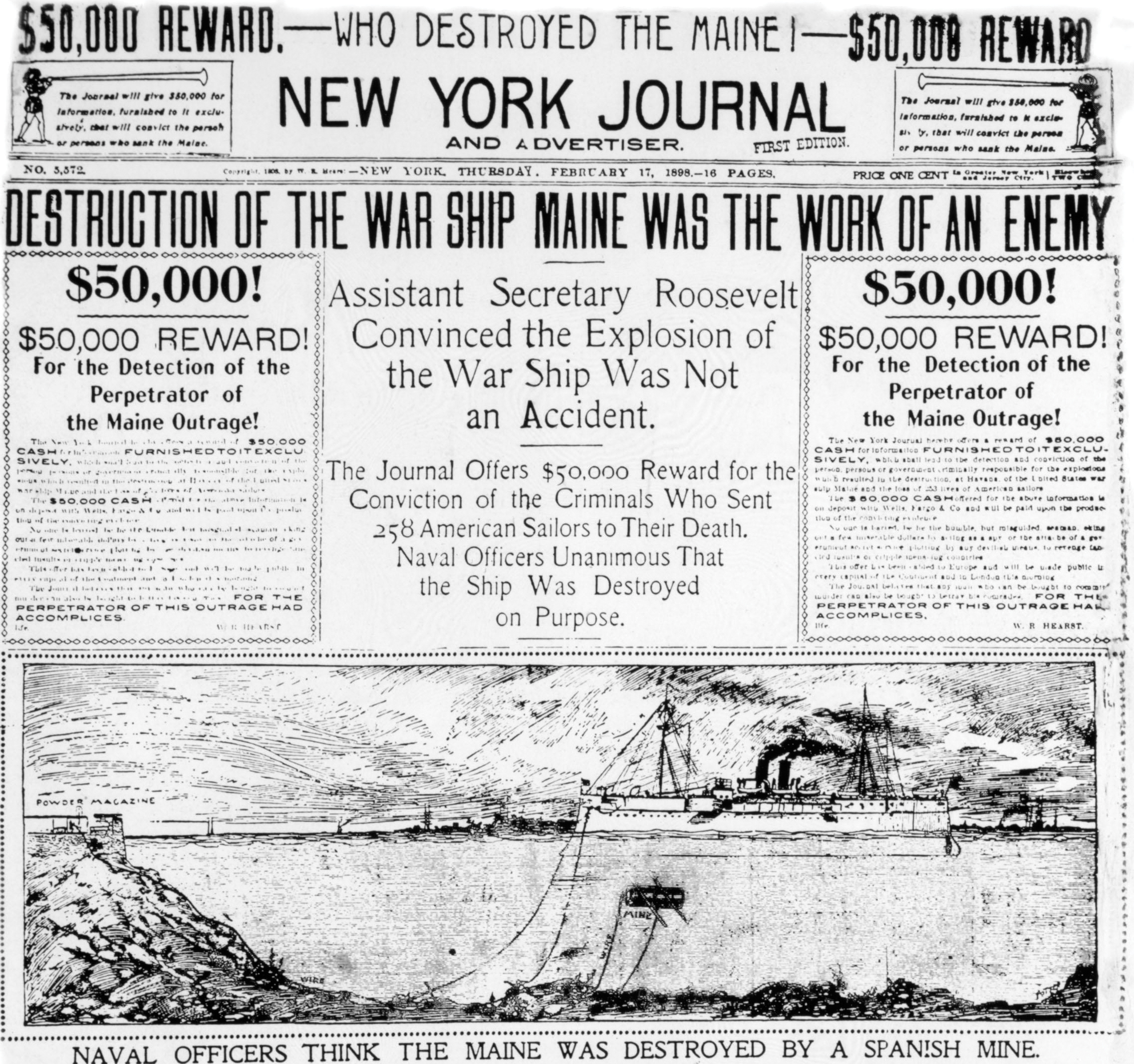
In the weeks following the sinking, the Spanish government agreed to every major demand by the American government regarding its rule over Cuba. But the weight of outraged public opinion and the influence of Republican “jingoists” (war-loving patriots) such as Roosevelt and the president’s closest friend, Senator Henry Cabot Lodge, eroded McKinley’s neutrality.
“We are all jingoes now,” trumpeted the New York Sun, “and the head jingo is the Hon. William McKinley.” On April 11, McKinley asked Congress for authority to use armed force in Cuba to end the fighting there. On April 20, Congress responded by demanding the withdrawal of Spanish forces. The Spanish government quickly broke diplomatic ties with the United States. After U.S. ships began blockading Cuban ports, Spain declared war on April 24. The next day, Congress passed its own declaration of war. The Teller Amendment to the war resolution denied any U.S. intention to annex Cuba.
President McKinley called for 125,000 volunteers to supplement the 28,000 men already serving in the U.S. Army. Among the first to enlist was Theodore Roosevelt, who resigned from his government post and told his tailor to make him a dashing army uniform. To him, combat would help America reclaim “the stern and manly qualities which are essential to the well-being of a masterful race.”
THE SPANISH-AMERICAN WAR IN THE PACIFIC
- Why did Theodore Roosevelt order Commodore Dewey to take Manila?
- What role did Filipino nationalist leader Emilio Aguinaldo play?
- Why were many Americans opposed to the acquisition of the Philippines?
Never has an American war, so casually begun and so enthusiastically supported, generated such unexpected and far-reaching consequences as did the conflict against Spain. Although McKinley had gone to war reluctantly, he soon saw an opportunity to acquire overseas territories. “While we are conducting war and until its conclusion,” he wrote privately, “we must keep all we get; when the war is over, we must keep what we want.” A war to free Cuba thus became a way to gain an empire.
“A Splendid Little War”
The Acquisition of the Philippines
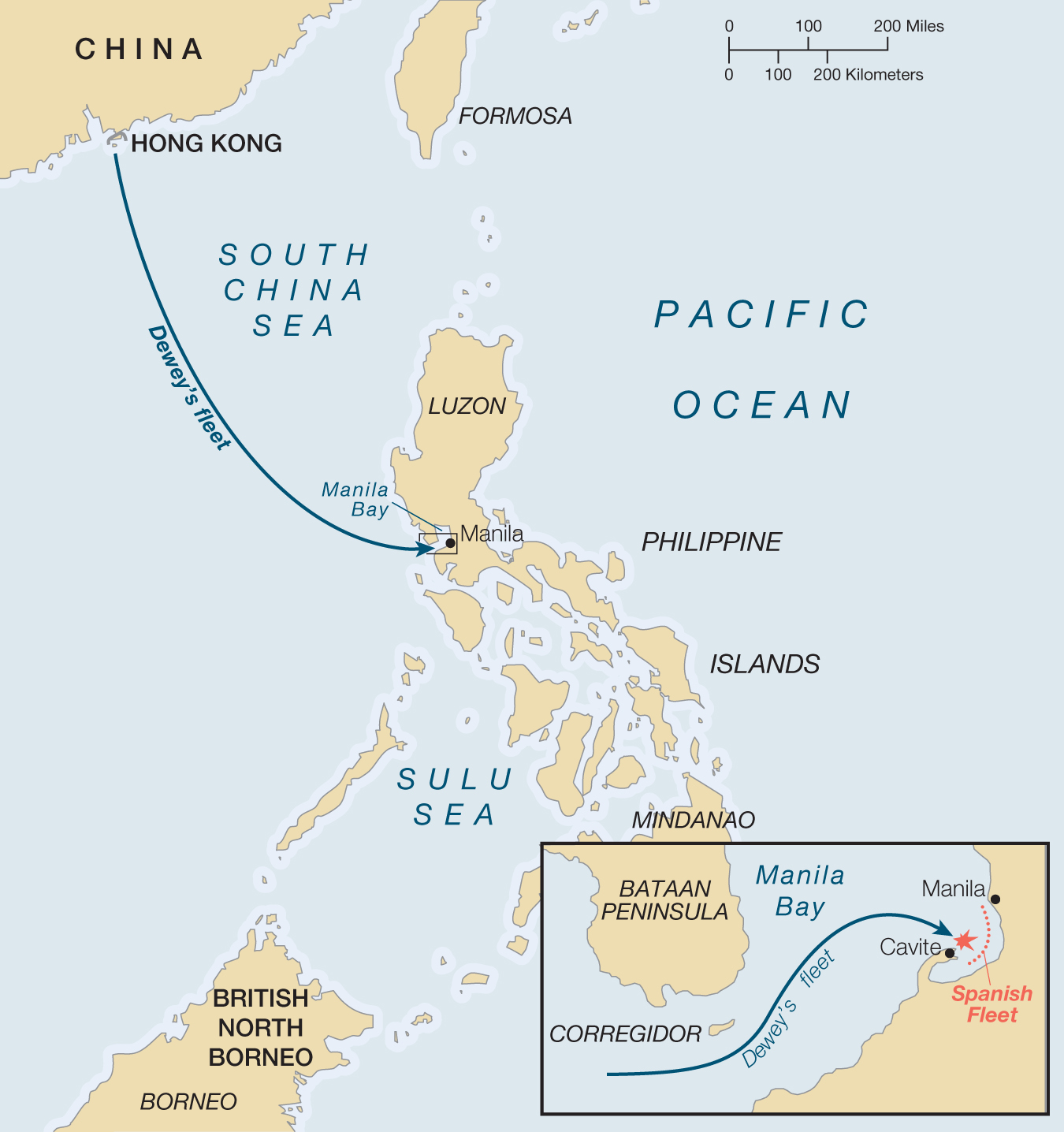
The war with Spain lasted only 114 days, but it transformed the role of the United States in the world. The conflict was barely under way before the U.S. Navy produced a spectacular victory 7,000 miles away, at Manila Bay in the Philippine Islands, a colony controlled by Spain for more than 300 years. Just before war was declared, Theodore Roosevelt, still assistant secretary of the navy, had ordered Commodore George Dewey, commander of the U.S. Asiatic Squadron, to engage Spanish warships in the Philippines in case the United States went to war in Cuba.
Dewey arrived in Manila Bay on April 30 with six modern warships, which quickly destroyed the outdated Spanish vessels. An English reporter called it “a military execution rather than a real contest.” News of Dewey’s victory set off wild celebrations in the United States.
Commodore Dewey was now in awkward possession of Manila Bay but without any soldiers to go onshore. While he waited for reinforcements, German and British warships cruised offshore like watchful vultures, ready to seize the Philippines if the United States did not.
In the meantime, Emilio Aguinaldo, the leader of the Filipino nationalist movement, declared the Philippines independent from Spain on June 12. With Aguinaldo’s help, Dewey’s augmented forces entered Manila on August 13 and accepted the surrender of the Spanish troops.
News of the American victory sent President McKinley scurrying to find a map of the Philippines to locate “these darned islands” now occupied by U.S. soldiers and sailors. Senator Lodge was delighted with the news from the Philippines: “We hold the other side of the Pacific,” he announced. “We must on no account let the [Philippine] Islands go.”
As a result of the American victory, Aguinaldo’s dream of Filipino independence and self-rule would soon be crushed by U.S. forces. As the writer Mark Twain would explain, “There must be two Americas: one that sets the captive free, and one that takes a once-captive’s new freedom away from him.”
The Cuban Campaign
While Commodore Dewey was defeating the Spanish in the Philippines, the fighting in Cuba reached a surprisingly quick climax. At the start of the war, the Spanish army in Cuba was five times as large as the entire U.S. Army. President McKinley’s call for volunteers, however, inspired nearly a million men to enlist, and some 200,000 were accepted.
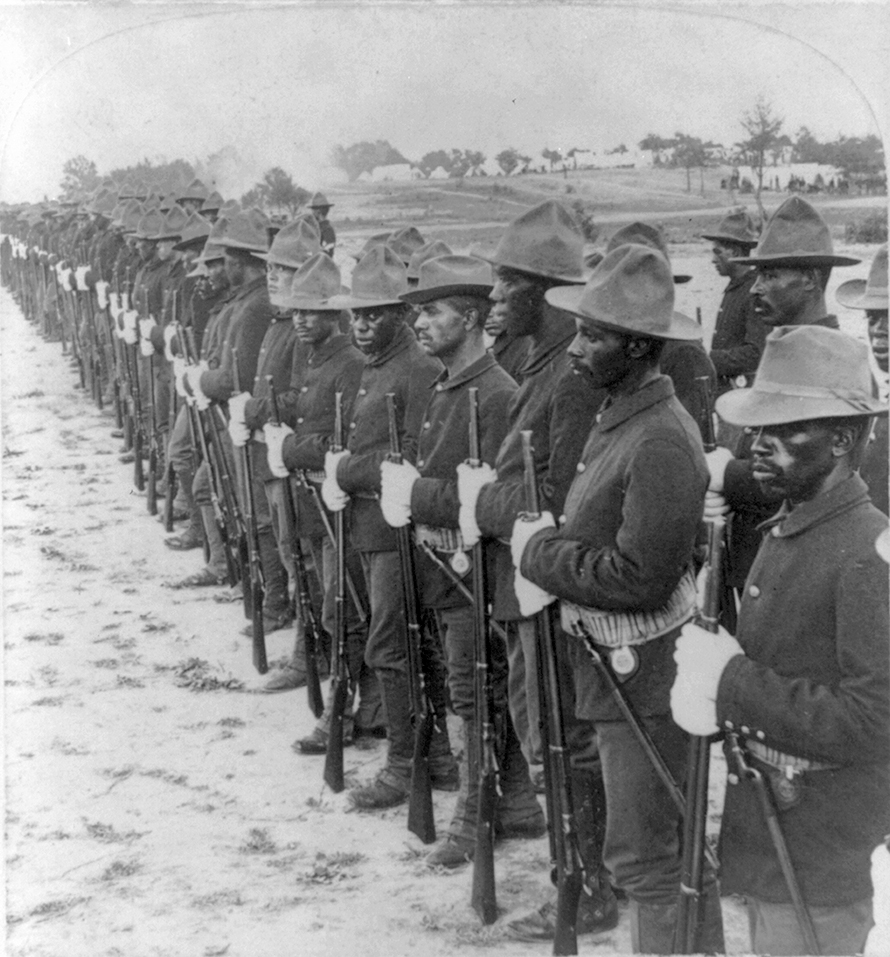
Among the new recruits were some 10,000 African American soldiers, mostly northerners determined to “show our loyalty to our land.” In the Jim Crow South, however, Blacks were less eager to enlist because, as a Virginia newspaper editor observed, they suffered “a system of oppression as barbarous as that which is alleged to exist in Cuba.”
In the meantime, the U.S. Navy blockaded the Spanish fleet inside Santiago Harbor while some 17,000 American troops assembled at Tampa, Florida. The most flamboyant unit was the First Volunteer Cavalry, better known as the Rough Riders, a special regiment made up of former Ivy League athletes; Irish policemen; ex-convicts; cowboys from Oklahoma and New Mexico; Texas Rangers; gold miners; and Cherokee, Choctaw, Chickasaw, Pawnee, and Creek Indians. All were “young, good shots, and good riders.”
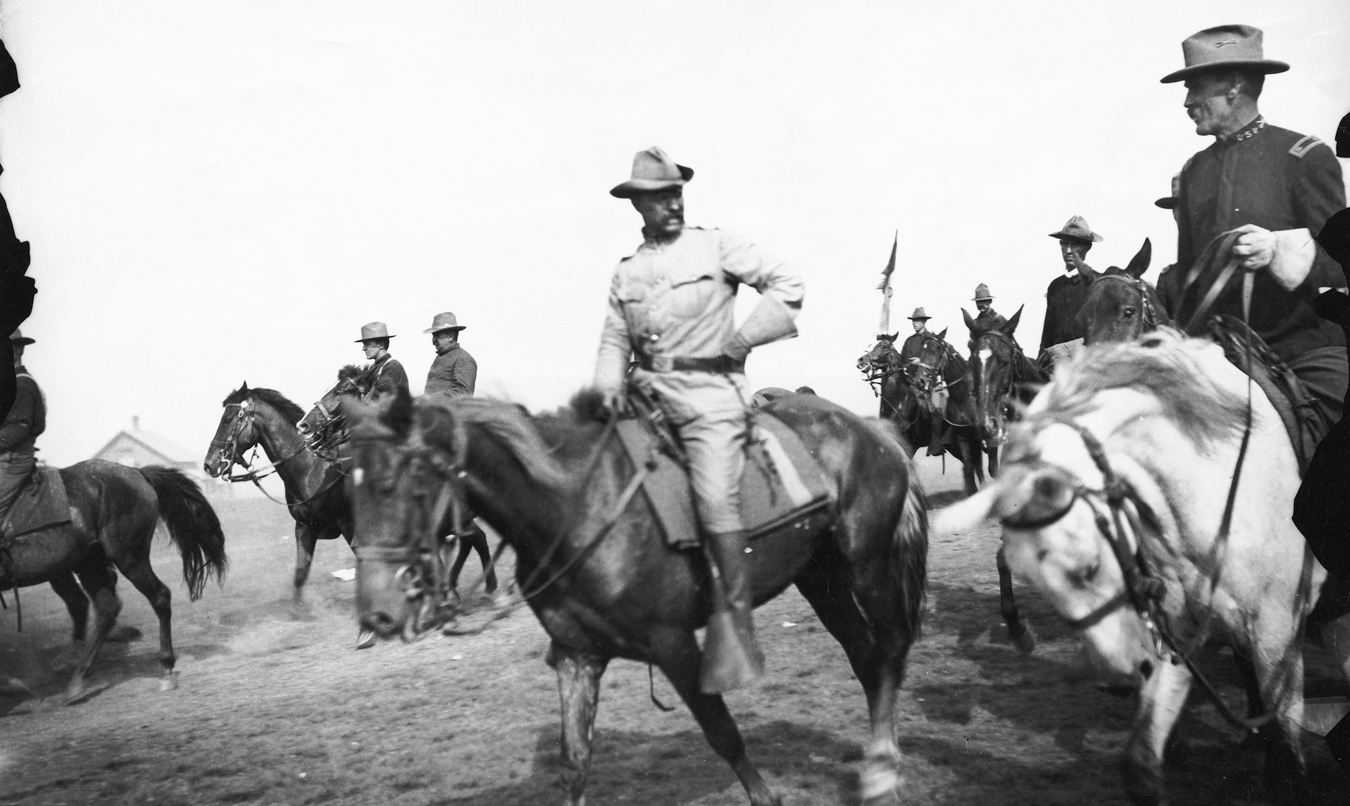
The Rough Riders are best remembered because Theodore Roosevelt was second in command. One Rough Rider said that Roosevelt was “nervous, energetic, virile [manly]. He may wear out some day, but he will never rust out.”
When the 578 Rough Riders, accompanied by a gaggle of reporters and photographers, landed on June 22, 1898, at the undefended southeastern tip of Cuba, chaos ensued. Most of the unit’s horses and mules had been mistakenly sent elsewhere, leaving the Rough Riders to become the “Weary Walkers.” Nevertheless, land and sea battles quickly broke Spanish resistance.
On July 1, about 7,000 U.S. soldiers took the fortified village of El Caney. While a much larger force attacked San Juan Hill, a smaller unit, led by Theodore Roosevelt on horseback and including the Rough Riders on foot, seized nearby Kettle Hill. Situated in a field of tall grass, the frustrated Americans were being shot at by Spanish snipers while waiting to attack. Captain Bucky O’Neill decided to boost morale by strolling among the men while smoking a cigarette. When one of them shouted, “Captain, a bullet is sure to kill you,” O’Neill replied, “Sergeant, the Spanish bullet ain’t made that will kill me”—whereupon a Spanish bullet struck him in the jaw, killing him instantly.
O’Neill’s death prompted Roosevelt to mount his horse and order his men to charge the Spaniards. Thanks to widespread newspaper coverage, much of it exaggerated, Roosevelt became a home-front legend for his headlong gallop toward the Spanish defenders wearing a blue polka-dot bandana. The New York Times reported that he had led the charge with “bulldog ferociousness,” acting in a “grand drama for the world to watch and admire.” Roosevelt claimed that nobody “else could have handled this regiment quite as I handled it.” He may have been bragging, but what he said was true.
Roosevelt crowed that he had “killed a Spaniard with my own hand—like a jack rabbit.” Unburdened by humility, he requested a Congressional Medal of Honor for his exploits. It did not come. (President Bill Clinton finally awarded the medal posthumously in 2001.)
While Colonel Roosevelt was basking in the glory of battle, other U.S. soldiers in Cuba were less enthusiastic about the terrors of modern warfare. Walter Bartholomew, a private from New York, reported that the war “in all its awfulness” was so “much more hideous than my wildest imagination that I have not yet recovered from the shock.” A soldier standing beside him had “the front of his throat torn completely off” by a Spanish bullet.
Spanish Defeat and Concessions
On July 3, the Spanish navy trapped at Santiago made a gallant run to evade the American fleet blockading the harbor. The outgunned Spanish ships were quickly destroyed by the more modern American fleet. On July 25, an American force took control of Spanish-held Puerto Rico, meeting only minor resistance as it took control of that island.
The next day, July 26, the Spanish government sued for peace. In Cuba, the Spanish forces formally surrendered to the U.S. commander and then sailed for home; excluded from the ceremony were the Cubans, for whom the war had supposedly been fought.
THE SPANISH-AMERICAN WAR IN THE CARIBBEAN
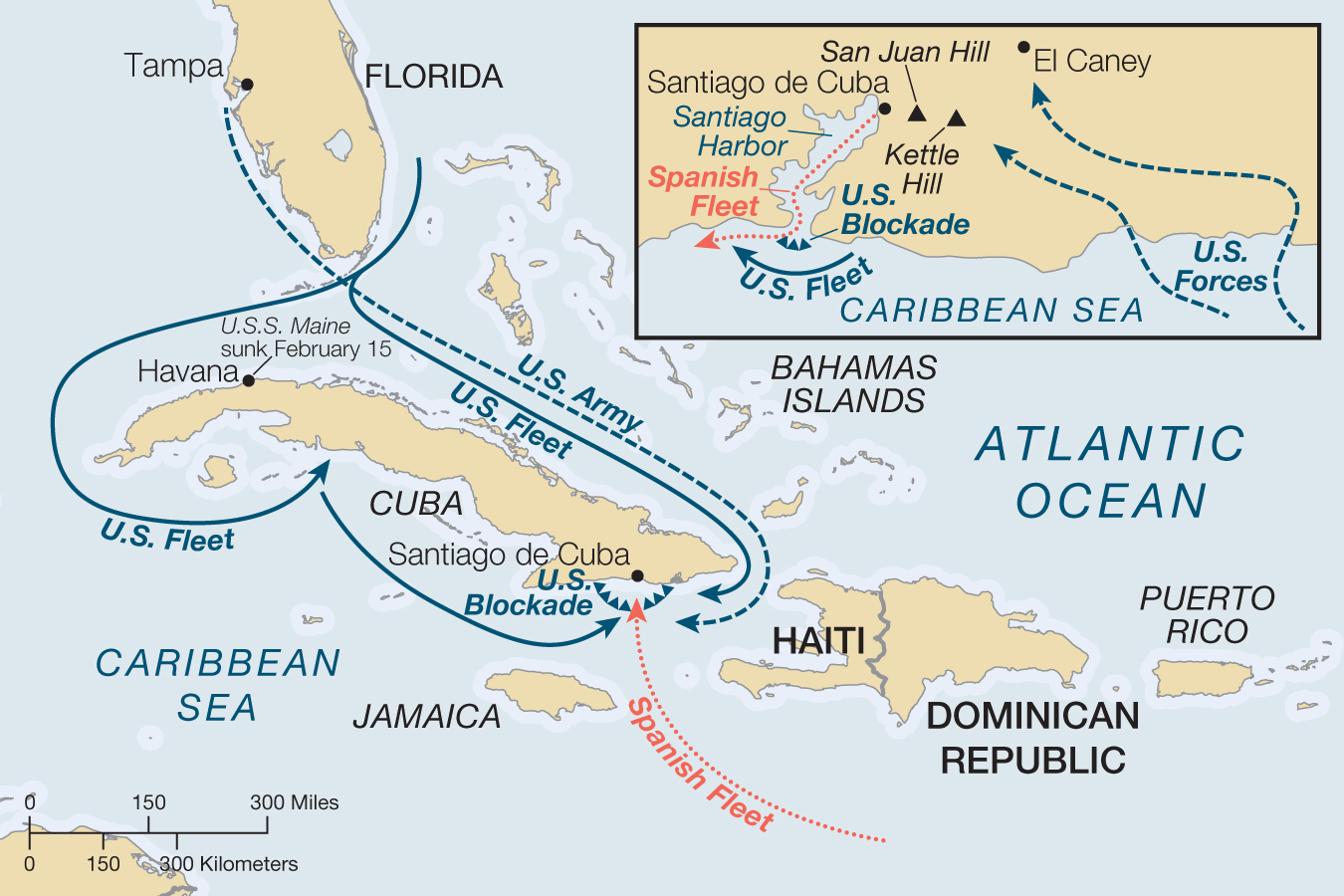
- What started the Spanish-American War?
- What caused most of the casualties in the war?
On December 10, the United States and Spain signed the Treaty of Paris. Under its terms, Cuba was to become independent, and the United States was to annex Puerto Rico and continue to occupy Manila, pending a transfer of power in the Philippines.
With the Treaty of Paris, the Spanish empire in the Americas, initiated by the voyages of Christopher Columbus some four centuries earlier, came to a humiliating end. Now the United States was ready to create its own empire.
During the four-month Spanish-American War, more than 60,000 Spanish soldiers and sailors died of wounds or disease—mostly malaria, typhoid, dysentery, or yellow fever. Among the 274,000 Americans who served in the war, 5,462 died, but only 379 in battle; most died from unsanitary conditions in the army camps. At such a cost, the United States was launched onto the world scene as a great power, with all the benefits—and burdens—of a colonial empire of its own.
Halfway through the conflict in Cuba, John Hay, the U.S. ambassador to Great Britain, who would soon become secretary of state, wrote a letter to Roosevelt, his close friend. In acknowledging Roosevelt’s trial by fire, Hay called the conflict “a splendid little war, begun with the highest motives, carried on with magnificent intelligence and spirit, favored by that fortune which loves the brave.”
Glossary
- U.S. battleship Maine
- American warship that exploded in the Cuban port of Havana on February 15, 1898; though later discovered to be the result of an accident, the destruction of the Maine was initially attributed by war-hungry Americans to Spain, contributing to the onset of the Spanish-American War.
- de Lôme letter (1898)
- Private correspondence written by the Spanish ambassador to the United States, Depuy de Lôme, that described President McKinley as “weak”; the letter was stolen by Cuban revolutionaries and published in the New York Journal in 1898, deepening American resentment of Spain and moving the two countries closer to war in Cuba.
- Teller Amendment (1898)
- Addition to the congressional war resolution of April 20, 1898, which marked the U.S. entry into the war with Spain; the amendment declared that the United States’ goal in entering the war was to ensure Cuba’s independence, not to annex Cuba as a territory.
- Rough Riders
- The First Volunteer Cavalry, led in the Spanish-American War by Theodore Roosevelt; victorious in their only engagement, the Battle of San Juan Hill.
- yellow journalism
- A type of news reporting, epitomized in the 1890s by the newspaper empires of William Randolph Hearst and Joseph Pulitzer, that intentionally manipulates public opinion through sensational headlines, illustrations, and articles about both real and invented events.