Explain the causes of the economic depression of the late 1830s and the emergence of the Whig Party.
Political Battles
Jackson’s Transformational Presidency
Andrew Jackson’s controversial policies regarding the Indigenous people, nullification, and the B.U.S. aroused intense opposition. Some congressional opponents talked of impeaching him; while other, unidentified people sent him death threats.
In January 1835, the threat became real. After attending the funeral service for a member of Congress, Jackson was leaving the Capitol when an unemployed English-born housepainter named Richard Lawrence emerged from the shadows and pointed a pistol at the president’s heart. When he pulled the trigger, however, the gun misfired. Jackson lifted his walking stick and charged at Lawrence, who pulled out another pistol—but it, too, miraculously misfired. Jackson claimed that his political foes, including John C. Calhoun, had planned the attack. A jury, however, decided that Lawrence, the first person to try to kill a U.S. president, was insane and ordered him confined in an asylum.
A Third Party
In 1832, for the first time in a presidential election, a third party entered the field. The grassroots movement known as the Anti-Masonic Party grew out of popular hostility toward the Masonic fraternal order, a large, all-male social organization that originated in Great Britain early in the eighteenth century. By 1830, there were some 2,000 Masonic “lodges” scattered across the United States with about 100,000 members, including Andrew Jackson and Henry Clay.
Suspicions of the Masonic order as a secret elite organization intent on undermining democracy was an unlikely foundation upon which to build a lasting political party. The Anti-Masonic Party, however, had three important firsts to its credit: in addition to being the first third party, it was the first party to hold a national convention to nominate a presidential candidate and the first to announce a “platform” of specific policy goals.
The 1832 Election
In preparing for the 1832 election, the Democrats and the National Republicans followed the example of the Anti-Masonic Party by holding presidential nominating conventions of their own for the first time. In December 1831, the National Republicans gathered to nominate Henry Clay.
Eager to demonstrate popular support for his own party’s candidates, Jackson endorsed the idea of a nominating convention for the Democratic Party as well. Subsequently the Democratic convention named New Yorker Martin Van Buren as Jackson’s running mate. However, unlike the other two parties, the Democrats adopted no formal platform and relied upon the popularity of the president to carry their cause.
The outcome was an overwhelming endorsement of Jackson, who received 219 Electoral College votes—versus 49 for Clay, 11 for the Independent Governor John Floyd of Virginia, and 7 for the Anti-Masonic candidate William Wirt—and a solid popular-vote victory, 688,000 to 530,000. Dazzled by the president’s strong showing, Wirt observed that Jackson could “be President for life if he chooses.”
The Removal of Government Deposits
Andrew Jackson interpreted his lopsided reelection as a “decision of the people against the bank.” Having vetoed the charter renewal of the B.U.S., he ordered the Treasury Department to transfer federal monies from the national bank to twenty-three state banks—called “pet banks” by Jackson’s critics because many were run by Jackson’s friends and allies. When the Treasury secretary balked, a furious Jackson fired him.
Transferring the government’s deposits from the B.U.S. to the pet banks was likely illegal but went unchallenged. However, the Senate, led by Henry Clay, voted in March 1834 to censure (issue a formal statement of disapproval) Jackson for it—the first time an American president was reprimanded instead of being impeached. Jackson was so angry after being censured that he wanted to challenge Clay to a duel.
Biddle’s Response
Nicholas Biddle responded to Jackson’s actions by ordering the B.U.S. to quit making loans, and demanded that state banks exchange their paper currency for gold or silver coins as quickly as possible. Through such deflationary policies that reduced the amount of money circulating in the economy, the desperate Biddle was trying to create an economic depression to reveal the importance of maintaining the national bank. An enraged Jackson said the B.U.S. under Biddle was “trying to kill me, but I will kill it!”
Jackson prevailed in the Bank War; the B.U.S. would shut down by 1841. With the restraining effects of Biddle’s national bank removed, hundreds of new state banks sprouted like mushrooms, each printing its own paper currency to lend to land speculators and new businesses.
Jackson’s war on the national bank ended up sparking the sort of actions on the part of small state banks that he most feared. As Senator Thomas Hart Benton, one of Jackson’s most loyal supporters, said in 1837, those who helped kill the B.U.S. did not intend to create a “wilderness of local banks.”
But that is what happened. During what was called the “free banking era” after 1837, anyone who could raise a certain minimum amount of money (capital) could open a bank. And many speculators did. With no central bank to regulate and oversee the operations of “wildcat” banks, many of them went bankrupt after only a few months or years.
The Money Question
During the 1830s, the federal government acquired huge amounts of money from the sale of government-owned lands. Initially, the Treasury department used the annual surpluses from land sales to pay down the accumulated federal debt, which it eliminated in 1835, the first time that any nation had done so. By 1836, the federal budget was generating an annual budget surplus, which led to intense discussions about what to do with the increasingly worthless paper money flowing into the Treasury’s vaults.
The surge of unstable paper money issued by state banks peaked in 1836, when events combined suddenly to destroy the value of the bank notes. Two key developments, the passage of the Distribution Act and the Specie Circular, together played havoc with the economy and devastated the nation’s financial system.
In June 1836, Congress approved the Distribution Act that required the federal government to “distribute” surplus revenue from land sales to the states by “depositing” the funds into eighty-one state banks in proportion to each state’s representation in Congress. The state governments would then draw upon those deposits to fund roads, bridges, and other internal improvements, including the construction of new public schools.
A month later, President Jackson issued the Specie Circular (1836), which announced that the federal government would accept only specie (gold or silver coins) in payment for land purchased by speculators (farmers could still pay with paper money). Westerners opposed the Specie Circular because most of the government land sales were occurring in the western states. They helped convince Congress to pass an act overturning Jackson’s policy. The president, however, vetoed it.
Once enacted, the Distribution Act and the Specie Circular put added strains on the nation’s already-tight supplies of gold and silver. Eastern banks had to transfer much of their gold and silver reserves to western banks. As banks reduced their reserves of gold and silver coins, they had to reduce their lending. Soon, the once-bustling economy began to slow into a recession as the money supply contracted. Nervous depositors rushed to their local banks to get their money out.
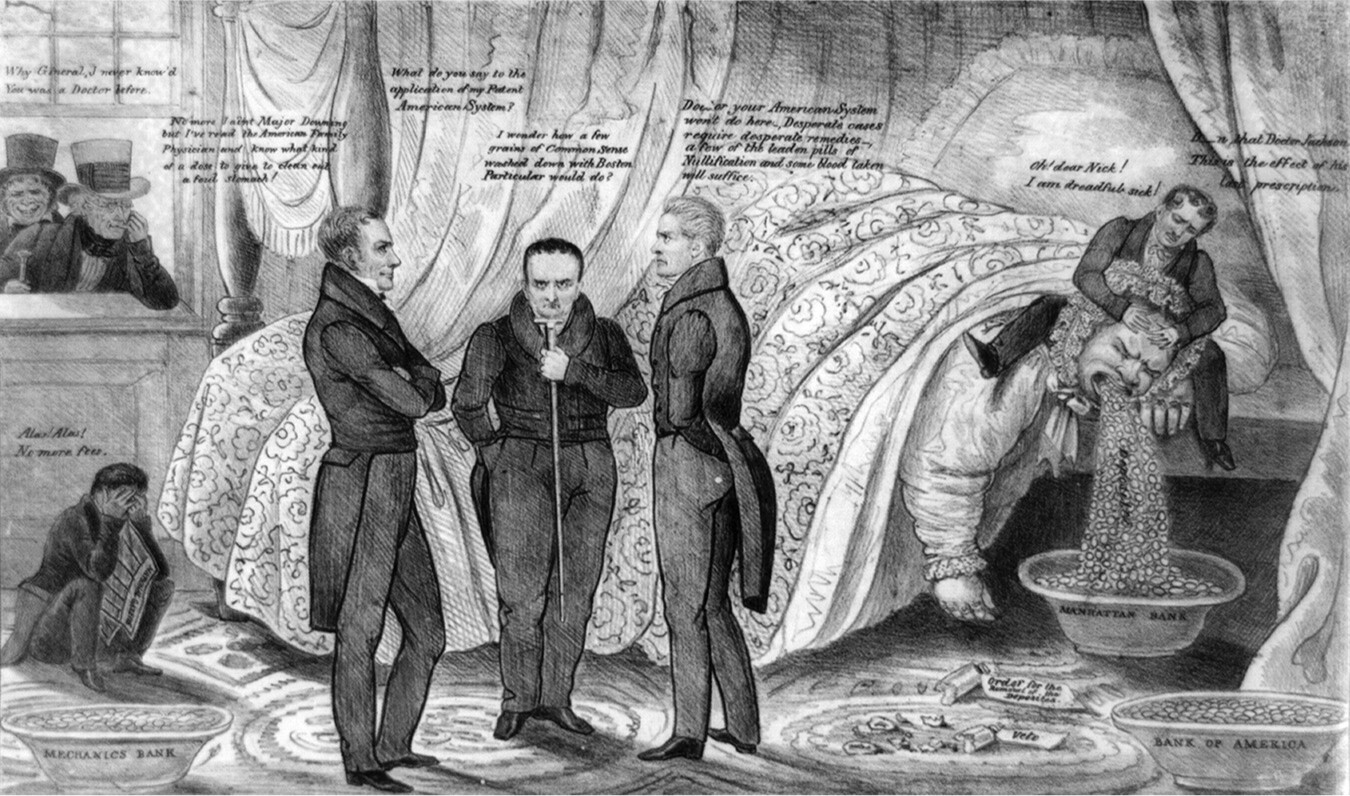
More information
A drawn cartoon of an oversized patient vomiting gold and silver coins into pans labelled “Manhattan Bank,” “Mechanics Bank,” and “Bank of America” laying on a bed in the background. Three men in suits stand talking in the foreground, and another man leans in through the open window. Under the window one man crouches down and clutches his head and a newspaper and cries “Alas! Alas! No more fees.”
THE DOCTORS PUZZLED, OR THE DESPERATE CASE OF MOTHER U.S. BANK (1833) In this satire of Andrew Jackson’s Distribution Act and Specie Circular, the B.U.S. is portrayed as an oversized patient vomiting gold and silver coins into pans representing local banks. Henry Clay, Daniel Webster, and John C. Calhoun discuss various prescriptions while Jackson leans on the windowsill, insisting he knows the best cure.
Censoring the Mail
While concerns about the strength of the economy grew, slavery again emerged as a national issue. In 1835, northern abolitionist organizations began mailing anti-slavery pamphlets and newspapers to prominent White southerners, hoping to convince them to end the “peculiar institution.”
Francis Pickens of South Carolina urged southerners to stop abolitionists from spreading their “lies.” Angry pro-slavery South Carolinians in Charleston broke into the federal post office, stole bags of abolitionist mailings, and ceremoniously burned them. Southern state legislatures passed laws banning such “dangerous” publications. Jackson asked Congress to pass a federal censorship law that would prohibit “incendiary” materials intended to incite “the slaves to insurrection.”
Congress took action in 1836; but instead of banning abolitionist materials, a bipartisan group reaffirmed the sanctity of the federal mail. Southern post offices began censoring the mail anyway, arguing that federal authority ended when the mail arrived at the post office door. Jackson decided not to enforce the congressional action, creating what would become a growing split in the Democratic Party over the future of slavery.
The controversy over the mails proved to be a victory for the growing abolitionist movement. One anti-slavery publisher said that instead of stifling their efforts, Jackson and the southern radicals “put us and our principles up before the world—just where we wanted to be.” Abolitionist groups now started mailing their pamphlets and petitions to members of Congress. At this, James Hammond, a pro-slavery South Carolinian, called for Congress to ban such anti-slavery petitions. When that failed, Congress in 1836 adopted an informal solution suggested by Martin Van Buren: whenever a petition calling for the end of slavery appeared, someone would immediately move that it be tabled rather than discussed. This “gag rule,” Van Buren claimed, would preserve the “harmony of our happy Union.”
The Whig Coalition
President Jackson’s war on the B.U.S. led his opponents to create a new anti-Jackson political party. They claimed that he was ruling like a monarch, sarcastically dubbed him “King Andrew I,” and called his Democratic supporters Tories (a reference to those who had supported the British monarchy during the American Revolution). The new anti-Jackson coalition called itself the Whig Party, a name that had been used by the Patriots of the American Revolution (as well as by the parliamentary opponents of the Tories in Britain).
The Whig Party grew directly out of a coalition of National Republicans led by John Quincy Adams, Henry Clay, and Daniel Webster. The Whigs also found support among Anti-Masons and even some Democrats who resented President Jackson’s war on the national bank. For the next twenty years, the Whigs and the Democrats would be the two major political parties, and for a second time a two-party system emerged.
The Whigs supported Henry Clay and his American System of economic nationalism. They favored federal support for internal improvements to foster economic growth. They also supported a national bank and high tariffs. In the South, the Whigs tended to be bankers and merchants. In the West, they were mostly farmers who valued government-funded infrastructure improvements: more roads, canals, and railroads. Unlike the Democrats, who attracted Catholic voters among German and Irish immigrants, northern Whigs tended to be native-born Protestants—Congregationalists, Presbyterians, Methodists, and Baptists—who advocated the abolition of slavery and efforts to restrict alcoholic beverages.
The Election of 1836
In 1835, eighteen months before the presidential election, the Democrats nominated Jackson’s handpicked successor, Vice President Martin Van Buren. The Whig coalition, united chiefly in its opposition to Jackson, adopted a strategy of nominating multiple candidates, hoping to throw the election into the House of Representatives.
The Whigs put up three regional candidates: New Englander Daniel Webster, Hugh Lawson White of Tennessee, and William Henry Harrison of Indiana. But the multi-candidate strategy failed. In the popular vote of 1836, Van Buren defeated the entire Whig field, winning 170 electoral votes while the others collected only 113 combined.
The Eighth President
More information
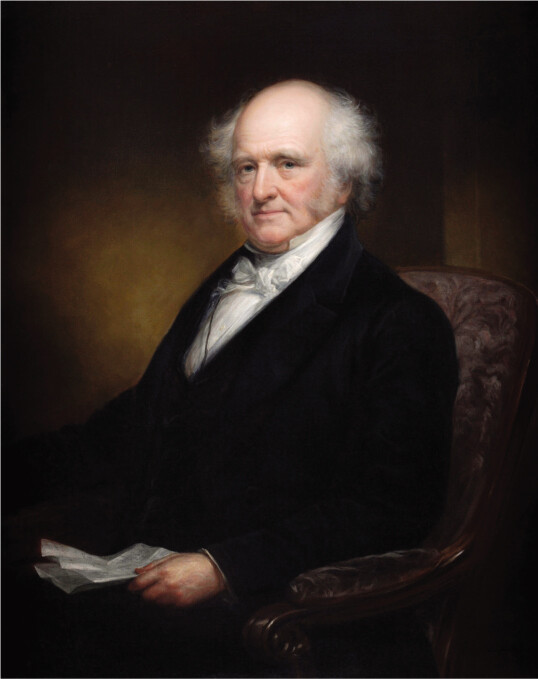
A painted portrait of an old man, Martin Van Buren, seated in an arm chair. He has bushy white hair around the sides of his head and large sideburns. He holds two pieces of paper in his left hand.
MARTIN VAN BUREN Van Buren earned the nickname of “Little Magician” not only for his short stature but also for his “magical” ability to exploit his political and social connections.
Born into a family of Dutch-speaking New York farmers, Martin Van Buren remains the only president for whom English was a second language. Like Andrew Jackson, Van Buren was an outsider and took great pride in his successful efforts to strip the political “old guard” of their powers. Van Buren was largely responsible for the formation of the Democratic Party. Elected governor of New York in 1828, he had resigned to become Andrew Jackson’s secretary of state, then became vice president in 1833.
Martin Van Buren had been Jackson’s closest political adviser and ally, but many in government thought he was too self-centered. John Quincy Adams wrote in his diary that Van Buren was “by far the ablest” of the Jacksonians, but he had wasted “most of his ability upon mere personal intrigues. His principles are all subordinate to his ambition.”
At his inauguration, Van Buren promised to follow “in the footsteps of President Jackson.” Before he could do so, however, the nation’s financial sector began to collapse. On May 10, 1837, several large state banks in New York, running out of gold and silver, suddenly refused to convert customers’ paper money into coins. Other banks across the nation quickly did the same. This financial crisis, the worst yet faced by the young nation, would become known as the Panic of 1837. It would soon mushroom into the republic’s worst depression, lasting seven years.
The Panic of 1837
The financial crisis had started in Europe. During the mid-1830s, Great Britain, America’s largest trading partner, experienced an acute financial crisis when the Bank of England, worried about a run on the gold and silver in its vaults, curtailed its loans. This forced most British companies to reduce their trade with America. As British demand for American cotton plummeted, so did the price they were willing to pay for cotton.
Causes of the Economic Depression of the Late 1830s
As creditors hastened to foreclose on struggling businesses and farms unable to make their debt payments, U.S. government spending plunged. Many canals under construction were shut down, and many state governments could not repay their debts. By early fall, 90 percent of the nation’s factories had closed. Workers who still had jobs saw their wages plummet, sometimes in half. Hundreds of thousands of people across the nation were not only jobless but homeless as well.
Not surprisingly, the economic crisis frightened people. As a newspaper editorial complained, the economy “has been put into confusion and dismay by a well-meant, but extremely mistaken” pair of decisions by Congress and President Jackson: the Specie Circular and the elimination of the B.U.S.
The first “mistake” was the Specie Circular. Its requirement that all federal land purchases be transacted in gold or silver coins greatly reduced government land sales, thus pinching the federal budget. Struggling American banks had to borrow gold from European banks, but they could not get enough to prevent a financial panic and a deepening depression.
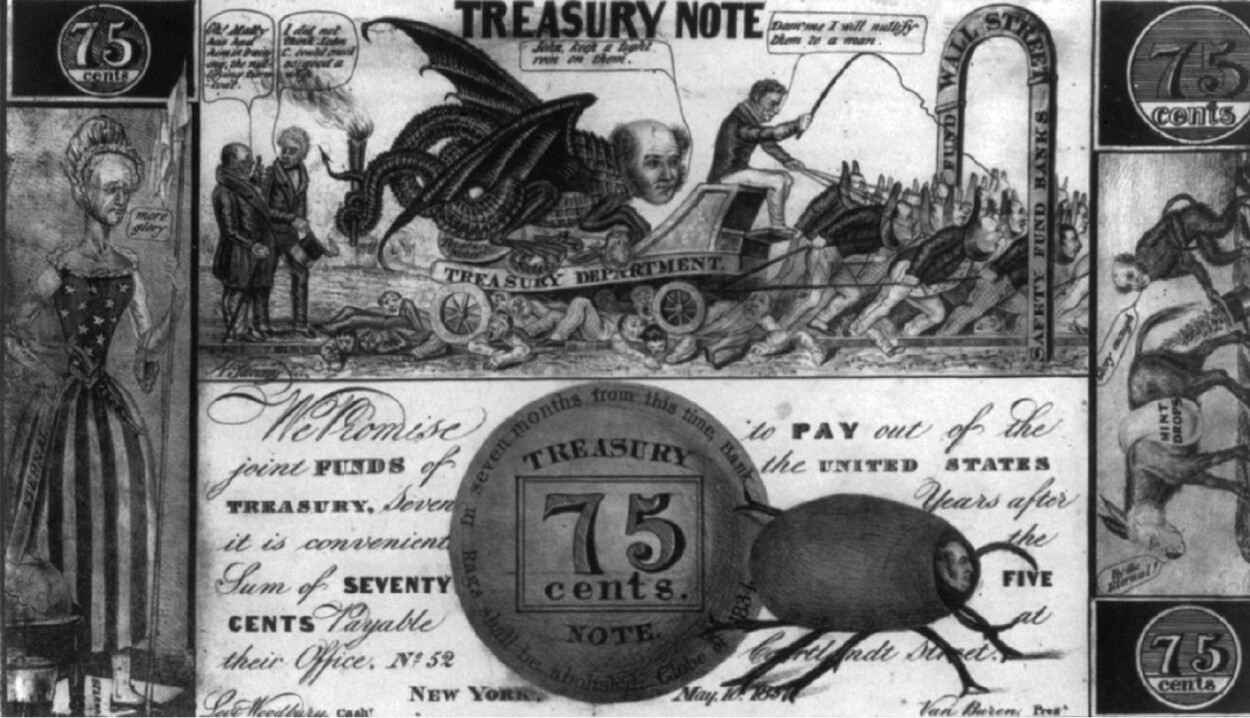
More information
A political cartoon of a Treasury 75 cent note. In the top scene, a wagon labeled “Treasury Department” is pulled by several men. The wagon carries Martin Van Buren as a dragon and John C. Calhoun as the driver as it passes through an arch labeled “Wall Street” and “Safety Fund Banks.” In the scene on left, a frowning old woman wears an American flag patterned dress and holds a white flag in her hand. A text box near her head reads, “more glory.” In the scene on right, a man uses his hat to catch excrement from a donkey with bags on its back that read, “Mint Drops.” A dung beetle pushes a circle in the center labeled “Treasury 75 cents note.”
JACKSONIAN TREASURY NOTE A parody of the often-worthless fractional notes issued by local banks and businesses in lieu of coins. These notes proliferated during the Panic of 1837, with the emergency suspension of gold and silver payments. In the main scene, Martin Van Buren, depicted as a monster on a wagon driven by John C. Calhoun, is about to pass through an arch labeled “Wall Street” and “Safety Fund Banks.”
Jackson’s second mistake was his decision to eliminate rather than reform the B.U.S. It could have acted as a stabilizing force amid the financial panic. Instead, unregulated state banks around the country flooded the economy with paper money that was basically worthless because it lacked adequate backing in gold or silver.
In April 1836, Niles’ Weekly Register, the nation’s leading business journal, reported that the economy was “approaching a momentous crisis.” State governments canceled plans to build roads, bridges, railroads, canals, and ports. Forty percent of the state banks shut their doors. Even the federal government itself, having put most of its gold and silver in state banks, was verging on bankruptcy. The National Intelligencer newspaper reported in May that the federal treasury “has not a dollar of gold or silver in the world!”
Poor people, enslaved Blacks, and Indigenous Americans, as always, were particularly hard hit. By the fall of 1837, one-third of workers were jobless, and those still fortunate enough to have jobs had their wages slashed. At the same time, prices for food and clothing soared. As the winter of 1837 approached, a New York City journalist reported that the nation had a “poverty-struck feeling.”
Politics amid Depression
The unprecedented economic calamity sent shock waves through the political system. Critics called the president “Martin Van Ruin” because he did not believe that the government had any responsibility to rescue hard-pressed farmers, bankers, or businessmen or to provide relief for the jobless and homeless.
How best to deal with the economic depression clearly divided Democrats from Whigs. Unlike Van Buren, the Whig Henry Clay insisted that suffering people were “entitled to the protecting care of a parental Government.” To him, an enlarged role for the federal government was the price of a maturing, expanding republic in which elected officials had an obligation to promote public “safety, convenience, and prosperity.” In contrast, Van Buren and the Democrats believed that the government had no such obligations. Henry Clay, among others, savaged the president for his “cold and heartless” attitude.
An Independent Treasury
Martin Van Buren believed that the federal government should stop risking its cash deposits in insecure pet banks. Instead, he wanted to establish an independent Treasury system whereby the government would keep its funds in its own bank vaults and do business entirely in gold or silver, not in paper currency. Van Buren wanted the federal government to regulate the nation’s supply of gold and silver and let the marketplace regulate the supply of paper currency.
It took Van Buren more than three years to convince Congress to pass the Independent Treasury Act on July 4, 1840. Although it lasted little more than a year (the Whigs repealed it in 1841), it would be restored in 1846. Not surprisingly, the state banks that lost control of the federal funds howled in protest.
The “Log Cabin and Hard Cider” Campaign
By 1840, an election year, the Van Buren administration and the Democrats were in deep trouble. The depression continued to worsen and the suffering spread, leading the Whigs to grow confident they could win the presidency. At their nominating convention, they passed over Henry Clay, the Kentucky legislator who had been Jackson’s consistent foe, in favor of William Henry Harrison, whose credentials were impressive: victor at the Battle of Tippecanoe against Tecumseh’s Shawnee warriors in 1811, former governor of the Indiana Territory, and former congressman and senator from Ohio. To balance the ticket geographically, the Whigs nominated John Tyler of Virginia as their vice president.
The Whigs refused to take a stand on major issues. They did, however, seize upon a catchy campaign slogan: “Tippecanoe and Tyler Too.” When a Democratic newspaper declared that General Harrison was the kind of man who would spend his retirement “in a log cabin [sipping hard apple cider] on the banks of the Ohio [River],” the Whigs chose the cider and log cabin symbols to depict Harrison as a simple man sprung from the people, in contrast to Van Buren’s wealthy, aristocratic lifestyle. (Harrison actually was born into one of Virginia’s wealthiest families.)
Harrison defeated Van Buren easily, winning 234 electoral votes to his opponent’s 60. The Whigs had promised a return to prosperity without explaining how it would happen. It was simply time for a change. The most remarkable aspect of the election of 1840 was the turnout. More than 80 percent of White American men voted, many for the first time—the highest turnout before or since.
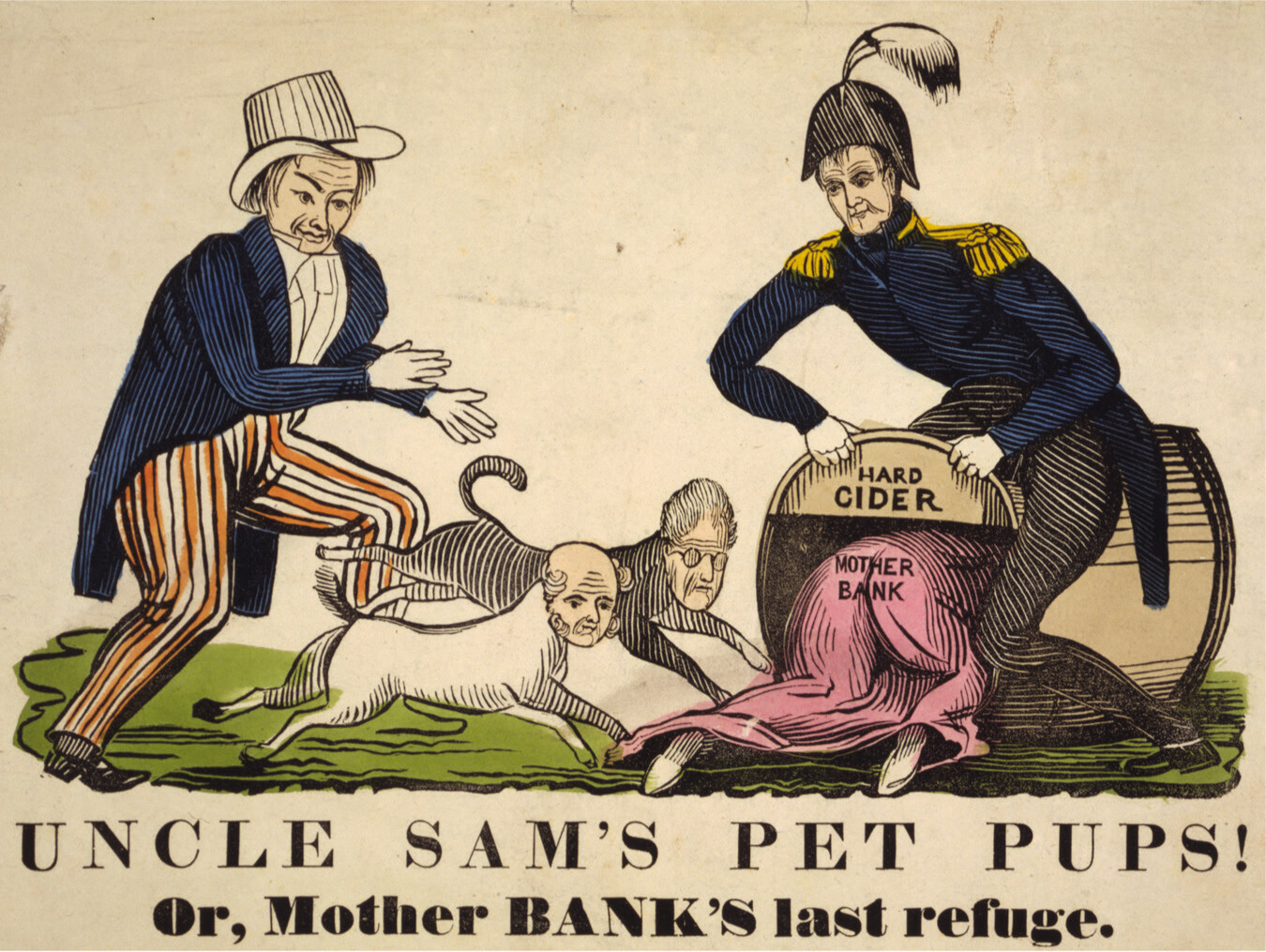
More information
A woodcut showing William Henry Harrison and Uncle Sam luring a woman representing “Mother Bank,” and two goats with the faces of Andrew Jackson and Martin Van Buren, into a barrel of alcoholic hard cider. Text below says “Uncle Sam’s Pet Pups! Or, Mother Bank’s last refuge.”
UNCLE SAM’S PET PUPS! (1840) A woodcut showing William Henry Harrison luring “Mother Bank,” Andrew Jackson, and Martin Van Buren into a barrel of hard (alcoholic) cider. While Jackson and Van Buren sought to destroy the Bank of the United States, Harrison promised to re-establish it—which is why he provides “Mother Bank” a refuge in this scene.
Overall, Andrew Jackson’s use of the presidential veto, combined with his bank policies, triggered opposition that led to the election of William Henry Harrison, a Whig. The Whig Party had formed in direct response to Jackson’s authoritarian moves as president. Moreover, in response to reduced British trade with America in the mid-1830s, which caused the U.S. economy to falter, Jackson had sought legislation that further destabilized the economy—the Distribution Act and the Specie Circular. Although a more severe economic depression and the financial Panic of 1837 occurred under President Van Buren, these prior moves by Jackson had set the process in motion and generated support for the Whigs. Now entering a new era, the next president would lead the nation in a slightly different direction.
Glossary
- Whig Party
- A political party founded in 1834 in opposition to the Jacksonian Democrats; supported federal funding for internal improvements, a national bank, and high tariffs on imports.
- two-party system
- The domination of national politics by two major political parties, such as the Whigs and the Democrats during the 1830s and 1840s.
- Panic of 1837
- A financial calamity in the United States brought on by a dramatic slowdown in the British economy and falling cotton prices, failed crops, high inflation, and reckless state banks.
- Independent Treasury Act (1840)
- A system created by President Martin Van Buren that moved federal funds from favored state banks to the U.S. Treasury, whose financial transactions could only be in gold or silver.
- Distribution Act (1836)
- A law requiring distribution of the federal budget surplus to the states, creating chaos among unregulated state banks dependent on such federal funds.