 Slavery in the Western Territories
How did the federal government try to resolve the issue of slavery in the western territories during the 1850s?
SLAVERY IN THE TERRITORIES
At midcentury, political storm clouds were forming over the fate of slavery. The United States was a powerful nation, but, as Henry Clay said, it was an “unhappy country” torn by the “uproar, confusion, and menace” caused by the deepening agony over slavery. The United States had developed two different societies, one in the North and the other in the South, and the two sections increasingly disagreed over the nation’s future. In 1833, Andrew Jackson had predicted that southerners “intend to blow up a storm on the slave question.” He added that pro-slavery firebrands like John C. Calhoun “would do any act to destroy this union and form a southern confederacy bounded, north, by the Potomac River.” By 1848, Jackson’s prediction seemed close to reality.
THE WILMOT PROVISO President Polk had naively assumed that the expansion of American territory to the Pacific would strengthen “the bonds of Union.” Instead, the fate of slavery in the new western territories ignited a violent political debate that would lead to secession and civil war.
The Mexican-American War was less than three months old when it sparked a new political conflict over slavery. On August 8, 1846, an obscure Democratic congressman from Pennsylvania, David Wilmot, delivered a speech to the House of Representatives in which he proposed that if any Mexican territory should be acquired, slavery would be banned there.
The proposed Wilmot Proviso reignited the debate over the westward expansion of slavery that had been lurking since the Missouri controversy of 1819–1821. The Missouri Compromise had provided a temporary solution by protecting slavery in states where it already existed but not allowing it in newly acquired territories north of the 36°30ʹ latitude. Now, with the territories taken from Mexico, the political dispute over slavery would explode.
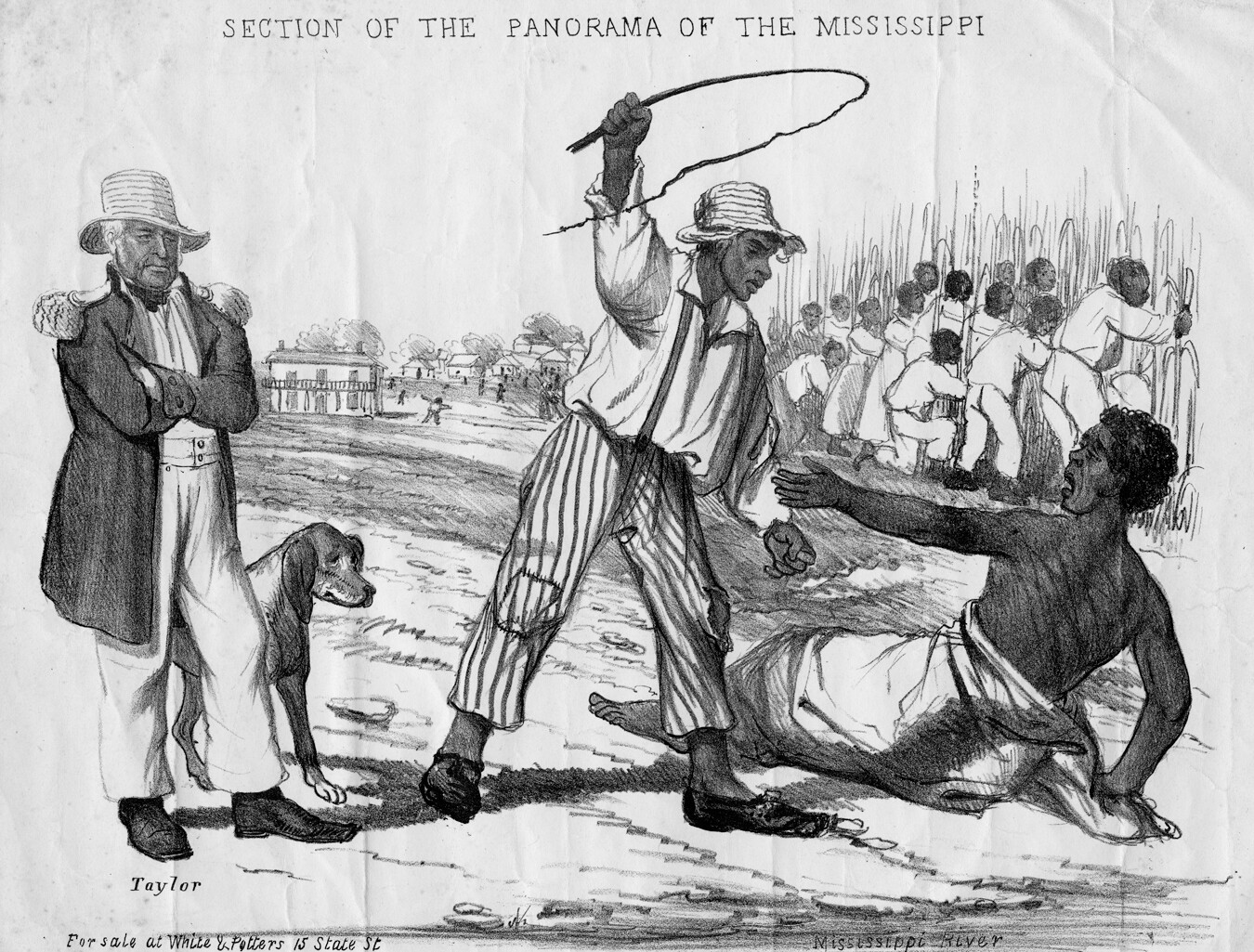
The House of Representatives approved the Wilmot Proviso, but the Senate balked. President Polk dismissed the proviso as “mischievous and foolish” but privately worried that “the slavery question is assuming a fearful . . . aspect” that might “ultimately threaten the Union itself.” If slavery were banned from the western territories, all new states would be free states, thus putting at risk the future of slavery everywhere and shifting the political balance in Congress against the slave states.
Polk convinced Wilmot to withhold his amendment from any bill dealing with the annexation of Mexican territory. By then, however, others were ready to take up the cause. In one form or another, Wilmot’s proposal would frame the furious debate in Congress over the expansion of slavery. Abraham Lincoln recalled that during his one term as a congressman, in 1847–1849, he voted for restricting slavery in the new territories forty times.
Senator John C. Calhoun, meanwhile, countered Wilmot’s proviso with a pro-slavery plan, which he introduced on February 19, 1847. Calhoun insisted that Wilmot’s effort to exclude enslaved people from territories would violate the Fifth Amendment, which forbids Congress to deprive any person of life, liberty, or property without due process of law. Enslaved people, he argued, were property.
By this clever stroke of logic, Calhoun turned the Bill of Rights into a guarantee of slavery. Senator Thomas Hart Benton of Missouri, a slaveholder but also a nationalist eager to calm sectional tensions, found in Calhoun’s stance a set of dangerous abstractions “leading to no result.” Wilmot and Calhoun between them, he said, had fashioned a pair of scissors. Neither blade alone would cut very well, but joined together they could sever the nation in two.
POPULAR SOVEREIGNTY Thomas Hart Benton and others tried to deflect the brewing conflict over slavery by suggesting that Congress simply extend the Missouri Compromise line, dividing free and slave territory at the latitude of 36°30ʹ, all the way to the Pacific Ocean. Senator Lewis Cass of Michigan suggested a different solution: that the citizens of each territory “regulate their own internal concerns in their own way,” like the citizens of a state. Such an approach would take the issue of slavery in new territories out of Congress and put it in the hands of those directly affected. “Popular sovereignty,” as Cass called his idea, appealed to many eager to protect states’ rights.
President Polk had promised to serve only one term, and, having accomplished his goals, he refused to run again in 1848. Cass won the Democratic presidential nomination, but the party refused to endorse his “popular sovereignty” plan. Instead, their platform denied the power of Congress to interfere with slavery in the states and criticized all efforts by anti-slavery activists to bring the question before Congress.
The Whigs, as they had in 1840, passed over their party leader, Henry Clay, in favor of General Zachary Taylor, the hero of the Mexican-American War. Taylor owned a Louisiana plantation with more than 100 enslaved people. Yet he vigorously opposed the extension of slavery into new western territories.
THE FREE-SOIL COALITION As it had done in the 1840 election, the Whig party in 1848 offered no platform to avoid the divisive issue of slavery. The anti-slavery crusade, however, was not easily silenced. Americans who worried about slavery but could not endorse outright abolition could support banning slavery from the western territories. As a result, “Free Soil” in the western territories became the rallying cry for a new political party: the Free-Soil coalition, which focused on preventing the spread of slavery.
The Free-Soil party attracted northern Democrats, anti-slavery northern Whigs, and members of the abolitionist Liberty party, created in 1840. In 1848, Free-Soilers nominated former Democratic president Martin Van Buren as their candidate. The party’s platform stressed that slavery would not be allowed in the western territories.
The Free-Soilers split the Democratic vote enough to throw New York to the Whig Zachary Taylor, and they split the Whig vote enough to give Ohio to the Democrat Lewis Cass. However, Van Buren’s approximately 291,000 third-party votes lagged well behind the 1,361,000 for Taylor and 1,222,000 for Cass.
THE CALIFORNIA GOLD RUSH Meanwhile, a new development emerged in the Mexican province of Alta California. On January 24, 1848, on part of John Sutter’s land along the south fork of the American River, a group of Mormon and Indian workers building a sawmill in eastern California discovered gold. Just nine days later, California would be labeled the “great prize” transferred to the United States through the treaty ending the Mexican-American War.
Word of the gold strike spread rapidly after President Polk confirmed the news in a speech to Congress. In 1849, nearly 100,000 Americans, mostly young men infected with gold fever, quit jobs, left farms, deserted from the army, abandoned wives and children, and sold businesses to set off for California. Within a matter of weeks after the news, three-quarters of the men living in San Francisco had rushed to the gold fields. By 1854, the number would top 300,000, vastly outnumbering the disinherited Mexican population. Thousands more came from across the world—Mexico, Central and South America, Canada, Australia, New Zealand, Asia, and Europe.
A U.S. army officer reported that the “vast deposits of gold” had “entirely changed the character of Upper California.” Within two years, San Francisco was transformed from a sleepy coastal village of 800 residents to a bustling city of 20,000. “We are on the brink of an Age of Gold,” gushed Horace Greeley, editor of the New York Tribune. “Go West, young man, go west!” So many New England men left for California that it would take years to restore the region’s gender balance, leading some women to form ambiguous same-sex partnerships in what novelist Henry James called “Boston marriages.”
Gold seekers, called forty-niners, found the long trip to California grueling beyond description. The favorite route to California was by sea around Cape Horn, the southern tip of South America, and then up the Pacific to San Francisco. The 13,000-mile journey took an average of six months, twice as long as the trek overland.
For all its hardships, however, the California Gold Rush became the greatest mass migration in American history. Between 1851 and 1855, the “diggings” throughout California produced almost half the world’s output of gold, and the nation’s supply of gold coinage increased twentyfold.
DECIMATING NATIVE AMERICANS AND MEXICAN AMERICANS For Native Americans in California, however, the Gold Rush was a disaster. In 1848, there were 150,000 Indians in California, ten times as many Whites; by 1870, there were only 30,000 left (80% decrease). Starvation, disease, and a declining birth rate took a heavy toll. But many, perhaps 40 percent, were murdered by gold miners, soldiers, “Indian killers,” and others.
In 1851, Peter W. Burnett, the California territorial governor, pledged to continue “a war of extermination . . . between the two races until the Indian race becomes extinct.” His commitment to exterminating the Indians contradicted the Treaty of Guadalupe Hidalgo, which granted U.S. citizenship to the indigenous peoples in California.
With the governor’s approval and the added enticement of bounties paid for Indian scalps or ears, bands of White Indian-killers roamed the state massacring indigenous peoples. Sally Bell, a Sinkyone survivor of one of the raids, reported that “some white men came. They killed my grandfather and my mother and my father. . . . Then they killed my baby sister and cut her heart out and threw it in the brush where I ran and hid.” A California senator applauded the mass murders of Indians because “the interest of the white man demands their extinction.”
The infusion of California gold into the U.S. economy triggered a surge of prolonged prosperity. The Gold Rush also shifted the nation’s focus westward, spurred the construction of transcontinental railroads and telegraph lines, and prompted dreams of an American commercial empire linking the Pacific coast to Asia’s teeming markets.
Senator Stephen Douglas, a Democratic senator from Illinois, urged the federal government to build a transcontinental railroad from California through Indian Country to Chicago. Another senator, William Seward of New York, pointed out that there were eighteen Indian nations living along the proposed route. “Where will they go?” Seward asked. “Back across the Mississippi? . . . To the Himalayas?”
Cherokees were aghast. “No matter how little is left the red man,” warned an editorial in the Cherokee Advocate, the federal government would not “rest until the Indians are made landless and homeless.”
While native peoples were being targeted for removal, the influx of miners into California proved deadly for Mexican Californios. “Mexicans have no business in this country,” a miner wrote in a letter to the Stockton Times. “I don’t believe in them. The men were made to be shot at, and the women were made for our purposes. I’m a white man—I am. A Mexican is pretty near black. I hate all Mexicans.” In 1850, White miners convinced the new state legislature to pass a Foreign Miners’ Tax that drove most Mexicans from the diggings.
White miners treated Indians as roughly as Mexicans. In 1850, the California state legislature allowed Whites to force “unemployed” Indians to work for them in exchange for food and clothing. Some miners went further, forcing them out of the diggings and killing those who resisted.
MINING LIFE Sacramento, closer to the diggings, became the staging area for the northern mines. Many of the wealthiest Californians were providing goods and services to the miners. New business enterprises—saloons, taverns, gambling halls, restaurants, laundries, general stores—emerged to serve the miners. One of the new businesses made sturdy denim work pants, their pockets reinforced by copper rivets. The blue jeans, known to this day as Levi’s, were developed in San Francisco by the German-Jewish immigrant Levi Strauss.
The flannel-shirted forty-niners included people from every social class and every state and territory, as well as local Indians and enslaved people brought by their owners. Louis Manigault, the son of a South Carolina rice planter, reported that California was “filled with castoffs and exiles from almost every nation, the true and perfect scum of the Earth.” Life in the mining camps, he noted, “was not safe, and almost every [news]paper informed us of some dreadful murder, or horrible crime—everyone was armed.”
The miners were mostly unmarried young men of varied ethnic and cultural backgrounds, including some 20,000 Chinese. A Chinese shipowner recruited immigrants by portraying California as utopia: “Americans are very rich people. They want the Chinese to come and will make him welcome. There will be big pay, large houses, and food and clothing of the finest description. . . . It is a nice country, without mandarins [aristocrats] or soldiers. All alike: big man no larger than little man. . . . Never fear, and you will be lucky.” Few were interested in staying in California; they wanted to strike it rich and return home. “The manners and habits of the Chinese are very repugnant to Americans in California,” reported a San Francisco newspaper. “Of different language, blood, religion, and character, and inferior in most mental and bodily qualities, the Chinaman is looked upon . . . as only a little superior to the Negro.”
Mining camps sprang up like mushrooms and disappeared almost as rapidly. As soon as rumors of a new strike made the rounds, miners converged on the area; when no more gold could be found, they picked up and moved on. The mining camps and shantytowns may have had colorful names—Grizzly Flats, Whiskey Flat, Lousy Ravine, Petticoat Slide, Piety Hill—but they were raw, dirty, lawless, and dangerous places dotted with small tents, shanties, or cabins housing communities of strangers focused on gaining gold by hook or crook.
Women were as rare in the mining camps as liquor and guns were abundant. In 1850, less than 8 percent of California’s population was female. The few women who dared to live in the camps could demand a premium for their work as cooks, laundresses, entertainers, and prostitutes.
The mining communities were lawless and often violent places. Calaveras County experienced fourteen murders in a single week. Vigilante justice prevailed. “In the short space of twenty-four days,” one miner reported, “we have had murders, fearful accidents, bloody deaths, a mob, whippings, a hanging, an attempt at suicide, and a fatal duel.” One miner witnessed eight murders. If murderers were caught, many of them were lynched on the spot.
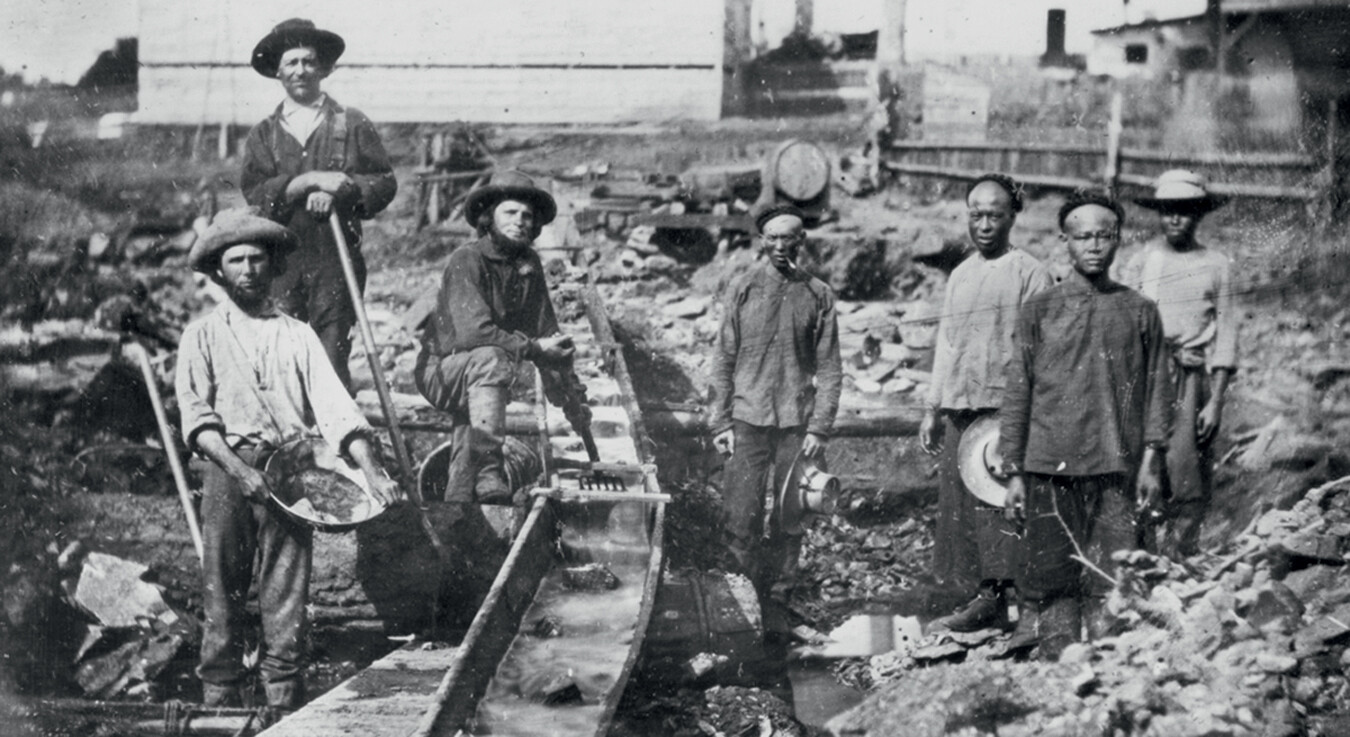
The gold rush for most forty-niners brought more frustration and failure than wealth. Within six months of arriving in California in 1849, one gold seeker in every five was dead. The gold fields and mining towns were so dangerous that insurance companies refused to provide coverage. Suicides were common, and disease and drunkenness were rampant. Twenty-seven-year-old prospector Olney Thayer of Massachusetts recognized the larger significance of the Gold Rush in 1852 when he predicted in a letter home that “California is destined to exert a powerful influence, not only upon the destiny of this nation, but upon the whole civilized globe.” He died nine months later of typhoid fever.
CALIFORNIA STATEHOOD New president Zachary Taylor decided in 1849 to use California’s request for statehood to end the congressional stalemate over slavery. Why not make California and New Mexico free states immediately, he argued, and thereby bypass the volatile issue of slavery?
Californians, however, were ahead of him. By December 1849, without consulting Congress, they had put a free-state (no-slavery) government into operation. New Mexico responded more slowly, but by 1850 it had also adopted a free-state constitution.
Yet while banning African American slavery, the new western states preserved peonage (involuntary servitude) of Native Americans. In California, the Indian Act (1850) allowed some 25,000 “unemployed” Indians (“vagrants”), including thousands of children, to be auctioned off to White settlers as forced laborers. Five years later, the state legislature passed the Anti-Vagrancy Act, also known as the Greaser Act. The act’s supporters claimed it was created “to protect honest people from the excesses of vagabonds.” In fact, however, it was directed at those of “Spanish and Indian blood,” commonly “known as greasers.” The Anti-Vagrancy Act allowed police to arrest any person suspected of being a vagabond and force them to work, usually on ranches or in mines.
THE COMPROMISE OF 1850 On December 4, 1849, President Zachary Taylor endorsed the immediate admission of California for statehood and urged Congress to avoid injecting slavery into the issue. The new Congress, however, was in no mood for simple solutions. Angry southerners threatened to leave the Union if Taylor brought California and New Mexico in as free states. Doing so, they feared, would upset the political balance of fifteen slave states and fifteen free states.
The spotlight then fell on the Senate, where an all-star cast—Henry Clay, John C. Calhoun, and Daniel Webster (all of whom would die within two years), with William H. Seward, Stephen A. Douglas, and Jefferson Davis in supporting roles—staged one of the great dramas of American politics: the Compromise of 1850.
SAVING THE UNION With southern extremists threatening secession, congressional leaders again turned to Henry Clay, now seventy-two, who, as Abraham Lincoln said, was “regarded by all, as the man for the crisis.”
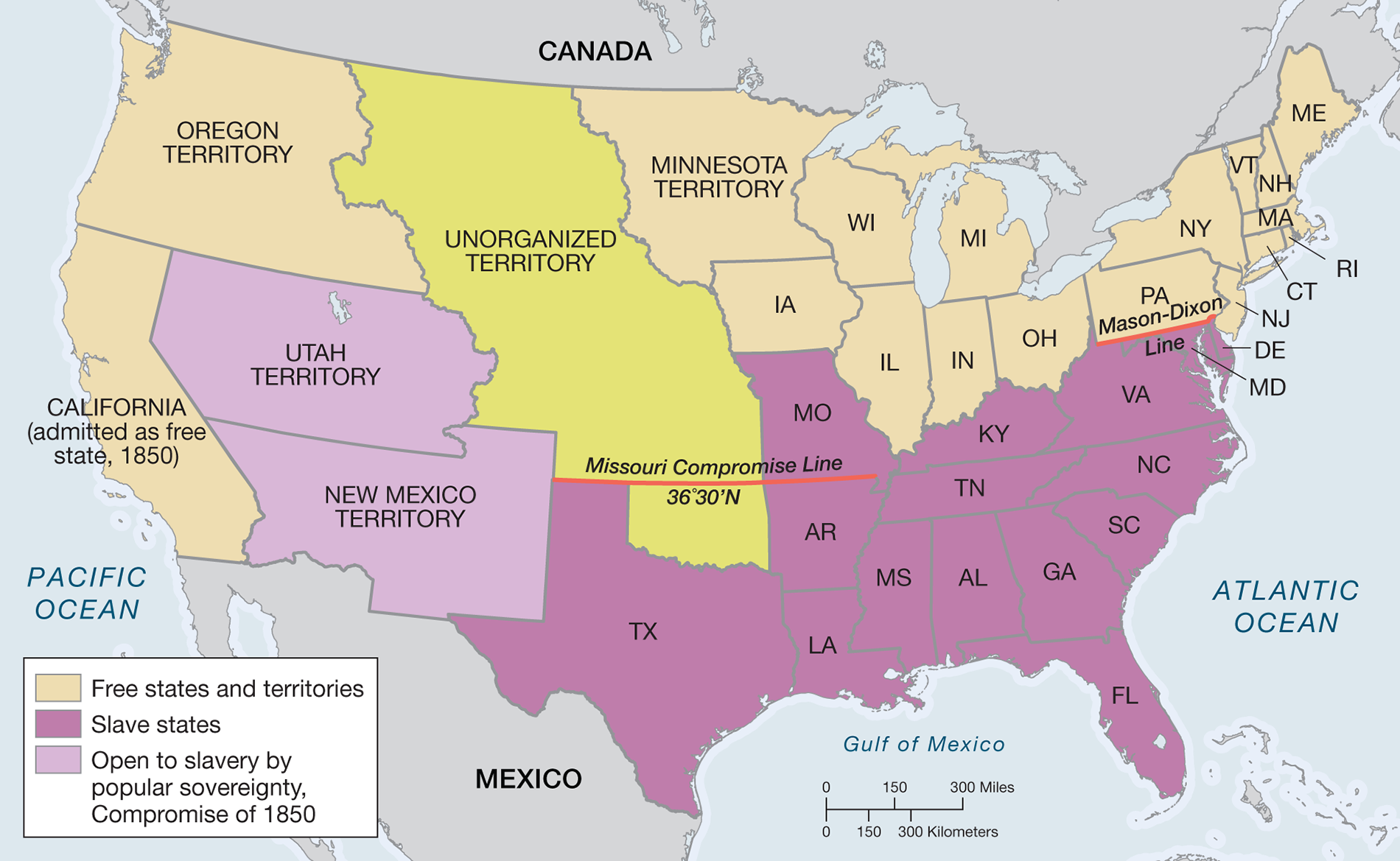
On January 29, 1850, having gained Webster’s support, Clay presented to Congress several resolutions meant to settle the “controversy between the free and slave states, growing out of the subject of slavery.” Clay proposed to (1) admit California as a free state; (2) organize the territories of New Mexico and Utah without restrictions on slavery, allowing the residents to decide the issue for themselves; (3) deny Texas its claim to much of New Mexico; (4) compensate Texas by having the federal government pay the pre-annexation Texas debts; (5) retain slavery in the District of Columbia but abolish the sale of enslaved people in the nation’s capital; (6) adopt a more stringent federal fugitive slave law; and (7) deny congressional authority to interfere with the interstate slave trade.
His complex proposals became in substance the Compromise of 1850, but only after months of negotiations punctuated by the most celebrated debates in congressional history.
THE GREAT DEBATE On March 4, a grim John C. Calhoun, the unbending defender of slavery, left his sickbed, draped himself in a black cloak, and sat in the Senate chamber, where he listened to a colleague read his defiant rejection of Clay’s proposal.
THE COMPROMISE OF 1850
- What events forced the Compromise of 1850?
- How did Stephen A. Douglas rescue the compromise? What were its terms?
Three days later, Calhoun, who would die in just three weeks, returned to the Senate to hear the “golden-throated” Daniel Webster. “I wish to speak today,” Webster began, “not as a Massachusetts man, not as a Northern man, but as an American. . . . I speak today for the preservation of the Union.” He criticized extremists on both sides for their “violent” actions and suggested that some new territories should become slave states and others free states.
Webster’s evenhanded speech angered extremists on both sides—in part because it was four hours long. On March 11, William Seward, the hook-nosed and shaggy-browed Whig senator from New York who had long been a fearless critic of slavery, declared that any compromise with slavery was “radically wrong and essentially vicious.” There was, he said, “a higher law than the Constitution,” and it demanded the abolition of slavery. A Georgia newspaper said that Seward should be dressed in a straitjacket and taken to a lunatic asylum.
COMPROMISE EFFORTS On July 4, 1850, Congress celebrated Independence Day by gathering at the base of the unfinished Washington Monument. While listening to the patriotic speeches, President Zachary Taylor collapsed in the heat and humidity. Five days later, he died of a violent stomach disorder, likely caused by tainted food or water.
Taylor’s shocking death bolstered the chances of a compromise in Congress, for his successor, Vice President Millard Fillmore, supported Clay’s proposals. It was a striking reversal: Taylor, the Louisiana slaveholder, had been ready to make war on his native South; Fillmore, who southerners thought opposed slavery, was ready to make peace.
The new president benefited from the support of Stephen A. Douglas of Illinois, a rising star in the Democratic party, the youngest man in the Senate, and a friend of the South. Douglas suggested that the best way to approve Clay’s “comprehensive scheme” was to separate the proposals and vote on each of them, one at a time. The plan worked. By September 20, President Fillmore had signed the last of the measures into law.
In its final version, the Compromise of 1850 included the following elements: (1) California entered the Union as a free state, ending forever the balance of free and slave states; (2) the Texas–New Mexico Act made New Mexico a separate territory and set the Texas state boundary at its present location (in return for giving up its claims to much of New Mexico, Texas received $10 million to erase the state’s debt); (3) the Utah Act set up the Utah Territory and gave the territorial legislature authority over “all rightful subjects of legislation,” including slavery; (4) a Fugitive Slave Act required the federal government and northern states to help capture and return freedom seekers to the South; and (5) as a gesture to anti-slavery groups, the public sale of enslaved people, but not slavery itself, was abolished in the District of Columbia.
THE FUGITIVE SLAVE ACT The Fugitive Slave Act was the most controversial element of the Compromise of 1850. It did more than strengthen the hand of slave catchers; it sought to recover freedom-seekers who had escaped. The law also unwittingly enabled slave traders to kidnap free Blacks in northern “free” states, claiming that they were freedom seekers, and it required citizens to help locate and capture freedom seekers. The act assigned federal officers to assist in slave-catching. Finally, the act denied freedom seekers the right to a jury trial and increased the penalty for interfering with slave catchers to $1,000 and six months in jail.
Abolitionists fumed. Ralph Waldo Emerson urged people to break the new law. In New York, Reverend Jermain Loguen, himself a freedom seeker, shouted: “I don’t respect this law—I don’t fear it—I won’t obey it! It outlaws me, and I outlaw it.”
In late October 1850, two slave catchers from Georgia arrived in Boston, determined to use the Fugitive Slave Act to recapture William and Ellen Craft, husband-and-wife cabinetmakers. Abolitionists mobilized to prevent the Crafts from being seized by the “man stealers.” After five days, the slave catchers gave up and returned to Georgia.
Anthony Burns had a much different experience, however. In 1853, he had escaped from slavery in Virginia and settled in Boston. The following year, his former owner captured him on his way home from work. Although Burns, as a freedom seeker, had no legal rights, his antislavery attorneys found ingenious ways to postpone the court date when he would be released to his former master.
Then something extraordinary occurred. Some 7,000 Black and White abolitionists stormed the courthouse in an effort to free Burns. During the fracas, a U.S. Marshal was killed and a dozen more people were wounded. Some 1,500 federal troops were sent to restore order and ensure that Burns’s hearing proceeded on schedule. The judge ruled that Burns must be returned to Virginia and his enslaved existence.
Amos Lawrence, one of the wealthiest men in Boston, was transformed by the government’s effort to return Burns to a life of forced servitude. He wrote his uncle that “we went to bed one night old-fashioned, conservative, Compromise Union Whigs and waked up stark mad Abolitionists.” Lawrence and other abolitionists began to endorse the use of violence to end slavery.
In Springfield, Massachusetts, fiery abolitionist John Brown formed an armed band of African Americans to attack slave catchers. Such efforts led Horace Greeley, the prominent New York newspaper editor, to write that the Fugitive Slave Act was “a very bad investment for slaveholders” because it was creating such a backlash against slavery throughout the northern states.
Several northern states countered the Fugitive Slave Act by passing what were called personal liberty laws. Some allowed jury trials for freedom seekers who had been captured and others prohibited state authorities from cooperating with slave catchers. Still others imposed stiff penalties on anyone who falsely accused African Americans of being freedom seekers.
SLAVERY: A FATE WORSE THAN DEATH The divisive Fugitive Slave Act quickly polarized the debate over the future of slavery. It also generated tragic consequences, the most poignant example of which occurred along the Kentucky-Ohio border. On January 28, 1856, a twenty-two-year-old enslaved woman, Margaret “Peggy” Garner, escaped from Maplewood, a northern Kentucky plantation. With her was Robert, her enslaved “husband,” four children, and several other enslaved families. They stole horses and a sleigh and made their way sixteen miles to the frozen Ohio River. At dawn, the seventeen escapees walked across the iced-over waterway and made their way to Cincinnati, where they split up. At long last, they were free—or so they thought.
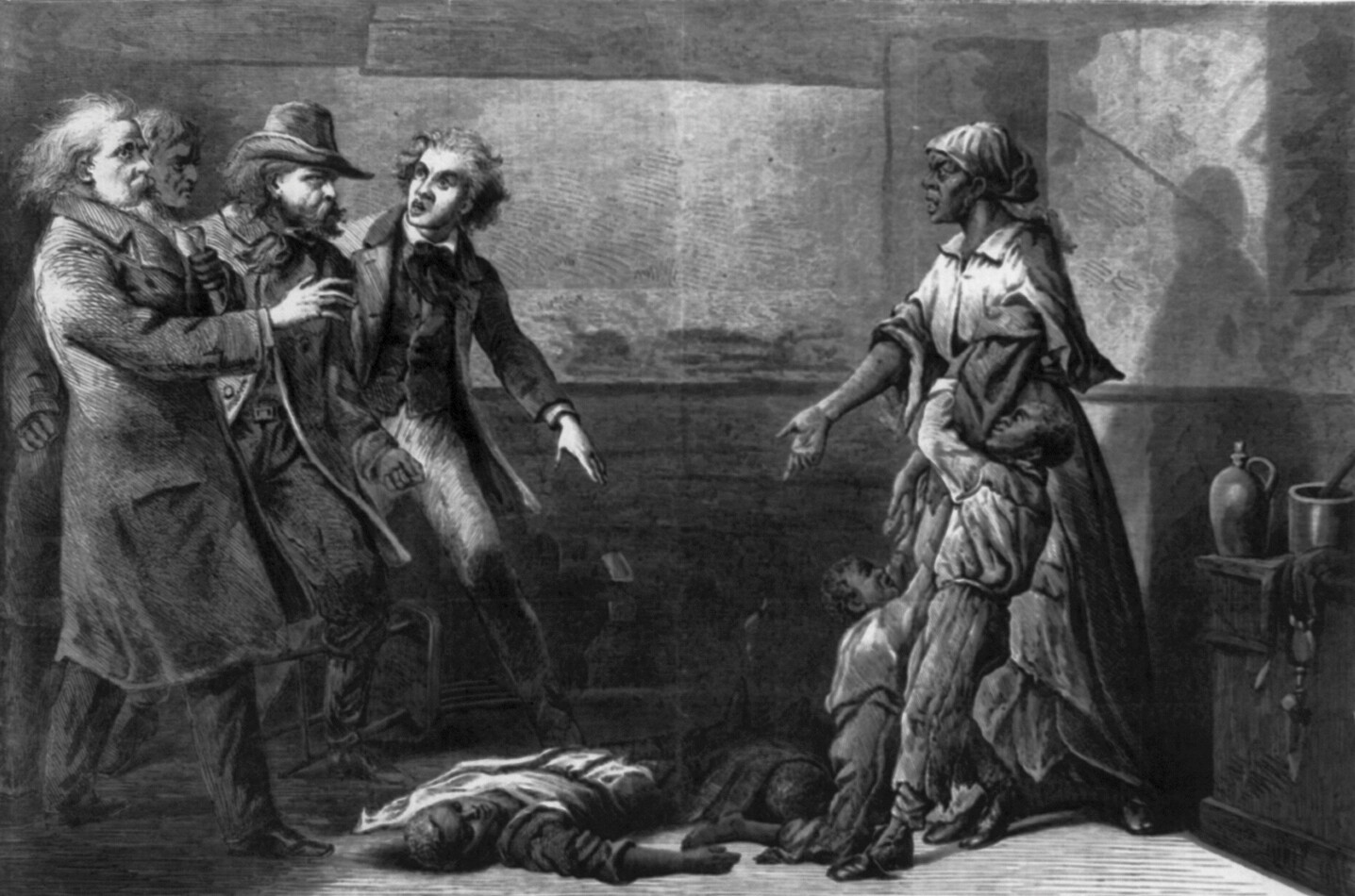
Within hours, slave catchers, federal marshals, and Archibald Gaines, the owner of Maplewood, found Garner and others barricaded in what they thought was a safe house. The posse, armed with warrants, stormed the house. Frantic with fright, Margaret killed her two-year-old daughter Mary with a butcher knife rather than see her returned to slavery. She was about to kill her other children and then herself when marshals arrested her.
Accounts of the incident spread quickly across the nation and the world. Both the Ohio governor and President Franklin Pierce took keen interest in the case, and more than a thousand people lined the streets each day to observe the trial.
On the trial’s final day, Garner called slavery a fate “more cruel than death,” especially for young women subject to daily sexual assaults. It was better for her children “to go home to God than back to slavery.”
In the end, the Ohio judge ruled that Garner was “property” to be returned to slave-state Kentucky. Yet no sooner was she back in Kentucky than abolitionists in Ohio got the state to issue warrants to have her returned to be tried for murder. (They assumed the governor would pardon her if convicted.) These efforts prompted Archibald Gaines to sell Margaret and her children to his brother in Arkansas. She died of typhoid fever in 1858.
UNCLE TOM’S CABIN During the 1850s, anti-slavery advocates gained a powerful new weapon in the form of Harriet Beecher Stowe’s best-selling novel, Uncle Tom’s Cabin; or Life among the Lowly (1852). Stowe epitomized the powerful moral and religious underpinnings of the abolitionist movement. The sister and daughter of prominent ministers and the wife of a theology professor, she could not help but absorb the deep religiosity and moral activism prevalent among her extended family members. While raising six children in Cincinnati, Ohio, during the 1830s and 1840s, she helped freedom seekers who had crossed the Ohio River from Kentucky.
Stowe detested the Fugitive Slave Act. In the spring of 1850, having moved to Maine, she began writing Uncle Tom’s Cabin. “The time has come,” she wrote, “when even a woman or a child who can speak a word for freedom and humanity is bound to speak.” The novel ended with Stowe predicting that Almighty God’s wrath would destroy America if slavery were not abolished.
Uncle Tom’s Cabin was a smashing success. Within two days, the first printing had sold out, and by the end of its first year, it had sold 300,000 copies in the United States and more than a million in Great Britain. By 1855, it was “the most popular novel of our day.”
Uncle Tom’s Cabin depicts improbable saints and sinners, crude stereotypes, impossibly virtuous Black victims, and sensational incidents. The novel tells the story of Eliza, a desperate freedom seeker who, clutching her baby, barely escapes her pursuers by taking a dangerous “flying leap” over the water onto “rafts of ice” in the Ohio River, frantically jumping from one ice “cake” to another until “she saw the Ohio side, and a man helping her up the bank” to freedom.
In the process of describing this young woman’s liberation, Stowe revealed how the brutal realities of slavery harmed everyone associated with it. The book incensed slaveholders, who called Stowe that “wretch in petticoats.” One of them mailed her a parcel containing the severed ear of a disobedient enslaved man.
THE ELECTION OF 1852 In 1852, the Democrats chose Franklin Pierce of New Hampshire as their presidential candidate; their platform endorsed the Compromise of 1850. For their part, the Whigs repudiated Millard Fillmore, who had faithfully supported the Compromise of 1850, and chose General Winfield Scott, another hero of the Mexican-American War.
Scott, an inept campaigner, carried only Tennessee, Kentucky, Massachusetts, and Vermont. Pierce overwhelmed him in the Electoral College, 254–42, although the popular vote was close: 1.6 million–1.4 million. The third-party Free-Soilers mustered only 156,000 votes for John P. Hale.
The forty-eight-year-old Pierce had fought in the Mexican-American War and was, like James Polk, touted as another Andrew Jackson despite his undistinguished record as a congressman and senator. He promoted western expansion, even if it meant adding more slave states to the Union. Yet he also acknowledged that the nation had recently survived a “perilous crisis,” and he urged both North and South to avoid aggravating the other.
By trying to be all things to all people, Pierce was labeled a “doughface”: a “Northern man with Southern principles.”
THE KANSAS-NEBRASKA CRISIS During the mid–nineteenth century, American merchants discovered the vast markets of Asia. As commerce with China and Japan grew, demand grew for a transcontinental railroad line connecting the eastern seaboard with the Pacific coast to facilitate both the flow of commerce with Asia and the settlement of the western territories. Those promoting the railroad did not realize that the issue would also reignite the debate over the westward extension of slavery.
In 1852 and 1853, Congress debated several proposals for a transcontinental rail line. Secretary of War Jefferson Davis of Mississippi favored a southern route across the territories acquired from Mexico. Senator Stephen Douglas of Illinois insisted that Chicago be the transcontinental railroad’s Midwest hub. To promote that idea, he urged Congress to pass the Kansas-Nebraska Act so that the vast territory west of Missouri and Iowa could be settled—by Whites.
To win the support of southern legislators, Douglas championed the principle of “popular sovereignty,” whereby voters in each new western territory would decide whether to allow slavery. It was a clever way to get around the 1820 Missouri Compromise, which excluded slavery north of the 36th parallel, where Kansas and Nebraska were located.
Southerners demanded more, however, and Douglas complied, in part because he would make a fortune if a railroad were built through the territory. He supported the formal repeal of the Missouri Compromise and the creation of two new territorial governments: Kansas, west of Missouri, and Nebraska, which then included the Dakotas. In 1854, Douglas and the Democrats pushed through the Kansas-Nebraska Act by a vote of 37–14 in the Senate and 113–100 in the House.
The anti-slavery faction in Congress, mostly Whigs, had been crushed, and the national Whig party died with them. Out of its ashes would emerge a new party, the Republicans.
Glossary
- Wilmot Proviso (1846)
- Proposal by Congressman David Wilmot, a Pennsylvania Democrat, to prohibit slavery in any lands acquired in the Mexican-American War.
- popular sovereignty
- Legal concept by which the White male settlers in a U.S. territory would vote to decide whether to permit slavery.
- Free-Soil party
- A political coalition created in 1848 that opposed the expansion of slavery into the new western territories.
- California Gold Rush (1849)
- A massive migration of gold hunters, mostly young men, who transformed the national economy after massive amounts of gold were discovered in northern California.
- Compromise of 1850
- A package of five bills presented to the Congress by Henry Clay intended to avoid secession or civil war by reducing tensions between North and South over the status of slavery.
- Fugitive Slave Act (1850)
- A part of the Compromise of 1850 that authorized federal officials to help capture and then return freedom seekers to their owners without trials.
- Kansas-Nebraska Act (1854)
- Controversial legislation that created two new territories taken from Native Americans, Kansas and Nebraska, where resident males would decide whether slavery would be allowed (popular sovereignty).