 The Challenges of Reconstruction
What major challenges did the federal government face in reconstructing the South after the Civil War?
THE WAR’S AFTERMATH IN THE SOUTH
In the spring of 1865, Southerners were emotionally exhausted; fully a fifth of southern White males had died in the war, and many others had been maimed for life. In 1866, Mississippi spent 20 percent of the state’s budget on artificial limbs for Confederate veterans. The economy was also ravaged. Property values had collapsed. In the year after the war ended, eighty-one Mississippi plantations sold for a tenth of what they had been valued in 1860. Confederate money was worthless; personal savings had vanished; tens of thousands of horses and mules had been killed; and countless farm buildings and agricultural tools had been destroyed.
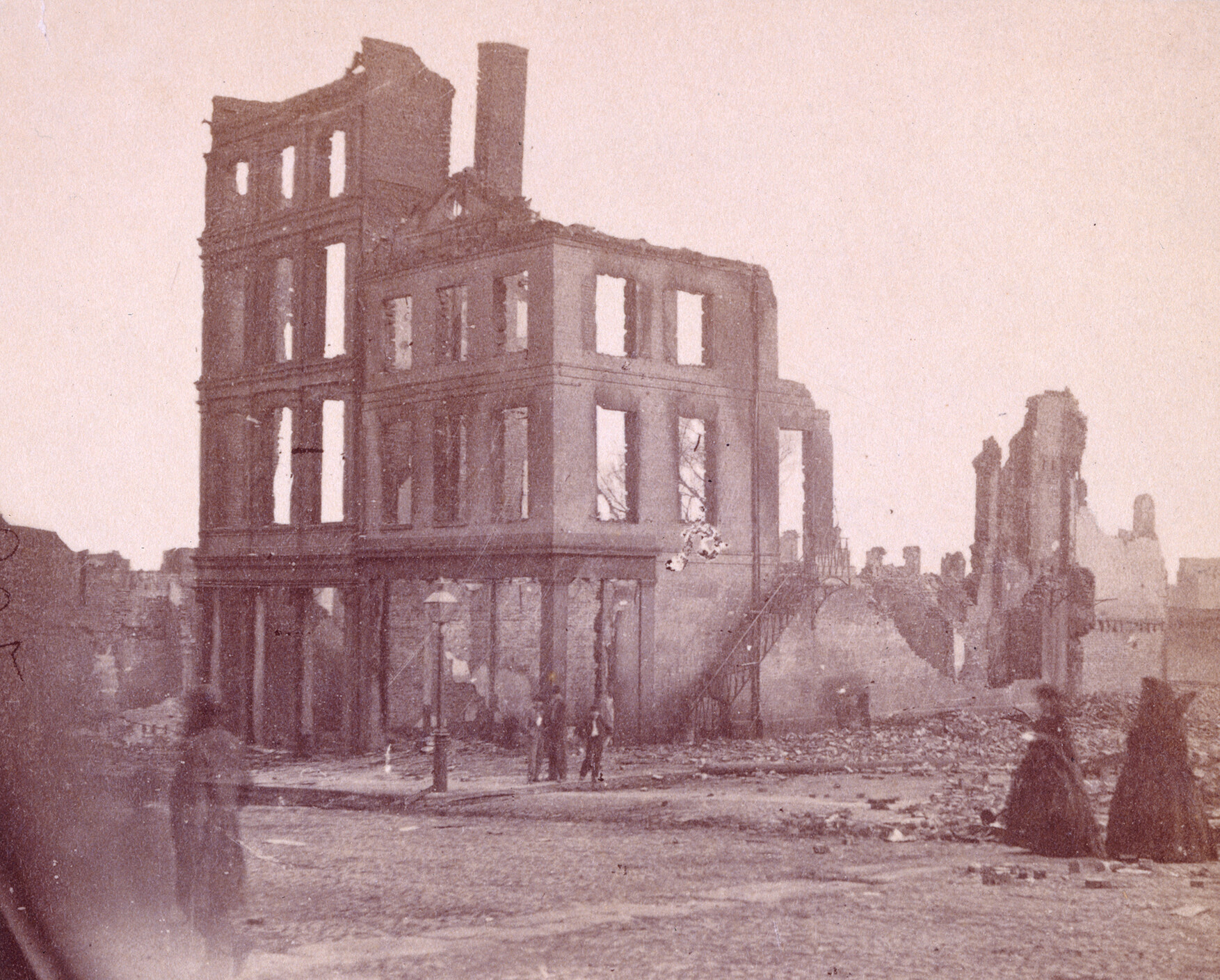
Many of the largest southern cities—Richmond, Atlanta, Columbia—were devastated. Most railroads and many bridges were damaged or destroyed, and Southerners, White and Black, were homeless and hungry. Along the path that General William T. Sherman’s Union army had blazed across Georgia and the Carolinas, the countryside “looked for many miles like a broad black streak of ruin and desolation.” Burned-out Columbia, South Carolina, said another witness, was “a wilderness of ruins”; Charleston, the birthplace of secession, had become a place of “vacant houses, of widowed women, of rotting wharves, of deserted warehouses, of weed-wild gardens, of miles of grass-grown streets, of acres of pitiful and voiceless barrenness.”
Between 1860 and 1870, northern wealth grew by 50 percent while southern wealth dropped 60 percent. Emancipation wiped out almost $3 billion invested in the slave labor system, which had enabled the explosive growth of the cotton culture. Not until 1879 would the cotton crop again equal the record harvest of 1860. Tobacco production did not regain its prewar level until 1880, the sugar crop of Louisiana did not recover until 1893, and the rice economy along the coasts of South Carolina and Georgia never regained its prewar levels of production or profit.
In 1860, just before the Civil War, the South had generated 30 percent of the nation’s wealth; in 1870, it produced but 12 percent. Amanda Worthington, a planter’s wife from Mississippi, could not believe “that we are no longer wealthy—yet thanks to the Yankees, the cause of all unhappiness, such is the case.”
Resentment boiled over. Union soldiers were cursed and spat upon. A Virginia woman expressed a common spirited defiance: “Every day, every hour, that I live increases my hatred and detestation, and loathing of that race. They [Yankees] disgrace our common humanity. As a people I consider them vastly inferior to the better classes of our slaves.” Fervent southern nationalists implanted in their children a similar hatred of Yankees and a defiance of northern rule.
The issues related to “reconstructing” the former Confederacy were complicated and controversial. For example, the process of forming new state governments required first determining the official status of the states that had seceded: were they now conquered territories? If so, then the Constitution assigned Congress authority to re-create their state governments. But what if, as Abraham Lincoln argued, the Confederate states had never officially left the Union because the act of secession was itself illegal? In that circumstance, the president, not Congress, would be responsible for re-forming state governments.
Whichever branch of government—Congress or the presidency—directed the reconstruction of the South, it would have to address the most difficult issue: what would be the political, social, and economic status of the freedpeople? They were free but by no means independent. Were they citizens? If not, what was their status?
What formerly enslaved people most wanted was to become self-reliant, to be paid for their labor, to reunite with their family members, to gain education for their children, to enjoy full participation in political life, and to create their own community organizations and social life. Most southern Whites were determined to prevent that from happening.