 Shifting Reconstruction Policies
How and why did Reconstruction policies change over time?
BATTLES OVER POLITICAL RECONSTRUCTION
Reconstruction of the former Confederate states began during the war and went through several phases, the first of which was called Presidential Reconstruction. In 1862, President Lincoln had named army generals to serve as temporary military governors for conquered Confederate areas. By the end of 1863, he had formulated a plan to reestablish governments in states liberated from Confederate rule.
LINCOLN’S WARTIME RECONSTRUCTION PLAN In late 1863, President Lincoln issued a Proclamation of Amnesty and Reconstruction, under which former Confederate states could re-create a Union government once a number equal to 10 percent of those who had voted in 1860 swore allegiance to the Constitution. They also received a presidential pardon acquitting them of treason. Certain groups, however, were denied pardons: Confederate government officials; senior officers of the Confederate army and navy; judges, congressmen, and military officers of the United States who had left their posts to join the rebellion; and those who had abused captured African American soldiers.
The North Helps the South Rebuild
CONGRESSIONAL WARTIME RECONSTRUCTION PLANS A few conservative and most moderate Republicans supported President Lincoln’s “10 percent” program that immediately restored pro-Union southern governments. Radical Republicans, however, argued that Congress, not the president, should supervise Reconstruction. Radical Republicans favored a drastic transformation of southern society that would immediately grant formerly enslaved people full citizenship. Many Radicals believed that all people, regardless of race, were equal in God’s eyes. They wanted no compromise with the “sin” of racism. They also hoped to replace the White, Democratic planter elite with a new generation of small farmers. “The middling classes who own the soil, and work it with their own hands,” explained Radical leader Thaddeus Stevens, “are the main support of every free government.”
In 1864, with war still raging, the Radicals tried to take charge of Reconstruction by passing the Wade-Davis Bill, named for two leading Republicans. In contrast to Lincoln’s 10 percent Reconstruction plan, the Wade-Davis Bill required that a majority declare their allegiance to the Union before a formerly Confederate state could be readmitted.
The bill never became law, however, because Lincoln vetoed it. In retaliation, Radicals issued the Wade-Davis Manifesto, which accused Lincoln of exceeding his constitutional authority. Unfazed by the criticism, Lincoln continued his efforts to restore the Confederate states to the Union. He also rushed assistance to the freedpeople in the South.
THE FREEDMEN’S BUREAU In early 1865, Congress approved the Thirteenth Amendment to the Constitution, officially abolishing slavery in the United States. It became law in December. Yet what did freedom mean for the formerly enslaved, most of whom had no land, no home, no food, no jobs, and no education? The debate over what freedom should entail became the central issue of Reconstruction. “Liberty has been won,” Senator Charles Sumner noted. “The battle for Equality is still pending.”
To address the complex issues raised by emancipation, Congress on March 3, 1865, created within the War Department the Bureau of Refugees, Freedmen, and Abandoned Lands (known as the Freedmen’s Bureau) to assist “freedmen and their wives and children.” It was the first federal effort to provide help directly to people rather than to states. And its task was daunting. When General William T. Sherman learned that his friend, General Oliver O. Howard, had been appointed to lead the Freedmen’s Bureau, he warned: “It is not . . . in your power to fulfill one-tenth of the expectations of those who framed the Bureau.”
Undeterred by such concerns, Howard declared that emancipated people “must be free to choose their own employers and be paid for their labor.” He assigned army officers to negotiate labor contracts between freedpeople and White landowners, many of whom resisted. The Bureau also provided the now free African Americans with medical care, clothing, shelter, and food. By 1868, the Bureau had distributed more than 20 million meals. It also assisted formerly enslaved people in seeking justice in courts, managed abandoned lands, and helped formalize marriages and find relatives.
The Bureau also helped establish schools and colleges. A Mississippi freedman explained that education was his essential priority, for it “was the next best thing to liberty.” By 1870, the Freedmen’s Bureau was supervising more than 4,000 new schools serving almost 250,000 students in the former Confederate states. The Bureau recruited thousands of teachers from the northern states. Charlotte Forten, an African American teacher, ventured south from Philadelphia after the war to be a volunteer teacher at a school for formerly enslaved people. She marveled at the passion for learning displayed by the students: “I never before saw children so eager to learn.”
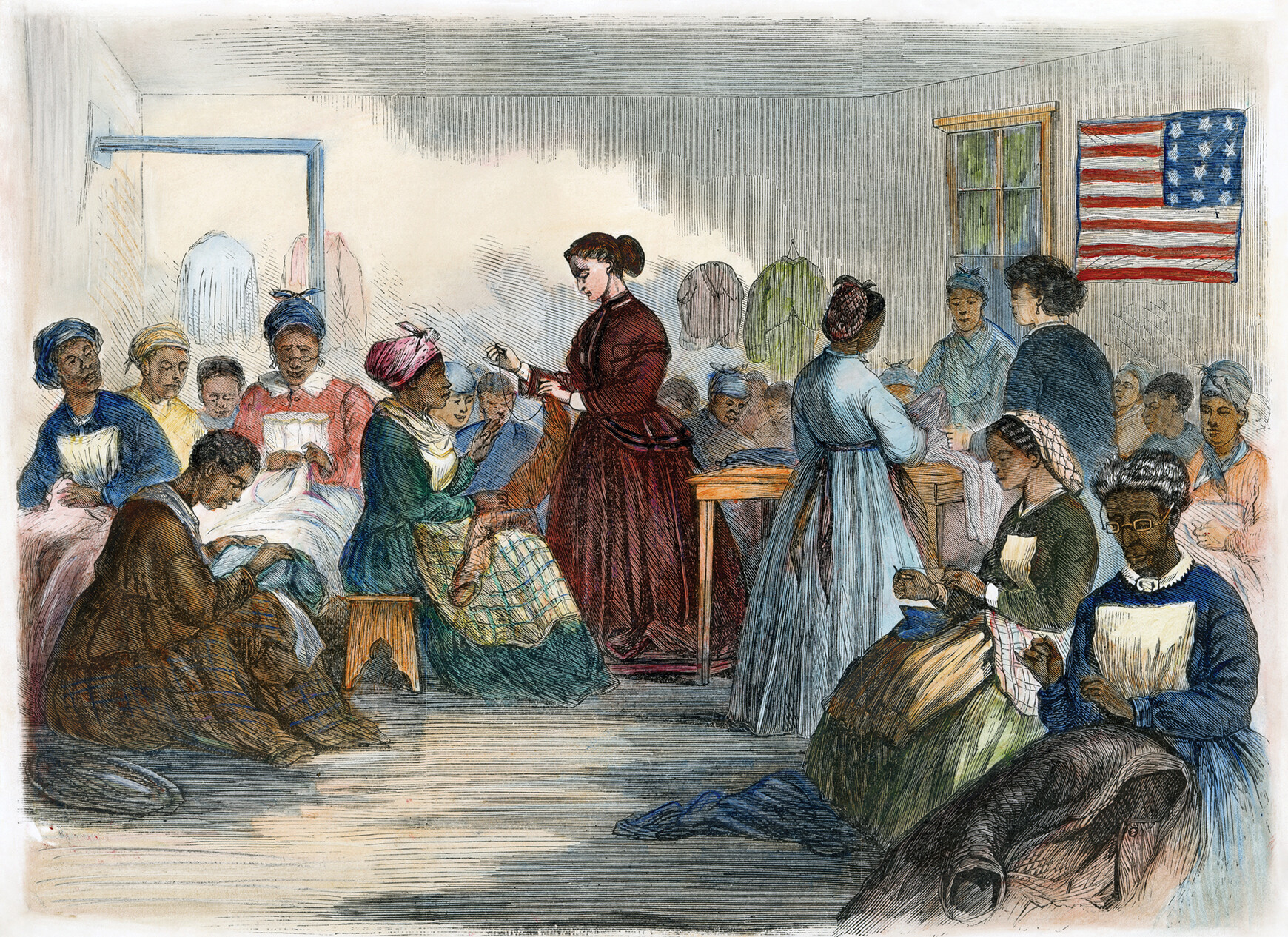
Yet the Freedmen’s Bureau had significant limitations. It never had more than 900 agents across thirteen states to deal with 3.5 million formerly enslaved people spread across a million square miles, not nearly enough to implement the Bureau’s broad goals. The number of federal troops supporting the Freedmen’s Bureau was also inadequate. As a Texas officer stressed, the Bureau agents were helpless “unless in the vicinity of our troops.” Perhaps the most glaring weakness of the Bureau was its failure to redistribute land to formerly enslaved people.
THE ASSASSINATION OF LINCOLN The possibility of a lenient federal Reconstruction of the Confederacy would die with Abraham Lincoln. The president who had yearned for a peace “with malice toward none, with charity for all” offered his last view of Reconstruction in the final speech of his life. On April 11, 1865, Lincoln rejected calls for a vengeful peace. He wanted “no persecution, no bloody work,” no hangings of Confederate leaders, and no extreme efforts to restructure southern social and economic life.
Three days later, on April 14, Lincoln and his wife attended a play at Ford’s Theatre in Washington, D.C. With his trusted bodyguard called away to Richmond, Lincoln was defenseless as twenty-six-year-old John Wilkes Booth, a celebrated actor and rabid Confederate, slipped into the presidential box and shot the president behind the left ear. As Lincoln slumped forward, Booth pulled out a knife, stabbed the president’s military aide, and jumped from the box to the stage, breaking his leg in the process. He then mounted a waiting horse and fled the city. Lincoln died nine hours later, the first president to be killed in office.
As Booth was shooting the president, other Confederate assassins were hunting Vice President Andrew Johnson and Secretary of State William H. Seward. Johnson escaped injury because his would-be assassin got drunk in the bar of the vice president’s hotel. Seward and four others, including his son, however, suffered severe knife wounds when attacked at home.
The government was suddenly leaderless, and the nation was overwhelmed with shock, horror, and anguish. African American leader Frederick Douglass described Lincoln’s murder as “an unspeakable calamity.” In his view, Lincoln was “the black man’s President: the first to show any respect for their rights as men” by rising “above the prejudice of his times.” Confederates had a different view. A seventeen-year-old South Carolina girl celebrated the news of Lincoln’s murder. As she wrote in her diary, “Old Abe Lincoln has been assassinated!”
Vice President Andrew Johnson became the new president shortly after Lincoln was declared dead. Eleven days later, Union troops found John Wilkes Booth hiding in a Virginia tobacco barn. In his diary the night before, he had vowed never to be taken alive: “I have too great a soul to die like a criminal!” The soldiers set the barn on fire, and, a few minutes later, one of them shot and killed Booth. As he lay dying, the assassin whispered, “Tell my mother I died for my country.” Three of Booth’s collaborators were convicted by a military court and hanged, as was Mary Surratt, a middle-aged widow who owned the Washington boardinghouse where the assassination had been planned. Surratt and her extended family were ardent supporters of the Confederacy. The outpouring of grief after Lincoln’s death transformed the fallen president into a sacred symbol. Lincoln’s body lay in state for several days in Washington, D.C., before being transported 1,600 miles by train for burial in Springfield, Illinois. In Philadelphia, 300,000 mourners paid their last respects; in New York City, 500,000 people viewed the president’s body. On May 4, Lincoln was laid to rest.
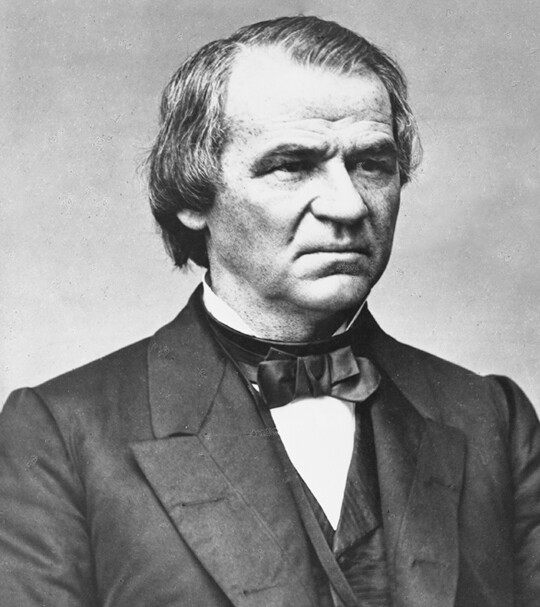
JOHNSON’S RECONSTRUCTION PLAN The new president, Andrew Johnson of Tennessee, was a pro-Union Democrat who had been added to Lincoln’s National Union ticket in 1864 to help the president win reelection. Humorless, insecure, combative, and self-righteous, Johnson hated both the White southern elite and the idea of racial equality. He also had a weakness for liquor.
Like Lincoln, Johnson was a self-made man, but he displayed none of Lincoln’s dignity or eloquence. Born in 1808 in a log cabin near Raleigh, North Carolina, he lost his father when he was three and never attended school. His illiterate mother apprenticed him to a tailor to learn a trade. He ran away from home at thirteen and eventually landed in Greeneville, in the mountains of East Tennessee. There he taught himself to read, and his sixteen-year-old wife showed him how to write and do basic arithmetic.
Over time, Johnson prospered and acquired five enslaved people, which he sold in 1863. A natural leader, he served as mayor, state legislator, governor, congressional representative, and U.S. senator. A friend described the trajectory of Johnson’s life as “one intense, unceasing, desperate upward struggle” during which he identified with poor farmers and came to hate the “pampered, bloated, corrupted aristocracy” of wealthy planters.
During the Civil War, Johnson supported “putting down the [Confederate] rebellion, because it is a war [of wealthy plantation owners] against democracy.” Yet Johnson was also a venomous racist. “Damn the negroes,” he exclaimed during the war. “This is a country for white men,” he exclaimed, “and by God, as long as I am president, it shall be a government for white men.”
Early in his presidency, Johnson stressed that he would continue Lincoln’s policies in restoring the former Confederate states to the Union. Johnson’s Restoration Plan included a few twists, however. In May 1865, Johnson issued a new Proclamation of Amnesty that excluded not only those ex-Confederates whom Lincoln had barred from a presidential pardon but also anyone with property worth more than $20,000. Johnson was determined to keep the wealthiest Southerners from regaining political power.
Surprisingly, however, by 1866 President Johnson had pardoned some 7,000 former Confederates, and he eventually pardoned most of the White “aristocrats” he claimed to despise. What brought about this change of heart? Johnson had decided that he could buy the political support of prominent Southerners by pardoning them, improving his chances of reelection.
Johnson appointed a Unionist as provisional governor in each southern state. Each governor called a convention of men elected by “loyal” (not Confederate) voters. Johnson’s plan required that each state convention ratify the Thirteenth Amendment. Except for Mississippi, each former Confederate state held a convention that met Johnson’s requirements.
FREEDMEN’S CONVENTIONS Neither Abraham Lincoln nor Andrew Johnson saw fit to ask freedpeople in the South what they most needed. The formerly enslaved people therefore took matters into their own hands. They met and marched, demanding not just freedom but citizenship and full civil rights, land of their own, and voting rights. Especially in large cities such as New Orleans, Mobile, Norfolk, Wilmington, Nashville, Memphis, and Charleston, they organized regular meetings, chose leaders, protested mistreatment, learned the workings of the federal bureaucracy, and sought economic opportunities.
During the summer and fall of 1865, emancipated Southerners and free Blacks from the North (“missionaries”) and South organized freedmen’s conventions (sometimes called Equal Rights Associations). The conventions met in state capitals “to impress upon the white men,” as the Reverend James D. Lynch told the Tennessee freedmen’s convention, “that we are part and parcel of the American republic.” As such, the freedmen were eager to counter the Whites-only state conventions organized under President Johnson’s Reconstruction plan.
The North Carolina freedmen’s convention elected as its president James Walker Hood, a free Black from Connecticut. In his acceptance speech, he said: “We and the white people have to live here together. Some people talk of emigration for the Black race, some of expatriation, and some of colonization. I regard this as all nonsense. We have been living together for a hundred years and more, and we have got to live together still; and the best way is to harmonize our feelings as much as possible, and to treat all men respectfully.” Hood then demanded three constitutional rights for African Americans: the right to testify in courts, the right to serve on juries, and “the right to carry [a] ballot to the ballot box.”
In sum, the freedmen’s conventions demanded that their voices be heard. As the Virginia convention asserted, “Any attempt to reconstruct the states . . . without giving to American citizens of African descent all the rights and immunities accorded to white citizens . . . is an act of gross injustice.”
THE RADICAL REPUBLICANS President Johnson’s initial assault on the southern planter elite pleased Radical Republicans, but not for long. The most extreme Radical Republicans, led by Thaddeus Stevens of Pennsylvania and Charles Sumner of Massachusetts, wanted Reconstruction to provide social and political equality for Blacks.
Radical Reconstruction
Stevens and other Radicals resented Johnson’s efforts to bring the South back into the Union as quickly as possible. They viewed the Confederate states as “conquered provinces” to be readmitted to the Union by the U.S. Congress, not the president.
Johnson, however, balked at such an expansion of federal authority. He was committed to letting the states control their affairs. When the U.S. Congress met in December 1865 for the first time since the end of the war, the new southern state governments looked remarkably like the former Confederate governments. Southerners had refused to extend voting rights to the formerly enslaved population.
White voters in southern states elected former Confederate leaders as their new U.S. senators and congressmen. Across the South, four Confederate generals, eight colonels, six Confederate cabinet members, and several Confederate legislators were elected as new U.S. senators and congressmen. Outraged Republicans denied seats to all such “Rebel” officials and appointed a Joint Committee on Reconstruction to develop a plan to bring the former Confederate states back into the Union.
The joint committee discovered that White violence against Blacks in the South was widespread. A formerly enslaved man from Shreveport, Louisiana, testified that Whites still bullwhipped Blacks as if they were enslaved. He estimated that 2,000 freedpeople had been killed in Shreveport in 1865.
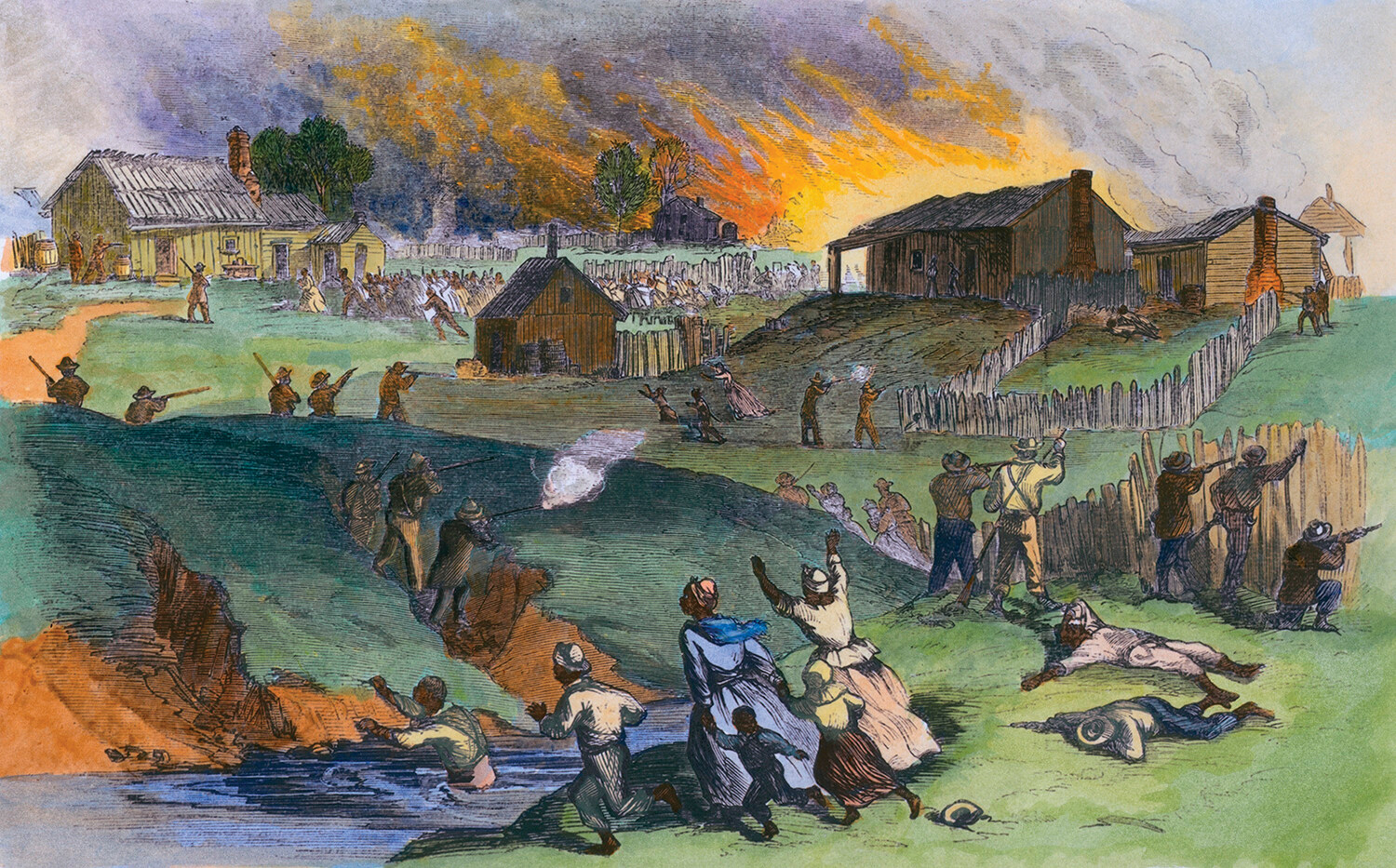
In 1866, White mobs murdered African Americans in Memphis and New Orleans. In Memphis, a clash between African American military veterans and city police triggered a race riot in which rampaging Whites raped and murdered Blacks before setting fire to their neighborhoods. Over two days, Black schools and churches were destroyed. Forty-six African Americans and two Whites were killed. Only the arrival of federal troops quelled the violence.
The racial massacres, Radical Republicans argued, resulted from Andrew Johnson’s lenient policy toward White supremacists. Senator Charles Sumner asked, “Who can doubt that the President is the author of these tragedies?” The race riots helped spur the Republican-controlled Congress to pass the Fourteenth Amendment (1868), extending federal civil rights protections to African Americans.
BLACK CODES The new all-White southern state legislatures quickly passed laws discriminating against formerly enslaved people. These “Black codes,” as a White Southerner explained, would ensure “the ex-slave was not a free man; he was a free Negro.” A Northerner visiting the South observed that the Black codes would guarantee that “the blacks at large belong to the whites at large.”
Black codes varied from state to state. In South Carolina, African Americans were required to remain on their former plantations, forced to labor from dawn to dusk. Mississippi prohibited Blacks from hunting or fishing, making them even more dependent on their White employers.
Some Black codes recognized Black marriages but prohibited interracial marriage. Mississippi stipulated that “no white person could intermarry with a freedman, free negro, or mulatto.” Violators faced life in prison.
The codes also barred African Americans from voting, serving on juries, or testifying against Whites. In Mississippi, every Black male over eighteen had to be apprenticed to a White, preferably a former slave owner. Any Blacks not apprenticed or employed by January 1866 would be jailed as “vagrants.” If they could not pay the vagrancy fine—and most could not—they were jailed and forced to work for Whites as convict laborers in “chain gangs.”
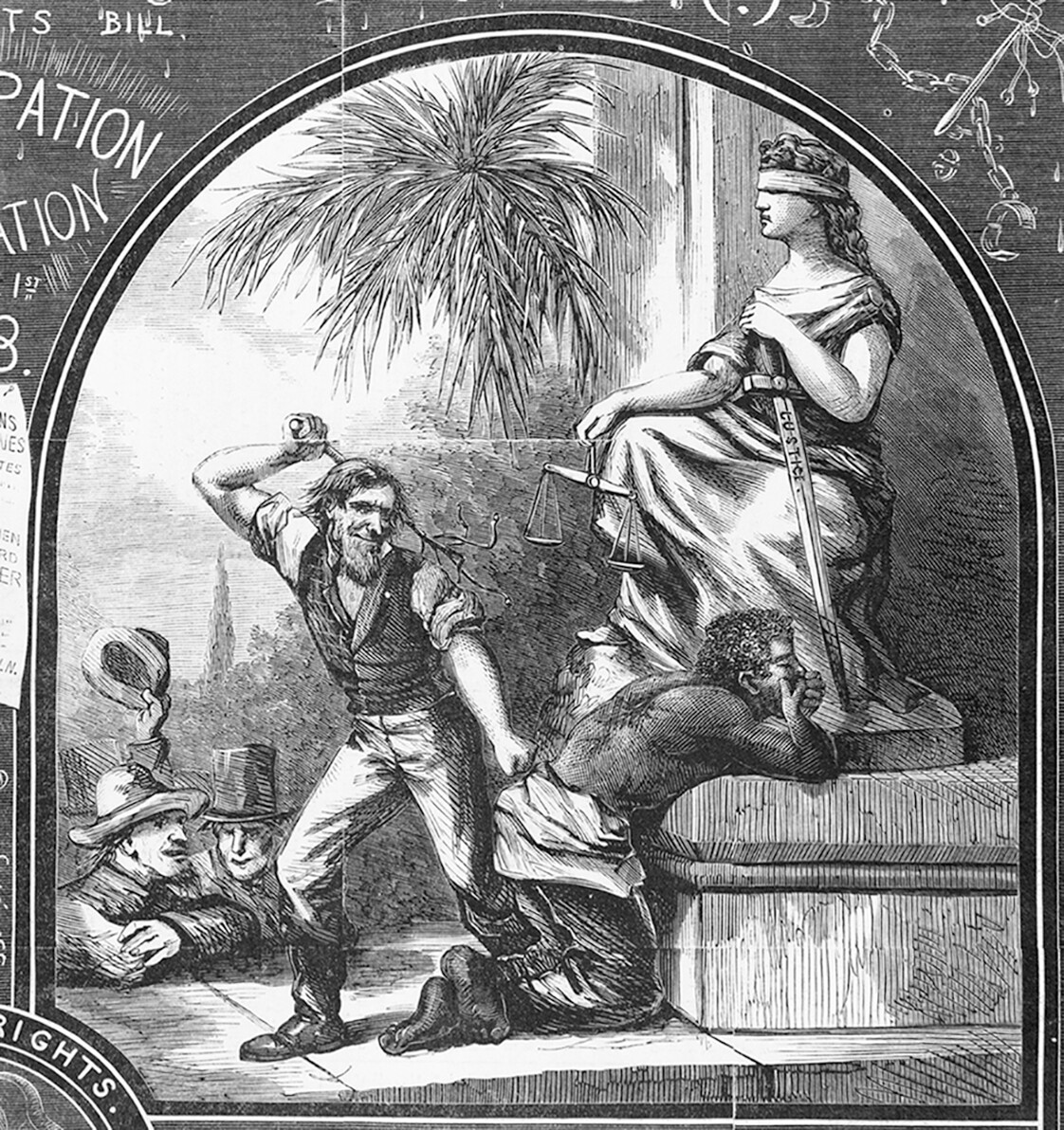
In part, states employed this “convict lease” system as a means of increasing government revenue and cutting the expenses of housing prisoners. Many southern prisons were destroyed during the war, and states lacked the funds to rebuild them. Since most prisoners were Black (only in Texas were White prisoners a majority), the popular solution was to rent them out to White farmers and businesses.
At its worst, convict leasing turned out to be one of the most exploitative labor systems in history, as people convicted of crimes, often African Americans who were falsely accused, were hired out by county and state governments to work for individuals and businesses—coal mines, lumber camps, brickyards, railroads, quarries, mills, and plantations. Convict leasing, in other words, was a thinly disguised form of slavery and often more brutal. More than 10 percent of Black convicts died on the job. A southern planter explained that before the Civil War “we owned the negroes. If a man had a good negro he could afford to keep him. . . . But these convicts, we don’t own 'em. [If] one dies, [we] get another.”
The Black codes infuriated Republicans. “We [Republicans] must see to it,” Senator William Stewart of Nevada resolved, “that the man made free by the Constitution of the United States is a freeman indeed.”
JOHNSON’S BATTLE WITH CONGRESS Early in 1866, the Radical Republicans openly challenged Andrew Johnson over Reconstruction policies after he vetoed a bill renewing funding for the Freedmen’s Bureau. The Republicans could not overturn the veto. Then, on February 22, 1866, Johnson criticized Radical Republicans for promoting Black civil rights. Moderate Republicans thereafter deserted the president and supported the Radicals. Johnson had become “an alien enemy of a foreign state,” Thaddeus Stevens declared.
In mid-March 1866, the Radical-led Congress passed the pathbreaking Civil Rights Act, the first federal law to define citizenship. It declared that “all persons born in the United States,” including the children of immigrants, but excluding Native Americans, were citizens entitled to “full and equal benefit of all laws.”
The Civil Rights Act infuriated President Johnson. Congress, he fumed, could not grant citizenship to Blacks, who did not deserve it. Claiming that the proposed legislation trespassed on states’ rights, Johnson vetoed it. This time, however, Republicans overrode the veto. The government, said Senator Richard Yates of Illinois, never intended “to set 4 million slaves free . . . and at the same time leave them without the civil and political rights which attach to a free citizen.” It was the first time that Congress had overturned a presidential veto of a major bill. From that point on, Johnson steadily lost both public and political support.
FOURTEENTH AMENDMENT To remove all doubt about the legality of the new Civil Rights Act, Congress passed the Fourteenth Amendment to the Constitution in 1866. (It gained ratification in 1868.) It guaranteed citizenship not just to freedpeople but also to immigrant children born in the United States (known as birthright citizenship).
The Fourteenth Amendment overturned the Black codes by prohibiting any efforts to violate the civil rights of “citizens,” Black or White or Yellow; to deprive any person “of life, liberty, or property, without due process of law”; or to “deny any person . . . the equal protection of the laws.”
The Fourteenth Amendment gave the federal government responsibility for protecting (and enforcing) civil rights. Not a single Democrat in the House or Senate voted for it. All states in the former Confederacy were required to ratify the amendment before they could be readmitted to the Union and to Congress. President Johnson urged the southern states to refuse to ratify the amendment. He predicted that the Democrats would win the congressional elections in November and then nix the amendment.
JOHNSON VERSUS THE RADICAL REPUBLICANS To win votes for Democratic candidates in the 1866 congressional elections, Andrew Johnson went on a nineteen-day speaking tour during which he gave more than 100 speeches promoting his plan for reconstructing the South. He drew large crowds in Baltimore, Philadelphia, and New York City, during which he denounced Radical Republicans as traitors who should be hanged. His partisan speeches backfired, however.
In Cleveland, Ohio, Johnson savaged Radical Republicans as “factious, domineering, tyrannical” men. When a heckler shouted that Johnson should hang Jefferson Davis as a war criminal, the thin-skinned president retorted, “Why not hang Thad Stevens?” Then a crowd member yelled, “Is this dignified?” Johnson shouted: “I care not for dignity.”
The backlash was intense. One newspaper denounced Johnson’s remarks as “the most disgraceful speech ever delivered” by a president. Even the pro-Johnson New York Times concluded that the president’s boorish behavior was “compromising his official character.”
Voters agreed. The 1866 congressional elections brought a devastating defeat for Johnson and the Democrats; in each house, Radical Republican candidates won more than a two-thirds majority, the margin required to override presidential vetoes. Congressional Republicans would now take over the process of reconstructing the former Confederacy.
CONGRESS TAKES CHARGE OF RECONSTRUCTION On March 2, 1867, Congress passed, over President Johnson’s vetoes, the First Reconstruction Act, which included three laws creating what came to be called Congressional Reconstruction: the Military Reconstruction Act, the Command of the Army Act, and the Tenure of Office Act.
The Military Reconstruction Act abolished the new governments “in the Rebel States” established under Andrew Johnson’s lenient Reconstruction policies. In their place, Congress established military control over ten of the eleven former Confederate states. (Tennessee was exempted because it had already ratified the Fourteenth Amendment.) The other ten states were divided into five military districts, each commanded by an army general who acted as governor.
Yet only 10,000 federal troops, mostly African Americans, were dispatched to police the sprawling “military districts.” Between 1865 and 1871, the federal army shrank from more than a million men to 30,000, most of them stationed in the West to suppress Indian uprisings. The entire state of Mississippi, for instance, had fewer than 400 U.S. soldiers assigned to ensure compliance with Reconstruction.
The Military Reconstruction Act required each former Confederate state to create a constitution that guaranteed all adult males the right to vote—Black or White, rich or poor, landless or property owners. Women—Black or White—were still not included.
The act also stipulated that the new state constitutions were to be drafted by conventions elected by male citizens “of whatever race, color, or previous condition.” Once a majority of voters ratified the new constitutions, the state legislatures had to ratify the Fourteenth Amendment; once the amendment became part of the Constitution, the former Confederate states would be entitled to send representatives to Congress. Several hundred African American delegates participated in the constitutional conventions.
The Command of the Army Act required that the president issue all army orders through general in chief Ulysses S. Grant. (The Radicals feared that President Johnson would appoint anti-Black generals to head the military districts who would be too lenient toward defiant Whites.) The Tenure of Office Act stipulated that the Senate must approve any presidential effort to remove federal officials whose appointments the Senate had confirmed. Radicals intended this act to prevent Johnson from firing Secretary of War Edwin Stanton, the president’s most outspoken critic in the cabinet. Congressional Reconstruction embodied the most sweeping peacetime legislation in history to that point. It sought to ensure that formerly enslaved people could participate in the creation of new state governments in the former Confederacy. As Thaddeus Stevens explained, the Congressional Reconstruction plan would create a “perfect republic” based on the principle of equal rights for all citizens. “This is the promise of America,” he insisted. “No More. No Less.”
IMPEACHING THE PRESIDENT The first two years of Congressional Reconstruction produced dramatic changes in the South, as new state legislatures rewrote their constitutions and ratified the Fourteenth Amendment. Radical Republicans were in control of Reconstruction, but one person still stood in their way—Andrew Johnson. During 1867 and early 1868, more and more Radicals decided that the president must be removed from office.
Johnson himself opened the door to impeachment (the formal process by which Congress charges the president with “high crimes and misdemeanors”) when, in violation of the Tenure of Office Act, he suspended Secretary of War Edwin Stanton, who had refused to resign despite his harsh criticism of the president’s Reconstruction policy.
Johnson, who considered the Tenure of Office Act an illegal restriction of presidential power, fired Stanton and replaced him with Ulysses S. Grant. The Radicals now saw their chance to impeach the president. By removing Stanton without congressional approval, Andrew Johnson had violated the law.
On February 24, 1868, the Republican-dominated House passed eleven articles of impeachment (that is, specific charges against the president), most of which dealt with Stanton’s firing—and all of which were flimsy. In reality, the essential grievance against the president was that he had opposed the policies of the Radical Republicans and in doing so had brought “disgrace, ridicule, hatred, contempt, and reproach” onto the Congress. According to Secretary of the Navy Gideon Welles, Radicals were so angry at Johnson that they “would have tried to remove him had he been accused of stepping on a dog’s tail.”
The first Senate trial of a sitting president began on March 5, 1868. The Republicans held a majority, but not the two-thirds required to convict. It was a dramatic spectacle before a packed gallery of journalists, foreign dignitaries, and political officials. As the trial began, Stevens warned the president: “Unfortunate, unhappy man, behold your doom!”
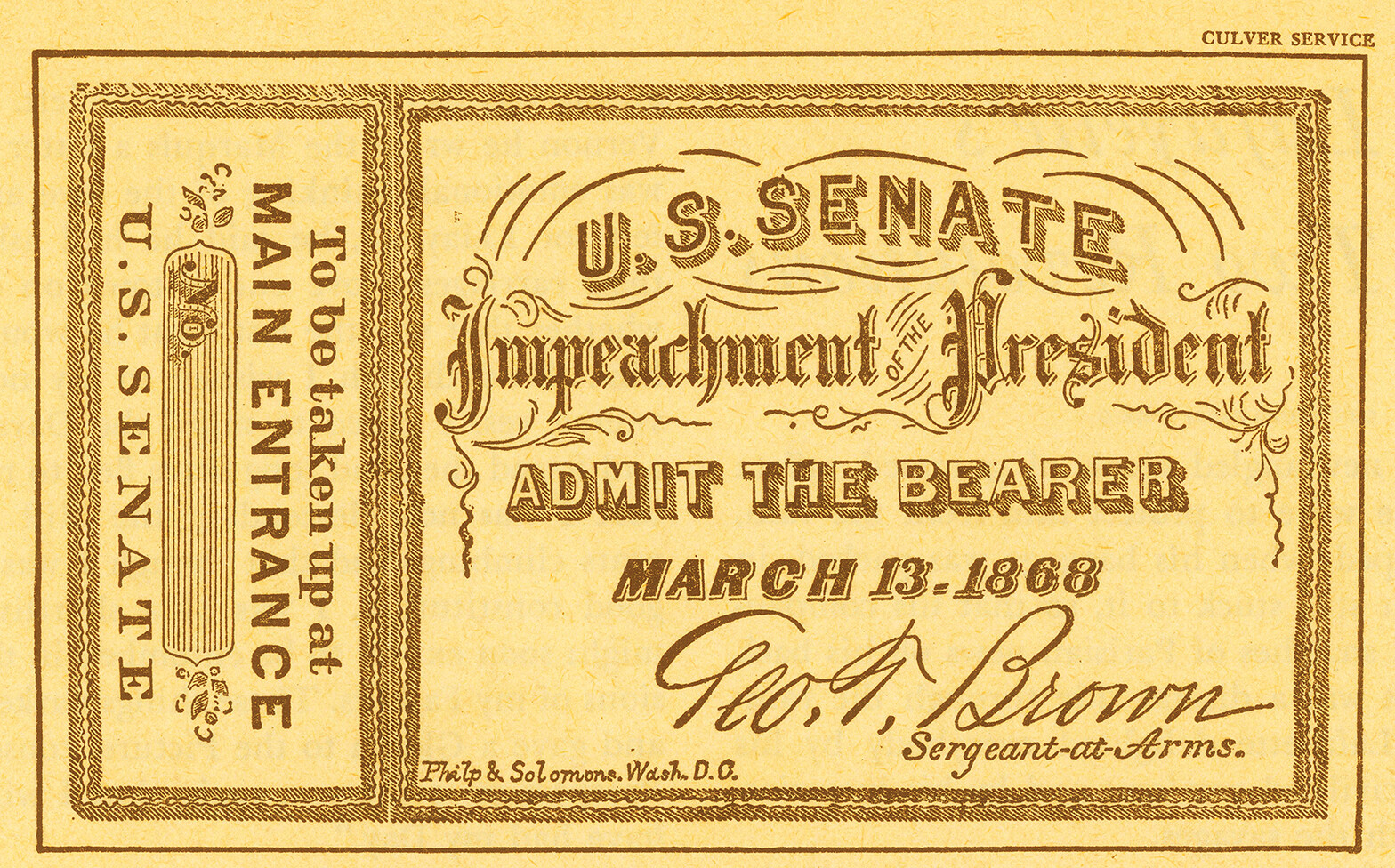
The five-week trial came to a stunning end when the Senate voted 35–19 for conviction, only one vote short of the two-thirds needed for removal. Senator Edmund G. Ross, a young Republican from Kansas, cast the deciding vote in favor of acquittal. He later explained that despite tremendous pressure from his fellow Republicans, he decided that the evidence against Johnson was both insufficient for conviction and overtly partisan. More recent research, however, suggests that Ross secretly sold his vote for acquittal. After the impeachment trial ended, Ross asked the embattled president to get friends appointed to federal jobs, and Johnson agreed to every request. The president may also have given Ross cash from a $150,000 slush fund raised by Johnson’s supporters. In the end, the effort to remove Johnson weakened public support for Congressional Reconstruction. The Richmond Daily Dispatch stressed that Johnson’s acquittal was “a terrible rebuke on the Radical party and diminished its physical force (it never had any other).” Nevertheless, the Radical cause did gain Johnson’s private agreement to stop obstructing Congressional Reconstruction. (He would later break his pledge by turning a deaf ear to pleas for federal support in suppressing Ku Klux Klan violence.)
REPUBLICAN RULE IN THE SOUTH In June 1868, congressional Republicans announced that eight southern states could again send delegates to Congress. The remaining former Confederate states—Virginia, Mississippi, and Texas—were readmitted in 1870, with the added requirement that they ratify the Fifteenth Amendment, which gave voting rights to African American men. As the formerly enslaved Frederick Douglass had declared in 1865, “slavery is not abolished until the black man has the ballot.”
Reconstruction, Women, and the Vote
The Fifteenth Amendment prohibited states from denying a citizen’s right to vote on grounds of “race, color, or previous condition of servitude.” Prior to its ratification, the individual states determined voting eligibility. But Susan B. Anthony and Elizabeth Cady Stanton, the leaders of the movement to secure voting rights for women, insisted that the amendment should have included women. As Anthony stressed, the U.S. Constitution refers to “We, the people; not we, the white male citizens; nor yet we, the male citizens; but we, the whole people, who formed the Union—women as well as men.”
PREJUDICE AGAINST CHINESE AMERICANS Still another group ignored by the Fifteenth Amendment was Chinese Americans. In California, Nevada, and Oregon, state laws prevented them from voting. People v. Hall, an 1857 California supreme court case, described the Chinese as “a race of people whom nature has marked as inferior, and who are incapable of progress.”
During Reconstruction, elected officials from the western states insisted that citizenship and voting rights were appropriate for Blacks but not Asians. The Chinese, asserted Senator Henry W. Corbett of Oregon, were “a different race entirely” and should not be allowed to vote. A Nevada congressman added that there were not “ten American citizens” in the Far West “who favor Chinese suffrage.”
In the end, California and Oregon refused to ratify the Fifteenth Amendment because of the Chinese issue. Federal policies continued to bar Chinese Americans from citizenship and voting until 1943. In 1952, Asian Americans were made eligible for citizenship and voting. Native Americans were precluded from citizenship until 1924, and many states continued to deny them voting rights until 1947. Most men also remained opposed to voting rights for women. Radical Republicans tried to deflect the issue by declaring that it was the “Negro’s hour.” Anyway, argued Senator Richard Yates, allowing a woman to vote would be “destructive of her womanly qualities.” Another Radical Republican, John M. Broomall, added that “the head of the family does the voting for the family.” Women seeking voting rights would have to wait—another fifty years, as it turned out.
Glossary
- Radical Republicans
- Congressmen who identified with the abolitionist cause and sought swift emancipation of the enslaved, punishment of the Rebels, and tight controls over former Confederate states.
- Johnson’s Restoration Plan
- A plan to require southern states to ratify the Thirteenth Amendment, disqualify wealthy ex-Confederates from voting, and appoint a Unionist governor.
- Black codes
- Laws passed in southern states to restrict the rights of formerly enslaved people.
- Fourteenth Amendment (1866)
- Amendment to the U.S. Constitution guaranteeing equal protection under the law to all U.S. citizens, including formerly enslaved people.
- Congressional Reconstruction
- Phase of Reconstruction directed by Radical Republicans through the passage of three laws: the Military Reconstruction Act, the Command of the Army Act, and the Tenure of Office Act.
- Fifteenth Amendment (1870)
- Amendment to the U.S. Constitution forbidding states to deny any male citizen the right to vote on grounds of “race, color or previous condition of servitude.”
- Freedmen’s Bureau
- Federal Reconstruction agency established to protect the legal rights of formerly enslaved people and to assist with their education, jobs, health care, and land ownership.