 A New Republican Party
How did the appeal of the Republican party to northern voters lead to Abraham Lincoln’s victory in the 1860 presidential contest?
THE EMERGENCE OF THE REPUBLICAN PARTY
The dispute over the Kansas-Nebraska Act led northern anti-slavery Whigs and some northern anti-slavery Democrats to align with one of two new parties. One was the American (“Know-Nothing”) party, which had emerged in opposition to the surge of mostly Catholic immigrants from Ireland and Germany, nearly 3 million of whom arrived in the United States between 1845 and 1854. The Know-Nothings embraced nativism (opposition to immigrants) by proposing that newcomers be denied citizenship and the right to run for public offices. Many also were opposed to the territorial expansion of slavery and the “fanaticism” of abolitionists. In the early 1850s, Know-Nothings won several local elections in Massachusetts and New York.
The other new party, the Republicans, attracted even more northern Whigs. It was formed in February 1854 in Ripon, Wisconsin, when the so-called “conscience Whigs” (those opposed to slavery) split from the southern pro-slavery “cotton Whigs.” The conscience Whigs joined with anti-slavery Democrats and Free-Soilers to form a Republican party dedicated to the exclusion of slavery from the western territories.
Abraham Lincoln made the transition from Whig to Republican. He said that the passage of Douglas’s Kansas-Nebraska Act angered him “as he had never been before” and transformed his views on slavery. Unless the North mobilized to stop the efforts of pro-slavery southerners, Lincoln believed, the future of the Union was endangered. From that moment on, he focused his career on reversing the Kansas-Nebraska Act and preventing the extension of slavery into any new territories.
“BLEEDING KANSAS”
The passage of the Kansas-Nebraska Act soon placed Kansas at the center of the increasingly violent debate over slavery. While Nebraska would become a free state, Kansas was up for grabs. According to the Kansas-Nebraska Act, the residents of the Kansas Territory were “perfectly free to form and regulate their domestic institutions [slavery] in their own way.”
The law, however, said nothing about when Kansans could decide about slavery, so each side tried to gain political control of the 50-million-acre territory. “Come on then, Gentlemen of the Slave States,” New York senator William Seward taunted. “We will engage in competition for the virgin soil of Kansas, and God give the victory to the side which is stronger in numbers as it is in the right.” South Carolina congressman Preston Brooks accepted the challenge, announcing that “the fate of the South is to be decided in Kansas.”
Groups for and against slavery recruited armed emigrants to move to Kansas. “Every slaveholding state,” said an observer, “is furnishing men and money to fasten slavery upon this glorious land, by means no matter how foul.” When Kansas’s first federal governor arrived in 1854, he sent an urgent message to President Pierce, reporting that southerners were arriving with a “dogged determination to force slavery into this Territory” in advance of an election of a territorial legislature in March 1855.
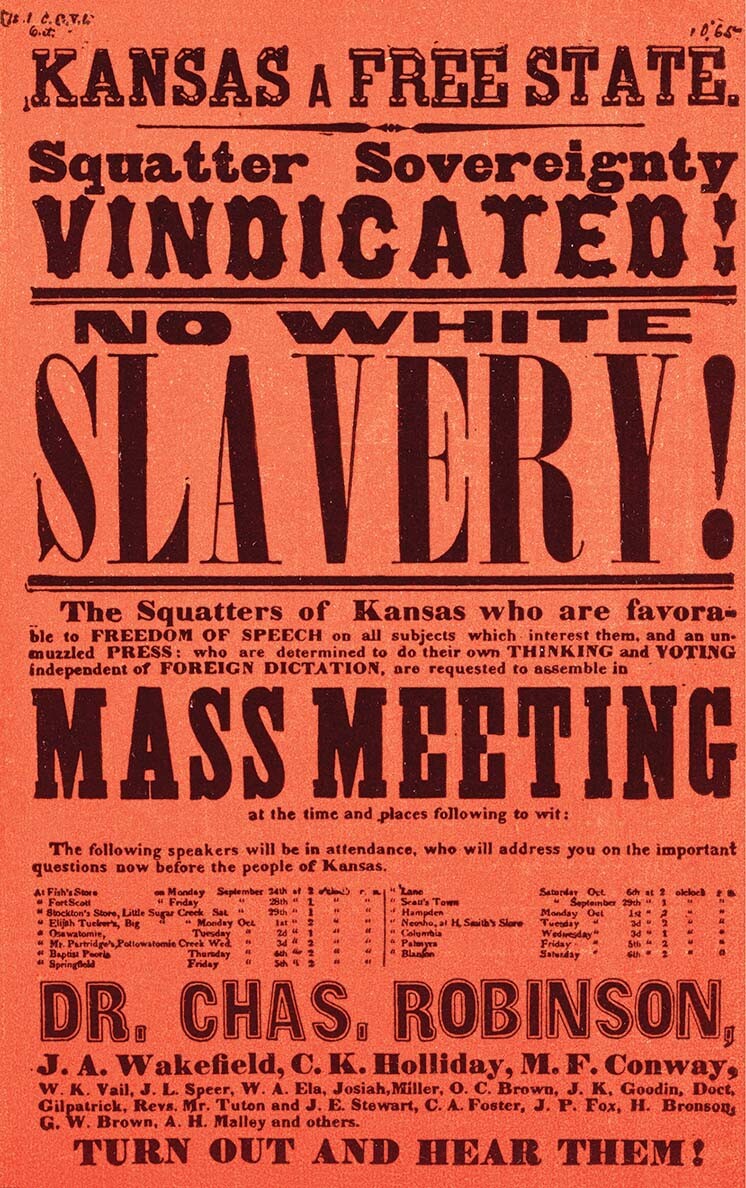
On Election Day, 5,000 “border ruffians” from Missouri crossed into Kansas. They seized polling places, illegally elected pro-slavery legislators (casting four times as many votes as there were residents), and vowed to kill every “God-damned abolitionist in the Territory,” as militia leader David Atchison urged. As soon as it convened, the territorial legislature expelled its few anti-slavery members and declared that the territory would be open to slavery. The governor denounced the fraudulent vote but did nothing to alter the results for fear of being killed himself. The territorial legislature expelled its few anti-slavery members and declared the territory open to slavery.
Outraged free-state advocates in Kansas spurned this “bogus” legislature and elected their own delegates to a “free state” constitutional convention that met in Topeka in 1855. The convention drafted a new state constitution excluding slavery and applied for statehood. By 1856, a free-state “governor” and “legislature” were operating in Topeka; thus, there were two illegal governments in the Kansas Territory. Soon the political conflict mushroomed into a civil war, which journalists called “Bleeding Kansas.”
In May 1856, a pro-slavery force of more than 500 Missourians, Alabamans, and South Carolinians invaded the free-state town of Lawrence, Kansas, just twenty-five miles from the Missouri border. David Atchison, a former U.S. senator from Missouri, urged the southern raiders not “to slacken or stop until every spark of free-state, free-speech, free-colored people, or free in any shape is quenched out of Kansas.” As they prepared to use “the bayonet and blood” to teach the “damned abolitionists a southern lesson,” Atchison yelled: “Boys, this is the happiest day of my life!”
THE KANSAS-NEBRASKA ACT, 1854
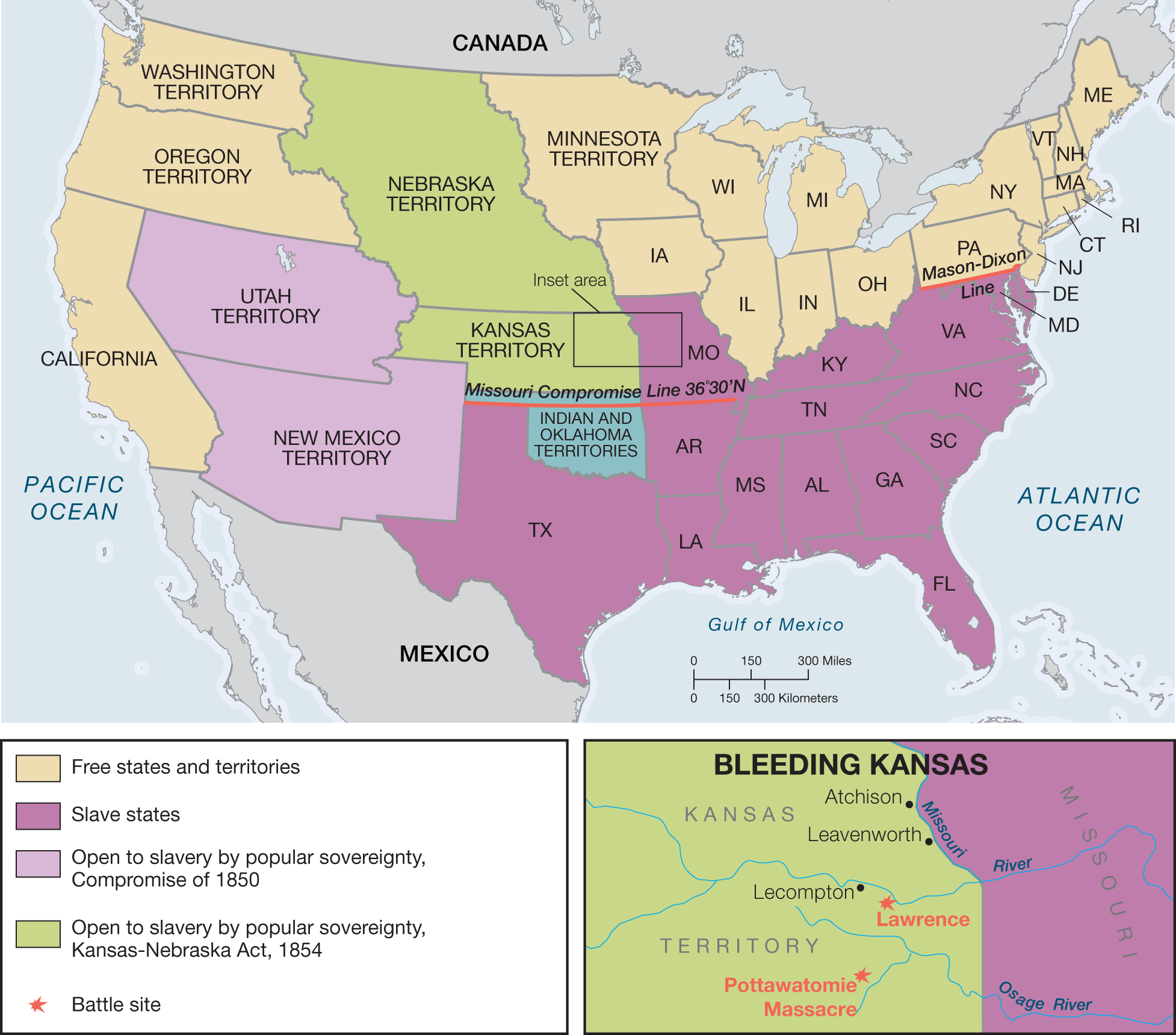
- What were the terms of the Kansas-Nebraska Act?
- How did it lead to the creation of the Republican party?
- What happened at Lawrence and Pottawatomie?
The “Sack of Lawrence” further ignited the vengeance of John Brown. Brown believed that life was a crusade against sin and that Christians must “break the jaws of the wicked,” and that the wickedest Americans were those who owned and traded enslaved people. Upon meeting Brown, many declared him crazy; those who supported his efforts thought he was a saint. He was some of both.
By the mid-1850s, the fifty-five-year-old Brown, the father of twenty children, had left his home in Springfield, Massachusetts, to become a holy warrior against slavery. In his view, Blacks in the United States deserved both liberty and full social equality. A newspaper reporter said that the white-haired Brown was a “strange” and “iron-willed” old man with a “fiery nature and a cold temper.” His hatred of slavery was merciless.
Two days after the attack on Lawrence, Brown led four of his sons to Pottawatomie, Kansas, a pro-slavery settlement near the Missouri border. On the night of May 24, 1856, Brown and his group dragged five men from their houses and hacked them to death with swords. “God is my judge,” Brown told one of his sons. “We were justified under the circumstances.” Without “the shedding of blood,” he added, “there is no remission of sins.”
The Pottawatomie Massacre ignited a brutal guerrilla war in the Kansas Territory. On August 30, pro-slavery Missourians raided a free-state settlement at Osawatomie. They looted and burned houses and shot Frederick Brown, John’s son, through the heart. By the end of 1856, about 200 settlers had been killed in “Bleeding Kansas.”
VIOLENCE IN THE SENATE
On May 22, 1856, just before the Pottawatomie Massacre, an ugly incident in the U.S. Senate shocked the nation. Republican senator Charles Sumner of Massachusetts, a passionate abolitionist, had delivered a scalding speech in which he showered slave owners with insults and charged them with unleashing assassins in Kansas. He directed his most savage attack at Andrew Pickens Butler, an elderly senator from South Carolina, a state that Sumner said displayed a “shameful imbecility” resulting from its passion for slavery. Butler, Sumner charged, had “chosen a mistress . . . who . . . though polluted in the sight of the world, is chaste [pure] in his sight—I mean the harlot [prostitute], Slavery.”
Sumner’s speech enraged Butler’s young cousin, Preston S. Brooks, a hotheaded South Carolina congressman. On May 22, Brooks resolved to defend the honor of his family, state, and region. He strode into the Senate, confronted Sumner, and began beating him about the head and shoulders with a gold-knobbed cane. Sumner nearly died; he would not return to the Senate for almost four years.
Southerners celebrated Brooks as a hero; dozens of supporters sent him new canes, one of which carried the inscription: “Hit Him Again.” In satisfying his rage, though, Brooks had created a martyr—“Bleeding Sumner”—for the anti-slavery cause. A New Hampshire newspaper said the brutal beating had aroused “hostility against the Slave Power more intense than ever.” Brooks’s assault on Sumner thus had an unintended political effect: it drove more northerners into the new Republican party.
SECTIONAL SQUABBLES
The violence during the spring of 1856 spilled over into the presidential election—one in which the major parties could no longer evade the slavery dilemma. At their first national convention, the Republicans fastened on the eccentric John C. Frémont, “the Pathfinder,” who had led the conquest of Mexican-controlled California.
The Republican platform borrowed heavily from the former Whigs. It endorsed federal funding for a transcontinental railroad and other transportation improvements. It denounced the repeal of the Missouri Compromise, the Democratic party’s policy of territorial expansion, and the “barbarism” of slavery. For the first time, a major-party platform had taken a stand against slavery.
The southern-dominated Democrats dumped the unpopular President Franklin Pierce, who remains the only elected president to be denied renomination by his party. Instead, they chose James Buchanan of Pennsylvania, a mild-mannered former senator and secretary of state who had long sought the nomination. The Democratic platform endorsed the Kansas-Nebraska Act, called for vigorous enforcement of the Fugitive Slave Act, and stressed that Congress should not interfere with slavery in states or territories.
In the 1856 campaign, the Republicans had few southern supporters and only a handful in the border slave states of Delaware, Maryland, Kentucky, and Missouri, where fear of disunion held many Whigs in line. Buchanan thus went into the campaign as the candidate of the only remaining national party. Millard Fillmore ran as the candidate of the American party, focusing on opposing Catholic immigrants from Germany and Ireland.
Frémont swept the northernmost states with 114 electoral votes, but Buchanan added five free states—Pennsylvania, New Jersey, Illinois, Indiana, and California—to his southern majority for a total of 174. Fillmore garnered almost 22 percent of the votes but won only Maryland’s 8 electoral votes. The Democrats now would control the White House, the Congress, and the Supreme Court.
PRESIDENT JAMES BUCHANAN
James Buchanan had built his career on his commitment to states’ rights and his aggressive promotion of territorial expansion. Saving the Union, he believed, depended upon making concessions to the South. Republicans charged that he lacked the backbone to stand up to the southern slaveholders who dominated the Democratic majorities in Congress.
The sixty-five-year-old Buchanan was—and remains—America’s only president who was a lifelong bachelor. (His niece, Harriet Lane, handled the duties of First Lady during his term in office.) He was also rumored to be the first gay president. To be gay or lesbian or bisexual in the mid-nineteenth century (the term homosexual had yet to appear) was to risk arrest or social censure—or both. Most states enforced “anti-sodomy” laws prohibiting “unnatural acts,” forcing same-sex relationships underground. For that reason, historians struggle to know with certainty the sexual orientation of people who were determined to keep it concealed.
That is the case with James Buchanan. Before becoming president, he had lived for sixteen years with Democrat William Rufus King, a former U.S. senator from Alabama who had also served as ambassador to France. King and Buchanan attended many official functions and social events together. And they shared a bed. To be sure, it was not uncommon in the nineteenth century for single men to room together or even sleep together, whether they knew each other or not. In the case of Buchanan and King, however, there seemed to be more at stake than simple expediency. Friends referred to King as Buchanan’s “better half,” and one congressman nicknamed him “Mrs. B.” When King left for Paris, Buchanan confessed that he was “now ‘solitary and alone,’ having no companion in the house with me. I have gone a wooing to several gentlemen but have not succeeded with any one of them.”
King preferred that Buchanan not find another companion while they were separated. As he wrote from France, “I am selfish enough to hope you will not be able to procure an associate who will cause you to feel no regret at our separation.” That King and Buchanan had family members destroy their correspondence after their deaths has added to the speculation about their relationship.
Whatever Buchanan’s sexual orientation, there is no doubt that he was a “doughface,” a northerner with southern sympathies. No sooner was he elected president than he chose mostly slave-state men for his cabinet.
Although Buchanan had vast political experience, he had limited leadership ability—and bad luck. During his first six months in office in 1857, three main events brought about his undoing: (1) a sharp downturn in the economy; (2) the controversial Supreme Court decision in the Dred Scott case; and (3) new troubles in the strife-torn Kansas Territory.
THE PANIC OF 1857
By the summer of 1857, the economy had overheated. Too many railroads and factories were being built, and European demand for American corn and wheat was slackening. The result was a financial panic triggered by the failure of the Ohio Life Insurance and Trust Company on August 24, 1857. If such a prestigious institution could close its doors, people worried, the entire economy might collapse.
Upon hearing the news, worried customers began withdrawing their money from banks, which forced those institutions to “call in” loans (the requirement that the loans to businesses be paid off in full immediately), causing many businesses to go bankrupt. By the fall, newspapers across the North highlighted the “hard times” that had befallen the nation. Tens of thousands lost their jobs, and banks started foreclosing on homes, farms, and businesses. Virtually every bank in New York City closed its doors. Jobless men roamed city streets demanding work or food or money. Federal troops had to be sent to disperse angry mobs in New York City.
Amid the growing hysteria over the economic collapse, President Buchanan refused to intervene in what came to be called the Panic of 1857. In December of that year, he pledged that the government would do nothing to relieve the individual suffering caused by the financial panic.
THE DRED SCOTT CASE
In his inaugural address, President Buchanan asserted that the Supreme Court should decide the issue of slavery in the western territories. Two days later, on March 6, 1857, the justices delivered a decision in the long-awaited case of Dred Scott v. Sandford, which had taken eleven years to work its way through the state and federal courts. The New York Times declared it “the most important decision ever made by the Supreme Court.
Scott, born a slave in Virginia, had been taken to St. Louis in 1830, where slavery was legal. There he was sold to an army surgeon, who took him to Illinois, then to the Wisconsin Territory (later Minnesota), and finally back to St. Louis in 1842. While in the Wisconsin Territory, Scott had married Harriet Robinson, and they had two daughters.
In 1846, Scott, with the aid of abolitionist attorneys, filed suit in Missouri, claiming that his residence in Illinois and the Wisconsin Territory had made him “free” because slavery was outlawed in those areas. A Missouri jury decided in his favor, but the state Supreme Court ruled against him. When the case was appealed to the U.S. Supreme Court, the nation anxiously awaited its opinion on whether freedom once granted could be lost by returning to a slave state.
Seven of the nine justices were Democrats, and five of the seven were southern slaveholders. Buchanan violated the separation of powers between the judicial and executive branches by browbeating a justice to go along with the southerners. The final vote was 7 to 2 against Scott.
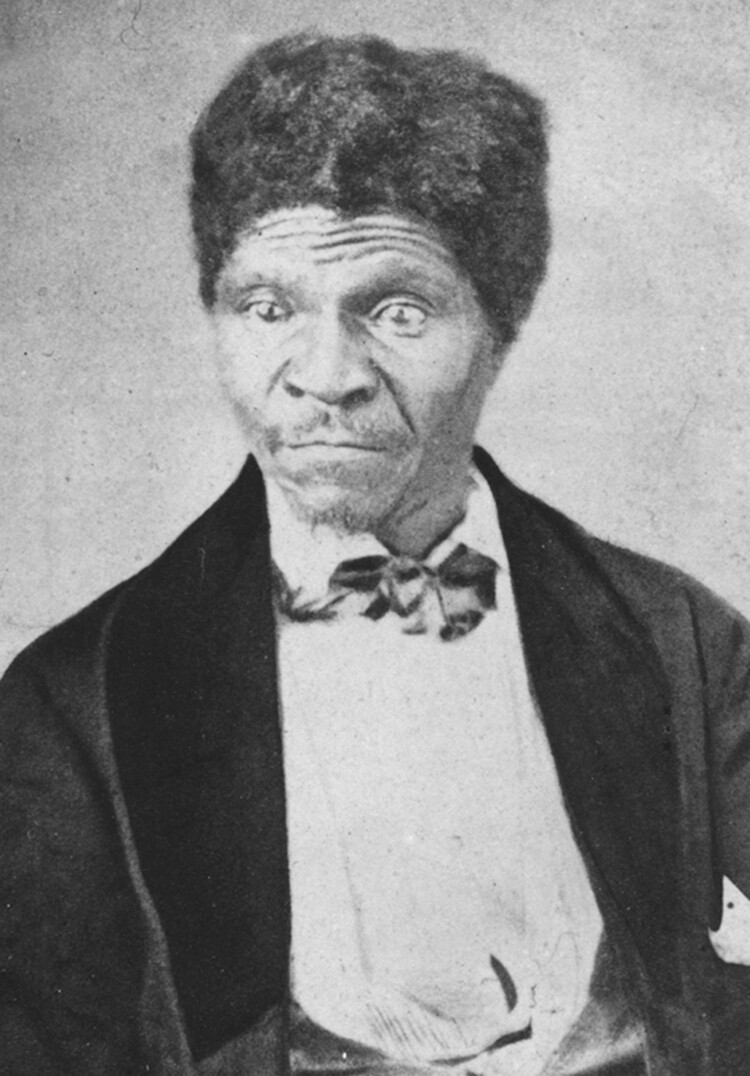
Chief Justice Roger B. Taney of Maryland, a devoted supporter of the South and of slavery, wrote the majority opinion. He ruled that Scott lacked legal standing because, like all enslaved people, he was property, not a human being. As such, he was not a U.S. citizen and could never become one, nor was he eligible to file suit in a court. When the Constitution was drafted in 1787, Taney claimed, African Americans were deemed “an inferior and subject race” that the Constitution had implicitly excluded from citizenship.
The Dred Scott case thus directly challenged the concept of “popular sovereignty.” If Congress could not exclude slavery from a territory, as Taney argued, then neither could a territorial government created by an act of Congress. Suddenly, all the West—and the North—was open to slavery.
Pro-slavery advocates loved the Court’s decision, as did President Buchanan. A Georgia newspaper said the decision “covers every question regarding slavery and settles it in favor of the South.” Republicans and abolitionists, on the other hand, protested the Dred Scott decision because it nullified the very basis of the anti-slavery movement—that slaves were people, not property.
THE LECOMPTON CONSTITUTION (1857)
Meanwhile, in the Kansas Territory, the furious fight over slavery intensified, with both sides resorting to voting trickery and violence. Just before James Buchanan’s inauguration, in early 1857, the pro-slavery territorial legislature scheduled a constitutional convention. The governor vetoed the measure, but the legislature overrode his veto. The governor resigned in protest, and Buchanan replaced him with Robert J. Walker.
With Buchanan’s approval, Governor Walker pledged to free-state Kansans (the overwhelming majority of residents) that the new constitution would be submitted to a fair vote. But when the pro-slavery constitutional convention, meeting at Lecompton, drafted a constitution under which Kansas would become a slave state and exclude free Blacks, opponents of slavery boycotted the referendum on the constitution. The boycott enabled the pro-slavery constitution to be approved. It was then sent to Congress for endorsement. At that point, Buchanan urged Congress to approve the Lecompton Constitution, triggering a new wave of outrage across the northern states. Stephen A. Douglas, the most prominent midwestern Democrat, sided with anti-slavery Republicans because Buchanan’s action would deny Kansas voters the right to decide the issue in a general election. Governor Walker resigned his post in protest of the Lecompton Constitution.
The new acting governor convened the anti-slavery legislature. It called for another election to vote the Lecompton Constitution up or down. Most pro-slavery settlers boycotted this election. The result, on January 4, 1858, was decisive: 10,226 voted against the Constitution, while only 138 voted for it. In April 1858, the U.S. Congress ordered that Kansans vote again. They did so, rejecting the Lecompton Constitution, 11,300–1,788. With that vote, Kansas cleared the way for its eventual admission as a free state.
DOUGLAS VERSUS LINCOLN (1858)
The controversy over slavery in Kansas fractured the Democratic party. Stephen A. Douglas, one of the few remaining Democrats with support in both the North and the South, struggled to keep the party from fragmenting. First, however, he had to secure his home base in Illinois, where in 1858 he faced a demanding Senate reelection campaign.
To challenge Douglas, Illinois Republicans selected a respected lawyer from Springfield, Abraham Lincoln. Lincoln was the son of a frontier farmer/carpenter so poor that he rented out his hardworking son to neighbors.
When Abraham was seven, the family moved from Kentucky across the Ohio River to Indiana. Two years later, Lincoln’s “angel mother” Nancy died, and his father remarried. In March 1830, the Lincolns moved to Illinois. In Springfield, Lincoln worked as a farmer, rail-splitter, and surveyor. He later became an attorney and married Mary Todd, from a wealthy, slave-owning family in Lexington, Kentucky.
In 1834, Lincoln was elected to the Illinois legislature, and he served four successive terms as a Whig. He was a true believer in Henry Clay’s leadership and Clay’s promotion of the American System. “My politics are short and sweet,” Lincoln said. “I am in favor of a national bank. I am in favor of the internal improvement system and a high protective tariff.” And he was opposed to the expansion of slavery into the western territories.
In 1846, Lincoln won a seat in the U.S. Congress while pledging to serve only one term. After his single unremarkable term, he returned to lawyering in Springfield. In 1854, however, Lincoln’s disgust at Douglas’s Kansas-Nebraska Act drew him back into the political arena. Lincoln hated slavery but was not yet an abolitionist. He did not believe that the nation should force the South to end what he referred to as “the monstrous injustice,” but did insist that slavery be banned in the new western territories.
In 1856, Lincoln joined the Republican party, and two years later he emerged as the obvious choice to oppose Douglas in the Illinois senatorial race. Lincoln sought to raise his profile by challenging Douglas to a series of debates. The seven Lincoln-Douglas debates took place between August 21 and October 15, 1858. They attracted tens of thousands of spectators and transformed the statewide race into a battle for the future of the entire republic.
The two men differed as much physically as they did politically. The brash and brilliant Douglas was short and stocky, barely five feet tall, but had an enormous head that inspired the nickname “the Little Giant.” He wore custom-tailored suits and traveled to the debates in a private railroad car.
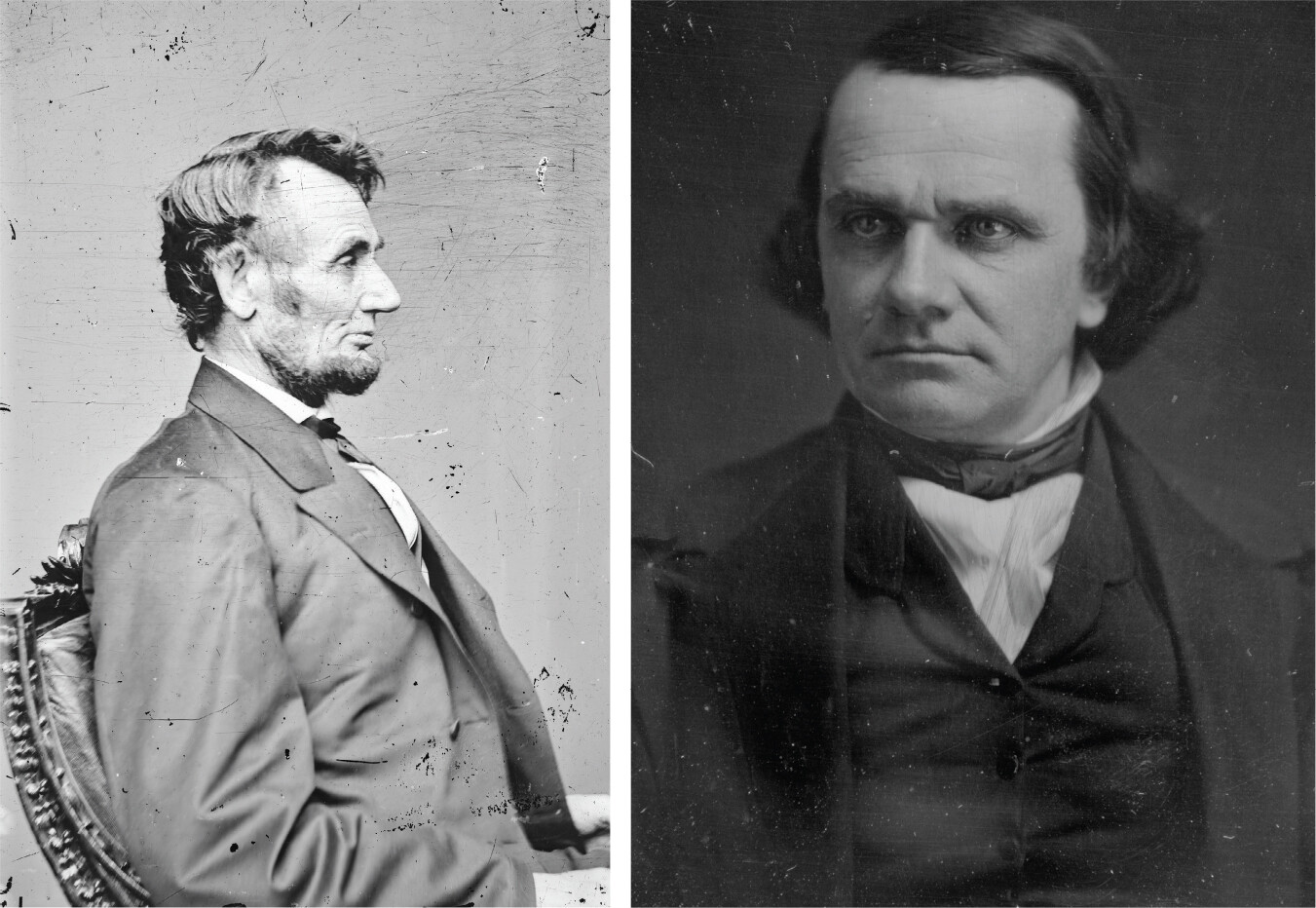
By contrast, Lincoln was homely—tall (six feet, four inches) and thin, with a long neck, big ears, enormous hands and feet, shaggy eyebrows, and deep-set, brooding eyes. Poet Walt Whitman said that Lincoln’s face was “so awful ugly it becomes beautiful.” His coarse black hair never looked the same from day to day, and his ill-fitting suits made him so unkempt that a Bostonian considered Lincoln “the ugliest man” he had ever seen. Lincoln, however, dazzled people with the rawboned genius of his speeches, which were highlighted by folksy humor, entertaining stories, and biblical eloquence. His opponent, Stephen Douglas, acknowledged that Lincoln was “the strong man of the [Republican] party—full of wit, facts, dates, and the best stump speaker . . . in the West.”
The basic dispute between the two candidates, Lincoln insisted, lay in Douglas’s indifference to the immorality of slavery. Douglas, he said, did not care whether slavery in the territories was “voted up, or voted down.” Instead, he was preoccupied only with process (popular sovereignty); in contrast, Lincoln claimed to be focused on principle. In a subtle revision of his stance on slavery, he now stressed that “I have always hated slavery as much as any abolitionist.” The American government, he predicted, could not “endure, permanently half slave and half free. . . . It will become all one thing, or all the other.”
Douglas responded that the United States was founded on the principle of White supremacy. “It was made by the white man, for the benefit of the white man, to be administered by the white man.” Blacks and Indians, he added, were members of an “inferior race.”
Although Lincoln won the popular vote, Douglas won the Senate seat because he won the support of the Democratic-controlled state legislature. Lincoln’s energetic campaign, however, had made him a national figure. And across the northern states, the Republicans won so many congressional seats in 1858 that they seized control of the House of Representatives.
AN OUTNUMBERED SOUTH
By the late 1850s, national politics was undergoing profound changes. In May 1858, the free state of Minnesota entered the Union; in February 1859, another nonslave territory, Oregon, gained statehood. The slave states of the South were quickly becoming a besieged minority, and their insecurity—even paranoia—deepened.
As tensions over the future of slavery rose, decorum in Congress plummeted. Legislators threatened each other with clenched fists. A few of them killed opponents in duels. In 1858, members of Congress engaged in the largest brawl ever staged on the floor of the House of Representatives.
Harsh words about slavery incited the free-for-all. According to a reporter, the House floor “was a sea of writhing bodies, a dozen Southerners pummeling—or being pummeled by—a dozen Northerners. The Speaker shouted and rapped for order, and the sergeant at arms, thinking he could make a difference, rushed among the combatants showing the House mace. One representative picked up a heavy stoneware spittoon and rushed into the fray. Several Quakers urged calm and peace.” The fracas ended when John “Bowie Knife” Potter of Wisconsin yanked off the hairpiece of a Mississippi congressman and shouted, “I’ve scalped him.”
Like the fighting members of Congress, more and more Americans decided that compromise over the extension of slavery was impossible. The editor of a pro-slavery Kansas newspaper wanted to kill abolitionists: “If I can’t kill a man, I’ll kill a woman; and if I can’t kill a woman, I’ll kill a child.” Some southerners were already talking of secession again. In 1858, former Alabama congressman William L. Yancey, the leader of the fire-eaters, said that it would be easy “to precipitate the Cotton States into a revolution.”
JOHN BROWN’S RAID (1859)
Such violent threats drove John Brown into a desperate act. On the cool, rainy night of October 16, 1859, Brown launched his supreme effort to end slavery. From a Maryland farm, he crossed the Potomac River with about twenty young men, including three of his sons and five African Americans. They walked five miles to the federal rifle arsenal in Harpers Ferry, Virginia (now West Virginia). There they took the sleeping residents by surprise, cut the telegraph lines, and occupied the arsenal with its 100,000 rifles.
Brown then sent several men to kidnap prominent slave owners and arm thousands of enslaved people in the area, in the hope of triggering mass uprisings. “I want to free all the negroes in this state,” Brown said. “If the citizens interfere with me, I must burn the town and have blood.”
Only a few enslaved people heeded the call, however, and by dawn, enraged townsmen had surrounded the raiders. Brown and a dozen of his men, along with eleven White hostages and two of their enslaved workers, holed up in the firehouse.
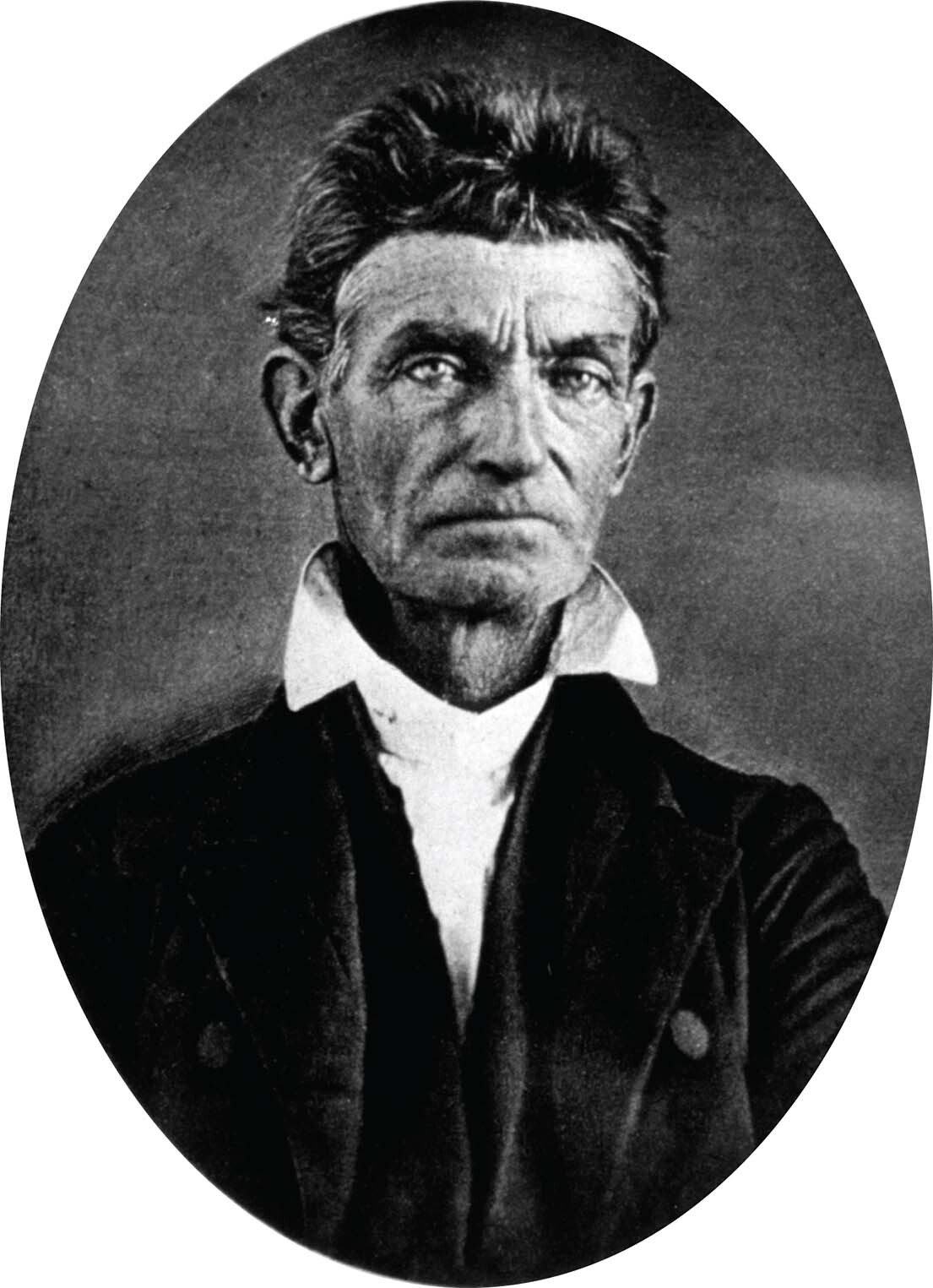
In response, hundreds of armed men poured into Harpers Ferry. Among them was Lieutenant Colonel Robert E. Lee, who arrived with a force of U.S. Marines. On the morning of October 18, the marines broke down the firehouse’s barricaded doors and rushed in. The siege was over. Brown’s men had killed four townspeople and wounded another dozen. Of their own group, ten were killed (including two of Brown’s sons), and five were captured; another five escaped.
A jury quickly convicted John Brown and his accomplices of treason, murder, and “conspiring with Negroes to produce insurrection.” A wounded Brown, appearing more rational than crazed, delivered a stirring speech: “Now, if it is deemed necessary that I should forfeit my life for the furtherance of the ends of justice, and mingle my blood further with the blood of my children and with the blood of millions in this slave country whose rights are disregarded by wicked, cruel, and unjust enactments, I say, let it be done.”
On December 2, 1859, wearing a black coat and black pants stained with blood, Brown climbed into a wagon, sat on his empty black walnut coffin, and rode to the gallows, which was surrounded by 1,500 soldiers. (Among the onlookers was a popular actor named John Wilkes Booth, who would later assassinate Abraham Lincoln.)
If Brown had failed to ignite a massive slave rebellion, he had successfully become a martyr for the anti-slavery cause. In the North, church bells tolled in his honor and cannons fired salutes. In the South, he had stirred the region’s worst nightmare: that armed enslaved people would revolt. John Brown, wrote the African American abolitionist Frederick Douglass, “began the war that ended American slavery.”
Throughout the fall and winter of 1859–1860, rumors of abolitionist conspiracies and slave insurrections swept through the southern states. Some 300 abolitionists were murdered or forced out of the region. “We regard every man in our midst an enemy to the institutions of the South,” said the Atlanta Confederacy, “who does not boldly declare that he believes African slavery to be a social, moral, and political blessing.”
THE DEMOCRATS DIVIDE (1860)
Amid such hysteria, the nation mobilized for another presidential election, destined to be the most fateful in its history. In April 1860, Democrats gathered for what would become a disastrous nominating convention in Charleston, South Carolina.
President Buchanan decided not to seek a second term, leaving Stephen A. Douglas as the front-runner. His northern supporters tried to straddle the issue of slavery by promising to defend the institution in the South while assuring northerners that it would not spread to new states. Southern militants, however, used the Dred Scott ruling to demand federal protection for slavery in the territories as well as the states.
When the pro-slavery advocates lost, delegates from eight southern states walked out, and the convention disintegrated. Before departing, William Preston, a plantation owner, left no doubt about the reason for the split: “Slavery is our King; Slavery is our truth; Slavery is our divine right.” Douglas’s supporters reassembled in Baltimore on June 18 and nominated him for president.
Southern Democrats met first in Richmond and then in Baltimore, where they adopted the pro-slavery platform that had been defeated in Charleston. They named John C. Breckinridge, vice president under Buchanan, as their candidate because he promised to protect the right of emigrants to take their enslaved workers to the western territories. Thus, another cord binding the nation together had snapped: the fracturing of the Democratic party made a Republican victory in 1860 almost certain. That President Buchanan refused to endorse candidate Douglas revealed how splintered the Democrats had become.
LINCOLN’S ELECTION (1860)
The Republicans gathered in Chicago, where everything came together for Abraham Lincoln. Inside the convention building, the “wildest excitement and enthusiasm” swelled to a “perfect roar” as Lincoln was nominated. The convention reaffirmed the party’s opposition to the extension of slavery and endorsed a series of traditional Whig policies promoting a higher protective tariff, free farms (homesteads) on federal lands out west, and federally financed internal improvements, including a transcontinental railroad.
The rival conventions revealed that opinions about the future of slavery tended to be more extreme in the Northeast and the Lower South. Attitude followed latitude. In the border states of Maryland, Delaware, Kentucky, and Missouri, former Whigs made one more try at sectional reconciliation. Meeting in Baltimore a week before the Republicans met in Chicago, they reorganized as the Constitutional Union party and nominated John Bell of Tennessee for president. Their platform promoted “the Constitution of the Country, the Union of the States, and the Enforcement of the Laws.”
The bitterly contested presidential campaign became a choice between Abraham Lincoln and Stephen A. Douglas in the North (Lincoln was not even on the ballot in the South), and between Breckinridge and Bell in the South. Douglas, the only candidate to mount a nationwide campaign, promised that he would “make war boldly against” extremists in both regions. His heroic effort did little good, however.
At midnight on November 6, Lincoln won with 39 percent of the popular vote, the smallest plurality ever, but he captured a clear majority (180 votes) in the Electoral College. He carried all eighteen free states but none of the slave states. Douglas came in second and had worn himself out in doing so. He would die just seven months later at age forty-eight.
THE ELECTION OF 1860
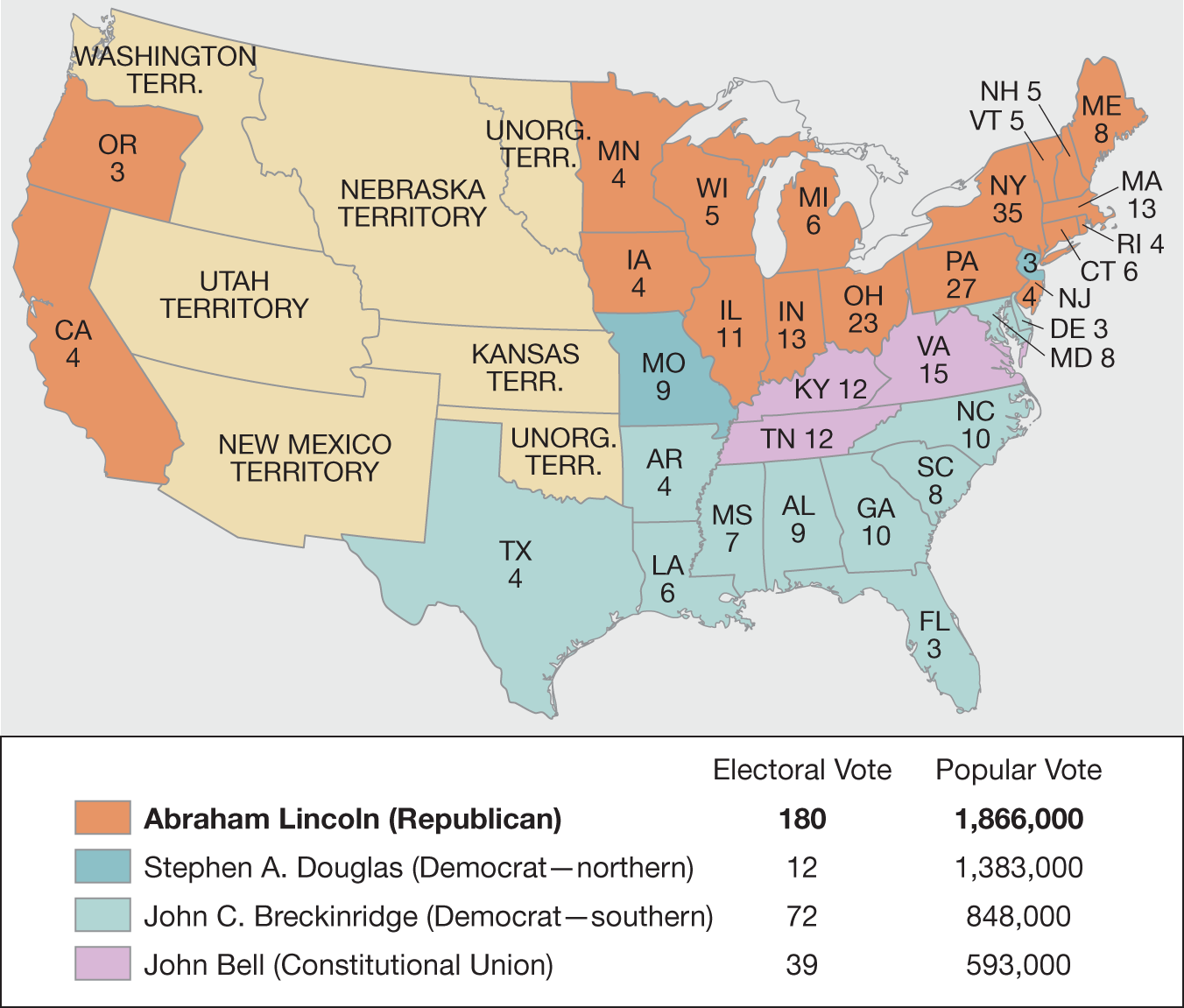
- What caused the division within the Democratic party in 1860?
- How did Lincoln win the 1860 presidential election?
Lincoln’s political experience was meager, his learning limited, and his popular support shallow. “Never did a President enter upon office with less means at his command,” the poet James Russell Lowell remarked. Yet the unassuming lawyer from Springfield, Illinois, would become, as Walt Whitman wrote, “the grandest figure yet, on all the crowded canvas of the Nineteenth Century.”
Glossary
- Bleeding Kansas (1856)
- A series of violent conflicts in the Kansas Territory between anti-slavery and pro-slavery factions over the status of slavery.
- Dred Scott v. Sandford (1857)
- U.S. Supreme Court ruling that enslaved people were not U.S. citizens and that Congress could not prohibit slavery in territories.
- Lincoln-Douglas debates (1858)
- In the Illinois race between Republican Abraham Lincoln and Democrat Stephen A. Douglas for a seat in the U.S. Senate, a series of seven dramatic debates focusing on the issue of slavery in the territories.