MODERNISM
What does “modernism” mean in intellectual and artistic terms? How did the modernist movement influence American culture in the early twentieth century?
THE MODERNIST REVOLT
“The world broke in two in 1922 or thereabouts.” So wrote author Willa Cather. She meant that during the 1920s, cultural modernists and their traditionalist critics clashed in passionate defense of their opposing worldviews.
Modernism was an intellectual, literary, and artistic movement that appeared first in the capitals of Europe—London, Paris, Berlin, and Vienna—in the 1890s. By the second decade of the twentieth century, cultural modernism had spread to the United States, especially New York City and Chicago.
Modernists rebelled against what they saw as a repressive, conventional Christian morality. It was an obstacle to artistic creativity and personal freedom, they believed, and they engaged in a relentless search for new modes of expression and behavior, the more provocative and scandalous the better.
Modernism did not simply drop out of the sky in 1922. It had been years in the making. Modernism reflected a widespread recognition that Western civilization was experiencing bewildering changes. New technologies, new and improved modes of transportation and communication, and startling scientific discoveries were transforming the nature of everyday life and the way people “saw” the world.
Since the eighteenth-century Enlightenment, conventional wisdom had held that the universe was governed by basic laws of time and energy, light and motion. This rational world of order and certainty disintegrated in the early twentieth century, thanks to the discoveries of European physicists.
SCIENCE AND MODERNISM: EINSTEIN AND RELATIVITY
In the first decade of the twentieth century, Albert Einstein, a young German physicist, published several research papers that changed how scientists viewed the world—and the universe. Einstein used his intuition, ingenuity, and analytical skill to conduct what he called thought experiments. “Imagination,” he said, “is more important than knowledge.” He left it to others to test his mind-bending conclusions.
Einstein first asserted that unseen and unmeasurable atoms and subatomic particles constitute the building blocks of all solids, liquids, and gases. Second, he demonstrated through the now-famous equation E = mc2 (in which E stands for energy, m for mass, and c2 the speed of light multiplied by itself) that matter and energy are different forms of the same thing and that splitting the atoms within even small amounts of matter (mass) has the potential to release titanic amounts of energy. (That is why nuclear power plants and atomic and hydrogen bombs are so powerful.)
Third, Einstein predicted that nothing could travel faster than light and that light was not a continuous wave of energy, as had long been believed, but a stream of tiny particles, called quanta (now called photons), that emit light in bursts. This breakthrough would provide the theoretical basis for quantum physics and ultimately lead to new technologies such as television, laser beams, and semiconductors that are used to make computers and cell phones.
Einstein’s most controversial discovery overturned traditional notions of the universe by introducing his “special theory of relativity.” It explained that no matter how fast one is moving toward or away from a source of light, the speed at which that light beam travels will remain a constant 186,282 miles per second.
Space and time, however, will change relative to the constant speed of light. So, if a train were traveling at the speed of light, time would slow down from the perspective of those watching, and the train itself would get shorter and heavier. Space and time, Einstein determined, are not independent of each other. They instead form the fabric of space-time within which the universe resides.
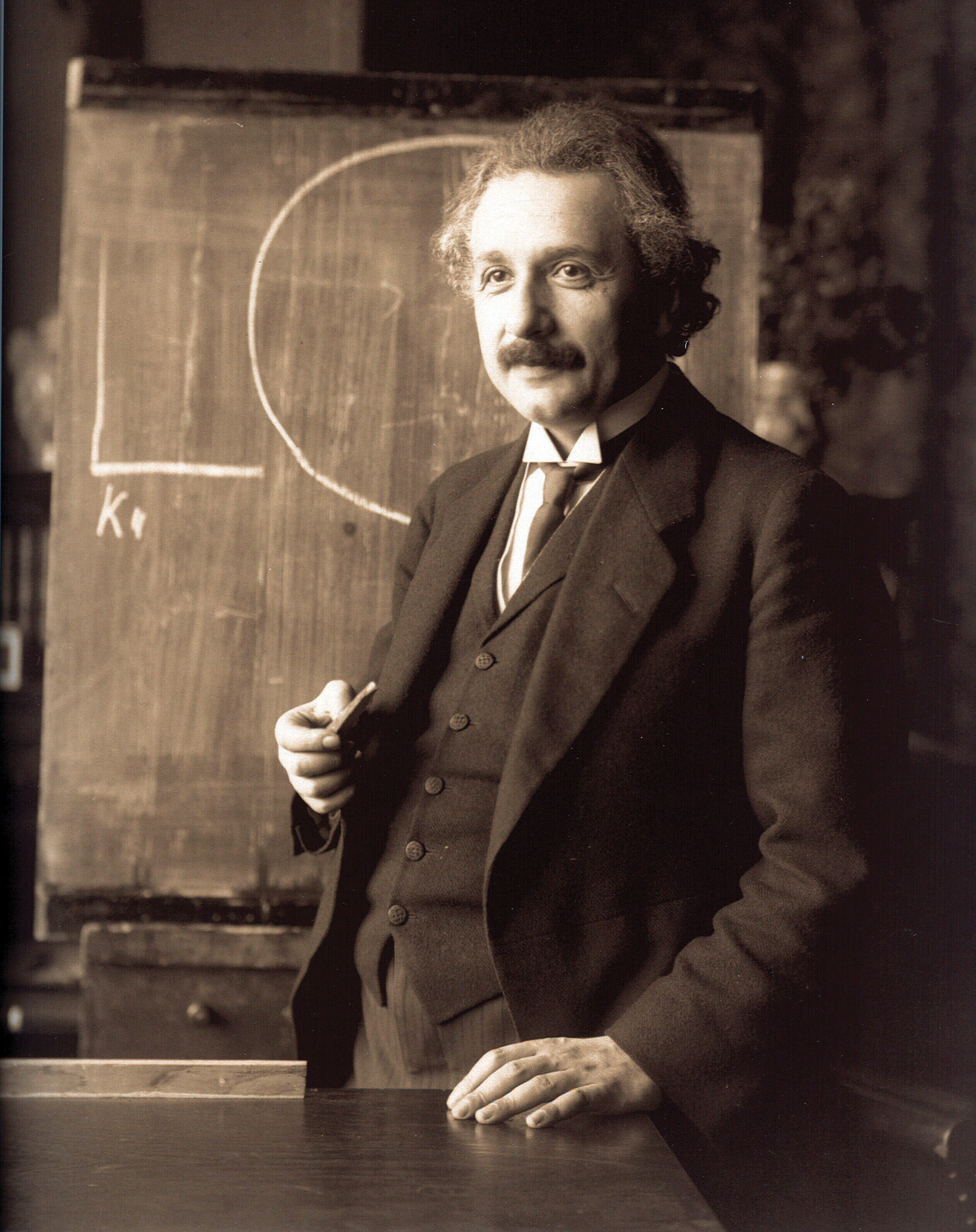
More information
A sepia photograph of a man, Albert Einstein, posing in front of a chalkboard. He wears a black suit and holds a pipe in his right hand.
It took Einstein ten more years to devise his mind-boggling gravitation theory, which he called a general theory of relativity. It built upon his earlier insights while focusing on the role of gravity. Instead of being an invisible force that attracts objects to one another, gravity in Einstein’s view represents a curving or warping of space. The more massive an object, the more gravity it exerts to warp the space around it.
Imagine placing a bowling ball in the center of a trampoline. The heavy ball would press down into the fabric, causing it to dimple. A marble rolled around the edge of the trampoline would spiral inward toward the bowling ball, pulled in much the same way that the gravity of a planet pulls objects toward it. Like the speed of light, this gravitational force also distorts time; for example, clocks run slower in a strong gravitational field than they do in empty space.
Einstein revolutionized notions of time, space, and light. Although only a few scholars understood the details of his theories, many began to embrace the idea that there were no absolute standards or fixed points of reference in the world. During the 1920s, the idea of “relativity” gradually emerged in popular discussions of decidedly nonscientific topics such as sexuality, the arts, and politics; there was less faith in absolutes, not only of time and space but also of truth and morality.
In 1920, the year before Einstein was awarded the Nobel Prize, an American journalist said that the German physicist’s theories had moved physics into the region of “metaphysics, where paradox and magic take the place of solid fact . . . and common sense.” As scientists reached farther out into the universe and probed more deeply into the microscopic world of the atom, traditional certainties dissolved.
MODERNIST ART AND LITERATURE
The scientific breakthroughs associated with Sigmund Freud, Albert Einstein, and others helped to inspire and shape a “modernist” cultural revolution. The horrors of the Great War made romantic views of nature and human nature seem outdated, thereby accelerating and expanding the appeal of modernism. To be modern was to take chances, violate artistic rules and moral restrictions, and behave in deliberately shocking ways. “Art,” said a modernist painter, “is meant to disturb.”
Modernism thrived on three unsettling assumptions: (1) God did not exist; (2) reality was not rational, orderly, or obvious; and (3) in the aftermath of the Great War, social progress could no longer be taken for granted. These premises led writers, artists, musicians, designers, and architects to rebel against former standards of good taste, old-fashioned morals, and old-time religion.
Modernists refused to be conventional. The poet Ezra Pound, a propagandist for the modernist movement, believed that he and other cultural rebels were “saving civilization” from the dictatorship of tradition: “We are restarting civilization.” Pound provided the slogan for modernism when he exclaimed, “Make It New!”
Like many previous cultural movements, modernism involved a new way of seeing the world, led by an intellectual and cultural elite determined to capture and express the hidden realm of imagination and dreams. Doing so, however, often made their writing, art, music, and dance difficult to understand, interpret, or explain. “The pure modernist is merely a snob,” explained a British writer.
But for many modernists, being misunderstood was a badge of honor. American experimentalist writer Gertrude Stein, for example, declared that a novel “which tells about what happens is of no interest.” Instead of depicting real life or telling recognizable stories in books such as Three Lives and Tender Buttons, she was interested in playing with language. Words, not people, are the characters in her writings.
Until the twentieth century, most writers and artists had taken for granted an accessible, identifiable world that could be readily observed, scientifically explained, and accurately represented in words or paint or even music. Modernists, however, applied Einstein’s ideas about relativity to a world in which reality no longer had an objective or recognizable basis. They agreed with Freud that reality was an intensely inward and subjective experience—something deeply personal that was to be imagined and expressed by one’s innermost being. Walter Pach, an early champion of modern art, explained that modernism resulted from the discovery of “the role played by the unconscious in our lives.”
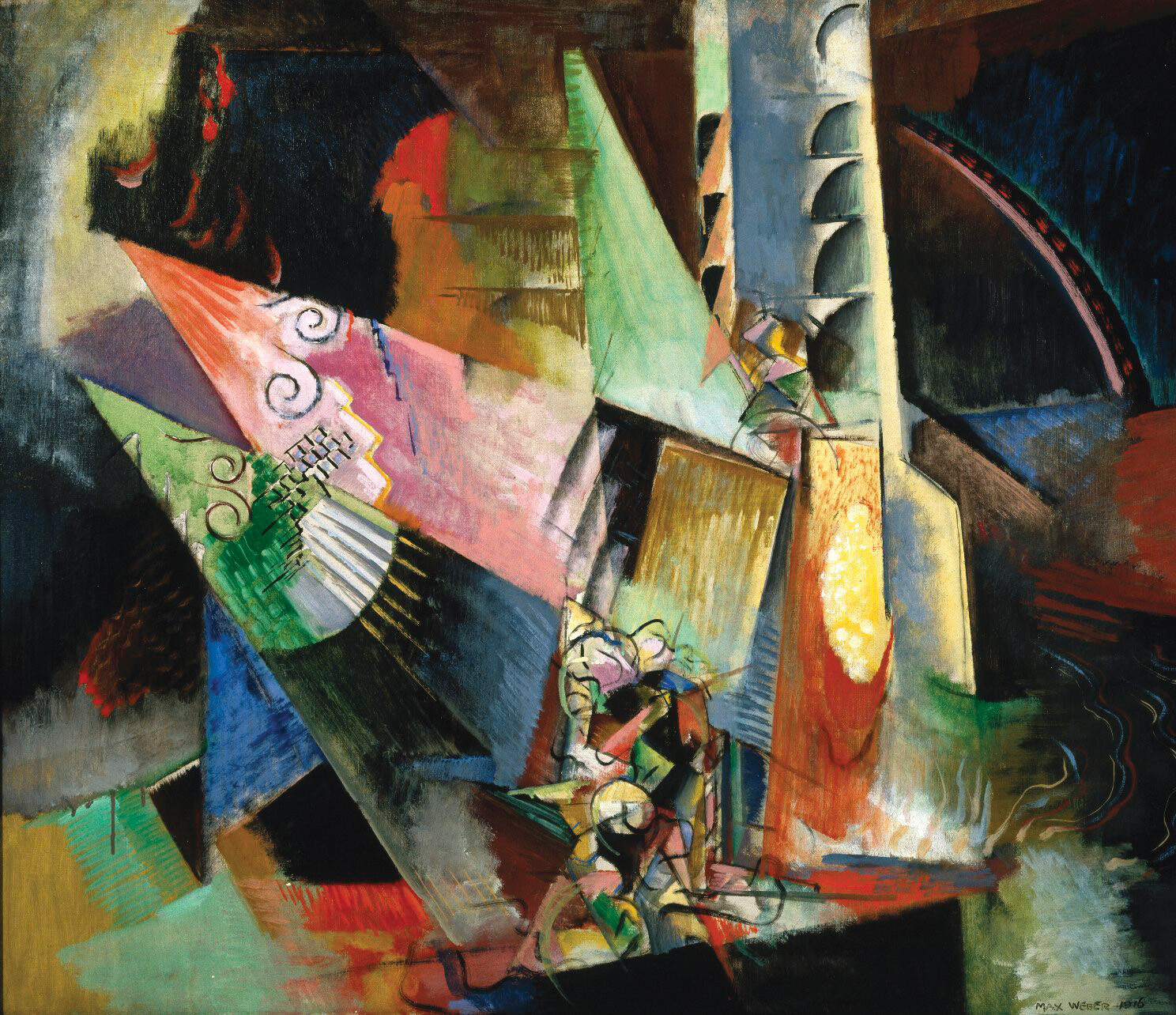
More information
An abstract painting that depicts two ballet dancers on stage. The scene is represented abstractly using overlapping and brightly-colored shapes, including triangular light beams at the top left, rectangular curtains and doorway on the right, and human figures in the center of the painting made of triangles, circles, and quadralaterals.
For modernists such as the Spanish painter Pablo Picasso and the Irish writer James Joyce, art involved an unpredictable journey into the realm of individual fantasies and dreams, exploring and expressing the personal, the unknown, the primitive, the abstract.
In the early-twentieth-century art world, modernists discarded literal representation of recognizable subjects in favor of vibrant color masses, simplified forms, or geometric shapes. American artist Marsden Hartley reported from Paris that his reading of Freud and other “new psychologists” had led him to quit painting objects from “real life” and instead inspired him to paint “intuitive abstractions.”
THE ARMORY SHOW
The efforts to bring European-inspired modernism to the United States reached a climax in the Armory Show of 1913, the most controversial event in the history of American art. Mabel Dodge, one of the organizers, wrote to Gertrude Stein that the exhibition would cause “a riot and revolution and things will never be the same afterwards.”
To house the 1,200 works of modern art collected from more than 300 painters and sculptors in America and Europe, the two dozen young painters who organized the show leased the vast 69th Army Regiment Armory in New York City. The Armory Show, officially known as the International Exhibition of Modern Art, opened on February 17, 1913. As Dodge had predicted, it created an immediate sensation.
For many who toured the Armory Show, modern art became the thing that they loved to hate. Modernism, growled a prominent art critic, “is nothing else than the total destruction of the art of painting.” The New York Times warned visitors who shared the “old belief in reality” that they would enter “a stark region of abstractions” at the “lunatic asylum” show that was “hideous to our unaccustomed eyes.”
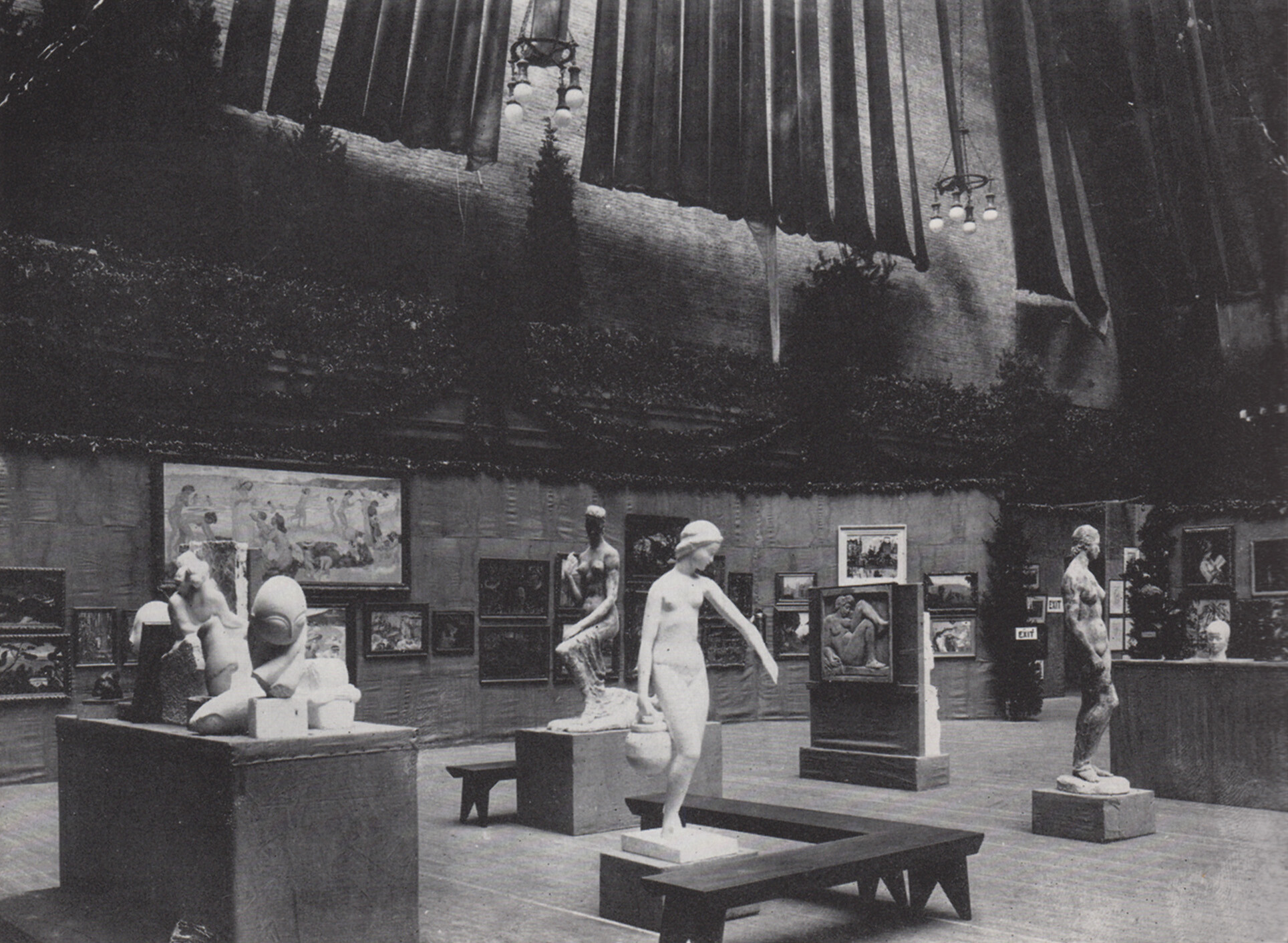
More information
A black-and-white photograph of a large exhibition room with works from the 1913 Armory Show. They include life-sized sculptures of humans, relief sculptures, paintings, and abstract works.
The experimentalist, or avant-garde, artists whose works were on display (including paintings by Vincent Van Gogh, Paul Gaugin, and Henri Matisse as well as Cezanne and Picasso) were “in love with science but not with objective reality,” the Times critic complained. He added that these artists had produced paintings “revolting in their inhumanity.”
Yet the Armory Show also generated excitement. “A new world has arisen before our eyes,” announced an art magazine. “To miss modern art,” a critic stressed, “is to miss one of the few thrills that life holds.” From New York, the show went on to Chicago and Boston, where it aroused similarly strong responses and attracted overflow crowds. A quarter-million people viewed the exhibition in the three cities.
After the Armory Show, modern art became one of the nation’s favorite topics of debate. Many artists, writers, and critics adjusted to the shock of modernism and found a new faith in the disturbing powers of art. “America in its newness,” predicted Walt Kuhn, a painter who helped organize the exhibition, “is destined to become the coming center” of modernism. Indeed, the Museum of Modern Art, founded in New York City in 1929, came to house the world’s most celebrated collection of avant-garde paintings and sculpture.
POUND, ELIOT, AND STEIN
The leading American champions of modernist art and literature lived in England and Europe: Idaho-born Ezra Pound and St. Louis–born T. S. Eliot in London, and the Californian Gertrude Stein in Paris. They wanted to create strange, new, and often beautifully difficult forms of expression, and they found more inspiration and more receptive audiences in Europe than in the United States.
As the foreign editor of the Chicago-based Poetry magazine, Pound became the cultural promoter of modernism. In bitter poems and earnest essays denouncing war and commercialism, he displayed an uncompromising urgency to transform the literary landscape. An English poet called him a “solitary volcano.” Eliot claimed that Pound was single-handedly responsible for the modernist movement in poetry.
Pound recruited, edited, published, and reviewed the best young talents among the modernist writers, improving their writing, bolstering their courage, and propelling their careers. In his own poetry, he expressed the feeling of many that the Great War had wasted a generation of young men who died in defense of a “botched civilization.”
One of the young American writers Pound took under his wing was T. S. Eliot, who had recently graduated from Harvard. Within a few years, Eliot surpassed Pound to become the leading American modernist. Eliot’s epic 433-line poem The Waste Land (1922), which Pound edited, became a monument of modernism. It expressed a sense of postwar disillusionment and melancholy that had a powerful effect on other writers. As a poet and critic for the Criterion, a poetry journal that he founded in 1922, Eliot became the authority on modernist taste in Anglo-American literature.
Gertrude Stein was the self-appointed champion of the American modernists living in Paris. An uninhibited eccentric, she sought to capture in words the equivalent of abstract painting and its revolt against portraying recognizable scenes from real life. Stein also hosted an effervescent cultural salon in Paris that became a gathering place for American and European modernists. On any night, she and her lifelong partner, Alice B. Toklas, might be hosting her “charmed circle” of literary stars and painters—James Joyce, Ernest Hemingway, F. Scott Fitzgerald, Ezra Pound, Henri Matisse, and Pablo Picasso—surrounded by her fabled collection of modern art.
THE “LOST GENERATION”
Modernist art and literature of the 1920s were greatly influenced by the horrors of the Great War. F. Scott Fitzgerald wrote in This Side of Paradise (1920) that the younger generation of Americans, the “sad young men” who had fought in Europe to “make the world safe for democracy,” had “grown up to find all Gods dead, all wars fought, all faiths in man shaken.” Cynicism had displaced idealism in the wake of the war’s brutality and senselessness. As Fitzgerald asserted, “There’s only one lesson to be learned from life anyway. . . . That there’s no lesson to be learned from life.”
Hemingway, Fitzgerald, and other young modernists came to be labeled the Lost Generation—those who had lost faith in the values and institutions of Western civilization and were looking for new gods to worship. In 1921, Gertrude Stein told Hemingway that he and his dissolute friends who had served in the war as soldiers or ambulance drivers “are a lost generation.” When Hemingway objected, she held her ground. “You are [lost]. You have no respect for anything. You drink yourselves to death.”
In his first novel, The Sun Also Rises (1926), Hemingway used the phrase “lost generation” in the book’s opening quotation. The novel centers on Jake Barnes, a young American castrated by a war injury. His impotence leads him to wander the cafes and nightclubs of postwar Europe with his often-drunk friends, who acknowledge that they are all wounded and neutered in their own way. They have lost their innocence, their illusions, and their motivation to do anything with their lives.
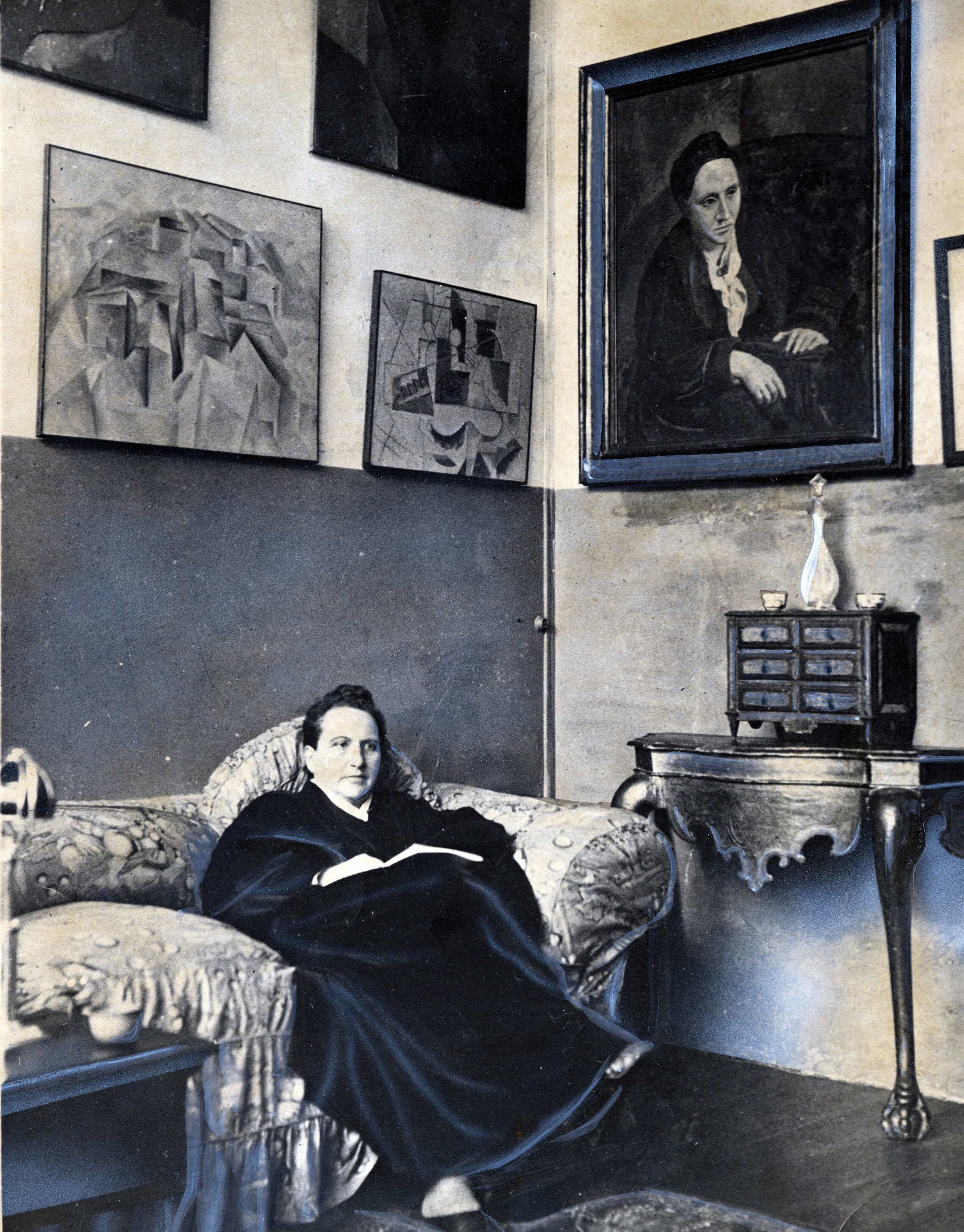
More information
A photograph of a woman, Gertrude Stein, reclining on a couch, which sits in the corner of the room. She looks off into the distance. There are several paintings on the walls above her. There is a side table to her left, with a small chest of drawers and and vase on it.
Hemingway sought “in all my stories to get the feeling of the actual life across—not just to depict life—but to actually make it alive. So that when you have read something by me you actually experience the thing.” In his characteristically unadorned prose, Hemingway conveyed the visceral experience of bullfights in Pamplona, the brutality of war, or the loneliness and disillusionment of modern life.
Hemingway’s friend and rival, Fitzgerald, shared a similar goal. The chronicler of the Lost Generation, Fitzgerald was “our darling, our genius, our fool,” according to a fellow writer. His novels depicted the thirst for life and experience among the “upper tenth” social elite, but also the emptiness of their frivolous lives. Like his fictional characters, Fitzgerald delighted in the heavy-drinking, party-going pace of the Jazz Age, only to see his own bright light snuffed out by drunkenness and his early death.
In 1924, while drafting The Great Gatsby, Fitzgerald announced his intention to “write a novel better than any novel ever written in America.” It chronicled the misfortunes of the fortunate: self-indulgent and self-destructive wealthy people who drank and partied as a means of numbing themselves to the fact that they led pointless, shallow lives.
Jay Gatsby, the main character, is a self-made tycoon with a crooked past who excels at selling con-man illusions. He seduces the wealthy with his gaudy mansion, jazz parties, flashy cars, and mysterious charm. A stylish fraud, Gatsby symbolizes America itself during the 1920s: a nation overflowing with wealth and excess that was hollow at its core.
What gave depth to the best of Fitzgerald’s stories was what a character in The Great Gatsby called “a sense of the fundamental decencies” amid the superficial merriment and fanatical materialism. The stories conveyed a sense of impending doom in a world that had lost its meaning through the disorienting discoveries of modern science and the horrors of war.
The Jazz Age “leaped to a spectacular death,” as Fitzgerald put it, in October 1929 when the stock market collapsed. Six months later, his marriage with Zelda Fitzgerald collapsed as well. Triggered by schizophrenia and punctuated by attempted suicide, Zelda experienced the first of several nervous breakdowns. She and Scott had always drunk heavily and fought viciously, but they now felt the full weight of the “crack up” of their lives, just as the world careened into the Great Depression. The title of Fitzgerald’s early novel, The Beautiful and the Damned, seemed to have predicted it all.
The 1920s, to be sure, roared primarily for a small group of affluent Americans. Yet the modernist spirit—the breaking free from inherited traditions and the celebration of creativity and personal freedom—filtered into the broader culture. As the combination of Einstein’s theory of relativity, Freud’s psychological explorations, and the horrors of the Great War challenged the long-held view of a world governed by reason, modernists sought new and provocative modes of expression channeled through the individual’s consciousness. Their works and behavior often conveyed disillusionment and a loss of faith in traditional values, yet also produced startling, sometimes shocking, works of art and literature.
Glossary
- modernism
- An early twentieth-century cultural movement that rejected traditional notions of reality and adopted radical new forms of artistic expression.