1920S TURBULENCE
How did reactionary conservatism during the 1920s manifest itself in social life and governmental policies?
THE REACTIONARY TWENTIES
For most Americans, the frivolity and excess of the Jazz Age were just something they read about in magazines. They were not disillusioned, self-destructive, or defiantly modernist. Most people still led traditional lives based on established values, old certainties, and the comfort of past routines. For many of them, the decade’s social turmoil and cultural rebelliousness were both shocking and scary.
In national politics, an urban-versus-rural divide stoked fears among those who felt left behind. They feared immigrants plotting revolution, liberal churches embracing the theory of evolution, and young people rejecting traditional notions of moral behavior. These cultural tensions fueled Republican efforts to reverse the progressivism of Theodore Roosevelt and Woodrow Wilson.
By 1920, the progressive political coalition that had reelected Wilson in 1916 was fragmented. Many Americans in the growing middle class left behind earlier preoccupations with reform. Instead, they enjoyed the nation’s economic prosperity, the outcome of increased mass production, mass consumption, and labor-saving electrical appliances.
These Americans traced the seeds of radicalism to cities teeming with immigrants. That was where foreign ideas such as socialism, communism, anarchism, and labor union militancy were taking root. Others feared the erosion of traditional religious beliefs in the face of secular modernism. Many people were convinced that dangers from abroad and at home must be vigorously resisted.
This defense of traditionalism in the 1920s was rooted in a sense of nativism; that is, prejudice against any non-native-born people. In this case, the targets of nativist prejudice were Catholic and Jewish immigrants from southern and eastern Europe. Americans who held these reactionary beliefs felt that only a militant Protestant fundamentalism could restore traditional Christian morality, which was the bedrock, they believed, of all that was truly American.
REACTIONARY POLITICS AND IMMIGRATION RESTRICTION
It was nativism that fueled the Red Scare of 1919, a crackdown on suspected political subversives that led to the arrest of several thousand people and the deportation of some 500 people. Immigration surged once again after the Great War ended, generating a new wave of strongly anti-immigrant sentiment.
Between 1919 and 1924, more than 800,000 Europeans—many of them Italians, Jews, Poles, and Russians—entered the United States. At the same time, some 150,000 Mexicans crossed the American border, most of them settling in the Southwest and California. In the early 1920s, more than half of the White men and a third of the White women working in mines, mills, and factories were immigrants. Most were Catholics or Jews, representing alien faiths for the Protestant majority of Americans. A small minority harbored a passion for socialism or anarchism—and a tinier group still were willing to use violence to achieve their political goals.
White Protestant nativists became convinced that immigrants of this sort were threats to the nation. Racism and fears of an invasion of foreign radicals, especially Communists and anarchists, led Congress to pass the Emergency Immigration Act of 1921, which limited total annual immigration to 150,000 people from outside the Western Hemisphere. More important, it restricted newcomers by “national origin.” The annual quota from each European country was limited to 3 percent of the total number of that nationality represented in the 1910 census.
Three years later, Congress took an even more dramatic step. The Immigration Act of 1924 (the National Origins Act) reduced the number (“quota”) of visas from 3 percent to 2 percent of the total number of people of each nationality in the United States as of the 1890 census. The goal was to lock in place the racial and ethnic balance of the country—maintaining a large White Protestant majority—that had existed almost thirty years earlier, before the massive wave of southern and eastern European immigration at the turn of the twentieth century. The legislation also banned almost all immigrants from Asia and introduced a new category—“illegal alien.”
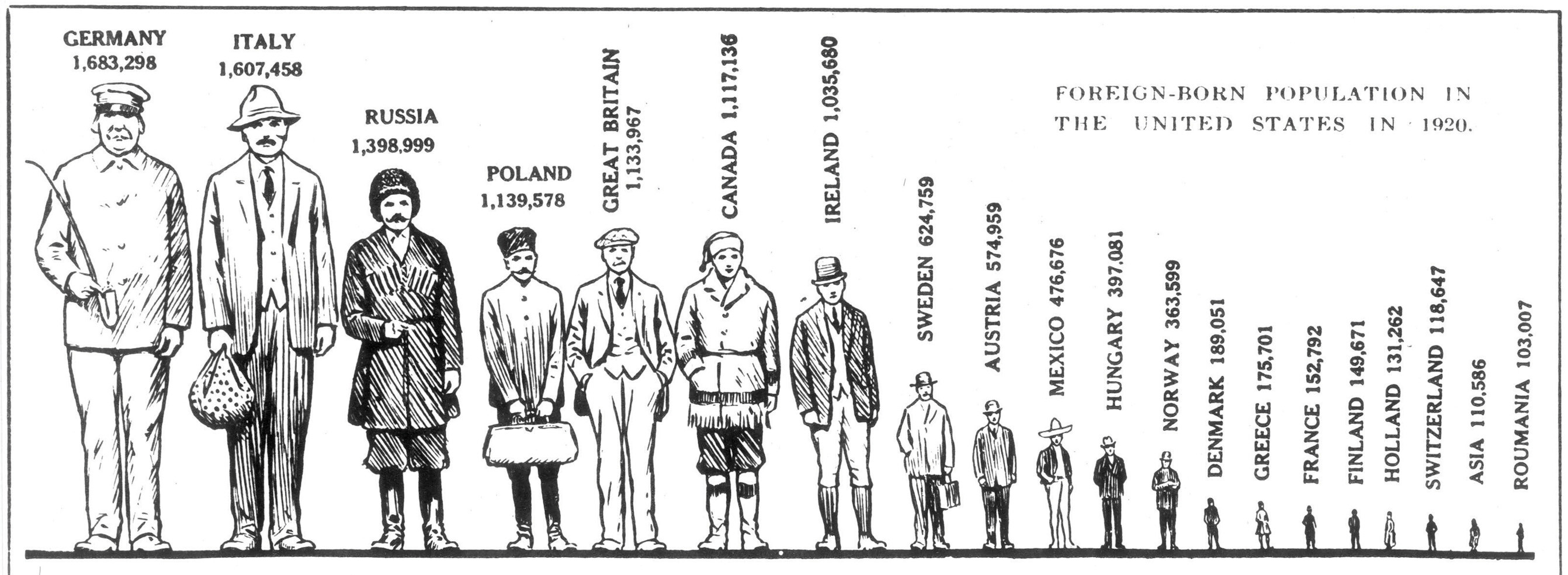
More information
An illustrated chart depicting the foreign-born population in the United States in 1920 as adult men of diminishing size. Figures representing each nationality are in order from tallest to shortest per size of population from largest to smallest. Labels from left to right read, “Germany, 1,683,298; Italy, 1,607,458; Russia, 1,398,999; Poland, 1,139,578; Great Britain, 1,133,967; Canada, 1,117,136; Ireland, 1,035,680; Sweden, 624,759; Austria, 574,959; Mexico, 476,676; Hungary, 397,081; Norway, 363,599; Denmark, 189,051; Greece, 175,701; France, 152,792; Finland, 149, 671; Holland, 131,262; Switzerland, 118,647; Asia, 110,586; Roumania, 103,007.”
The law, in essence, created a hierarchy for determining who should be admitted to the country. Immigrants from northern and western Europe were at the top. Much further down were immigrants from southern and eastern Europe. Asians were at the bottom. Under the quota system, more than 50,000 Germans could enter the nation annually, while fewer than 4,000 Italians were allowed. By comparison, between 1910 and 1920, more than 2 million Italians had entered the country.
The law was openly racist. Congressman Fred S. Purnell of Indiana urged legislators to stop the “stream of irresponsible and broken wreckage that is pouring into the lifeblood of America the social and political diseases of the Old World.” “Shut the door,” urged Senator Ellison D. “Cotton Ed” Smith, a South Carolina Democrat. “Americanize what we have and save the resources of America for the natural increase of our population.”
In contrast, H. L. Mencken, the celebrated columnist for the Baltimore Evening Sun, denounced the Immigration Act for trying “to hobble and cage the citizen of newer [racial] stocks in a hundred fantastic ways.” Immigrants from southern and eastern Europe were being treated as domestic enemies, he charged, even though they were benefiting the nation. “The fact that they increase [in number] is the best hope of civilization in America. They shake the old race out of its spiritual lethargy and introduce it to disquiet and experiment. They make for a free play of ideas.”
Such arguments had no effect on President Calvin Coolidge. “America,” he emphasized, “must be kept American.” He readily signed the immigration restriction bill, which remained in force until 1965. Its impact was immediate.
Interestingly, the Immigration Act of 1924 placed no quota on immigrants from countries in the Americas. Between 1890 and 1920, some 1.5 million Mexicans had entered the United States. Up to that point, they were not required to apply for legal entry. By the 1920s, many employers in the western states had grown dependent on Mexican workers, and they pressured Congress to ensure an adequate supply of low-paid laborers from Mexico, Puerto Rico, and Cuba.
After 1924, however, Latin American immigrants for the first time would be required to have passports and visas before entering the United States. Otherwise, they would be charged as “illegal aliens.” Congress created the U.S. Border Patrol to enforce the new requirements.
An unexpected result of the 1924 Immigration Act was that people of Latin American descent became the nation’s fastest-growing ethnic minority during the 1920s. The number of Mexicans living in Texas increased tenfold between 1900 and 1930 in response to the needs of Texas farmers for “stoop” laborers hired to harvest cotton and other crops. “Cotton picking suits the Mexican,” was the common assertion among Texas growers. Because migrant workers were less likely to have established “roots” in the United States and because they were willing to move with the seasons, farm owners came to prefer them over Black or Anglo tenants and farm laborers.
SACCO AND VANZETTI
The most celebrated criminal case of the 1920s reinforced the connection between European immigrants and political radicalism. On May 5, 1920, two Italian immigrants who described themselves as revolutionary anarchists eager to topple the American government were arrested outside Boston, Massachusetts.
Shoemaker Nicola Sacco and fish peddler Bartolomeo Vanzetti were accused of stealing $16,000 from a shoe factory and killing the paymaster and a guard. Both men carried loaded pistols when arrested, both lied to the police, both were identified by eyewitnesses, and both had flimsy alibis. The stolen money, however, was never found, and several people claimed that they had been with Sacco and Vanzetti far from the scene of the crime when it occurred.
The Sacco and Vanzetti case erupted at the height of Italian immigration to the United States and against the backdrop of numerous terror attacks by anarchists, some of which Sacco and Vanzetti had participated in. The charged atmosphere, called “the Red hysteria” by one journalist, ensured that their trial would be a public spectacle.
In July 1921, Sacco and Vanzetti were convicted and sentenced to death. Their legal appeals lasted six years before they were electrocuted on August 23, 1927, still claiming innocence. To millions around the world, Sacco and Vanzetti were victims of capitalist injustice. People still debate their guilt.
THE SECOND KLAN
The most violent of the reactionary movements during the 1920s was a revived Ku Klux Klan. The infamous post–Civil War group of White racists was reborn in 1915. The first Klan had been a largely southern phenomenon that targeted Black southerners and their White Republican supporters. The second Klan combined anti-Black racism with the widespread nativist sentiment of the era, making it a national movement. At its peak in 1924, the Klan numbered more than 4 million members, making it the largest far-right movement in American history. Its decline was even more dramatic than its rise, however, as many of the organizers turned out to be con men and as anti-Klan movements gained momentum.
An unexpected spur for the Klan’s rebirth was the enormously popular film The Birth of a Nation, which premiered in 1915. Produced and directed by D. W. Griffith, the movie was Hollywood’s first blockbuster. At a time when most movies ran about ten minutes, Birth of a Nation was three hours long and was the first film to utilize a publicity campaign. Griffith was determined to turn the movies into high art. The son of a Confederate army officer, he chose the subject of Reconstruction for his first epic film. He based the story on a novel, The Clansman: An Historical Romance of the Ku Klux Klan (1905), written by Thomas Dixon, a Princeton classmate of Woodrow Wilson. President Wilson hosted a special showing of the film at the White House and was reported to have said, “It is like writing history with lightning. And my only regret is that it is all so terribly true.”
The Birth of a Nation rewrote southern history, portraying Klansmen as crusading heroes and newly freed slaves as working with unprincipled carpetbaggers and scalawags (see Chapter 15) to corrupt state governments. In Atlanta, Georgia, William J. Simmons, a traveling salesman who had become a Methodist preacher, was so inspired by the film that he determined to reestablish the Klan. Utilizing the same techniques of modern advertising that fueled the rise of mass consumption, Griffith quickly found an eager following.
A Nationwide Organization.
This second Ku Klux Klan was, by 1920, a nationwide organization devoted to “the maintenance of White Supremacy” and “100 percent Americanism.” Only “natives”—meaning white, “Anglo-Saxon,” evangelical Protestants born in the United States—could be members. (It is no coincidence that 1924 was the same year in which numerous states erected memorial statues celebrating Confederate generals such as Robert E. Lee.)
Shrouded in secrecy and costumed in White sheets and tall, pointed hats, the Klan was both unusual and mainstream, sponsoring baseball teams, college fraternities, and county fairs. It even hosted beauty pageants in which young women competed to be “Miss 100 Percent America.” The new Klan included a women’s auxiliary group called the Kemellia, and whole families attended Klan gatherings, “klasping” hands while listening to inflammatory speeches, watching fireworks, and burning crosses. Most Klan members were small farmers, sharecroppers, or wage workers; but the organization also attracted clergymen, engineers, doctors, lawyers, accountants, business leaders, teachers, judges, mayors, sheriffs, state legislators, six governors, and three U.S. senators.
Klan leader Hiram Wesley Evans explained that the organization embodied “an idea, a faith, a purpose, an organized crusade” against “that which is corrupting and destroying the best in American life.” The Klan embraced militant patriotism, restrictions on immigration and voting, and strict personal morality. It opposed illegal (“bootleg”) liquor and labor unions; and it preached hatred against African Americans, Roman Catholics, Jews, immigrants, Communists, atheists, prostitutes, and adulterers.
Targeted Groups and Political Collaborators.
The Klan became infamous for its blanket assaults on various categories of Americans. As one member stressed, “Every criminal, every gambler, every thug . . . every wife beater . . . every moonshiner, every crooked politician . . . is fighting the Klan.” The United States was no melting pot, shouted William Simmons: “It is a garbage can! . . . When the hordes of aliens walk to the ballot box and their votes outnumber yours, then that alien horde has got you by the throat.”
In the Southwest, Klansmen directed their anger at Mexicans; in the Pacific Northwest, people of Japanese ancestry were the enemy; in New York, the targets were primarily Jews and Catholics. Klan members were elected governor in Oregon, Texas, and Colorado; others were mayors in Portland, Oregon, and Portland, Maine.
In Texas, Klan members used harassment, intimidation (often in the form of burning crosses), and beatings to—as they saw it—“discipline” alcoholics, gamblers, adulterers, and other sinners. In the spring of 1922 alone, the Dallas Klan flogged sixty-eight men.
The reborn Klan, headquartered in Atlanta and calling itself the Invisible Empire, grew rapidly, especially in the rural Midwest. During the 1920s, fully 40 percent of its “Anglo-Saxon” members were in three midwestern states: Illinois, Indiana, and Ohio. Only 16 percent of registered Klansmen were in the former Confederate states. Recruiters, called Kleagles, were told to “play upon whatever prejudices were most acute in a particular area.”
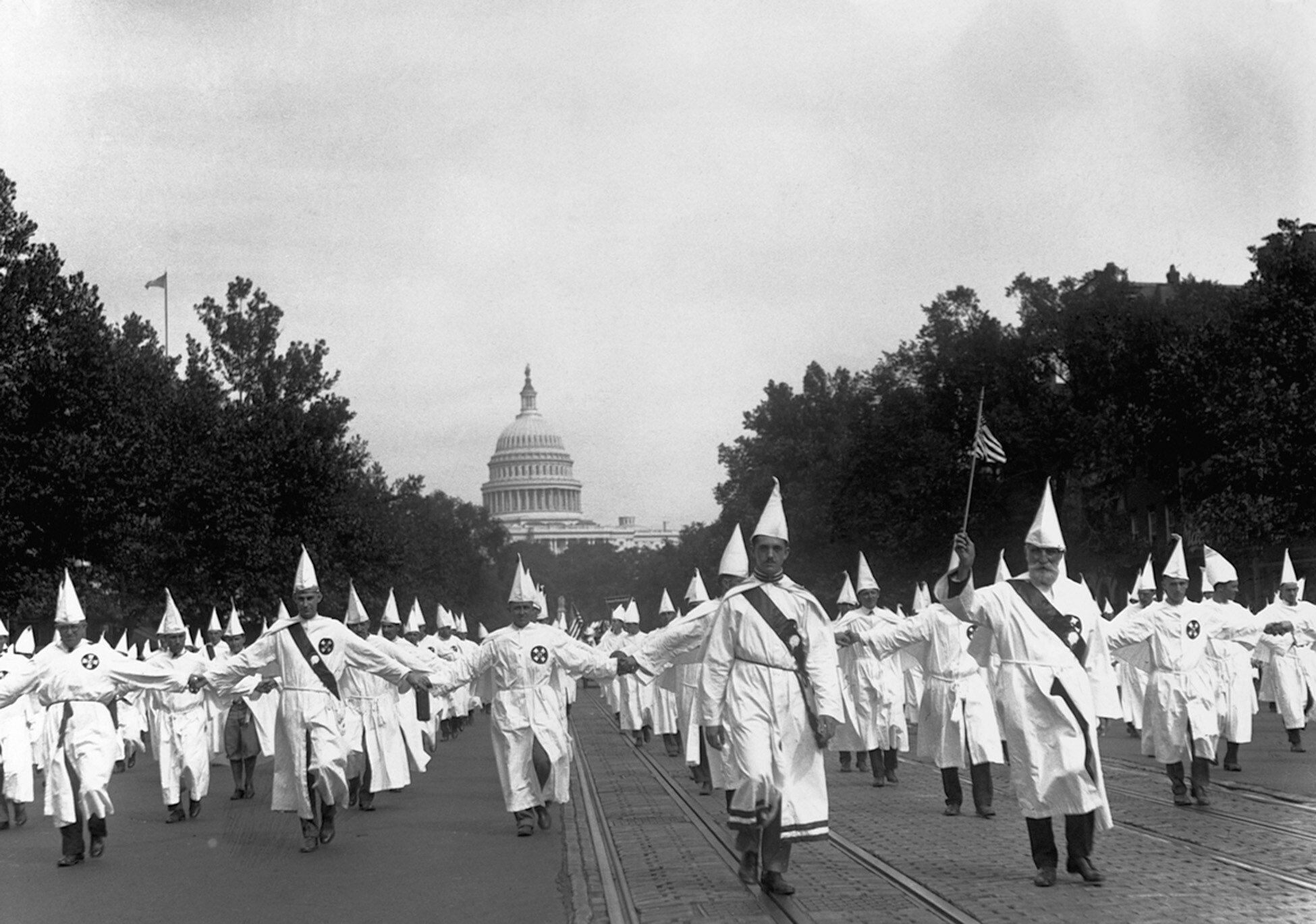
More information
A black-and-white photograph of Ku Klux Klan members marching down the street. Rows of Klan members dressed in white robes and pointed hats walk down the street hand-in-hand with the United States Capitol dome in the background. One man at the front of the group holds up a small American flag on stick.
African Americans grew increasingly concerned about Klan violence. The Chicago Defender, the African American newspaper with the widest circulation in the nation, urged its readers to fight back against Klansmen trying to “win what their fathers [in the Civil War] lost by fire and sword.”
The Grand Dragon of Indiana, a con man named David C. Stephenson, grew so influential in electing local and state officials (the “kluxing” of America, as he called it) that he boasted, “I am the law in Indiana!” Klan-endorsed candidates won the Indiana governorship and controlled the state legislature.
At the 1924 Indiana Republican State Convention, Stephenson patrolled the aisles with a pistol and later admitted that he “purchased the county and state officials.” Stephenson, who had grown wealthy by skimming from the dues he collected from Klan members as well as selling robes and hoods, planned to run for president of the United States.
Waning Influence.
In August 1925, some 25,000 Klansmen paraded down Pennsylvania Avenue in the nation’s capital, dressed in their white-hooded regalia. But the Klan’s influence, both in Indiana and nationwide, crumbled after Stephenson was sentenced to life in prison in 1925 for kidnapping and raping a twenty-eight-year-old woman who then committed suicide. Stephenson assumed the governor would pardon him. When that did not happen, he told police about the widespread political bribery he had engaged in. As a result, the governor, the Indianapolis mayor, the county sheriff, numerous congressmen, and other officeholders were indicted. Many ended up in prison.
News of the scandal caused Klan membership to tumble. More than a dozen Klan offices and meeting places across the country were bombed, burned, or blasted by shotguns. At the same time, several states passed anti-Klan laws and others banned the wearing of masks. By 1930, nationwide membership had dwindled to 100,000—mostly southerners. Yet the bigoted impulse underlying the Klan lived on, fed by deep-seated fears and hatreds.
FUNDAMENTALISM
While the Klan saw a threat mainly in the “alien menace,” many defenders of “old-time religion” felt threatened by ideas circulating in what were considered to be progressive Protestant churches. Especially troubling to these traditionalists were the ideas that the Bible should be studied in the light of modern scholarship or that it should accommodate Darwinian theories of biological evolution. In response to such so-called “modern” notions, a group of conservative Protestants published a series of pamphlets titled The Fundamentals that laid out the critique of theological modernism. The pamphlets sparked a term and a movement, fundamentalism, that insisted on the literal truth of the Bible, embraced a strict return to Christian orthodoxy, and was deeply skeptical of “liberal” beliefs of all sorts. While most American Christians fell somewhere between the poles of modernism and fundamentalism, the debate between the two became a front line in the cultural wars of the 1920s.
Despite the movement’s emphasis on returning to traditional ways, the most beloved and influential fundamentalist preacher of the 1920s was a woman, Aimee Semple McPherson, who founded a religious empire in Los Angeles that she ruled over until her death in 1944. McPherson’s fame as a defender of old-time religion rested in part on her ability to take advantage of many of the innovations of the modern consumer age.
Born in Canada in 1890, McPherson attended a tent revival when she was seventeen years old and fell under the sway of a Pentecostal missionary from Ireland, whom she married not long after. Her husband died of malaria while the couple served as missionaries in China, but his Pentecostal faith—with its charismatic forms of worship, including speaking in tongues—marked McPherson for the rest of her life.
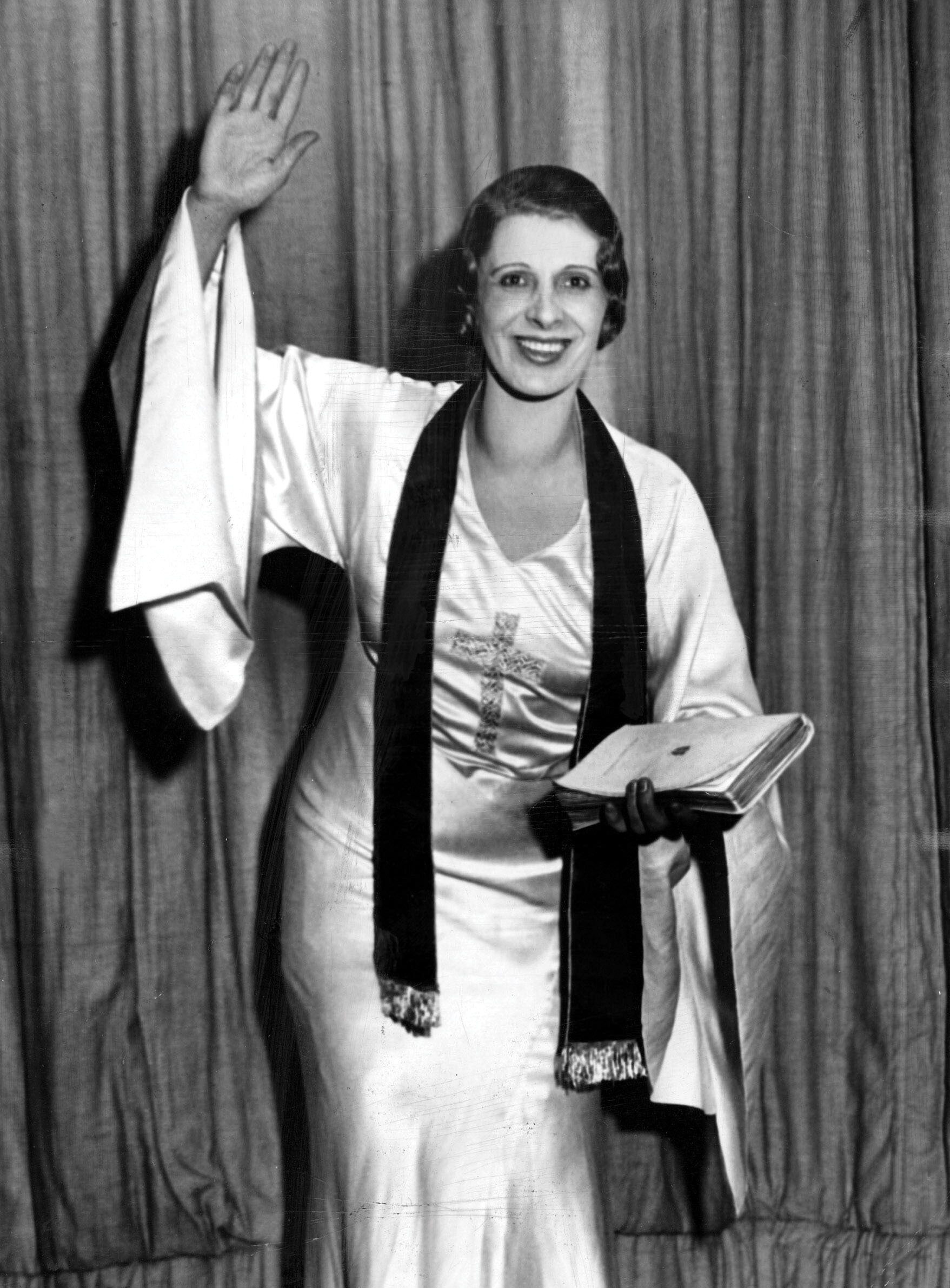
More information
A black-and-white photograph of Sister Aimee Semple McPherson standing in front of a dark grey curtain. She wears a long white dress with a cross embroidered on the chest and has a black scarf draped around her neck. She holds a book in her left hand and waves with her right hand.
McPherson soon remarried and became a well-known itinerant preacher and faith healer. By 1920, she heard a call from God to establish a temple in Los Angeles. The next year, construction started on the Angelus Temple; with a seating capacity of five thousand, it was one of the largest churches in the country. It became home to the Church of the Foursquare Gospel. By 1924, between thirty and fifty thousand people attended the church’s multiple weekly services. They often included elaborate religious dramas unfolding on stages that mimicked Hollywood movie sets.
Taking advantage of the new technology of radio, McPherson established one of the first Christian broadcasting stations. She delivered daily sermons to audiences of thousands, with listeners as far away as Australia. McPherson eventually founded a Bible college to train ministers.
Like many fundamentalist ministers, McPherson railed against the forces that were seen as destructive to traditional Christian faith—chief among them recent scientific teachings that denied the existence of God. In the summer of 1925, McPherson sent a telegram to her friend and fellow fundamentalist William Jennings Bryan, the former Democratic congressman, secretary of state, and three-time presidential candidate. Bryan was in the midst of a campaign against Darwinian theories of evolution, which would become one of the most famous cultural clashes of the 1920s.
McPherson praised Bryan for his “lion hearted championship of the Bible against evolution,” reminding him that “ten thousand members of Angelus Temple” and “millions of radio church membership” were with him. Bryan was convinced that “all the ills from which America suffers can be traced back to the teaching of evolution.”
THE SCOPES TRIAL
In 1925, the Tennessee state legislature had outlawed the teaching of evolution in public schools and colleges. Enterprising civic leaders in the tiny mining town of Dayton, Tennessee, eager for publicity, persuaded John T. Scopes, a twenty-four-year-old high-school science teacher, to become a test case against the new law. Scopes taught his students from a textbook on Darwinian evolution, and police promptly arrested him for doing so. The town boosters succeeded beyond their wildest hopes: the Scopes Trial received worldwide publicity—but it was not flattering to Dayton.
Before the start of the twelve-day “monkey trial” (a reference to the scientific theory that humans evolved from apes and monkeys) on July 10, 1925, the narrow streets of Dayton swarmed with evangelists, atheists, hot-dog and soda-pop peddlers, and hundreds of newspaper and radio reporters. A man tattooed with Bible verses preached on a street corner while a live monkey was paraded about town.
The stars of the show pitting science against fundamentalism were both national celebrities. William Jennings Bryan, who believed in the literal biblical account that the world was created by God in six days, volunteered his services to the prosecution. Clarence Darrow, the nation’s most well-known trial lawyer, famous for defending controversial causes, offered to defend Scopes and the theory of evolution.
Temperatures surpassed 100 degrees as the trial began. Bryan insisted that the trial was not about Scopes but about a state’s right to determine what was taught in the public schools, and he announced that the “contest between evolution and Christianity is a duel to the death.” Darrow countered: “Scopes is not on trial. Civilization is on trial.” His goal was to prevent “bigots and ignoramuses from controlling the education of the United States” by proving that America was “founded on liberty and not on narrow, mean, intolerable and brainless prejudice of soulless religio-maniacs.”
On July 20, the seventh day of the trial, the defense called Bryan as an expert witness on biblical interpretation. Darrow began by asking him about biblical stories. Did he believe that Jonah was swallowed by a whale and that Joshua made the sun stand still? Yes, Bryan replied, as beads of sweat streamed down his face; all things are possible with God. Darrow pressed on relentlessly. What about the great flood and Noah’s ark? Was Eve really created from Adam’s rib? Bryan hesitated, and the crowd grew uneasy as the hero of fundamentalism crumpled in the heat. Bryan appealed to the judge, claiming that the Bible was not on trial, only to have Darrow yell: “I am examining you on your fool ideas that no intelligent Christian on earth believes.” A humiliated Bryan claimed that Darrow was insulting Christians. Darrow, his thumbs clasping his colorful suspenders, shot back: “You insult every man of science and learning in the world because he does not believe in your fool religion.” At one point, the men lunged at each other, prompting the judge to adjourn court for the day.
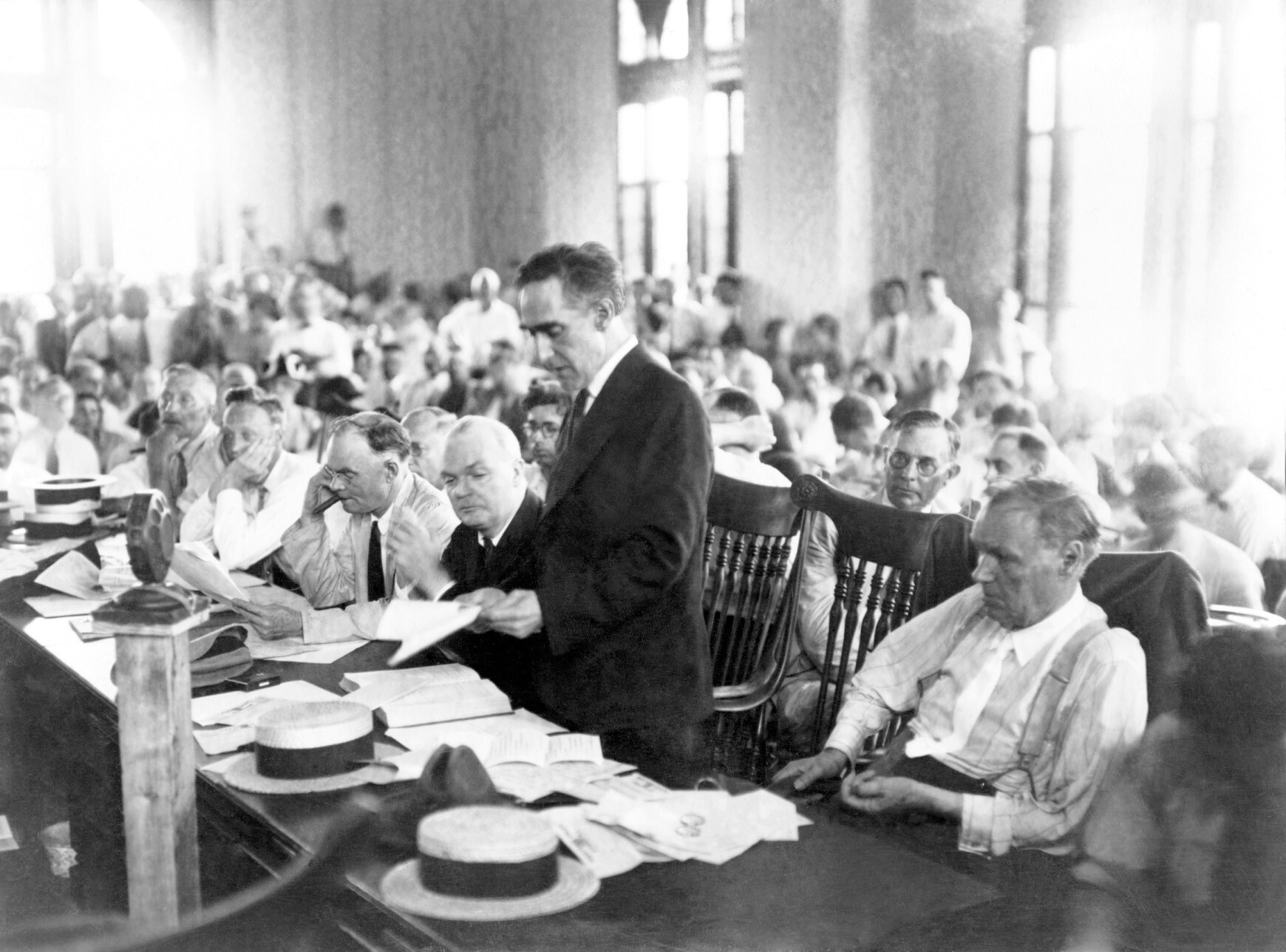
More information
A black-and-white photograph of a courtroom filled with people. Several men sit behind tables. The tables are covered with papers, books, and the men’s hats. On the far left, the defendant clasps his face in his hands. His lawyer stands in the center. He wears a black suit and looks at papers he holds in his hands. On the right, a man slouches in his chair. He wears a white shirt that has been soaked through with sweat.
As the trial ended, the judge ruled that the only issue before the jury was whether John T. Scopes had taught evolution, and no one had denied that he had done so. Eager to get on with their lives and get the peach harvest in, the jurors did not even sit down before deciding that Scopes was guilty. But the Tennessee Supreme Court, while upholding the anti-evolution law, waived Scopes’s $100 fine on a technicality. Both sides claimed victory.
Five days after the trial ended, William Jennings Bryan died of a heart condition aggravated by heat and fatigue. Scopes left Dayton to study geology at the University of Chicago; he became a petroleum engineer. Meanwhile, the Scopes Trial only sharpened the national debate between fundamentalism and evolution that continues today.
PROHIBITION
William Jennings Bryan died knowing that one of his other religious crusades had succeeded: alcoholic beverages had been outlawed nationwide. The movement to prohibit beer, wine, and liquor forged an unusual alliance between rural and small-town Protestants and urban political progressives—between believers in old-time religion who considered drinking sinful, and social reformers, mostly women, who were convinced that Prohibition would reduce divorces, prostitution, spousal abuse, and other alcohol-related violence. “There would not be any social evil,” insisted Ella Boole of the Women’s Christian Temperance Union, “if there was no saloon evil.”
It is easy, in retrospect, to dismiss temperance advocates as intrusive moralists; but in an era before federal welfare protections and medical understandings of addiction, the campaign against alcohol was often the most direct way to advocate for the well-being of women and children. Elizabeth Tilton, a Bostonian active in efforts to ban alcohol, claimed that alcohol was “directly and indirectly responsible for 42 percent of broken homes, 45 percent of children cruelly deserted, 50 percent of crime, 25 percent of our poverty, not to mention feeble mindedness and insanity.”
What connected the two groups to each other and to nativist movements were the ethnic and social prejudices that many members shared. The head of the Anti-Saloon League, for example, declared that German Americans “eat like gluttons and drink like swine.” For many anti-alcohol crusaders, in fact, the primary goal of Prohibition seemed to be policing the behavior of the foreign-born, the working class, the poor, and Blacks.
During the Great War, both houses of Congress had responded to the efforts of the Anti-Saloon League and the Women’s Christian Temperance Union. The wartime need to use grain for food rather than for making liquor, combined with a grassroots backlash against beer brewers because so many had German backgrounds, transformed the cause of Prohibition into a virtual test of American patriotism. On December 18, 1917, Congress sent to the states the Eighteenth Amendment. Ratified on January 16, 1919, it banned “the manufacture, sale, and transportation of intoxicating liquors,” effective one year later.
Prohibition was thus the law during the 1920s—but it was not widely followed. As the most ambitious social reform ever attempted in the United States, it proved to be a colossal and costly failure. It was too sweeping for the government to enforce and too frustrating for most Americans to respect, and it had many unforeseen consequences.
The loss of liquor taxes, for example, cost the federal government almost 30 percent of its annual revenue. The closing of breweries, distilleries, and saloons eliminated thousands of jobs. Even more consequential was the huge number of Americans who broke the law and the enormous boost that Prohibition gave to police corruption and to organized crime.
The Volstead Act (1919), which outlined the rules and regulations needed to enforce the Eighteenth Amendment, had so many loopholes that it guaranteed failure. For example, the law allowed individuals and organizations to keep and use any liquor owned on January 16, 1919, when the amendment was officially ratified. Not surprisingly, people stocked up before the law took effect. The Yale Club in Manhattan, for example, stored enough liquor to supply itself for the entire thirteen years that Prohibition was enforced.
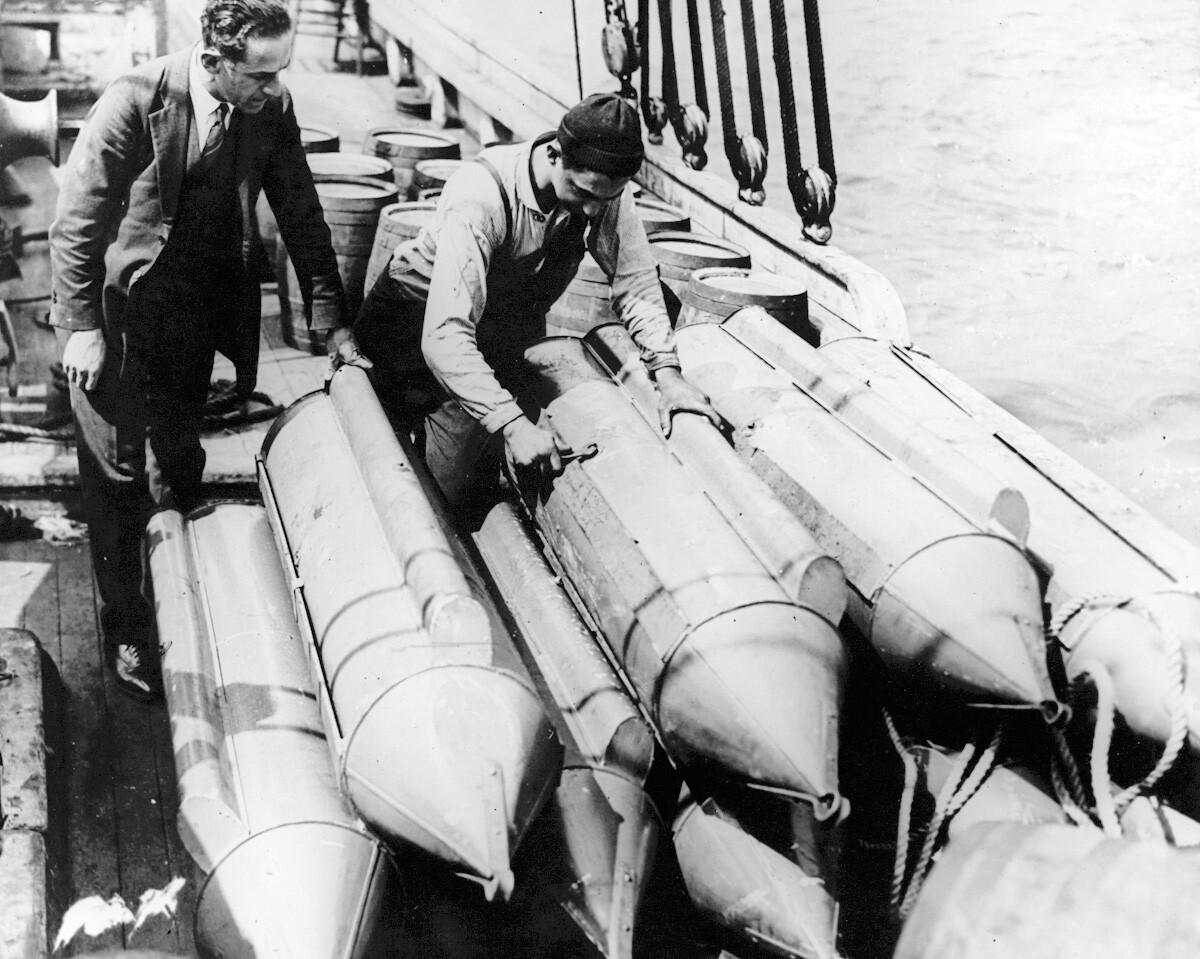
More information
A black-and-white photograph of two men standing on a boat near a stacked pile of torpedoes. The man on the left wears a suit and tie. The man on the right wears suspenders and a beanie hat. He uses a tool to pry open a torpedo.
Thousands of people set up home breweries, producing 700 million gallons of beer in 1929 alone. Wine was made just as easily, and “bathtub gin” was the simplest of all, requiring little more than a one-gallon still and some fruit, grain, or potatoes. Two thirds of illegal liquor came from Canada, with most of the rest from Mexico or overseas. Yet this bootleg alcohol became notoriously dangerous. Tens of thousands were killed or disabled by overconsumption of dangerously strong batches of illegal liquor, whose alcohol content usually exceeded that in wine and beer.
Many of the activities associated with the Roaring Twenties were fueled by bootleg liquor supplied by organized crime and sold in illegal saloons called speakeasies, which were often ignored by local police corrupted by bribes. New York City’s police commissioner estimated that there were 32,000 speakeasies in the city in 1929, compared with 15,000 saloons in 1919. Popular singer Bessie Smith openly proclaimed, “Any bootlegger sure is a pal of mine.”
President Warren G. Harding and members of Congress displayed the hypocrisies associated with Prohibition. While the president was lambasting the “national scandal” of noncompliance with Prohibition, he regularly drank and served bootleg liquor in the White House, explaining that he was “unable to see this as a great moral issue.”
Congress never supplied adequate funding to implement the Volstead Act. The Prohibition Unit, a new agency within the U.S. Treasury Department, had 3,000 employees to police the nation—five times the number at the new Federal Bureau of Investigation. Yet their numbers were not nearly enough to enforce Prohibition. New York’s mayor said it would require 250,000 police officers in his city alone. In working-class and ethnic-rich Detroit, the bootleg industry was second in size only to the auto industry. In Virginia, jails could not contain the 20,000 Prohibition-related arrests each year.
The efforts to defy Prohibition generated widespread police corruption and boosted organized crime. Well-organized crime syndicates controlled the entire stream of liquor’s production, pricing, distribution, and sales. As a result, the Prohibition era was a thirteen-year orgy of unparalleled criminal activity. By 1930, more than one third of federal prisoners were Prohibition violators.
Although total alcohol consumption did decrease during the 1920s, as did the number of deaths from alcohol abuse, in many cities drinking actually increased during Prohibition.
Al Capone and Organized Crime.
In addition to drawing some Americans into criminal activity, prohibition supplied organized crime with a source of enormous new income. The most ruthless Prohibition-era gangster was Alphonse Gabriel “Al” Capone. Born in Brooklyn in 1899, the son of Italian immigrants, he was expelled from school for hitting a female teacher. Capone then aligned himself with organized crime gangs. During a fight at a brothel, he suffered a knife wound on his cheek that gave him his lifelong nickname: “Scarface.”
Capone moved to Chicago and worked his way up in the city’s most notorious organized crime family. By age twenty-six, he was in charge. In 1927, his Chicago-based bootlegging, prostitution, and gambling empire involved 700 gangsters, extended from Canada to Florida, and brought in $60 million a year (over $1 billion in today’s dollars), much of which he spent bribing police officials, judges, and politicians.
Capone loved flashy clothes, gaudy jewelry, and expensive cars yet fancied himself a modern Robin Hood, a friend of the poor and jobless, dispensing wads of cash to soup kitchens throughout Chicago. Capone frequently insisted that he was merely giving the public the goods and services it demanded.
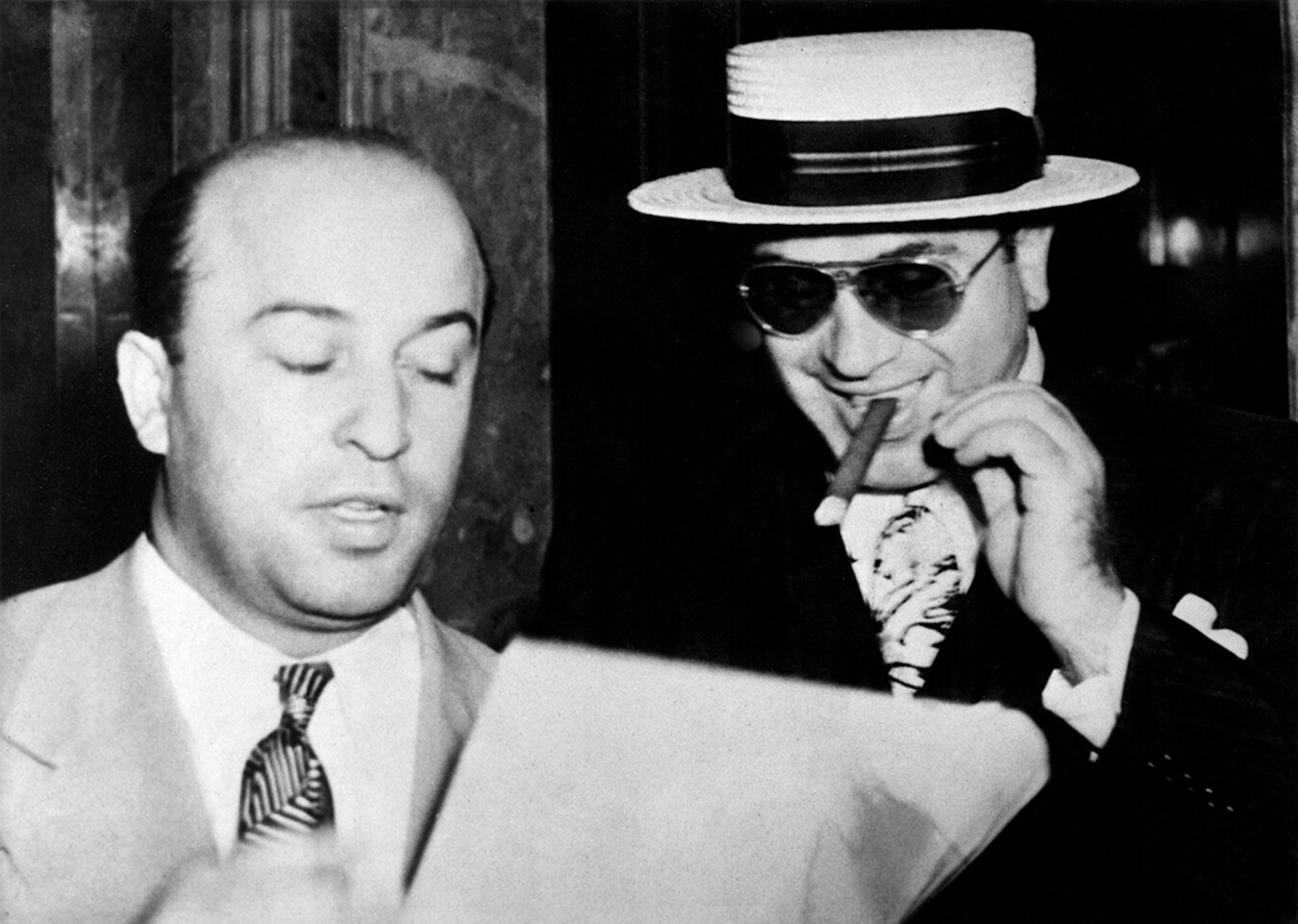
More information
A black-and-white candid photograph of two men wearing suits. The man on the left is balding and points to a piece of paper he holds in his hand. The man on the right, Al Capone, wears a boater hat and dark sunglasses, and grins as he looks at the paper, holding a cigar between his teeth.
Yet he was also ruthless. When he learned that two of his henchmen were planning to turn him in to the police, Capone invited them to dinner and then bludgeoned them to death with a baseball bat. He ordered the execution of dozens of rival criminals.
Capone’s Mafia empire grew so large that he attracted the attention of President Herbert Hoover, who in March 1929 asked Andrew Mellon, his treasury secretary, “Have you got this fellow Capone yet? I want that man in jail.” Mellon decided that the best hope for prosecuting the notorious mobster was to prove that he never paid taxes on his ill-gotten gains.
Federal law-enforcement officials, led by a dynamic agent named Eliot Ness, smashed Capone’s bootlegging operations in 1929. Soon thereafter, Ness, having refused bribes from Capone, charged the crime boss with tax evasion. Tried and found guilty in 1931, Capone spent most of the next thirteen years in federal prison. Bankrupt and helpless, he died in 1947 of degenerative syphilis contracted years before in one of his own brothels.
Capone’s criminal activities had been propelled by effects of Prohibition, one of many movements that sought to uphold traditional American culture in the midst of rapid change. In social life and government policies, a resurgence of nativism led to anti-immigrant legislation and the revival of the Ku Klux Klan, which briefly enjoyed significant political influence and nationwide membership. Meanwhile, religious fundamentalists campaigned against the teaching of evolution in public schools and also supported the prohibition of alcoholic beverages. This conservative trend was evidence that not all Americans at this time wanted to challenge convention.
Glossary
- nativism
- A reactionary conservative movement characterized by heightened nationalism, anti-immigrant sentiment, and laws setting stricter regulations on immigration.
- Immigration Act of 1924
- Federal legislation intended to favor northern and western European immigrants over those from southern and eastern Europe by restricting the number of immigrants from any one European country to 2 percent of the total number of immigrants per year, with an overall limit of slightly over 150,000 new arrivals per year.
- Sacco and Vanzetti case (1921)
- The trial of two Italian immigrants that occurred at the height of Italian immigration and against the backdrop of numerous terror attacks by anarchists; despite a lack of clear evidence, the two defendants, both self-professed anarchists, were convicted of murder and were executed.
- fundamentalism
- A movement in American Christianity that began in the early twentieth century in opposition to theological liberalism. Its followers believed in the literal truth of the Bible and embraced a return to strict Christian orthodoxy.
- Scopes Trial (1925)
- The highly publicized trial of a high-school teacher in Tennessee for violating a state law that prohibited the teaching of evolution; the trial was seen as the climax of the fundamentalist war on Darwinism.
- Prohibition (1920–1933)
- A national ban on the manufacture and sale of alcohol, although the law was widely violated and proved too difficult to enforce effectively.