THE SOCIETIES AND ECONOMIES OF THE COLONIES
What were the differences and similarities among the societies and economies of the southern, New England, and middle colonies? What was the role of indentured servants, enslaved Indigenous people, and enslaved Africans?
SOCIETY AND ECONOMY IN THE COLONIES
The British American colonies were part of a complex North Atlantic commercial network. Companies, merchants, and farmers traded sugar, wheat, tobacco, rum, rice, and many other commodities, including enslaved Africans and Native Americans, with Great Britain and its highly profitable island colonies in the West Indies—Bermuda, Barbados, and Jamaica. In addition, American merchants traded (smuggled) with Spain, France, Portugal, Holland, and their colonies, which were often at war with Britain and therefore officially off limits. Out of necessity, the colonists were dependent on Britain and Europe for manufactured goods and luxury items such as wine, glass, and jewelry.
The early British American colonies’ participation in this extensive trade network required a steady output of products to sustain their role in the commercial exchanges. Reflecting the differences among the colonies, environmental, social, and economic factors contributed to the diversity of commodities they were able to trade. So did the availability of labor.
INDENTURED SERVITUDE AND INDIGENOUS SLAVERY
During the seventeenth century, the English colonies grew so fast that they needed many more workers than there were settlers. They also required workers to support their participation in expanding trade networks.
INDENTURED SERVANTS
INDENTURED SERVITUDE
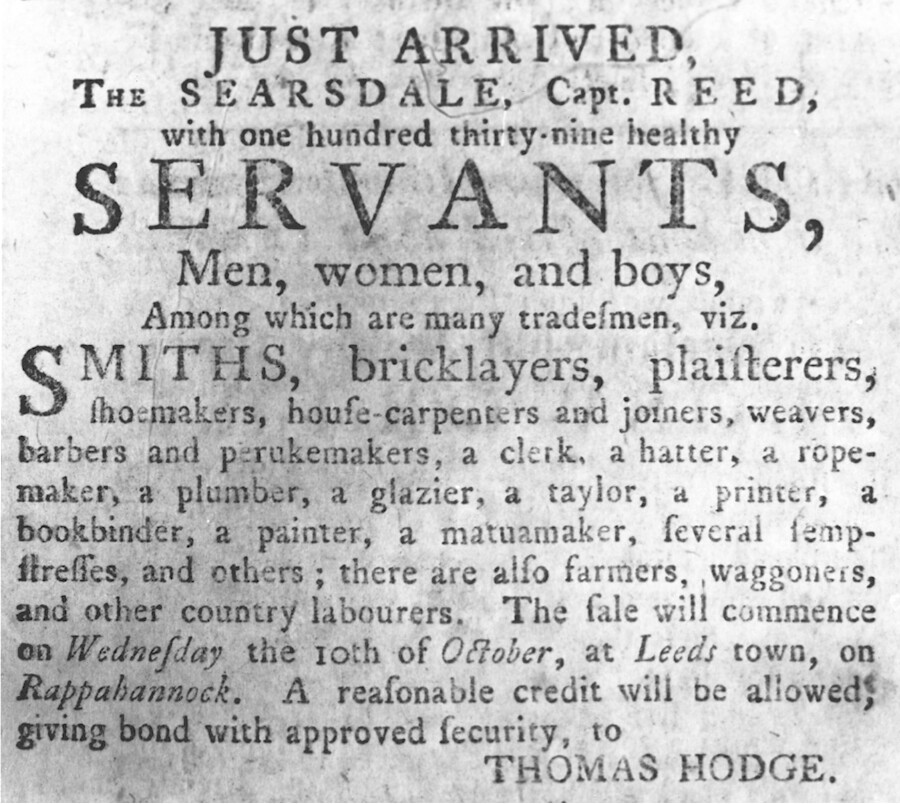
To solve the labor shortage, the planters first recruited indentured servants from England, Ireland, Scotland, and continental Europe. The term indentured servitude is derived from the word indenture, or contract, that enabled a person to pay for passage to America by promising to work for a fixed number of years (usually between three and seven). As tobacco production soared, indentured servants did most of the work. Of the 500,000 English immigrants to America from 1610 to 1775, some 350,000 came as indentured servants. However, not all servants came voluntarily. Many homeless children in London were “kid-napped” and sold into servitude in America. Also, Parliament decided it could save money on prisons by shipping felons to the colonies, and as a result some 50,000 were transported to North America. As the saying went, a convict “is banished from Scotland for a great crime, from England for a small one, and from Ireland for no crime at all.”
Once in the colonies, servants were provided with food and a bed, but life was harsh. Many of them died before their term of indenture ended. Servants also had few rights. As a Pennsylvania judge explained in 1793, indentured servants occupied “a middle rank between slaves and free men.” They could own property but could not engage in trade. Marriage required the master’s permission. Masters could whip servants and extend their length of service as punishment for bad behavior. Elizabeth Sprigs, a servant in Maryland, told of her “toiling day and night, and then [being] tied up and whipped to that degree you would not beat an animal, scarce [fed] anything but Indian corn and salt.” Servants, unlike enslaved Africans, could file a complaint with the local court.
More information
An advertisement for indentured servants announces an upcoming sale. It announces the arrival of the ship the Searsdale, it states that it has arrived “with 139 healthy servants, men, women, and boys, among which are many tradesmen, including smiths, bricklayers, plasterers, shoemakers, house-carpenters, and joiners, weavers, barbers and perukemakers (an old word for ‘wig-makers’), a clerk, a hatter, a rope-maker, a plumber, a glazier, a tailor, a printer, a printer, a bookbinder, a painter, a matuamaker (probably meaning a dress-maker), several seamstresses, and others; there are also farmers, wagoners, and other country laborers.” At the bottom, the ad states that the sale will take place on Wednesday, October tenth at Leeds town, and that reasonable amounts of credit will be allowed, giving bond with approved security to Thomas Hodge.
The most important difference between servanthood and slavery was that it did not last a lifetime. Once the indenture ended, the servant could claim the “freedom dues” set by custom and law: a little money, a few tools, some clothing and food, and—in some cases—small tracts of land. Some former servants did very well. In 1629, the Virginia legislature included seven members who had arrived in America as indentured servants; by 1637, fifteen former servants were serving in the Maryland Assembly. Such opportunities were much less common in England or Europe, giving people even more reason to travel to America.
ENSLAVING INDIGENOUS PEOPLE IN CAROLINA
At the same time that they benefited from contractual arrangements with indentured servants, English colonists in Carolina developed a profitable trade with—and in—Indigenous people.
By 1690, traders from Charles Town had made their way up the Savannah River to arrange deals with the Cherokee, Creek, and Chickasaw. Between 1699 and 1712, when Carolina was divided into two colonies, North and South, traders exported to England an average of 54,000 deerskins per year. The valuable hides were transformed into leather gloves, belts, hats, work aprons, and book bindings.
The Trade in Enslaved Native Americans.
English traders also bought enslaved Native Americans. To accomplish that, traders stirred up wars between Indigenous nations; they knew that the best sources of enslaved Native Americans were the rival Indigenous peoples who captured them. In fact, the growing trade in deerskins entwined Indigenous people in a dependent relationship with Europeans that would ultimately prove disastrous to their traditional way of life. Beyond seizing and enslaving Indigenous people, English traders provided firearms and rum as payment to those who sold their captured rivals into slavery.
The extraordinary profitability of captive Native Americans prompted a frenzy of slaving activity among English settlers, as it had earlier among Spanish conquistadors and French and Dutch colonizers. Until the eighteenth century, most enslaved workers in the British American colonies were Indigenous people, not enslaved Africans. More enslaved Indigenous people were exported during the seventeenth century than Africans were imported, and thousands of others were sold to “slavers” who took them to islands in the Caribbean Sea through New England ports. In Carolina, as many as 50,000 Indigenous people, mostly women and children, were sold into slavery in Charles Town between 1670 and 1715, with many of them being shipped to faraway destinations—Barbados, Antigua, New York.
By the early eighteenth century, however, traders in the Carolinas would come to prefer enslaved Africans over enslaved Native Americans because the Indigenous people were more familiar with the land and constantly escaped. Africans, by contrast, stood out because of the complexion of their skin. And before long, the colonists’ desire for more enslaved Native Americans led to violent conflicts between Indigenous nations in the region.
TUSCARORA AND YAMASEE WARFARE
In 1712, the Tuscarora of North Carolina attacked German and English colonists who had encroached upon their land. North Carolina authorities appealed to South Carolina for aid, and the colony, eager for more captive laborers, dispatched two expeditions made up mostly of Native American allies of the English—Yamasee, Cherokee, Creek, and Catawba. They destroyed a Tuscarora town, executed 162 male warriors, and took 392 women and children captive for sale in Charles Town. The surviving Tuscarora fled north, where they joined the Iroquois.
The Tuscarora War sparked more conflict in South Carolina. The Yamasee peoples in Carolina felt betrayed when White traders paid them less for their Tuscarora captives than they wanted. What made this shortfall so acute was that the Yamasee owed debts to traders totaling 100,000 deerskins. To recover their debts, White traders cheated the Yamasee, confiscated their lands, and began enslaving the women and children. In April 1715, the Yamasee attacked coastal plantations and killed more than 100 Whites.
Subsequently, the governor mobilized all White and Black men to defend the colony; other colonies supplied weapons. But it wasn’t until the governor bribed the Cherokee to join them that the Yamasee War ended—in 1717. The defeated Yamasee fled to Spanish-controlled Florida. By then, hundreds of Whites had been killed and dozens of plantations destroyed and abandoned. To prevent another conflict, the colonial government outlawed all private trading with Native Americans.
The end of the Yamasee War did not stop infighting among the Indigenous peoples, however. For the next ten years or so, the Creek and Cherokee engaged in a costly blood feud—one that would change the course of their history. One Carolinian explained that their challenge was to figure out “how to hold both [tribes] as our friends, for some time, and assist them in cutting one another’s throats without offending either. This is the game we intend to play if possible.”
SIMILARITIES AND DIFFERENCES AMONG THE BRITISH COLONIES
As the British colonies in North America began to mature, their output increased, their demand for labor increased, and they developed cultures that shared some features in common—but also reflected substantial differences.
THE SOUTHERN COLONIES
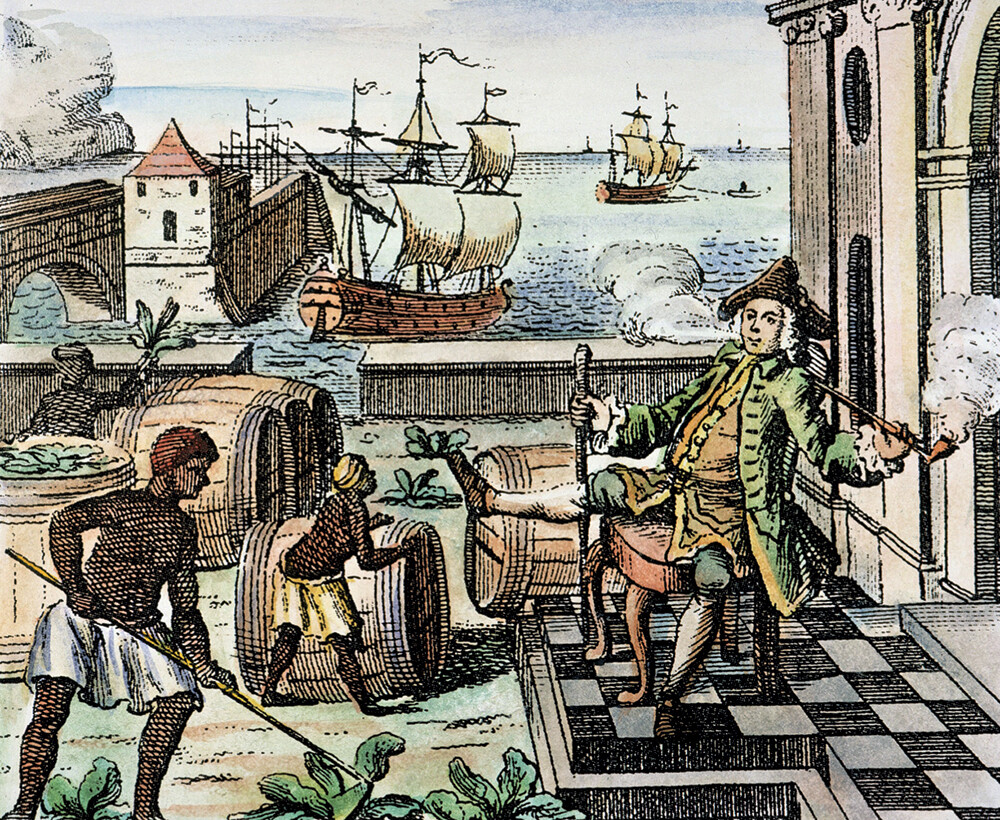
As the southern colonies matured, inequalities of wealth became more visible, and social life grew more divided by marked differences in clothing, housing, wealth, and status. The use of enslaved Indigenous and African people to grow and process crops generated enormous wealth for a few landowners. Socially, the planters and merchants became a class apart from the “common folk.” They dominated the legislatures, bought luxury goods from London and Paris, and built brick mansions with formal gardens.
More information
An illustration depicting a coastal plantation. A white man reclines on a harborside porch while smoking a pipe. In the adjoining field, enslaved individuals cultivate tobacco and pack it into barrels. Beyond the plantation, large ships approach a port.
Warm weather and plentiful rainfall helped the southern colonies grow the profitable staple crops valued by Great Britain: tobacco, rice, sugarcane, and indigo. Tobacco production soared during the seventeenth century. “In Virginia and Maryland,” wrote a royal official in 1629, “tobacco . . . is our All, and indeed leaves no room for anything else.” So much tobacco was grown in Virginia that the royal governor in 1616 passed Dale’s Laws (named for Virginia’s first governor, Thomas Dale) requiring every farmer to plant at least two acres of corn to ensure an adequate food supply.
The growing of rice also expanded dramatically. By 1700, South Carolina was exporting 400,000 pounds of rice each year; by 1768, some 66 million pounds of rice were shipped to Great Britain and northern Europe. Rice accounted for more than half of the colony’s exports during the eighteenth century.
Over time, South Carolina rice planters became the wealthiest group in the British colonies. They situated their plantations along coastal rivers so they could use barges to transport rice to nearby ports for shipment to Europe. As rice plantations grew, the demand for enslaved laborers rose dramatically, for White colonists balked at working long hours in “mud and water.” Almost 90 percent of the enslaved Africans transported to America were sold into the southern colonies. South Carolina had a majority Black population.
Unlike the stately mansions built by wealthy planters, the residences of most other English immigrants to Virginia and Maryland (the Chesapeake colonies) were one-room huts that provided limited protection and rotted quickly. A visitor to Virginia in 1622 reported that the colony’s huts “were the worst I ever saw.” Eventually, colonists built simple cabins on stone or brick foundations, roofed with thatched straw. The spaces between the log timbers were “chinked” with wattle and daub—a mix of mud, sand, straw, and wooden stakes that when dried formed a sturdy wall or seam. Most colonial homes had few furnishings; residents slept on the floor. Rarely did they have glass to fill windows. Instead, they used wooden shutters to cover the openings.
NEW ENGLAND
New England was quite different from the southern and middle Atlantic regions. Religious concerns outweighed all else. Commercial agriculture was almost nonexistent because of the rocky soil and frigid climate, so traders and shopkeepers predominated. Village and town life was much less reliant on plantation slavery, yet local economies grew profitable from participating in the transatlantic slave trade and producing goods such as shoes and clothing worn by the enslaved. The New England economy thrived off of slavery in different ways than their southern counterparts.
Puritan Religion.
When Puritans founded towns, the first public structure to be built was usually a church. By law, every town had to collect taxes to support a church, and every resident—church member or not—was required to attend midweek and Sunday religious services. The average New Englander heard more than 7,000 sermons in a lifetime.
The Puritans believed that God had created a covenant, or contract, through which people formed a congregation for common worship. This led to the idea of people joining together to form governments, which was a much more democratically based form of governance than Great Britain’s. Puritan leaders, however, also sought to do the will of God, and the ultimate source of authority for them was not majority rule of the members, but the Bible, as interpreted by ministers and magistrates (political leaders). Over time, however, growing numbers of children and grandchildren of the original members could not give the required testimony of spiritual conversion. Another blow to Puritan ideals came with the Massachusetts royal charter of 1691, which required the Puritan colony to “tolerate” religious dissenters (such as Quakers) and based the right to vote on property ownership rather than church membership.
Although the Puritans had left England and sailed to America with the goal of creating pious, prosperous communities, the traditional caricature of dour, black-clothed Puritans, hostile to anything that gave pleasure, is false. Yes, they banned card playing, dancing in taverns, swearing, and bowling. They fined people for celebrating Christmas, for in their view only pagans marked the birth date of their rulers with merrymaking. Puritans also frowned on nagging, lying, hurling insults, disobeying parents, and disrespecting civil and religious officials. In 1631, a servant named Phillip Ratcliffe had both of his ears cut off for making scandalous comments about the governor and the church in Salem.

More information
A photo of a red, colonial frame house. The house is in the salt box style, with a central chimney, a two story front wall, a one story back wall, and gabled sides.
Yet Puritans also wore colorful clothing, enjoyed secular music, and consumed prodigious quantities of beer and rum. “Drink is in itself a good creature of God,” said the Reverend Increase Mather, “but the abuse of drink is from Satan.” Drunks were arrested. A Salem man, for example, was tried for staggering into a house where he “eased his stomach in the chimney.” Repeat offenders were forced to wear the letter D in public.
Moderation was the Puritan guideline, and it applied to sexual life as well. Although sexual activity outside of marriage was strictly forbidden, New England courts overflowed with cases of adultery and illicit sex. A man found guilty of sleeping with an unwed woman could be jailed, whipped, fined, and forced to marry the woman. Female offenders were also jailed and whipped, and judges required adulterers to wear the letter A.
Dwellings and Daily Life.
The first colonists in New England initially lived in caves, tents, or cabins, but they eventually built simple wood-frame houses with steeply pitched roofs to reduce the buildup of snow. By the end of the seventeenth century, most New England homes were plain but sturdy dwellings. Interior walls were often plastered and whitewashed. Not until the eighteenth century were the exteriors of most houses painted—usually a deep “Indian” red, as the colonists called it. The interiors were dark and illuminated by candles or oil lamps, both of which were expensive; most people usually went to sleep soon after sunset.
There were no bathrooms (called privies at the time). Most families relieved themselves outside, often right beside the house. Family life revolved around the main room on the ground floor, called the hall, where meals were cooked in an open fireplace and where the family spent most of their time. Because of this, the main rooms came to be called living rooms.
Food was served at a table of rough-hewn planks, called the board, and the only eating utensils were spoons and fingers. The father was sometimes referred to as the “chair man” because he sat in the only chair (the origin of the term chairman of the board). The rest of the family usually stood or sat on stools or benches and ate with their hands and wooden spoons. Forks were not introduced until the eighteenth century. A typical meal consisted of corn, boiled meat, and vegetables washed down with beer, cider, rum, or milk. Cornbread was a daily favorite, as was cornmeal mush, known as hasty pudding.
Economy.
In 1630, as John Winthrop and the Puritans had prepared to embark for New England, he had stressed that God made some people powerful and rich and others helpless and poor—so that the elite should show mercy and the masses should offer obedience. Whether rich or poor, however, he had reminded the Puritans that all were given a noble “calling” by God to work hard and ensure that material pursuits never diminished the importance of spiritual devotion. This was the perspective under which New England colonial society was established.
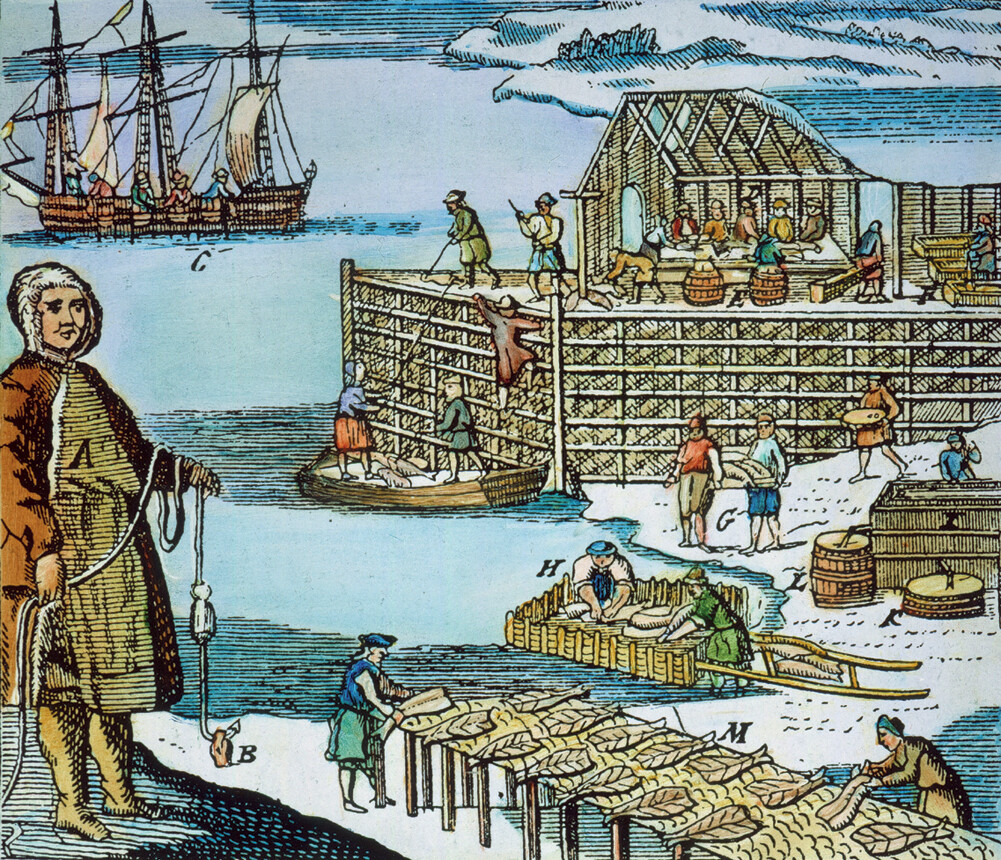
Early New England farmers and their families led hard lives. Clearing rocks might require sixty days of hard labor per acre. The growing season was short, and no staple (cash) crops grew in the harsh climate. The crops and livestock were those familiar to the English countryside: wheat, barley, oats; some cattle, pigs, and sheep. Many New Englanders turned to the sea for their livelihood. Codfish had been a regular element of the European diet for centuries, and the waters off the New England coast had the heaviest concentrations of cod in the world. Whales supplied ambergris, a waxy substance used in the manufacture of perfumes and lubrications; the colonists also burned it as lamp oil.
New Englanders exported dried fish to Europe, with lesser grades going to the West Indies as food for enslaved laborers. The thriving fishing industry encouraged the development of shipbuilding and spurred transatlantic commerce. Rising incomes and a booming trade with Britain and Europe soon brought a taste for luxury goods that clashed with the Puritan ideal of plain living and spiritual thinking.
More information
An illustration depicts the process of drying cod. In the foreground, a person wearing thick, bundled clothing holds a fishing line with a baited hook. In the background, workers in a snow-covered harbor work with slabs of salted cod, laid out on tables and packed in barrels. A group of people fish from a large ship just off shore.
Trade in New England and the middle colonies differed from that in the South in two respects. First, the lack of agricultural staple crops to exchange for English goods was a relative disadvantage, but the success of shipping and commercial enterprises worked in their favor. Second, after 1660, to protect its agriculture and fisheries, the English government placed prohibitive duties (taxes) on fish, flour, wheat, and meat, while leaving the door open to high-demand products such as lumber, furs, and whale oil. Between 1698 and 1717, New England and New York bought more from England than they exported to it, thereby creating an unfavorable balance of trade.
These circumstances gave rise to the triangular trade. New England merchants shipped rum to the western coast of Africa, where it was exchanged for captured and enslaved Africans. Ships then took the captive Africans to profitable Caribbean islands to sell. (The islands were profitable because of their sugar plantations, which produced highly desired raw sugar and molasses.) The ships returned home with various commodities, including molasses, from which New Englanders manufactured rum. In another version of the triangular trade, shippers sent foodstuffs to the Caribbean islands, carried sugar and molasses to England, and returned with goods manufactured in Europe. (See Map 3.1.)
MAP 3.1 ATLANTIC TRADE ROUTES, 1600–1800

More information
A map shows major and intercoastal trade routes in the Atlantic ocean between 1600 and 1800. Intercontinental routes show trade between Europe, Africa, North and South America and several smaller, Caribbean nations such as Madeira, Hispaniola, the West Indies, Cuba and Jamaica. In North America, trade goods imported from Scotland and Ireland included linens and horses. Manufactured goods came from England, the Netherlands, France, and Spain. Various European products went to the West Indies. Enslaved individuals from Africa were sent to North America, the West Indies, Jamaica, and Cuba. Fish, furs, and naval stores sourced from Boston were sent to the Netherlands. Rice, indigo, and skins shipped from Charles Town to England and the Netherlands. Enslaved individuals and molasses were shipped from Jamaica to North America. Fish and livestock were traded from the northeast cities of North America to Hispaniola and the West Indies. Sugar, molasses, and fruit were shipped from the West Indies to several ports in Europe. Wine was traded from Madeira to North America and Europe. Intercoastal trade routes include trade routes along the eastern coast of North America and along the western coast of Europe. Questions that accompany the map include the following: Count the number of major trade routes shown on the map. Where do they cluster most densely? Why? Make a list of every commodity shipped along the trade routes. Which three commodities are listed most often? Where do they originate, and where do they go? Based on your understanding of the chapter text, explain what the triangular trade involved. How does this map reflect it?
- Count the number of major trade routes shown on the map. Where do they cluster most densely? Why?
- Make a list of every commodity shipped along the trade routes. Which three commodities are listed most often? Where do they originate, and where do they go?
- Based on your understanding of the chapter text, explain what the triangular trade involved. How does this map reflect it?
THE MIDDLE COLONIES
Both geographically and culturally, the middle colonies (New York, New Jersey, Pennsylvania, Delaware, and Maryland) stood between New England and the South. They reflected the diversity of colonial life and foreshadowed the pluralism of the future nation. The middle colonies produced surpluses of foodstuffs for export to the slave-based plantations of the South and the islands of the West Indies: wheat, barley, oats, and other grains; flour and livestock. Three great rivers—the Hudson, Delaware, and Susquehanna—and their tributaries provided access to the backcountry of Pennsylvania and New York, and to a rich fur trade with Native Americans. The region’s bustling commerce thus rivalled that of New England.
In the makeup of their population, the middle colonies differed from New England’s Puritan settlements and the plantation colonies in the South. In New York and New Jersey, Dutch culture and language lingered. Place names such as the Bronx, Brooklyn, Wall Street, and Tappan Zee are remnants of Dutch colonization. Even the word Yankee was derived from a Dutch word describing the New Englanders who “harassed” them. Along the Delaware River near Philadelphia, the first settlers—Swedes and Finns—were overwhelmed by an influx of Europeans. By the mid-eighteenth century, the middle colonies were the fastest-growing region in North America.
Pennsylvania became the great distribution point for the ethnic groups of European origin. The Germans whom Benjamin Franklin was so concerned about came to America (primarily to Pennsylvania) mainly from the Rhineland region of Europe, where brutal religious wars had pitted Protestants against Catholics. William Penn’s recruiting brochures circulated throughout central Europe, and his promise of religious freedom appealed to members of many persecuted sects—especially the Mennonites, German Baptists whose beliefs resembled those of the Quakers.

More information
An engraving depicts a man, William Penn, in elegant attire welcoming two other men as they deboard a small boat. One newcomer has stepped from the rowboat up onto a dock, and a much larger ship is approaching behind them. A city can be seen in the background. In the sky, a flying figure with wings on his hands, feet, and helmet appears beside the year 1766.
In 1683, a group of Mennonites founded Germantown, near Philadelphia. They represented the first wave of German migrants, most of whom were indentured servants. Throughout the eighteenth century, a quarter-million Scots-Irish immigrants moved still farther out into the Pennsylvania backcountry. Plentiful land in America was the great magnet for the cash-poor Scots-Irish, most of whom were farmworkers eager “to have land for nothing” and “unwilling to be disappointed.” In most cases, the lands they “squatted on” were the ancestral grounds claimed by Native Americans. In 1741, for example, a group of Delaware protested that the Scots-Irish were taking “our land” without giving “us anything for it.” If the colonial government did not stop the flow of Whites, the Delaware people threatened, they would “drive them off.” In the end, the Scots-Irish continued to migrate to this region. However, most settlers had to move at least twice to find a place to establish their families and communities.
The Scots-Irish and Germans became the largest non-English ethnic groups in the colonies (see Map 3.2). Other ethnic minorities also enriched the population: Huguenots (French Protestants whose religious freedom had been revoked in 1685, forcing many to leave France), Irish, Welsh, Swiss, and Jews. New York had inherited from the Dutch a tradition of ethnic and religious tolerance, which had given the colony a diverse population: French-speaking Walloons (a Celtic people of southern Belgium), French, Germans, Danes, Portuguese, Spaniards, Italians, Bohemians, Poles, and others, including some New England Puritans.
Before the mid-eighteenth century, White settlers in the Pennsylvania backcountry had reached the Appalachian Mountains. A British official described these colonists as natural wanderers who “forever imagine the lands further off are still better than those upon which they are already settled.” Rather than crossing the steep mountain ridges, the Scots-Irish and Germans filtered southward down the Shenandoah Valley of Virginia and on into the Carolina and Georgia backcountry. Germans were the first White settlers in the Upper Shenandoah Valley in southern Pennsylvania, western Maryland, and northern Virginia, and the Scots-Irish filled the lower valley in western Virginia and North Carolina (see again Map 3.2).
In the eighteenth century, the population in British North America soared, and the colonies grew more diverse. In 1790, the White population was 61 percent English; 14 percent Scottish and Scots-Irish; 9 percent German; 5 percent Dutch, French, and Swedish; 4 percent Irish; and 7 percent “unidentifiable”—a category that included people of mixed origins as well as free Blacks. If one adds to the 3,172,444 Whites in the 1790 census the 756,770 non-Whites (without even considering the almost 100,000 Native Americans who went uncounted), only about half the nation’s inhabitants, and perhaps fewer, could trace their origins to England—thus revealing the increasing ethnic and cultural diversity of the British North American colonies.
COLONIAL SOCIETY: A SLAVE SOCIETY
The transport of African captives, mostly young men, across the Atlantic to the Americas was the largest forced migration in world history. Overall, Europeans transported 12.5 million enslaved Africans to communities in North and South America and the Caribbean (see Map 3.3). Of these, at least 15 percent died in transit; some historians argue much more. The majority were delivered to Portuguese Brazil (5.5 million) and the Caribbean “sugar” islands—Barbados, Cuba, Jamaica, and others (5 million). There the heat, humidity, and rigorous labor shortened the life expectancy of enslaved workers.
MAP 3.2 MAJOR IMMIGRANT GROUPS IN COLONIAL AMERICA

More information
A map depicts the locations of major immigrant groups in colonial America. English immigrants are shown to be living throughout all the colonies in the greatest numbers, spanning from Maine south into northern Florida. African people are concentrated in regions around Baltimore; Richmond and Williamsburg in Virginia, the Atlantic coastal area of North Carolina, Charleston, and Savannah. Scots-Irish immigrants are concentrated along the eastern and southeastern region of Pennsylvania, west of Baltimore, and the central regions of North and South Carolina. German immigrants are concentrated around the Mohawk River, north of Baltimore into eastern Pennsylvania, north of Charlotte in North Carolina, and in the central region of South Carolina. Dutch immigrants are concentrated along the Hudson River and slightly along the Delaware River. Highland Scots are centered in the region surrounding Fayetteville, North Carolina. French Catholics populate the St. Lawrence River from Montreal north past Quebec. Jewish immigrants are indicated in Rhode Island, New York, Philadelphia, Charleston, and Savannah. Swedish immigrants are shown to inhabit two regions around Philadelphia. Welsh immigrants are shown to populate Philadelphia and the region east of Fayetteville, North Carolina. French Huguenots are shown around Boston, New York, Richmond, New Bern, and Charleston and the regions between the Hudson and Delaware Rivers. Questions that accompany the map include the following: Judging from the map, what geographical features kept most immigrant groups from settling far from coastal areas? Which group settled farthest west? Identify its locations on the map. Within which other immigrant group’s settlements was it located? Explain why. According to this map and the chapter text, in what ways did the middle colonies foreshadow the diversity of the future nation?
- Judging from the map, what geographical feature kept most immigrant groups from settling far from coastal areas? Which group settled the farthest west?
- Identify its locations on the map. Within which other immigrant group’s settlements was it located? Explain why.
- According to this map and the chapter text, in what ways did the middle colonies foreshadow the diversity of the future nation?
MAP 3.3 THE AFRICAN SLAVE TRADE, 1500–1800

More information
A world map depicts the routes of the African Slave Trade between 1500 and 1800. The map shows the majority of the North American continent, all of the South American continent, Africa, and western Europe. A region in Africa is labeled, “Principal area of supply of captured Africans,” including Senegal, Gambia, Guinea, Sierra Leone, Ivory Coast, Gold Coast, Togo, Dahomey, Nigeria, Cameroon, Gabon, Congo, and Angola. Enslaved individuals were shipped in to these countries from East Africa, before being sent to Brazil (Portugal), Guiana, the West Indies, the Bahamas and English Colonies in North America. Questions that accompany the map include the following: Looking at the map of Africa, locate the principal area where captured Africans originated. Was it along the coast or farther inland? Based on the chapter text, explain how Africans were captured and enslaved, and describe the conditions they endured on the Middle Passage. Looking at the map, identify the destinations of the enslaved Africans. According to the chapter text, why did those areas want forced labor?
- Looking at the map of Africa, locate the principal area where captured Africans originated. Was it along the coast or farther inland?
- Based on the chapter text, explain how Africans were captured and enslaved, and describe the conditions they endured on the Middle Passage.
- Looking at the map, identify the destinations of the enslaved Africans. According to the chapter text, why did those areas want their forced labor?
By 1700, there were enslaved Africans in every colony, and they made up 11 percent of the total population (by 1770, the enslaved would constitute more than 20 percent). Slavery in English North America differed significantly from region to region, however. Africans were a tiny minority in New England (about 2 percent). Because the soil was not as fertile as in the South and could not sustain large plantations, slavery in New England prevailed in small settings where both enslavers and the enslaved often lived under the same roof.
Slavery was much more common in the Chesapeake colonies and the Carolinas, where large plantations dominated. By 1730, the enslaved Black population in Virginia and Maryland had become the first in the Americas to achieve a self-sustaining rate of population growth, enabling the population to increase naturally. By 1750, for example, about 80 percent of the enslaved Blacks in the Chesapeake region had been born there.
AFRICAN ROOTS AND THE MIDDLE PASSAGE
Enslaved Africans came from all over the African continent (see again Map 3.3), spoke as many as fifty distinct languages, and worshipped diverse gods. Some came from large kingdoms like Ghana, Songhai, and Mali, while others came from smaller, dispersed villages. In their homelands, warfare was as common as it was in Europe: rival nations conquered, kidnapped, and traded their prisoners of war.
Slavery in Africa, however, did not involve treating humans as a form of property. Rather, captured people lived with their captors, and their children were not automatically enslaved. The involvement of Europeans in transatlantic slavery, whereby captives were sold and shipped to other nations, is a different and more complex story. And it is a story that involved many European nations: Sweden, Denmark, France, Great Britain, the Netherlands, Spain, and Portugal.
During the seventeenth and eighteenth centuries, Europeans worked with African slave traders to bring captives to fortifications built along the West African coast. Few of the captives had ever seen the ocean, a sailing ship, or a White person. After languishing as prisoners for weeks or months, the captured Africans would be led to waiting ships owned by European slave traders. As one of them remembered, “it was a most horrible scene; there was nothing to be heard but rattling of chains, smacking of whips, and groans and cries of our fellow men.”
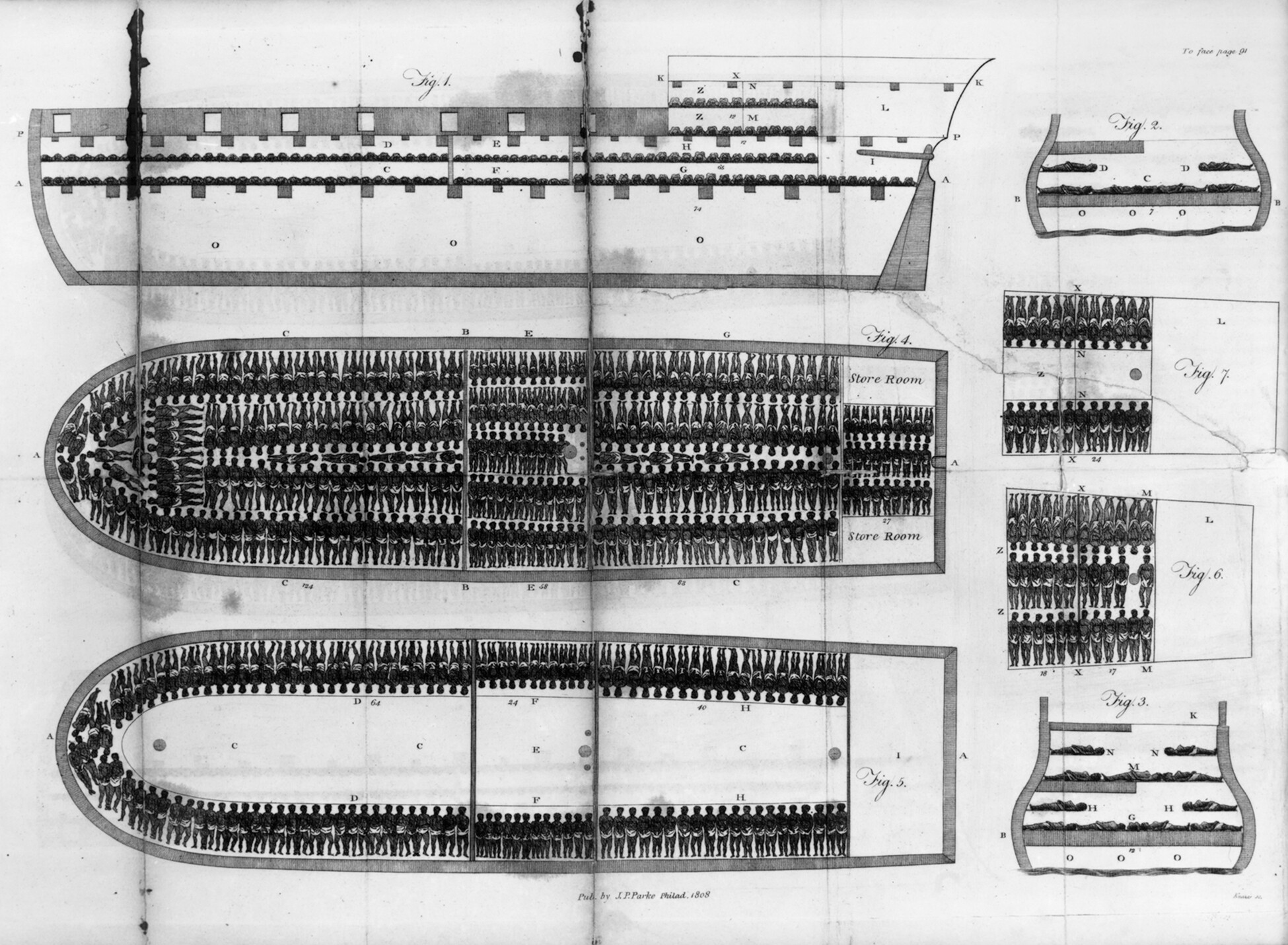
Once purchased, the millions destined for slavery in the Americas and the Caribbean islands were branded on the back, buttocks, or shoulder with a company mark, put in chains, and loaded onto mostly British-owned ships. Forced to stay below deck in constant darkness, they were chained together on top of one another with no room to move or stand. They slept in their own and others’ urine and excrement. Only occasionally were they allowed to go above deck for fresh air and exercise.
More information
An illustration of a ship used to transport enslaved individuals from Africa. It shows seven different locations within the boat, each containing row upon row of crowded individuals. Each person lies shoulder to shoulder with the others around them, with space appearing only between their heads and legs.
The transatlantic voyage of the slave ships, which could last up to six months, was known as the Middle Passage because it served as the middle leg of the triangular trade. On the first leg, European ships carried rum, clothing, household goods, and guns to Africa, which they exchanged for enslaved Africans. The captives then were taken on the second (or “middle”) leg of the triangular trade to the Americas. Once the human cargo was unloaded, the ships were filled with lumber, tobacco, rice, sugar, rum, and other products for the return voyage to English and European ports. (See again Map 3.1.)
The Middle Passage was horrific. One in six African captives died along the way. Almost one in ten of these floating prisons (as contemporary historians describe them) experienced a slave revolt. Some captives committed suicide by jumping off the ships; others starved themselves and refused to eat. Yet many of the English businessmen involved in human trafficking considered their work highly respectable. “What a glorious and advantageous trade this is,” wrote slave trader James Houston. “It is the hinge on which all the trade of this globe moves.”
AFRICANS AS PROPERTY
Those in the business of trading enslaved Africans justified their activities by embracing a widespread racism that viewed Africans as animals rather than human beings. Once they arrived in America, Africans were treated as property (chattel), herded in chains to public auctions, and sold to the highest bidder. Their enslavers required them to cook and clean; care for their babies and children; dig ditches; drain swamps; clear, plant, and tend fields; and feed livestock.
On large southern plantations that grew tobacco, sugarcane, or rice, the enslaved laborers worked in gangs sometimes supervised by Black “drivers” (privileged enslaved men who controlled the pace of the work) and White overseers who managed the labor on behalf of the owner. Enslaved Africans were often housed in crude cabins, fed like livestock out of horse troughs, and issued poor-quality clothes and shoes. To ensure that they worked hard and did not cause trouble, they were whipped, branded, shackled, castrated, sexually abused, or sold away, often to the Caribbean islands, where few survived the harsh working conditions.
Enslaved Africans, however, found ways to resist. Some rebelled by refusing work orders, sabotaging crops, stealing tools, faking illness or injury, or running away. If caught, the freedom seekers faced certain punishment—whipping, branding, and even the severing of an Achilles tendon. But if successful, runaways also faced uncertain freedom. Where would they run to in a society ruled by Whites and permeated by racism?
SLAVE CULTURE
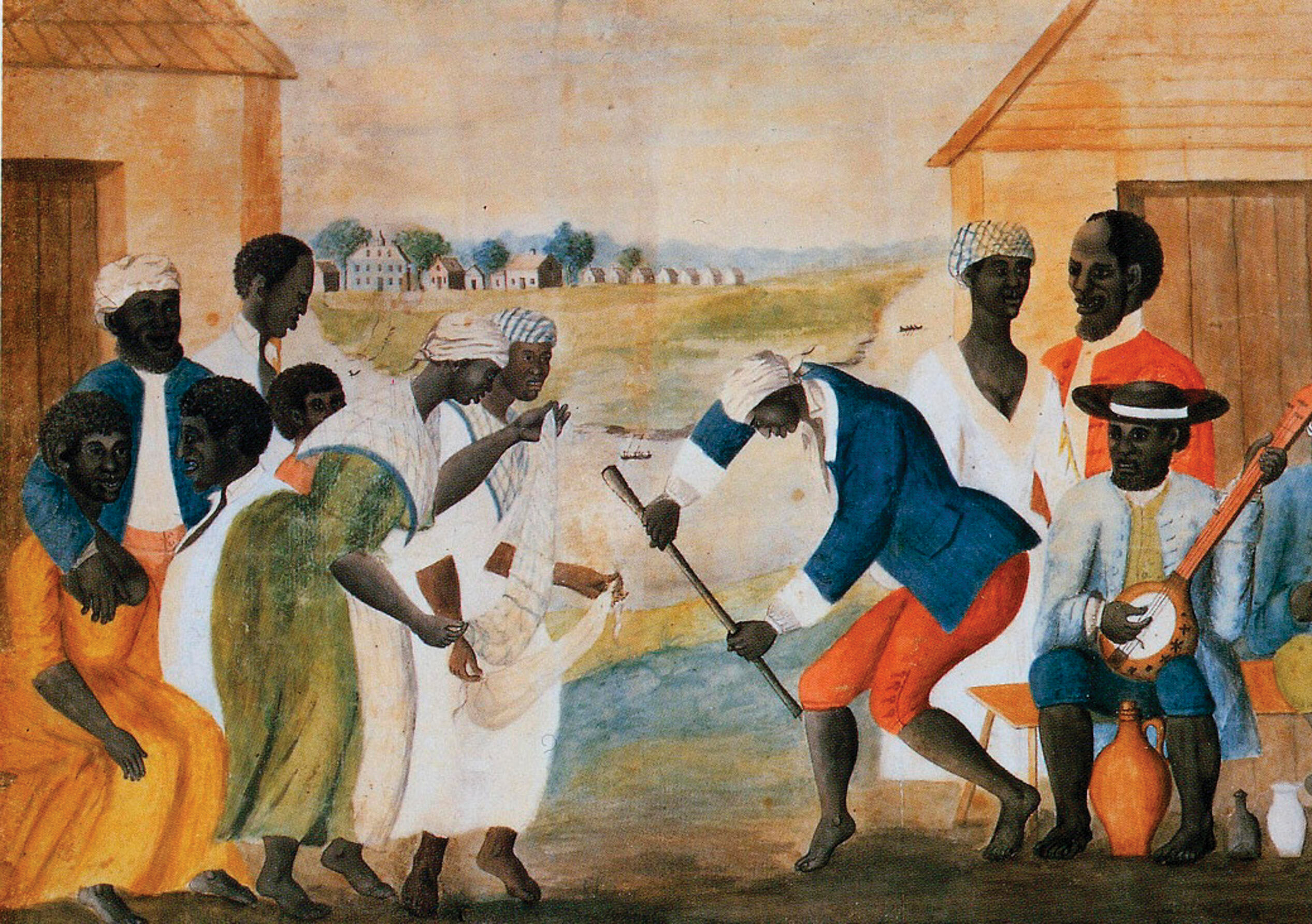
In the process of being forced into lives of bondage in a new world, Africans from diverse homelands forged a new identity as African Americans. At the same time, they wove into American culture many strands of their African heritage. These include new words that entered the language, such as tabby, tote, goober, yam, and banana, as well as the names of the Coosaw, Pee Dee, and Wando Rivers in South Carolina. More significant are lasting African influences upon American music, folklore, and religious practices. Enslaved men and women often used songs, stories, and religious preaching to circulate coded messages expressing their distaste for owners or overseers. The fundamental theme of their hybrid religion, adapted from the Christianity they were forced to embrace, was deliverance. God, many of them believed, would eventually open the gates to heaven’s promised land.
No matter where in the colonies enslaved Africans lived, their labor—and that of indentured servants—contributed to a thriving trading economy that characterized this period. Raw materials were sent to England, and a return flow of manufactured products supported the colonists’ increased consumption of both essential and luxury goods. The need for forced labor on Caribbean sugar plantations, as well as on rice, tobacco, and indigo plantations in the Carolinas, led European traders to develop a system of transporting millions of captured Africans across the Atlantic via the brutal Middle Passage. The period’s economic success, based largely on the labor of these groups as well as enslaved Indigenous people, attracted European immigrants from many different ethnic and religious backgrounds. All these elements combined to make colonial society increasingly diverse.
More information
A painting shows a group of enslaved individuals playing music and dancing. One man plays the banjo and another dances while holding a stick. Many other individuals have gathered to watch. Three pottery jugs have been placed on the ground near the banjo player’s feet, and two simple buildings appear behind the group. A large, colonial house is visible in the distance.
Glossary
- indentured servants
- Settlers who signed on for a temporary period of servitude to a master in exchange for passage to the New World.
- staple crops
- Profitable market crops, such as cotton, tobacco, and rice, that predominate in a region.
- triangular trade
- A network of trade in which exports from one region were sold to a second region; the second sent its exports to a third region, which exported its own goods back to the first country or colony. The term most often applies to the transatlantic slave trade of the seventeenth and early eighteenth centuries.
- Middle Passage
- The hellish and often deadly middle leg of the transatlantic “triangular trade” in which European ships carried manufactured goods to Africa, then transported enslaved Africans to the Americas and the Caribbean islands, and finally conveyed American agricultural products back to Europe.