RACE-BASED CHATTEL SLAVERY
How did race-based chattel slavery develop during the seventeenth century, and in what ways did it impact the social and economic development of colonial America?
RACE-BASED CHATTEL SLAVERY IN THE COLONIES
The profound economic, political, and cultural effects of African slavery in the Americas would be felt far into the future. Most Europeans during the colonial period viewed chattel slavery (the idea that people of African descent were moveable forms of property) as a normal aspect of everyday life; few considered it a moral issue. They believed that God determined one’s station in life. Slavery was thus considered a personal misfortune dictated by God rather than a social evil. It was not until the late eighteenth century that large numbers of White Europeans and Americans began to raise ethical questions about slavery, particularly those that addressed slavery as a hereditary condition.
DIFFERING TREATMENT OF ENSLAVED AFRICANS
The first Africans in North America were transported to New Spain in the sixteenth century, long before British colonists arrived in Virginia. In 1539, the Spanish explorer Hernando DeSoto brought some fifty enslaved Africans to help establish a settlement in what is now Florida. Thereafter, hundreds more enslaved Africans were taken to Florida.
The main difference in how enslaved Africans were treated in Spanish Florida compared with the British colonies centered on religion: the Spanish monarchy said enslaved people might be freed if they converted to Roman Catholicism. During the seventeenth century, growing numbers of enslaved people in the British colonies escaped and made their way to Florida, where Spanish authorities in 1623 announced that enslaved people who touched Spanish-controlled soil, requested refuge, agreed to serve in the militia, and converted to Catholicism could become free Spanish citizens.
Members of the Creek and Seminole nations in Florida also provided refuge for enslaved people who escaped from British colonies. In the eighteenth century, a British official reported that for decades, freedom seekers from Georgia and South Carolina had made their way to “Indian towns, from whence it proved very difficult to get them back.”
Slave Codes.
In the Chesapeake colonies of Virginia and Maryland, Africans were initially treated much like indentured servants—with a limited term of service, after which they gained their freedom (but not equality). By the 1640s, however, slavery had become a hereditary condition bound by race.
The case of John Punch (1641) marked the beginning of inequities among various groups of people, and some historians argue it marks the origin of racial slavery. Punch, an indentured servant from Africa, ran away with two other servants—a Scotsman named James Gregory and a Dutchman named Victor. All three worked for Hugh Gwyn, and they escaped together. However, when caught, James and Victor received an extension of their indentured service for a few extra years. Punch, because he was African, was punished with slavery for the rest of his “natural life.” This case reflects the fact that colonial legislatures formalized the institution of race-based slavery, with detailed slave codes regulating most aspects of enslaved people’s lives. The South Carolina code, for example, defined all “Negroes, Mulattoes, and Indians” sold into bondage as having become enslaved for life, as were the children born of enslaved mothers.
In 1667, the Virginia legislature declared that enslaved individuals could not serve on juries, travel without permission, or gather in groups of more than two or three. Some colonies even prohibited manumission, the practice whereby owners could free their enslaved people. Those who were enslaved usually were forbidden to use their native languages, practice African religions, or sustain their native cultures. With only rare exceptions, enslaved people were prohibited from owning anything unrelated to their work. Most enslaved Africans worked on farms or plantations from dawn to dusk, in oppressive heat and humidity.
The slave codes allowed owners to punish enslaved people by whipping them, slitting their noses, cutting the Achilles tendons in their ankles, castrating men, raping women, or killing them altogether. A 1669 Virginia law declared that accidentally killing an enslaved person who was being whipped or beaten was not a serious crime. In 1713, a South Carolina planter punished one of his enslaved men by closing him up in a coffin to die, only to have the trapped man’s son slip in a knife so that he could kill himself rather than suffocate.
More Africans, Fewer Indentured Servants.
During the seventeenth and eighteenth centuries, the sugar-based economies of the French and British West Indies and Portuguese Brazil sparked greater demand for enslaved Africans. By 1675, the island colonies in the Caribbean had more than 100,000 enslaved people, while the colonies on the North American mainland had about 5,000.
As tobacco, rice, and indigo crops became more established in Maryland, Virginia, and the Carolinas, however, the number of enslaved Africans in those colonies grew substantially, while the flow of White indentured servants from Britain and Europe to America slowed. Until the eighteenth century, English immigrants made up 90 percent of American colonists. After 1700, the largest number of new arrivals were enslaved Africans, who totaled five times more than all European immigrants combined. While most enslaved people were in the southern colonies, all thirteen colonies embraced slavery.
THE BUSINESS OF SLAVERY
During the late seventeenth century, the profitability of African slavery spawned dozens of slave-trading companies, both in Europe and America, thus expanding the availability of enslaved Africans and lowering the price. Once a slave ship arrived at an American port, Africans in chains would be auctioned to the highest bidder and taken away to begin lifelong work. Colonists favored enslaved people over indentured servants because enslaved people were viewed as property with no civil rights, and they were enslaved for life.
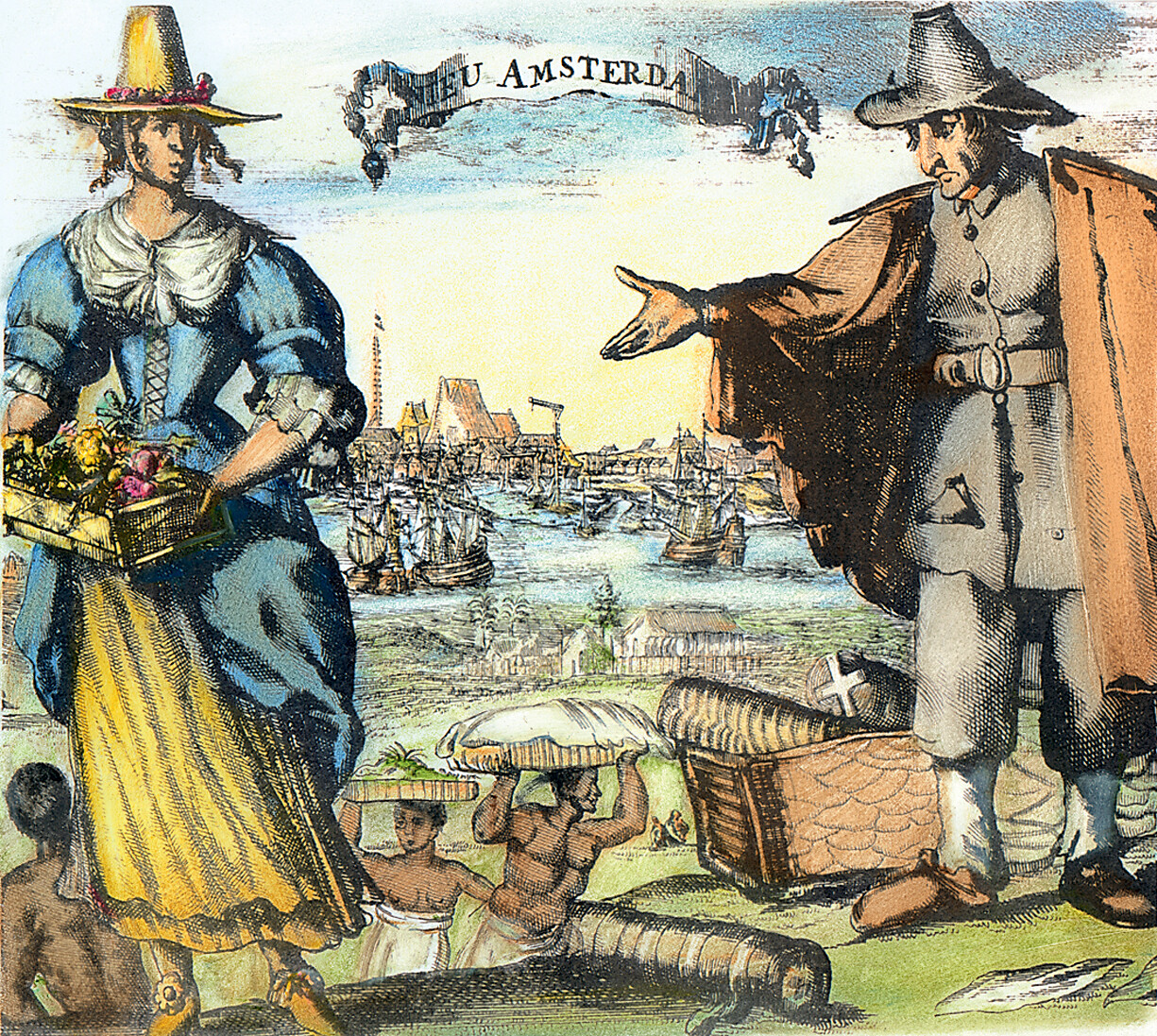
More information
A color engraving depicts Dutch settlers and enslaved African individuals. A man wearing a cloak and a tall hat gestures toward a woman who is also wearing a tall hat and carrying a basket of fruit. A banner between them reads, “Nieu Amsterdam.” In the middle ground, enslaved individuals load tobacco onto ships. A large, colonial style house appears in the distance, bordering a body of water with many large ships. Beyond the water is a city.
Enslaved laborers worked in virtually every area of the expanding colonial economy. As Jedidiah Morse, a prominent minister in Charles Town, admitted in the late eighteenth century, “No white man, to speak generally, ever thinks of settling a farm, and improving it for himself, without negroes.”
Slavery in New York City.
In contrast to their experience in the southern colonies, most enslaved people in the northern colonies lived in towns or cities. Ethnically diverse New York City had more enslaved people than any other American city, and by 1740 it was second only to Charles Town, South Carolina, in the percentage of enslaved people in its population.
ComparingPERSPECTIVES
INDENTURED SERVANTS AND THE LEGAL SYSTEM
From: John Punch Court Decision, 1640.
In the summer of 1640, the General Court punished three indentured servants, a Dutchman, a Scotsman, and an African. All three ran away to break their contract, however the court response showed different treatment based on race. Punch received enslavement for “the time of his natural Life.”
Listen as you read
Whereas Hugh Gwyn hath by order from this Board Brought back from Maryland three servants formerly run away from the said Gwyn, the court doth therefore order that the said three servants shall receive the punishment of whipping and to have thirty stripes apiece one called Victor, a Dutchman, the other a Scotchman James Gregory, shall first serve out their times with their master according to their Indentures, and one whole year apiece after the time of their service is Expired. By their said Indentures in recompense of his Loss sustained by their absence and after that service to their said master is Expired to serve the colony for three whole years apiece, and that the third being a negro named John Punch shall serve his said master or his assigns for the time of his natural Life here or elsewhere.
From: John Reid Jr., Indenture of Apprenticeship with Robert Livingston Jr., November 1, 1742.
Indentureship took many forms in the British American Colonies. In the case of John Reid Jr., from New Jersey, his parents signed an indenture agreement with Robert Livingston Jr., from a prominent New York family, so that he could learn the merchant trade.
Listen as you read
This Indenture Witnesseth, that John Reid of freedhold in the County of Monnmouth Jersey by and with the Consent of his father John Reid of Sd place hath put himself, and by these Presents doth voluntarily, and of his own free Will and Accord put himself an Apprentice to Robert Livingston Jun of New York with him to live, and (after the Manner of an Apprentice) to Serve from the first Day of November: Anno Domini, One Thousand Seven Hundred and Forty two till the full Term of five years be complete and ended. During all which Term the said Apprentice his said Master faithfully shall serve, his Secrets keep, his lawfull Commands gladly every where obey: he shall do no Damage to His said Master nor see to be done by others without letting or giving Notice to his said master he shall not waste his said Masters Goods, nor lend them unlawfully to any, he shall not commit Fornication, nor contract Matrimony within the said Term. At Cards, Dice or any other unlawful Game, he shall not play, whereby his said Master may have Damage with his own Goods, nor the Goods of others within the said Term, without Lisence [sic] from his said Master, he shall neither buy not [sic] sell, he shall not absent himself Day nor Night from his said Masters Service without his Leave, nor haunt Ale-Houses, Taverns or Play-Houses; but in all Things as a faithful Apprentice he shall behave himself to his said Master and all his during the said Term. And the said Master during the said Term shall by the best Means or Method that he can, Teach or cause the said Apprentice to be Taught the Art and Mystery of a Marchent [sic] And also shall find and provide unto the said Apprentice sufficient meat Drink and Lodging.
For the true Perfomance of all and every the said Covenants and Agreements, either of the said Parties bind themselves unto the other by these Presents. In Witness whereof they have hereunto interchangeably put their Hands and Seals this first Day of November in the Sixteenth Year of His Majesty’s Reign Annoq; [sic] Domini, One Thousand Seven Hundred and Forty Two, Sealed and delivered in the Presence of John Reid John Carpenter John Reid Jnr: Richard Smith.
More information
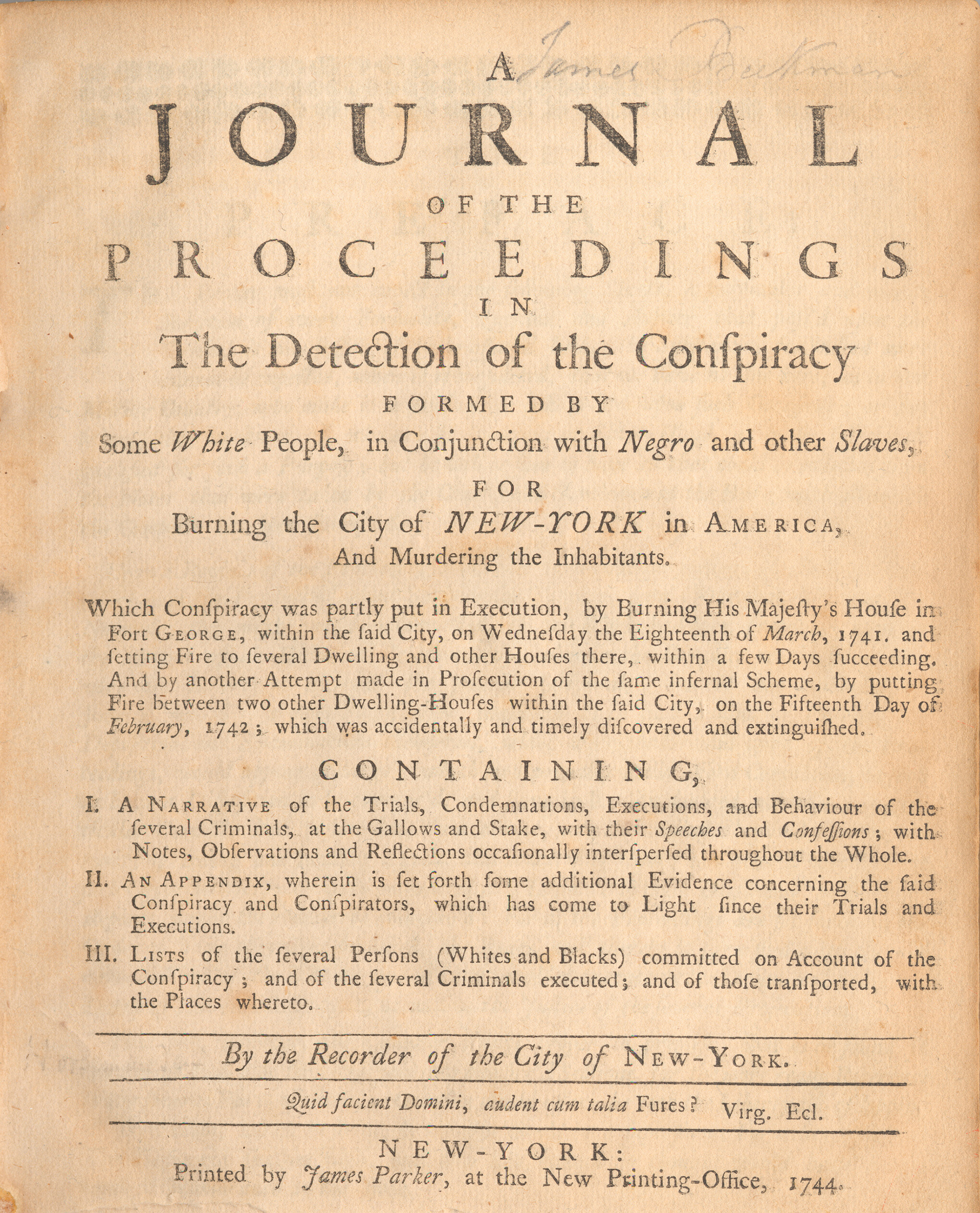
The title page of a document called, “A Journal of the Proceedings in the Detection of Conspiracy formed by some white people, in conjunction with Negro and other slaves, for burning the city of New York in America, and murdering the inhabitants.” The journal describes the trials held, presents additional incriminating evidence, and lists the sentencing of several individuals.
As the number of Africans increased in the city, fears and tensions mounted—and occasionally exploded. In 1712, several dozen enslaved people revolted; they started fires, then killed Whites trying to fight the blaze. Called out to suppress the “Negro plot,” the militia captured twenty-seven Africans, six of whom committed suicide. The rest were executed. New York officials thereafter passed a citywide black code that strictly regulated the behavior of both free and enslaved Blacks.
However, the harsh regulations did not prevent other acts of resistance. In March 1741, city dwellers worried that enslaved people were setting fires, including one at the governor’s house. “The Negroes are rising!” shouted terrified Whites. Mary Burton, a sixteen-year-old White indentured servant, told authorities that enslaved Blacks and poor Whites were plotting to “burn the whole town” and kill the White men. The plotters were supposedly led by John Hughson, a White trafficker in stolen goods. His wife, two enslaved people, and a prostitute were charged as co-conspirators. Despite their denials, all were convicted and hanged. Within weeks, more than half of the adult enslaved males in the city were in jail.
What came to be called the Conspiracy of 1741 ended after seventeen enslaved people and four Whites were hanged. Thirteen more Blacks were burned at the stake, while many others were deported to the Caribbean colonies.
Freedom Seekers and Slave Rebellions.
Many enslaved people who ran away (freedom seekers) in colonial America faced severe punishments when caught. For example, a man named Antonio was an enslaved West African who tried to escape several times. After his last attempt, in 1656, his owner, a young Dutch planter named Syman Overzee, tortured and killed him. Authorities charged Overzee with murder—only to have an all-White jury acquit him.
In a few cases, enslaved people organized rebellions in which they stole weapons, burned and looted plantations, and killed their captors. On Sunday morning, September 9, 1739, while White families were attending church, some twenty enslaved Africans attacked a store in Stono, South Carolina, twenty miles southwest of Charles Town. The rebels seized weapons, killed and decapitated two shopkeepers, and fled south toward Spanish Florida. Along the way, they gathered more recruits.
Within a few days, the Stono rebels had burned six plantations and killed about two dozen Whites. They spared one innkeeper because he was “kind to his slaves.” The rebels continued to free enslaved people as they moved southward. Then well-armed militiamen on horseback caught up with them. Most of the rebels were killed, and sixty of those captured were decapitated by enraged planters.
The Stono Rebellion, the largest uprising of the colonial period, so frightened White planters that they convinced the South Carolina assembly to ban the importation of enslaved Africans for ten years. They also convinced the assembly to pass the Negro Act of 1740, which called for more oversight of enslaved people’s activities and harsher punishments for rebellious behavior. Enslaved people could no longer grow their own food, gather in groups, learn to read or write, or earn money on the side. Those leaving their owner’s supervision were required to have a pass documenting their whereabouts. The law also reduced the penalty for a White killing an enslaved person to a minor offense, and it banned enslaved people from testifying in courts.
By the time of the American Revolution, slavery in North America wasa rapidly growing phenomenon driven by high profits and justified by a pervasive racism. The colonists believed they were entitled to enslave Africans and Native Americans because, in their view, these were people in need of civilizing. But at the same time, the colonists benefited from the diverse skills of enslaved laborers in helping to produce crops and goods that improved the colonists’ quality of life and sustained their dynamic economy. As the enslaved population expanded, worsening race relations and slave rebellions in the North and South prompted the issuing of slave codes to regulate the movement of all enslaved people. They were regarded merely as chattel—that is, as property. Not even the American Revolution’s ideals of freedom and equality (for Whites) would change that attitude.
Glossary
- chattel slavery
- The system of slavery that considered people a legal form of movable property. This type of enslavement included being bought and sold and forced to perform unpaid labor for life. Chattel slavery is most associated with slavery in the Americas and people of African descent.
- slave codes
- Laws passed by each colony, and later by states, governing the treatment of enslaved people; designed to deter freedom seekers and rebellions, slave codes often included severe punishments for infractions.
- Stono Rebellion
- A 1739 slave uprising in South Carolina that was brutally quashed, leading to executions as well as a severe tightening of the slave codes.
- The case was heard by the Governor’s Council, also known as the Privy Council, which served as the upper chamber in the Virginia legislature as well as the highest court in the colony. Hugh Gwyn himself was a member of the lower chamber, the House of Burgesses.
- “Stripes” in the seventeenth century is what we would call “lashes” today. Since it was administered publicly, whipping was both a bodily and a social punishment.
- The Court does not make reference to John Punch’s Indenture as it does here in referring to the other servants. It’s possible that Punch was serving under a form of chattel servitude that was imposed on laborers or tenants for the payment of a debt. While less formal than an Indenture, it would also have been limited by years.
- While most seventeenth-century Indentures were signed in Europe in exchange for passage to the Americas, Indentures in the eighteenth century were more likely between colonists and often for the service of a child, as here. They were common enough to have pre-printed forms with blanks for names, dates, and other details, as was also the case here.
- Most apprentices were in their teens when they went into service, but some were as young as ten years old, too young under today’s legal standards to contract “voluntarily.”
- Isolation and loneliness were the lot of many indentured servants, and were often as much of a reason to run away as was ill treatment. This clause anticipates this risk and forbids any exposure to public pleasures.