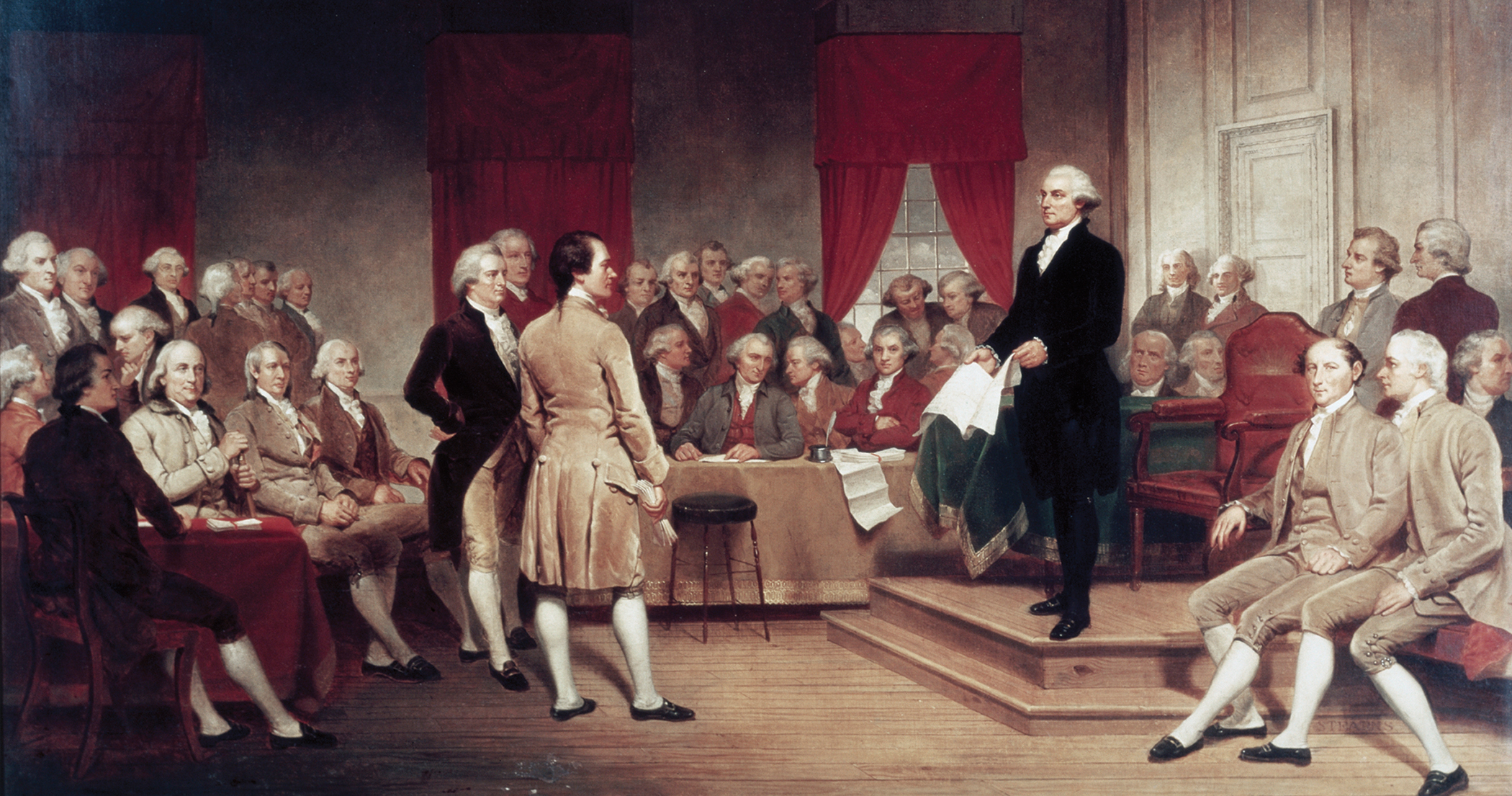
George Washington, the individual honored as “the father of his country” and chosen to preside over the 1787 convention that adopted the United States Constitution, thought the document produced that hot summer in Philadelphia would probably last no more than 20 years, at which time leaders would have to convene again to come up with something new. That Washington’s prediction proved wrong is a testament to the enduring strength of the Constitution. Nonetheless, the Constitution was not carved in stone. It was a product of political bargaining and compromise, formed very much in the same way that political decisions are made today.
The most important issues considered, debated, and resolved through compromises at the Constitutional Convention were questions related to the interplay between governance and representation. To begin with, the delegates hoped to build an effective government—one able to protect citizens’ liberties, maintain order, promote prosperity, and defend the nation’s interests in the world. The framers were afraid, however, that a government sufficiently powerful to achieve these goals might also become sufficiently powerful to endanger its citizens’ liberties.
To guard against this possibility, the framers designed America’s government to include the separation of powers, which divides the national government’s power among different institutions, and federalism, which divides power between the national government and state governments. The framers understood that this design could reduce governmental efficiency and effectiveness—produce “gridlock,” as we might say today—but they were willing to tolerate a bit of gridlock to safeguard liberty.
At the Constitutional Convention of 1787, the delegates debated and eventually agreed on a set of rules and procedures for American government. The political institutions that they designed shape representation and governance in the United States.
Most, if not all, of the delegates to the Constitutional Convention also agreed that the interests of ordinary citizens should be represented in the new government. Delegates were concerned, however, that most ordinary Americans had little knowledge of government and politics, could easily be led astray by unscrupulous politicians, and should play only a limited role in the nation’s governance.
How did the framers try to balance effective government with popular representation?
The institutional design chosen by the framers to reconcile these seemingly contradictory impulses was a system of indirect elections in which citizens would participate in the selection of those who would represent them but would not make the final choice. Senators were to be appointed by the state legislatures, judges were to be appointed by the president with the approval of the Senate, and the president was to be elected by an Electoral College chosen by the state legislatures. All these processes would begin with representative institutions elected popularly by ordinary citizens—the state legislatures—but the final outcomes would be determined and “refined” by members of the political elite, who, the framers hoped, would be somewhat more knowledgeable and wiser in their decisions. In the national institutions of government, only members of the House of Representatives were to be popularly elected, and some framers thought even this concession to direct democracy was a mistake.
Today, senators are also popularly elected, as are the members of the Electoral College. Nevertheless, for better or worse, the constitutional system of representation continues to affect governance in the United States. For example, two of America’s three most recent presidents—Donald Trump in 2016 and George W. Bush in 2000—joined Rutherford Hayes in 1876 and Benjamin Harrison in 1888 as presidents who were elected by winning majorities in the Electoral College despite losing the popular vote. We will discuss this topic in more detail in Chapter 10.
In this chapter we explore the institutions and procedures established in the Constitution, and how the framers settled on these features of government.
Learning Objectives
Describe the major political-historical developments that led to the Constitutional Convention of 1787.
Explain why the Articles of Confederation were not strong enough to provide effective governance.
Outline the major provisions of the United States Constitution.
Analyze how the framers attempted to balance representation with effective governance.
Describe how the amendment process allows the Constitution to evolve over time.