Chapter 3: Federalism and the Separation of Powers
3FEDERALISM AND THE SEPARATION OF POWERS
How do federalism and the separation of powers affect if, when, and how people matter in government?
On January 6, 2021, Norma Anderson watched as supporters of President Donald Trump launched an insurrection in the U.S. Capitol. A lifelong Republican who had served as the Republican majority leader in the Colorado House of Representatives, Anderson had a strong reaction when she witnessed Trump’s involvement in the day’s events. “I’ve lived through a lot of presidents. Some I liked, some I didn’t. But not one of them caused an insurrection, until Donald Trump,” she said.1
Anderson remained clear that she was a Republican (“I will be a Republican when I die. I was born one, I will die one.”),2 but she could not, in good conscience, support Trump’s actions. She was dismayed when he tried to run for election again in 2024. So when an organization called CREW—Citizens for Responsibility and Ethics in Washington—reached out to Anderson in 2023 to ask if she’d be interested in joining a case that would look to Section 3 of the Fourteenth Amendment to stop Trump from appearing on Colorado’s state ballot, Anderson knew she wanted to be involved.3
Anderson became the lead plaintiff in a case, Anderson v. Griswold, that sought to advance an interpretation of the Fourteenth Amendment that could keep Trump off the ballot in Colorado. The case drew on a clause in the amendment that specified that those who “engaged in” an insurrection against the United States after taking an oath to “support” the Constitution were rendered ineligible to hold future office.4
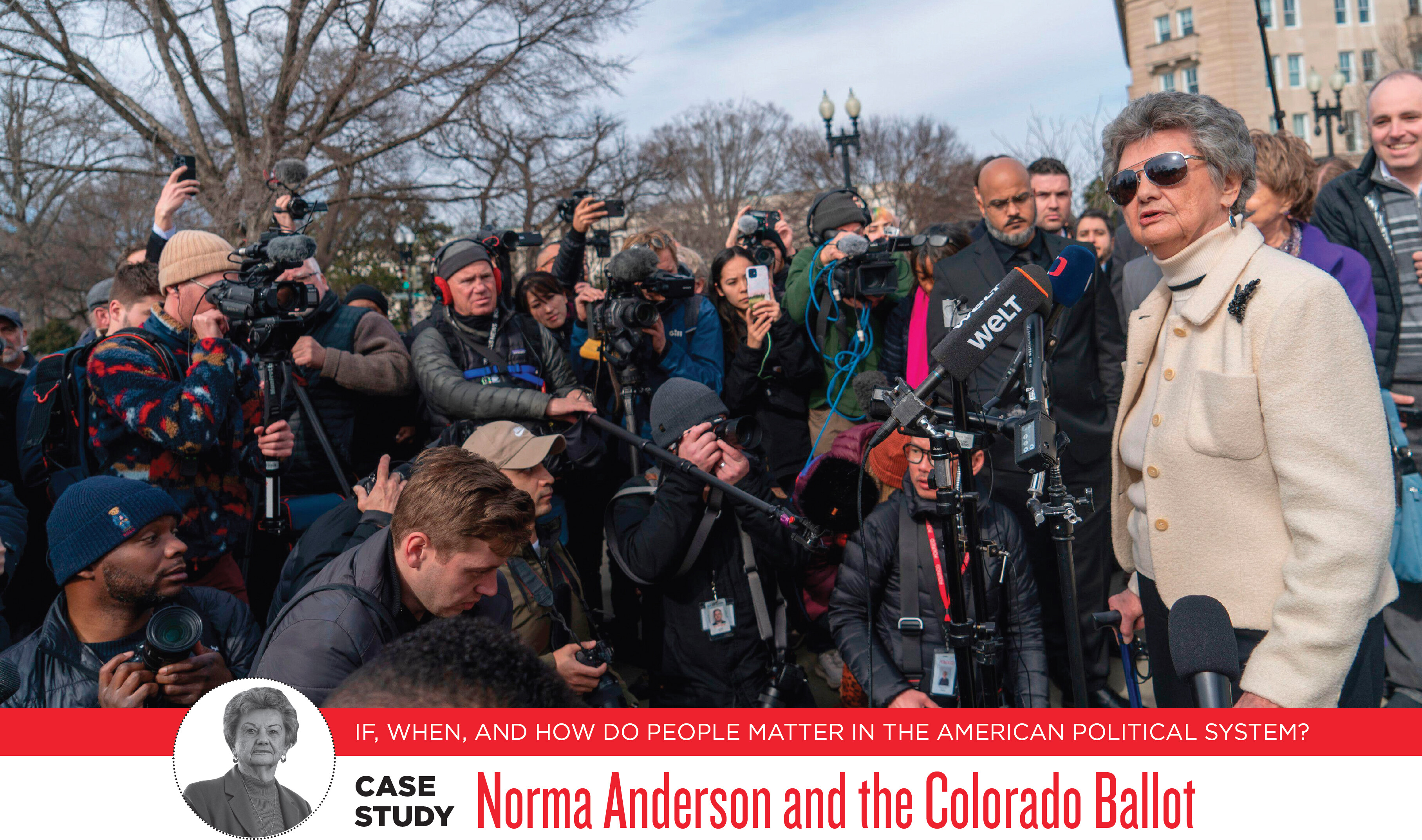
More information
A photo of Norma Anderson, who tried to get Trump off the California ballot. She stands in front of a media group waiting to ask her questions.
The case moved through the Colorado court system and ultimately went to the Colorado Supreme Court, which ruled that Trump’s actions indeed disqualified him from the presidency. From there, the case went to the U.S. Supreme Court, which faced an issue that got to the core of federalism: How does a nation think about proper allocation of authority between the federal government and state governments? In its decision, the Colorado Supreme Court leaned heavily into the authority states have over election administration in the United States; this authority affirms that states can decide which candidates to list on the ballot and varies from state to state. How would the U.S. Supreme Court rule?
The Constitution’s framers wanted to build a strong national government but, at the same time, they wanted to ensure that government would not use its strength to oppress citizens and would respect the knowledge states had about their own citizens’ needs. Federalism and the separation of powers are two of the most important ways that the framers hoped to balance these considerations.
Federalism seeks to limit government by dividing it into two levels: the national level and the state level. Often the two levels must cooperate; for example, state governments depend upon federal dollars to finance badly needed programs, while federal agencies rely on state and local officials to implement them. Yet each level retains sufficient independence to compete with the other, in this way restraining the power of both.
The separation of powers, for its part, seeks to limit the national government’s power by dividing government against itself—by assigning the legislative, executive, and judicial branches separate but overlapping functions, thus forcing them to share power. James Madison, the Constitution’s chief architect, wrote in Federalist 51 (reprinted in the Appendix), “The interior structure of the government” must be arranged so “that its several constituent parts may, by their mutual relations, be the means of keeping each other in their proper places.” Dividing power might sometimes make government less efficient—promote “gridlock,” as we might say today—but the framers thought this was a price worth paying to guard against oppressive governmental action.
Federalism and the separation of powers are among the building blocks of America’s complex system of representative government—the system that determines, essentially, if, when and how people matter in government and politics. But it creates a complicated system for decision making. In challenging the ability of Trump to stay on Colorado’s ballot, Norma Anderson was drawing on the state’s independent powers over election administration to advance what she thought was the right thing for the country. As she put it, “My biggest concern is losing our democracy.”5
But both federalism and the separation of powers complicate policy making in the United States. If governmental power were arranged neatly and simply in a single hierarchy, decisions could certainly be made more easily and efficiently. But would they be better decisions? The framers thought that although complexity, checks and balances, and institutionalized second-guessing are messy, they would allow more interests within society to have a voice and would eventually produce better results. Along the way, these decision processes would help preserve liberty and prevent tyranny. Although this complexity sometimes seems to make it impossible to get anything done collectively, political decision makers have developed a variety of strategies for overcoming the barriers to policy change. Let’s see how this complex system works and, ultimately, what the U.S. Supreme Court decided on the Colorado ballot.
After reading this chapter, you should be able to . . .
- Define federalism and explain how it limits national power.
- Trace how federalism evolved in the United States from the Founding through the twentieth century.
- Describe the shift toward increased national power since 1937 and the major features of American federalism today.
- Identify the major checks and balances among the institutions of government.
- Analyze how federalism and the separation of powers affect representation and governance.
Endnotes
- Marshall Cohen, “How Using the 14th Amendment against Trump Went from a ‘Pipe-Dream Fantasy’ to the Supreme Court,” CNN, February 6, 2024, https://www.cnn.com/2024/02/06/politics/14th-amendment-supreme-court-liberal-groups-planning/index.html (accessed 6/30/24). Return to reference 1
- Zach Montellaro, “‘When Duty Calls, You Do It’: The 91-Year-Old Lawmaker Who Could Have Trump Disqualified,” Politico, February 7, 2024, https://www.politico.com/news/2024/02/07/anderson-trump-supreme-court-ballot-00139991 (accessed 6/30/24). Return to reference 2
- Cohen, “How Using the 14th Amendment.” Return to reference 3
- Montellaro, “‘When Duty Calls.’” Return to reference 4
- Patrick Marley, “The 91-Year-Old Republican Suing to Kick Donald Trump off the Ballot,” Washington Post, February 5, 2024, https://www.washingtonpost.com/politics/2024/02/05/trump-supreme-court-ballot-norma-anderson/ (accessed 6/30/24). Return to reference 5