People rarely express in words all the premises they are using in an argument. Most arguments contain some premises that are assumed but not stated. We refer to these as implicit premises to distinguish them from the explicit premises that are actually stated. Suppose we are planning a hiking trip, and I tell you that Sally can’t come because she has a broken leg. My argument clearly assumes that people with broken legs can’t go hiking, but I didn’t state that premise, because it was too obvious. Everyday speech would be horribly stilted and tedious if we stated all our premises explicitly. It makes sense to state only the new, the substantive, or the controversial premises of an argument.
But sometimes it is the substantive and controversial premise that goes unspoken, making an argument seem more plausible than it really is. Suppose I argue that since bungee-jumping is dangerous, there ought to be a law against it. This argument relies on the implicit premise that the government should ban things that are dangerous. This is not an assumption that everyone would accept; it relies on a particular view about the proper role of government, and really should be supported logically before one uses it to derive a further conclusion.
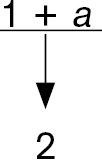
So when we analyze an argument, it is important to identify the implicit premises. They can then be labeled—using letters instead of numbers to distinguish them from explicit premises—and included in the diagram. The argument about Sally, for example, would be diagrammed as follows:
1. Sally has a broken leg.
a. No person with a broken leg can go hiking.
2. Sally can’t go hiking.
More information
The number 1 appears on a horizontal line along with the letter a, both separated by a plus sign. A downward arrow points from the line to the number 2 below it.
Notice that 1 and a are dependent premises. This will always be the case when we fill in implicit premises. Our justification for reading an implicit premise into an argument is that the assumption is necessary in order to link a stated premise with the conclusion. By the very nature of the case, the implicit premise has to work together with some explicit premise. If we supply a new independent premise, we are adding a new line of argument and not merely analyzing the argument at hand. Notice, too, that the argument is now a deductive one. If premises 1 and a are both true, then the conclusion must be true as well. This will not always be the case when we fill in implicit premises, however, for reasons that we will discuss in a moment.
In the argument above, it was easy to identify the implicit premise. It is not always so easy, and it will be helpful to have certain rules to follow. To understand these rules, we have to keep in mind what our goal is. Identifying implicit premises is a means to the goal of analyzing an argument. The point of argument analysis is to understand what the premises of an argument are and how they relate to the conclusion. In the case of implicit premises, however, we also need to consider what assumption would be necessary for the argument to provide good support for the conclusion. Identifying implicit premises is also a means, therefore, to the goal of evaluating an argument. In light of these goals, there are two basic rules we should follow:
The premise we supply should narrow the logical gap between the stated premise and the conclusion
The premise we supply should not commit us to more than is necessary.
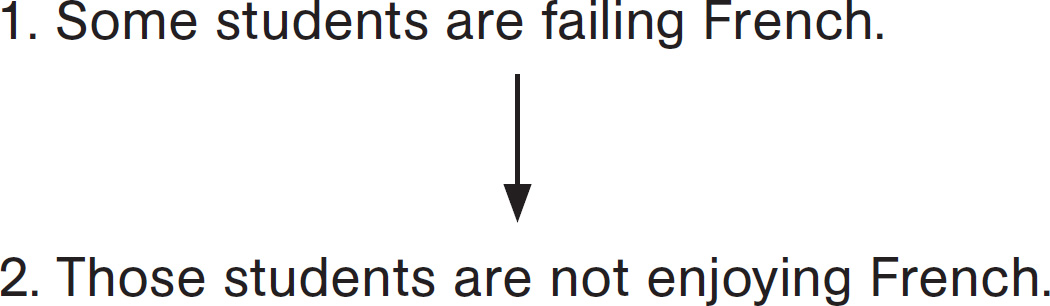
Let’s see how these rules apply to a specific case. Suppose you are taking French, and you learn that some of your classmates are failing; you infer they do not enjoy the subject. In diagram form:
More information
Text at the top reads: 1, Some students are failing French. A downward arrow points to the text: 2, Those students are not enjoying French.
What is the implicit premise in your argument? Consider the following candidates:
French is a Romance language.
Paris is beautiful in the springtime.
People never enjoy something that they find difficult.
Students never enjoy subjects in which they are failing.
Using rule 1, we can eliminate the first two candidates, both of which are irrelevant to the conclusion. Neither of them will help close the gap in the argument as stated. Rule 2 will help us choose between the remaining candidates. Both of the latter two would close the gap in the argument. Indeed, each of them would eliminate the gap entirely by making the argument deductive. But notice that the third premise is a much more sweeping generalization than the fourth; it applies to all people and all activities, whereas the last premise applies only to students and the subjects they are studying. Since the last premise serves our purpose without committing us to as much as the third one would, it is the one we should choose.
Sometimes we have to supply more than one premise in order to make sense of an argument. Consider the earlier example about gun control:
More information
Text at the top reads: 1, Restricting ownership of handguns will reduce crimes. A downward arrow points to the text: 2, The government should restrict handgun ownership.
To connect the premise with the conclusion, we need to say something about the government’s responsibility for reducing crime. Is the assumption that the government should take every means possible to reduce crime? No. That assumption would commit us to far more than is necessary. It would imply that the government should put troops in armored cars on every street corner, force people to ask permission before they leave their homes, and engage in all manner of other police-state tactics. For the argument to have any plausibility, the real assumption must be that the government should take any measures that will reduce crime without unduly sacrificing other values (such as liberty). But now we must introduce an additional implicit premise to the effect that restricting handgun ownership will not unduly sacrifice other values. The complete argument now goes like this:
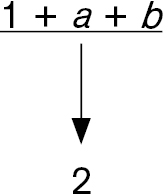
1. Restricting handgun ownership will reduce crime.
a. The government should take any measures that will reduce crime without unduly sacrificing other values.
b. Restricting handgun ownership will not unduly sacrifice other values.
2. The government should restrict handgun ownership.
In diagram form, it looks like this:
More information
The number 1 appears on a horizontal line along with the letters, a and b, each of them separated by a plus sign. A downward arrow points from the line to the number 2 below it.
REVIEWFinding Implicit Premises
To identify the implicit premise in an argument, look for a premise that:
Closes the logical gap between the stated premises and the conclusion.
Does not commit the speaker to more than is necessary.
In all the examples we have discussed so far, we supplied an implicit premise that made the argument deductive. Doing so has the advantage of eliminating any gap between premises and conclusion, so that we can then focus our attention exclusively on whether the premises are true. In some cases, however, it is more reasonable to supply a premise that makes the argument inductive. Consider an example from the previous section: It will probably rain tomorrow, because a cold front is moving in and cold fronts usually bring rain. Suppose that second premise had been left unstated. In that case, we would need to choose between two possible implicit premises:
Cold fronts usually bring rain.
Cold fronts always bring rain.
The first premise is true, and it gives us an inductive argument that is pretty strong. The second premise gives us a deductive argument, but only at the cost of a premise that is false. The trade-off isn’t worth it.
EXERCISE 2.5
Integrative Exercise
Identify the implicit premise(s) in each of the following arguments.
Tom is a very successful salesman, so he must be an outgoing person.
SHOW ANSWERHIDE ANSWER
Successful salesmen are outgoing people.
The doorbell just rang. Someone must be at the door.
Cheating is dishonest and therefore wrong.
This sample of copper melted at 1063°C in the laboratory. Therefore, all copper has a melting point of 1063°C.
SHOW ANSWERHIDE ANSWER
All copper has the same melting point.
Politicians who are convicted of crimes should not be returned to office, so Congressman Jones should not be re-elected.
The arresting officer had not read Johnson his Miranda rights, so the judge had to let him go, even though he confessed to the Pine Street burglary.
The traditional vinyl record, played on top-of-the-line equipment, can reproduce the spatial features of music such as the positions of the instruments in an orchestra. So in that respect it is superior to most mp3 recordings.
SHOW ANSWERHIDE ANSWER
(a) It is desirable for a recording to reproduce the spatial features of music.
(b) Most mp3 recordings do not reproduce the spatial features of music.
The government should continue to deregulate the telecommunications industry, because we need an industry that can act quickly and flexibly to exploit the new communications technology.
The plays attributed to Shakespeare exhibit a profound intelligence, but Shakespeare himself never went to college, and therefore could not have been very intelligent. So someone else wrote his plays.
When testing the effects of a new drug, it’s important to isolate the physical effects of the drug from the psychosomatic effects of taking it. Therefore, one must use a placebo.
SHOW ANSWERHIDE ANSWER
Placebos isolate physical effects from psychosomatic effects.
The washing machines and dryers at the laundromat only accept quarters. So I will need to get change before I take my laundry there.
The Australian tiger snake is one of the most venomous snakes in the world and is responsible, on average, for 12 deaths each year. Bites can be properly treated only with antivenom. Therefore if you are bitten by this snake, it is extremely important to seek out a hospital immediately.
Since the subway train didn’t stop at this platform, it must have been an express train.
SHOW ANSWERHIDE ANSWER
All non-express trains would stop at this platform.
Because magnets aren’t attracted to this can, I know it’s not made of steel. Thus it must have been made from pure aluminum.
Even though Nigel is very talented, and has sold a few of his sculptures, he will never be a great artist. Being a great artist requires more than talent. All great artists must be willing to devote themselves entirely to their art.