 what if . . .
What if our Solar System were located in the Andromeda Galaxy? What would our cosmic address be then?
1.1 Earth Occupies a Small Place in the Universe
Locating Earth in the larger universe is the first step in learning the science of astronomy. In this section, you will get a feel for the neighborhood in which Earth is located, and begin to develop a framework to organize your growing knowledge of the universe by both size and distance from Earth. You will also begin to explore the scale of the universe in both space and time.
Our Place in the Universe
Many people receive their postal mail at an address—house or building number, street, city, state, and country. If we expand our view to include the enormously vast universe, our “cosmic address” might include our planet, star, galaxy, galaxy group or cluster, and galaxy supercluster. Follow along in Figure 1.1 as we describe your cosmic address.
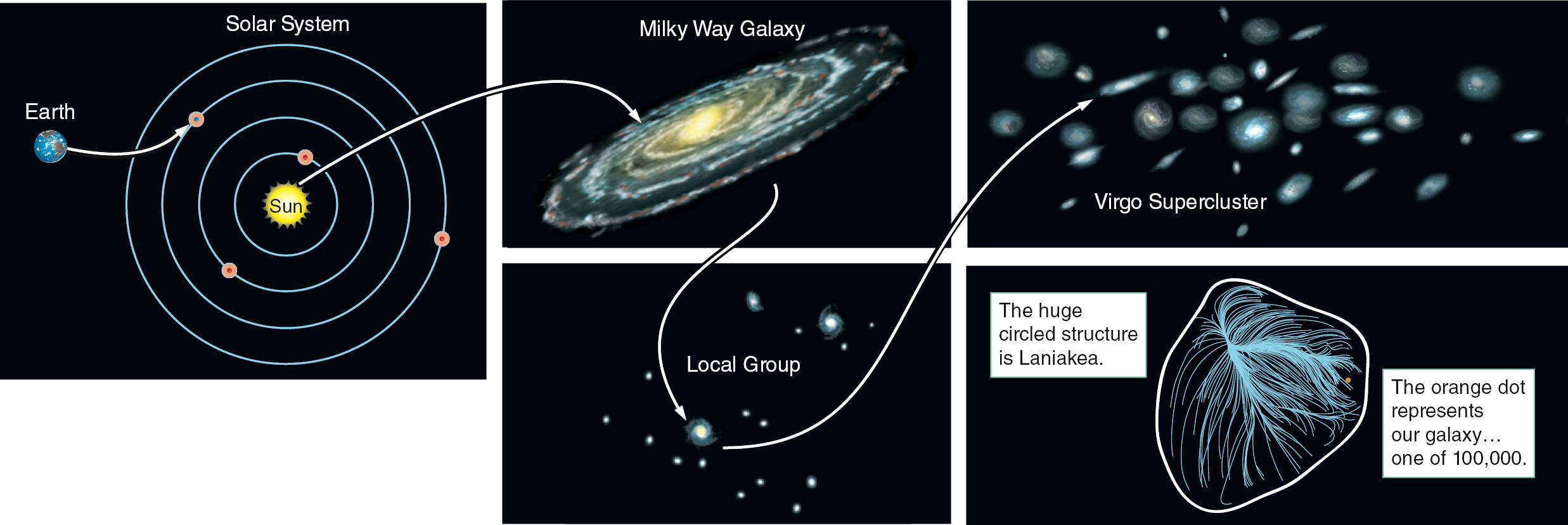
★ WHAT AN ASTRONOMER SEES In this type of figure, an astronomer will be especially sensitive to the arrows, which show that the figure “zooms out” from panel to panel. While each panel is the same size on the page, they represent dramatically different sizes in space. This figure is representative, without precision, but an astronomer will know that the Laniakea structure in the last panel is much larger—more than 100,000,000,000,000,000 times larger—than Earth, in the first panel. Learning to work with large numbers and ranges of size is one of the challenges of thinking like an astronomer.
We reside on a planet called Earth, which is orbiting under the influence of gravity around a star called the Sun. The Sun is an ordinary middle-aged star. It is more massive and luminous than some stars but less massive and luminous than others. The Sun is extraordinary only because of its importance to us within our own Solar System. Our Solar System consists of eight planets (listed in order of distance from the Sun): Mercury, Venus, Earth, Mars, Jupiter, Saturn, Uranus, and Neptune. It also contains many smaller bodies, such as dwarf planets (for example, Pluto, Ceres, and Eris), asteroids (for example, Ida and Eros), and comets (for example, Halley). All those objects are gravitationally bound to the Sun.
The Sun is one of several hundred billion stars in the Milky Way Galaxy, a pancake-shaped disk of stars, gas, and dust. The Sun is located about halfway out from the center of this disk. Like the Sun, most stars in the Milky Way Galaxy have planets in orbit around them.
The Milky Way is a member of a collection of a few dozen galaxies, including the Andromeda and Triangulum Galaxies, similar to the Milky Way, and about 20 smaller galaxies, called the Local Group. Most galaxies in that group are much smaller than the Milky Way. The Local Group, in turn, is part of a vastly larger collection of thousands of galaxies—a supercluster—called the Virgo Supercluster, which astronomers have more recently learned is part of an even larger grouping called the Laniakea Supercluster. (Unusually for astronomy, there are not special names that distinguish various sizes of superclusters.) The observable universe has millions of superclusters.
We can now define our cosmic address—Earth, Solar System, Milky Way Galaxy, Local Group, Virgo Supercluster, Laniakea Supercluster. Yet even that address is incomplete because it encompasses only the local universe. The part of the universe that we can see—the observable universe—extends to many times the size of Laniakea in every direction. This observable part of the universe contains roughly 2 trillion (two thousand billion) galaxies. The entire universe is much larger than the local universe and contains much more than the observed planets, stars, and galaxies. Astronomers estimate that about 95 percent of the universe is made up of matter that does not interact with light, known as dark matter, and a form of energy that permeates all space, known as dark energy. Dark matter and dark energy aren’t well understood, and they are among the many exciting areas of research in astronomy.
The Scale of the Universe
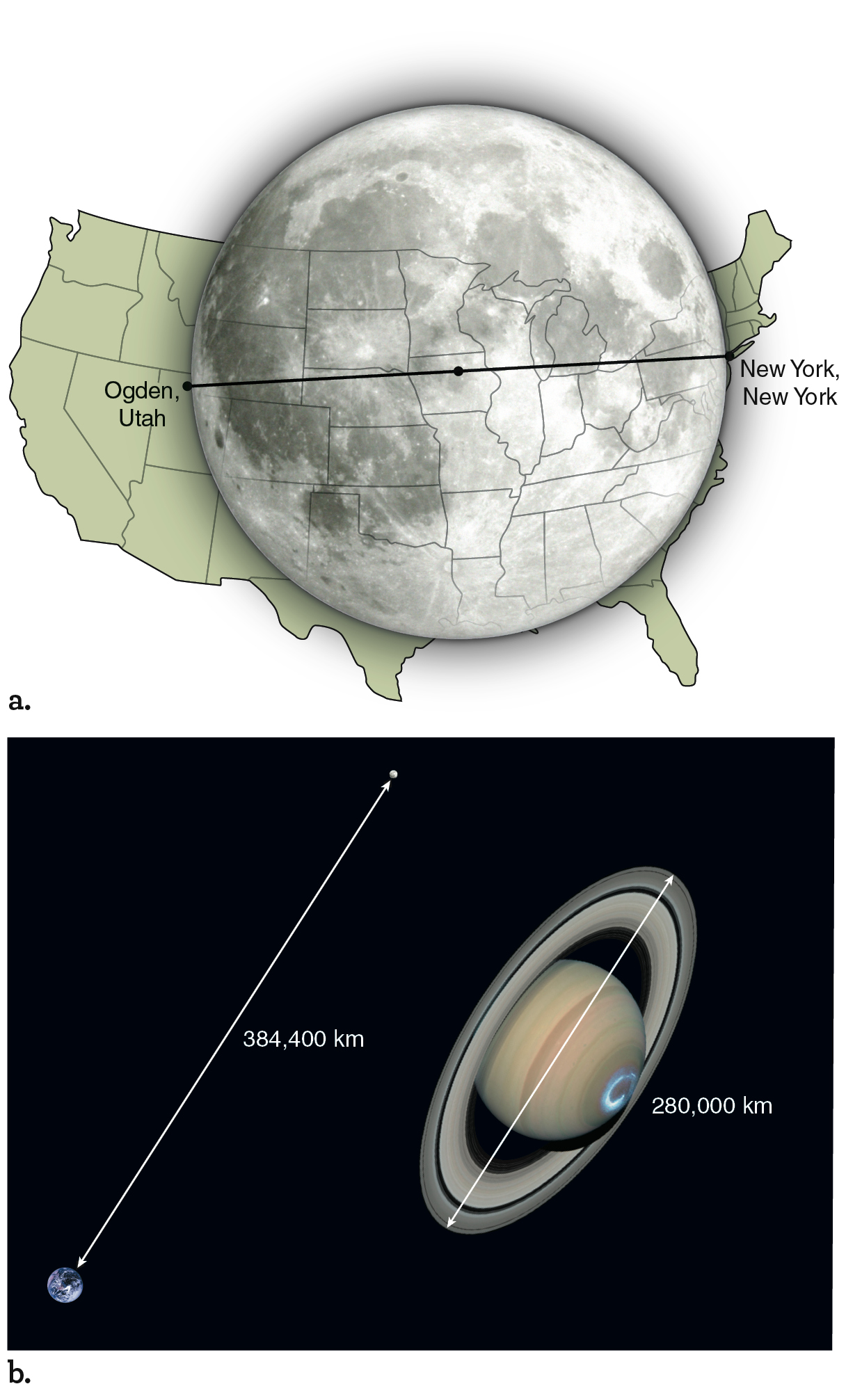
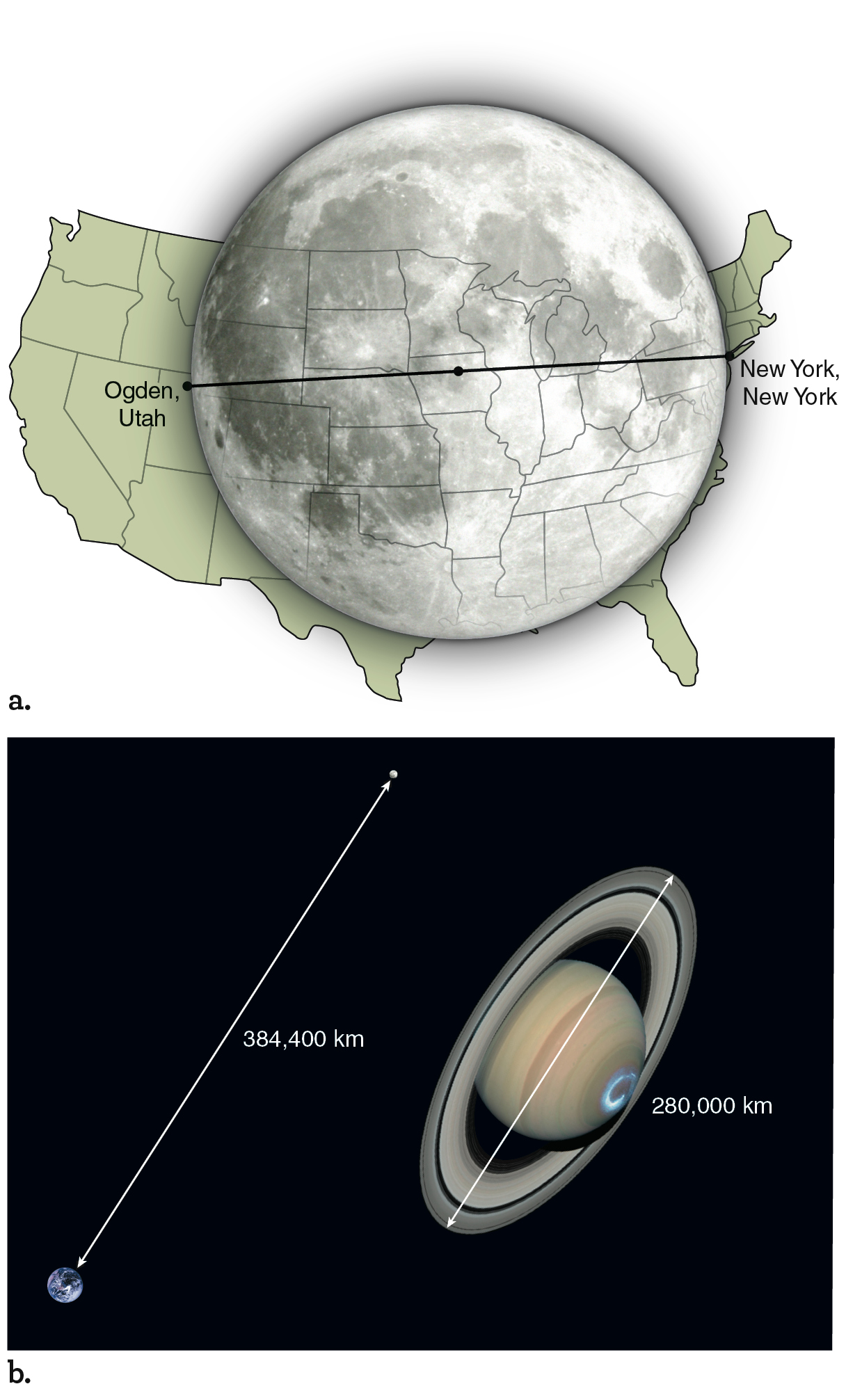
As shown in Figure 1.1, the size of the universe completely dwarfs our human experience. We can start trying to understand astronomical size scales by comparing astronomical sizes and distances to something more familiar. For example, the diameter of our Moon (3474 kilometers [km]) is slightly greater than the distance between New York, New York, and Ogden, Utah (Figure 1.2a), about 80 percent of the way across the United States. The distance from Earth to the Moon is about 100 times that distance, which is comparable to the diameter of the planet Saturn with its majestic rings (Figure 1.2b). The distance from Earth to the Sun is about 400 times the Earth–Moon distance, and the distance to the planet Neptune is about 30 times the Earth–Sun distance. We could multiply all those relationships together, to find that the distance from the Sun to Neptune is 1.2 million times greater than the distance from New York, New York to Ogden, Utah.
Credit (part b.): NASA, ESA, J. Clarke (Boston University, USA), and Z. Levay (STScI). https://esahubble.org/products/calendars/cal200604/. https://creativecommons.org/licenses/by/4.0/.
The enormous distances beyond the edge of the Solar System are even more difficult to comprehend, but astronomers have a useful “trick” to help with this problem. In common language, we often use distance and time interchangeably; for example, if someone asks you how far it is to the nearest city, you might say 100 km or you might say 1 hour. In either case, you will have given that person an idea of how far away the city is. It would be unusual to say that the city is one “car-hour” away, but inventing that term would be one way to be more precise in your language. The city is as far away as a car can travel in one hour; it is one car-hour away.
unanswered questions
What makes up the universe? We have listed planets, stars, and galaxies as components of the universe, but astronomers now have evidence that 95 percent of the universe is in the form of dark matter and dark energy, which we do not yet understand. Scientists are using the largest telescopes and particle colliders on Earth, as well as telescopes and experiments in space, to explore what makes up dark matter and what constitutes dark energy.
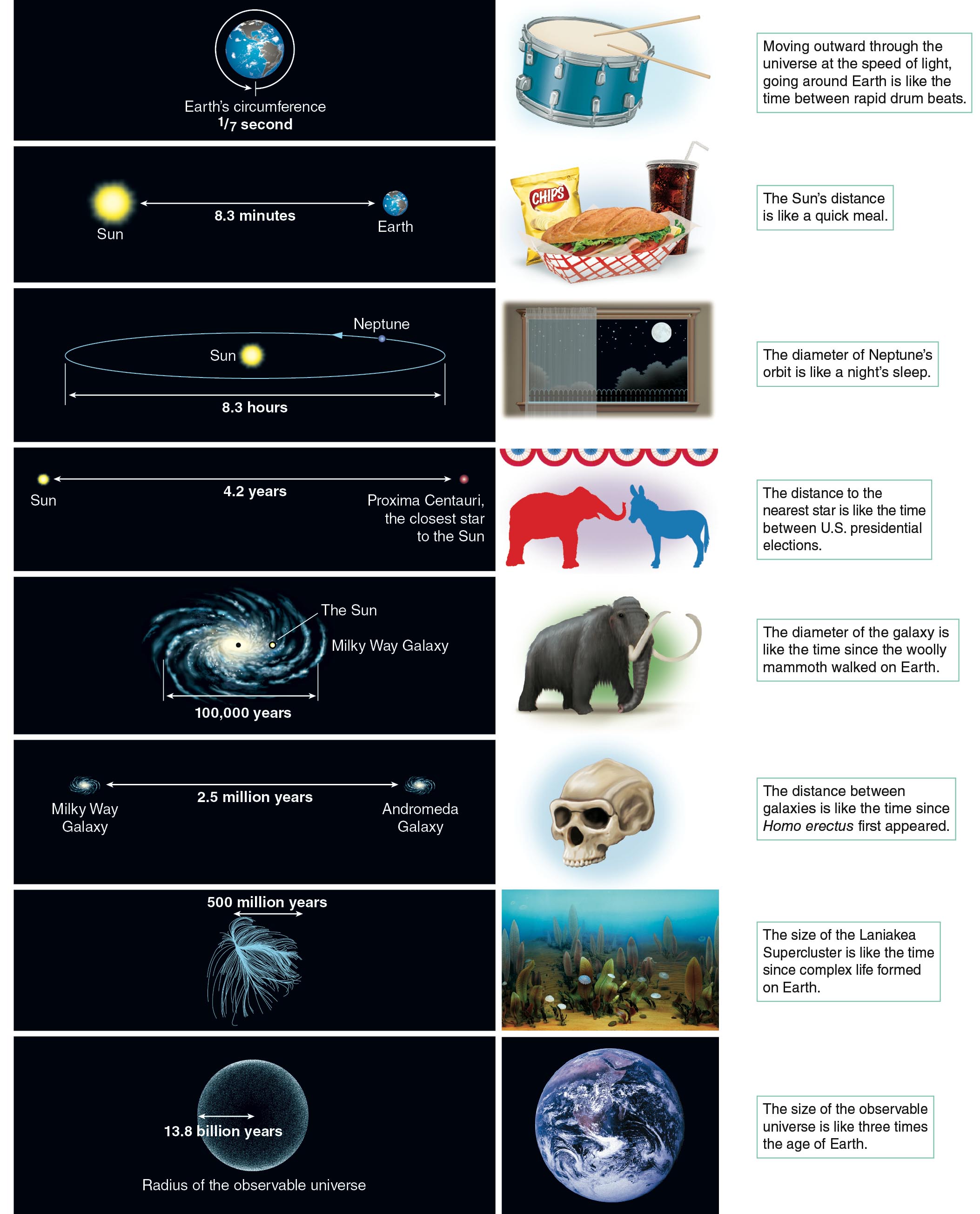
In astronomy, the speed of a car on the highway is far too slow to be useful. Instead, astronomers use the fastest speed in the universe—the speed of light—to express the vast distances. Light travels at 300,000 kilometers per second (km/s). Traveling at the speed of light, you could travel all the way around Earth—a distance of 40,000 km—in just under 1⁄7 of a second. Astronomers would then say that the circumference of Earth is 1⁄7 of a “light-second.” Most distances in astronomy are so vast that they are measured in units of light-years (ly): the distance light travels in 1 year—about 9.5 trillion km or 6 trillion miles. Pause for a moment to think about how much longer a year is than a second; this is how much bigger a light-year is than a light-second.
Because light takes time to reach us, we see astronomical objects not as they are now, but as they used to be. We see them as they were in the past, when the light left them to begin its travel toward Earth. Because light from the Moon takes 11⁄4 seconds to reach us, we see the Moon as it was 11⁄4 seconds ago. Because light from the Sun takes 81⁄3 minutes to reach us, we see the Sun as it was 81⁄3 minutes ago. We see the nearest star as it was more than 4 years ago and we see the Andromeda Galaxy as it was 2.5 million years ago. The light from the most distant observable objects has been traveling for almost the age of the universe—nearly 13.8 billion years. Figure 1.3 shows distances ranging from the size of Earth to the size of the observable universe, expressed as the time it takes light to travel that far. This is often called the “light travel time.”
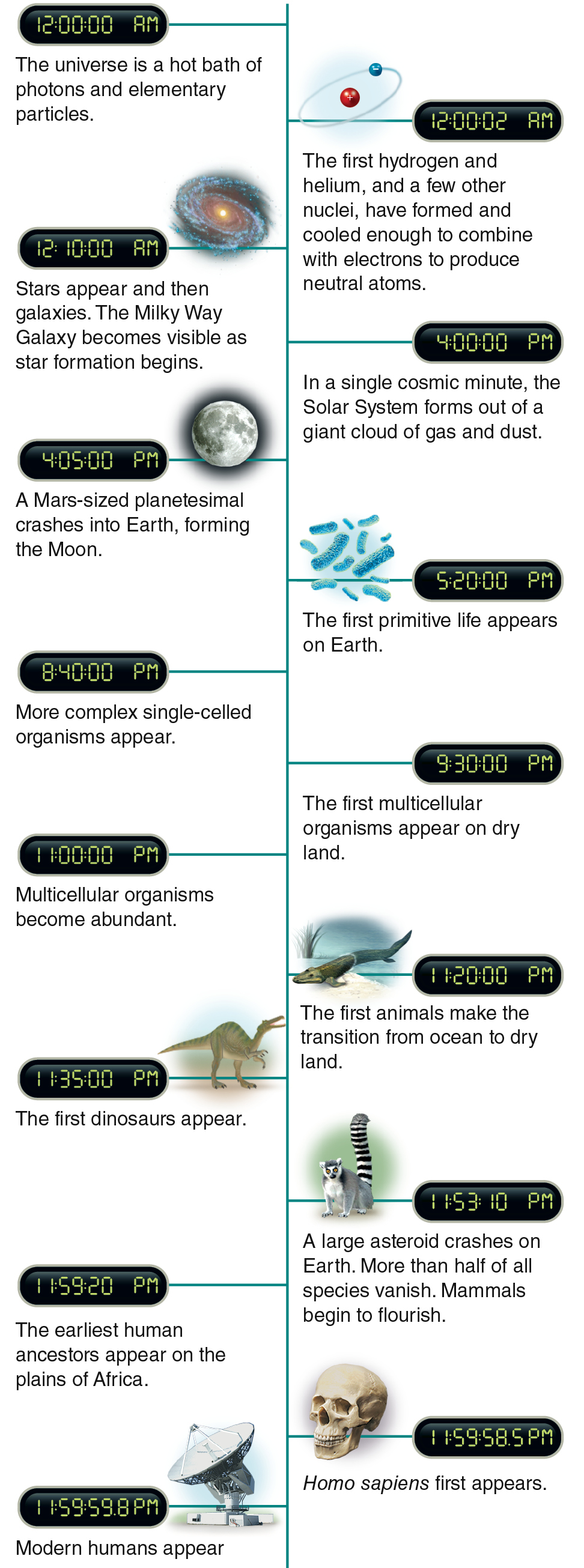
These vast distances show that we occupy a very small part of the space in the universe. We also occupy only a very small part of time. Imagine that the entire history of the universe took place within a single day. The universe begins the cosmic day at midnight, and hydrogen and helium cool enough to combine with electrons within the first 2 seconds. The first stars and galaxies appear within the first 10 minutes. Generations of stars are born and die before our Solar System forms from recycled gas and dust at about 4 p.m. The first bacterialon Earth appears at 5:20 p.m., the first land animals appear at 11:20 p.m., and modern humans appear at 11:59:59.8 p.m.—that is, with just 1⁄5 of a second left in the cosmic day. We humans occupy only a sliver of time in the history of the universe, as illustrated in Figure 1.4.
CHECK YOUR UNDERSTANDING 1.1
Rank the following from smallest to largest: (a) a light-minute, (b) a light-year, (c) a light-hour, (d) the radius of Earth, (e) the distance from Earth to the Sun, (f) the radius of the Solar System.
 Answer
 Answer
d, a, e, c, f, b
Glossary
- Sun
- The star at the center of the Solar System.
- Solar System
- The gravitationally bound system made up of the Sun, planets, dwarf planets, moons, asteroids, comets, and Kuiper Belt objects, along with their associated gas and dust.
- Milky Way Galaxy
- The galaxy in which the Sun and Solar System reside.
- Local Group
- The group of galaxies that includes the Milky Way and Andromeda galaxies.
- supercluster
- A large conglomeration of galaxy clusters and galaxy groups, typically more than 100–300 megaparsecs (Mpc) in size and containing tens of thousands to hundreds of thousands of galaxies. Compare galaxy cluster and galaxy group.
- light-years (ly)
- (ly) The distance that light travels in 1 year—about 9.5 trillion kilometers (km).