2.5 Eclipses Result from the Alignment of Earth, the Moon, and the Sun
Ancient peoples must have been terrified to see an eclipse, as they watched the Sun or the Moon being eaten away as if by a giant dragon. An eclipse is the total or partial obscuration of one celestial body, or the light from that body, by another celestial body. In this section, we describe the types of eclipses and their frequency.
Solar Eclipses
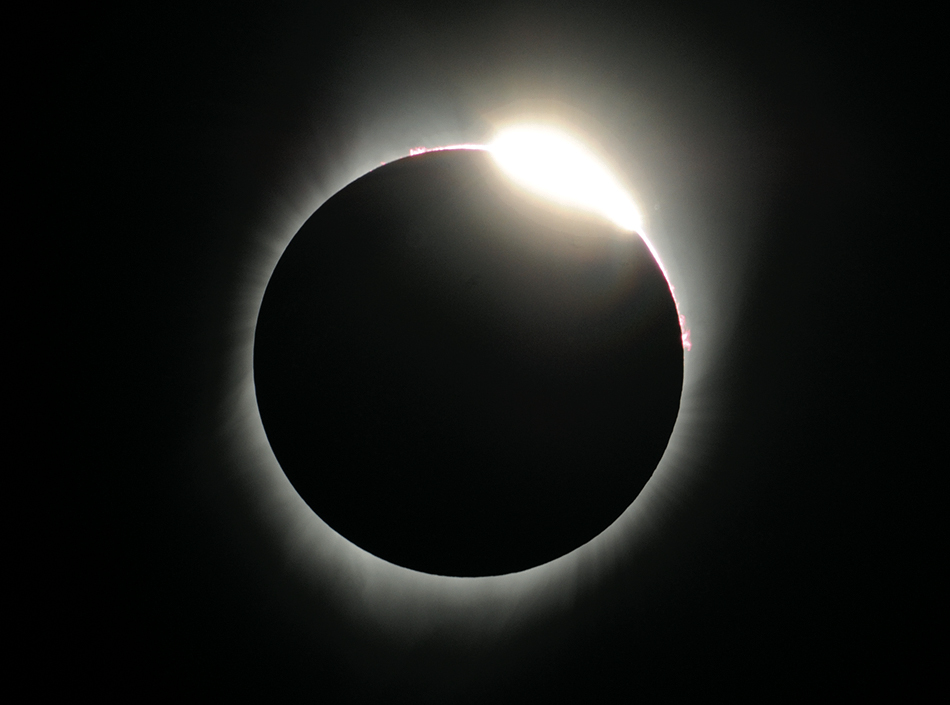
A solar eclipse occurs when the Moon passes between Earth and the Sun; observers on Earth in the shadow of the Moon will see the eclipse. Three types of solar eclipses exist: total, partial, and annular. Consider the structure of the shadow of the Sun cast by a round object such as the Moon, as shown in Figure 2.24. An observer at point A would see the Sun blocked. That darkest, inner part of the shadow is called the umbra. If a location on Earth passes through the Moon’s umbra, the Moon blocks all the Sun’s light, and a total solar eclipse will be observed (Figures 2.25 and 2.26a). At points B and C in Figure 2.24, an observer can see one side of the disk of the Sun but not the other. Only partially in shadow, that outer region is the penumbra. If a location on Earth passes through the Moon’s penumbra, viewers there will observe a partial solar eclipse, in which the Moon’s disk blocks the light from a portion of the Sun’s disk.
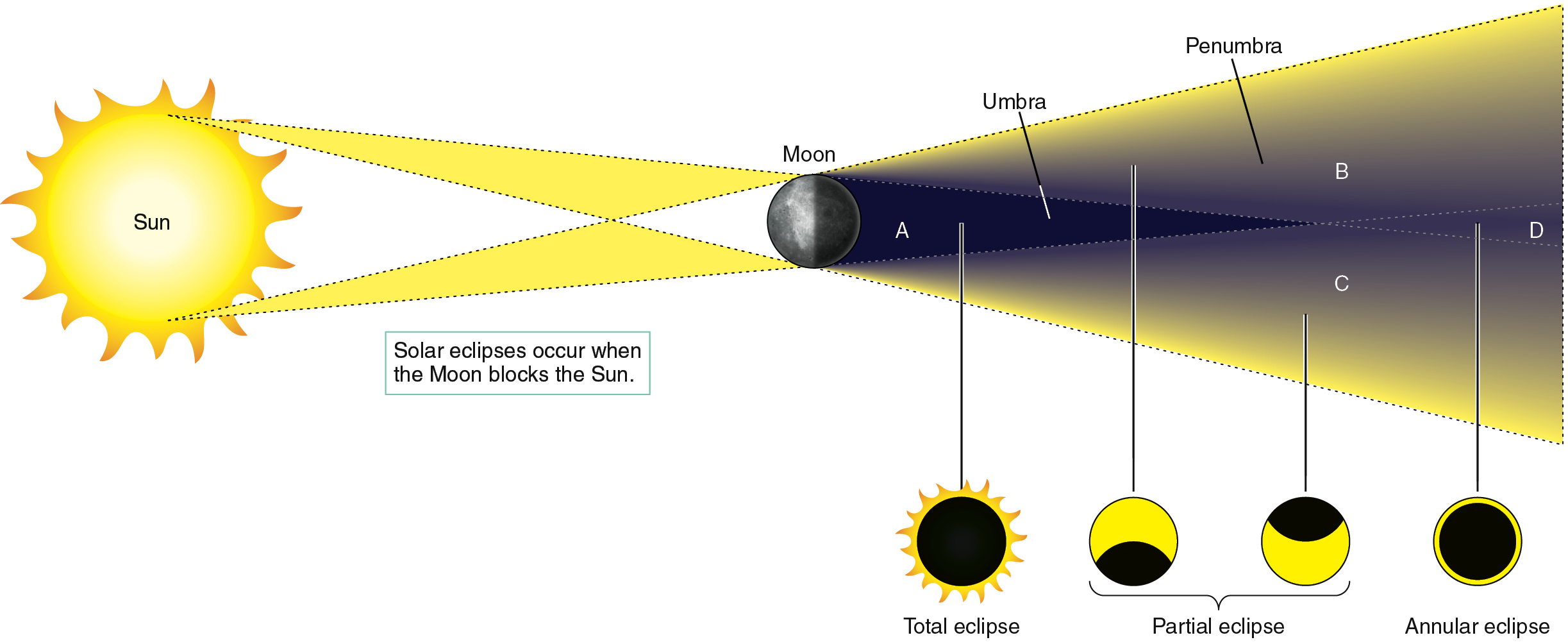
In the third type of solar eclipse, called an annular solar eclipse, the Sun appears as a bright ring surrounding the dark disk of the Moon (Figure 2.26b). An observer at point D in Figure 2.24 is far enough from the Moon that it appears smaller than the Sun. An object’s apparent size in the sky depends on the object’s actual size and its distance from us. The Sun is about 400 times the diameter of the Moon, and the distance between the Sun and Earth is about 400 times more than the distance between the Moon and Earth. As a result, the Moon and Sun have almost the same apparent size in the sky. In addition, the Moon’s orbit is not a perfect circle. When the Moon and Earth are a bit closer together than average, the Moon appears slightly larger in the sky than the Sun. An eclipse occurring then will be total for some observers. When the Moon and Earth are farther apart than average, the Moon appears smaller than the Sun, so eclipses occurring then will be annular for some observers. Among all solar eclipses, one-third are total at some location on Earth, one-third are annular, and one-third are only partial.

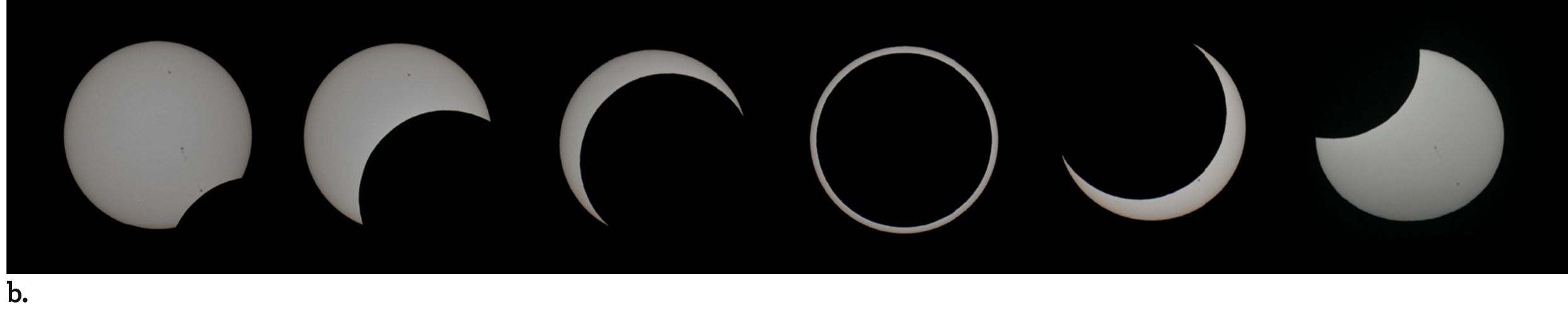
Figure 2.27 shows the geometry of a solar eclipse when the Moon’s shadowfalls on Earth’s surface. Figures like this one usually show Earth and the Moon much closer together than they really are. The page is too small to draw them to scale and still show the critical details. The relative sizes and distances between Earth and the Moon are roughly equivalent to the difference between a basketball and a tennis ball, respectively, placed 7 meters apart. Figure 2.27b shows the geometry of a solar eclipse with Earth, the Moon, and the separation between them drawn to scale. Compare that drawing with Figure 2.27a to see why drawings of Earth and the Moon are rarely drawn to scale. If the Sun were drawn to scale in Figure 2.27a, it would be bigger than your head and located almost 64 meters off the left side of the page.
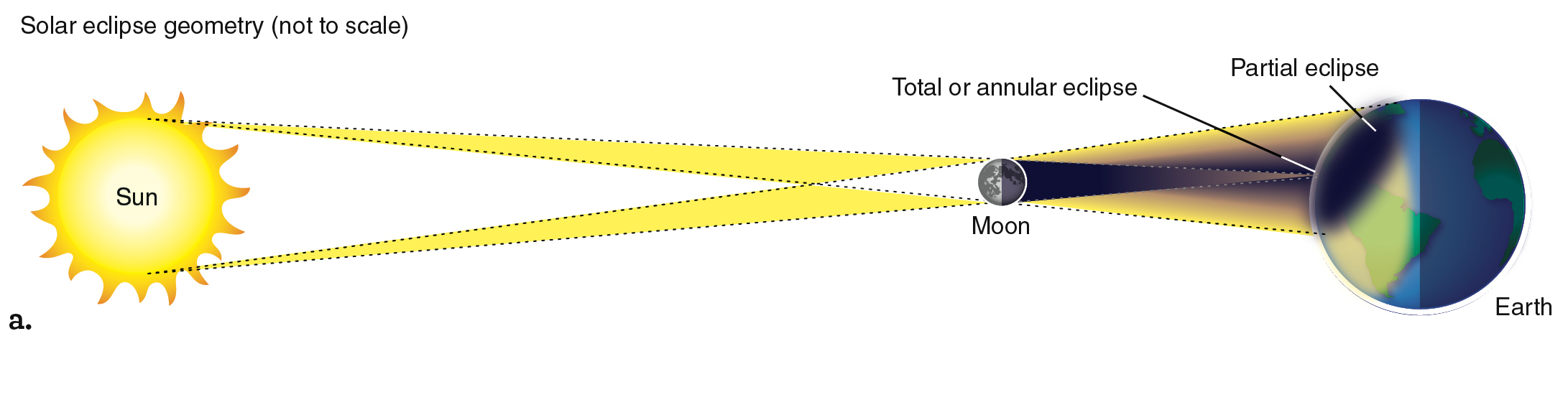

From any particular location, you are more likely to observe a partial solar eclipse than a total solar eclipse. Where the Moon’s penumbra touches Earth, it has a diameter of almost 7000 km—large enough to cover a substantial fraction of Earth. Thus, a partial solar eclipse is often visible from many locations on Earth. In contrast, the path along which a total solar eclipse is visible, shown in Figure 2.28, covers only a tiny fraction of Earth’s surface. Even when the distance between Earth and the Moon is at a minimum, the umbra is only 270 km wide on Earth. As the Moon moves along in its orbit, that tiny shadow sweeps across Earth at a few thousand kilometers per hour. In addition, the Moon’s shadow falls on Earth’s curved surface, causing the region shaded by the Moon during a solar eclipse to be elongated by various amounts. The curvature can even cause an eclipse that started out as annular to become total.
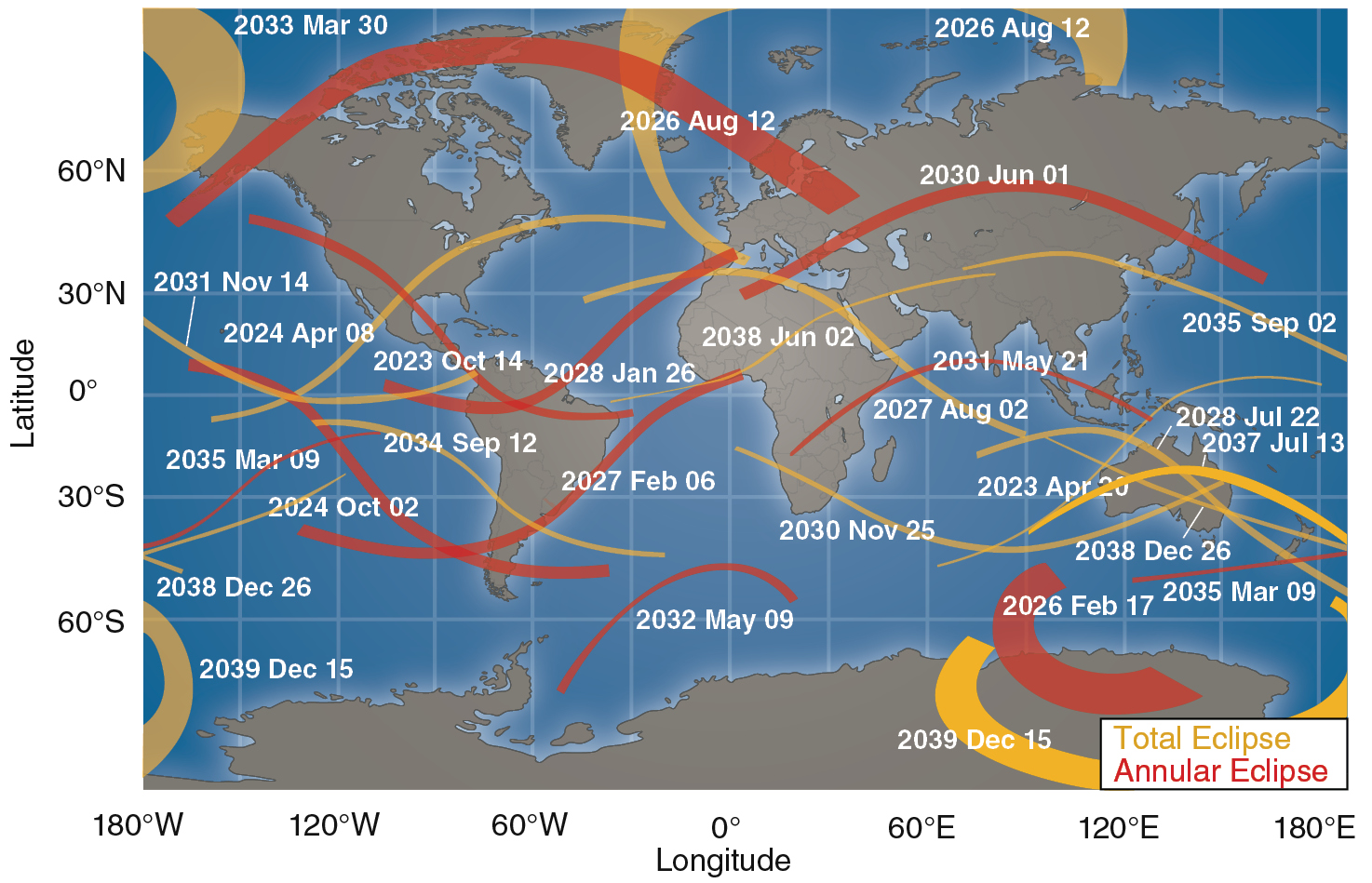
As a result of those factors, a total solar eclipse can never last longer than 71⁄2 minutes and is usually significantly shorter. Even so, it is one of the most amazing sights in nature. People all over the world flock to the most remote corners of Earth to witness the fleeting spectacle of the bright disk of the Sun blotted out of the daytime sky. Perhaps you saw the total eclipse visible from much of the United States in August 2017. The next total solar eclipse visible in the continental United States will take place in 2024. Annular eclipses will be visible from parts of the United States in 2021 and 2023. Viewing a solar eclipse should be on your lifetime to-do list!
 Reading Astronomy News
2500 Miles of Citizen Scientists
Laura Reed, sciencenode.org
Citizen scientists across the nation captured images of the Sun’s corona to create the largest dataset of its kind.
On August 21 [2017] many of us stood outside and marveled at the solar eclipse.
But for some, the eclipse was more than just a show. It was an opportunity to participate in the National Solar Observatory (NSO) Citizen Continental-America Telescopic Eclipse (CATE) Experiment.
The Citizen CATE Experiment is funded by federal, corporate, and private sources, including several companies that donated equipment to the project. Volunteer observers and schools get to keep the equipment used in the study.
A grand experiment
Scientists, students, and volunteers assembled along the 2500-mile path of eclipse totality tracked the Sun using 68 identical telescopes.
Using specialized software and instrument packages, they produced more than 1000 images from the start of the partial solar eclipse until totality.
The goal was to capture 90 minutes of continuous, high-resolution, rapid-cadence images detailing a difficult-to-capture region of the solar atmosphere: the Sun’s inner corona.
This is the first time scientists have collected research-quality observations of the corona during the eclipse’s entire transit across the United States.
“This dataset is extraordinary,” says Matt Penn, principal investigator for the project. “Normally during a solar eclipse, we get about 2 minutes of data in the region closest to the photosphere. But Citizen CATE allows us to get an hour and a half of data.”
My corona
The corona is the Sun’s outer atmosphere. It is difficult for scientists to study because the photosphere, or solar surface, is so bright that it overpowers the faint corona. We can only see the corona when something obscures the photosphere.
(Think of a light so bright that it makes it difficult to see an object close to you. Blocking the light with your hand allows a better view of the object.)
Scientists can create artificial eclipses using an instrument called a coronagraph that covers the Sun’s bright disk. The proximity of the instrument to the observer distorts the Sun’s edge, making precise observation and measurement difficult.
During a real eclipse, the Moon blocks the Sun. The Moon’s great distance lets scientists measure and study the corona in greater detail.
The process
On the day of the event, skies were clear for 58 of the 68 observation sites.
Observers, spaced about 50 miles from each other, started observations when the Moon’s shadow appeared on their horizon. They captured images every 10 seconds during totality.
The rapid cadence of imagery along with a 2-arcsecond pixel resolution should help scientists understand the intensity of the corona over an extended period as well as the motions of prominences, coronal inflows, coronal mass ejections, and other active regions.
The next total solar eclipse in the United States will be April 8, 2024. The path of totality will begin in Texas, moving north from Mexico, and will exit the U.S. via Maine.
Start making plans to join the next team of citizen scientists.
QUESTIONS
- Why does a solar eclipse move across the surface of the Earth?
- Why did scientists want data from along the whole track of the eclipse?
- Why can the corona be seen only during an eclipse?
- Would you have expected a lunar eclipse near the date of the solar eclipse? Explain.
- See whether any results are available on the project website (http://citizencate.org/). What did participants learn from this experiment?
Source: https://sciencenode.org/feature/2,500-miles-of-citizen-scientists.php.
Lunar Eclipses
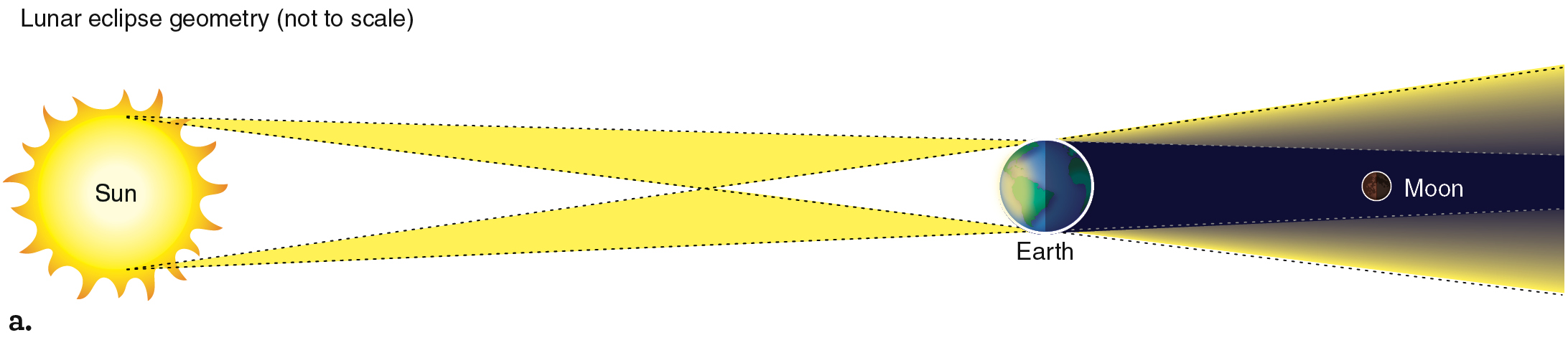
Lunar eclipses occur when the Moon moves through Earth’s shadow. Figure 2.29a shows the geometry of a lunar eclipse and is drawn to scale in Figure 2.29b. During a lunar eclipse, Earth is between the Sun and the Moon. Because Earth is much larger than the Moon, the dark umbra of Earth’s shadow at the distance of the Moon is more than 2 times the Moon’s diameter. A total lunar eclipse, in which the Moon is entirely within Earth’s shadow, lasts as long as 1 hour 40 minutes. In a total lunar eclipse, the Moon often appears red (Figure 2.30a). That “blood-red Moon,” as literature and poetry have called it, occurs because red light from the Sun is bent as it travels through Earth’s atmosphere and then illuminates the Moon. Earth’s atmosphere absorbs or scatters other colors of sunlight away from the Moon and therefore does not illuminate it.

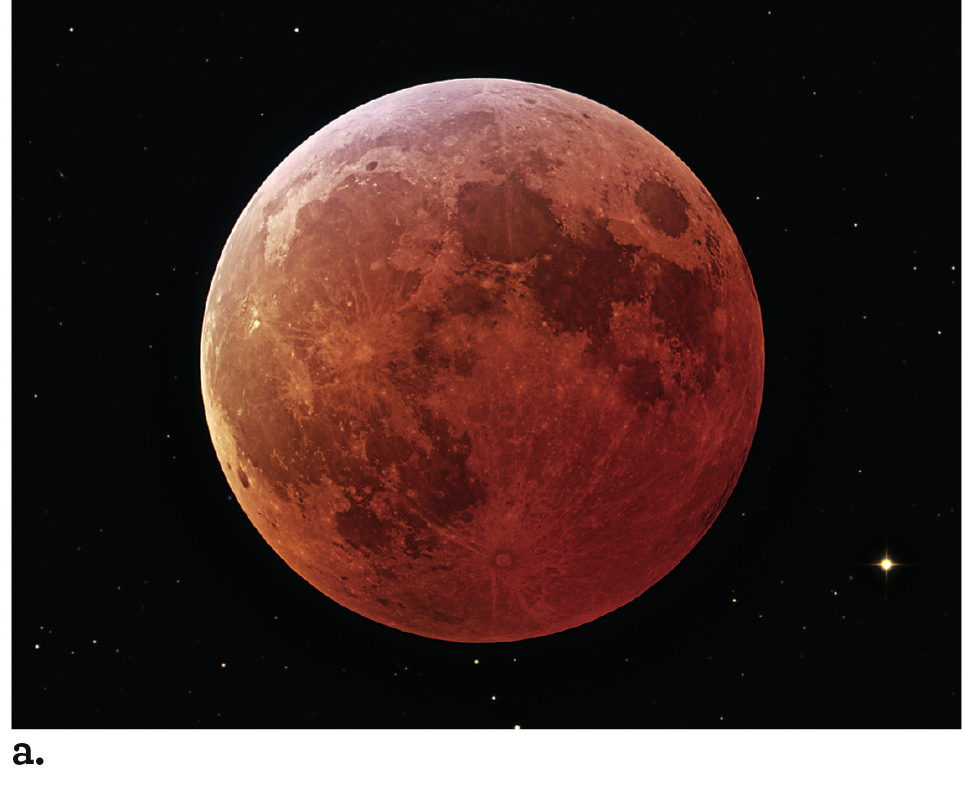
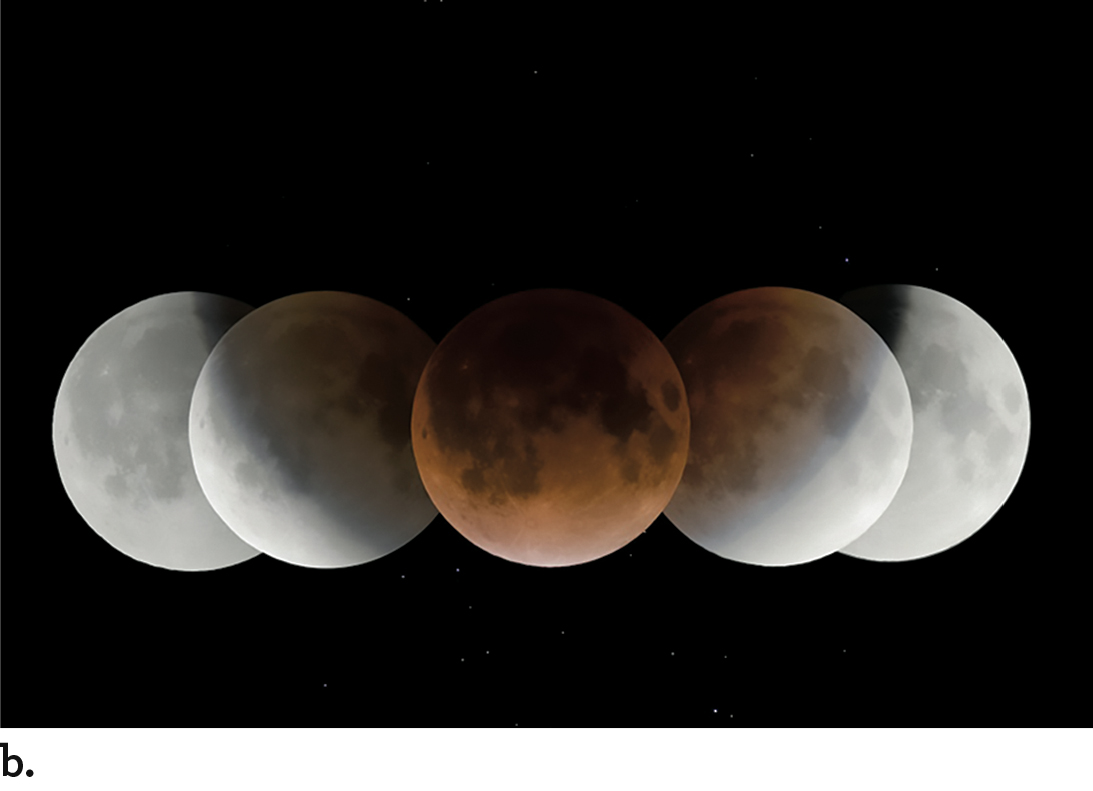
★ WHAT AN ASTRONOMER SEES Astronomers learn to be sensitive to color variations. An astronomer looking at these two images for the first time would immediately conclude from the difference in color between the images that the Moon in a. is in full lunar eclipse. An astronomer would also notice in b. that the images of the Moon were carefully aligned, so that in each image Earth’s shadow remained stationary. Combining the images in this way makes it possible to see (or measure) the size of Earth’s shadow relative to the Moon.
unanswered questions
How long will Earth continue to have total solar eclipses? Those occur because the Moon and the Sun are coincidentally the same size in our sky, but will that always be the case? An object’s observed size in the sky depends on its actual diameter and its distance from us. One or both of those can change. The Moon is slowly moving away from Earth by about 4 meters per century. Over time, the Moon will appear smaller in the sky, and it won’t be able to cover the full disk of the Sun. Although we can measure how fast the Moon is moving away from Earth now, we are less certain of how that rate may change with time. A lesser and more uncertain effect comes from the Sun—which will continue to brighten slowly, as it has throughout its history. With that brightening, the Sun’s actual diameter will slightly increase, and it will appear larger in our sky. A more distant Moon and a larger Sun will eventually (in hundreds of millions of years) end total eclipses on Earth.
A penumbral lunar eclipse occurs when the Moon passes through the penumbra of Earth’s shadow; those are noticeable only from a very dark location or when the Moon passes within about 1000 km of the umbra. If Earth’s shadow incompletely covers the Moon, some of the Moon’s disk remains bright and some of it is in shadow. The result is a partial lunar eclipse. Figure 2.30b shows a composite of images taken at different times during a partial lunar eclipse. In the middle frame, Earth’s shadow nearly completely eclipses the Moon.
Many more people have observed a total lunar eclipse than have observed a total solar eclipse. To see a total solar eclipse, you must be located within that very narrow band of the Moon’s shadow as it moves across Earth’s surface. In contrast, when the Moon is immersed in Earth’s shadow, anyone located in the hemisphere facing the Moon can see it. As a result, total eclipses of the Moon are relatively common from any location, so you may have seen at least one.

what if . . .
What if Earth had two moons, each having the same size and the same orbit, but located 120° apart in that orbit? Would we expect to see more solar eclipses in this case? Would the eclipses for both moons occur during the same eclipse seasons?
Frequency of Eclipse Seasons
How could some people in ancient cultures predict eclipses? From their understanding of lunar and solar cycles for making calendars, they computed cycles of eclipses. Imagine Earth, the Moon, and the Sun all sitting on the same flat tabletop. If the Moon’s orbit were in the same plane as Earth’s orbit, the Moon would pass directly between Earth and the Sun at every new Moon. The Moon’s shadow would pass across the face of Earth, and we would see a solar eclipse. Similarly, Earth would pass directly between the Sun and the Moon every synodic month, and a lunar eclipse would occur at each full Moon.
Solar and lunar eclipses do not happen every month, however, because the Moon’s orbit does not lie in the same plane as Earth’s orbit. As Figure 2.31 shows, the plane of the Moon’s orbit around Earth is inclined by about 5.2° with respect to the plane of Earth’s orbit around the Sun. The line along which the orbital planes of the Sun and the Moon intersect is called the line of nodes. For part of the year, the line of nodes points generally toward the Sun. During those times, called eclipse seasons, a new Moon passes directly between the Sun and Earth, casting its shadow on Earth’s surface and causing a solar eclipse. Similarly, a full Moon occurring during an eclipse season passes through Earth’s shadow, causing a lunar eclipse. An eclipse season lasts only 38 days. That’s how long the Sun is close enough to the line of nodes for eclipses to occur. Usually, the line of nodes points farther away from the Sun, so Earth, the Moon, and the Sun cannot line up closely enough for an eclipse to occur. At those times, a solar eclipse cannot take place because the shadow of a new Moon passes “above” or “below” Earth. Similarly, no lunar eclipse can occur because a full Moon passes “above” or “below” Earth’s shadow.
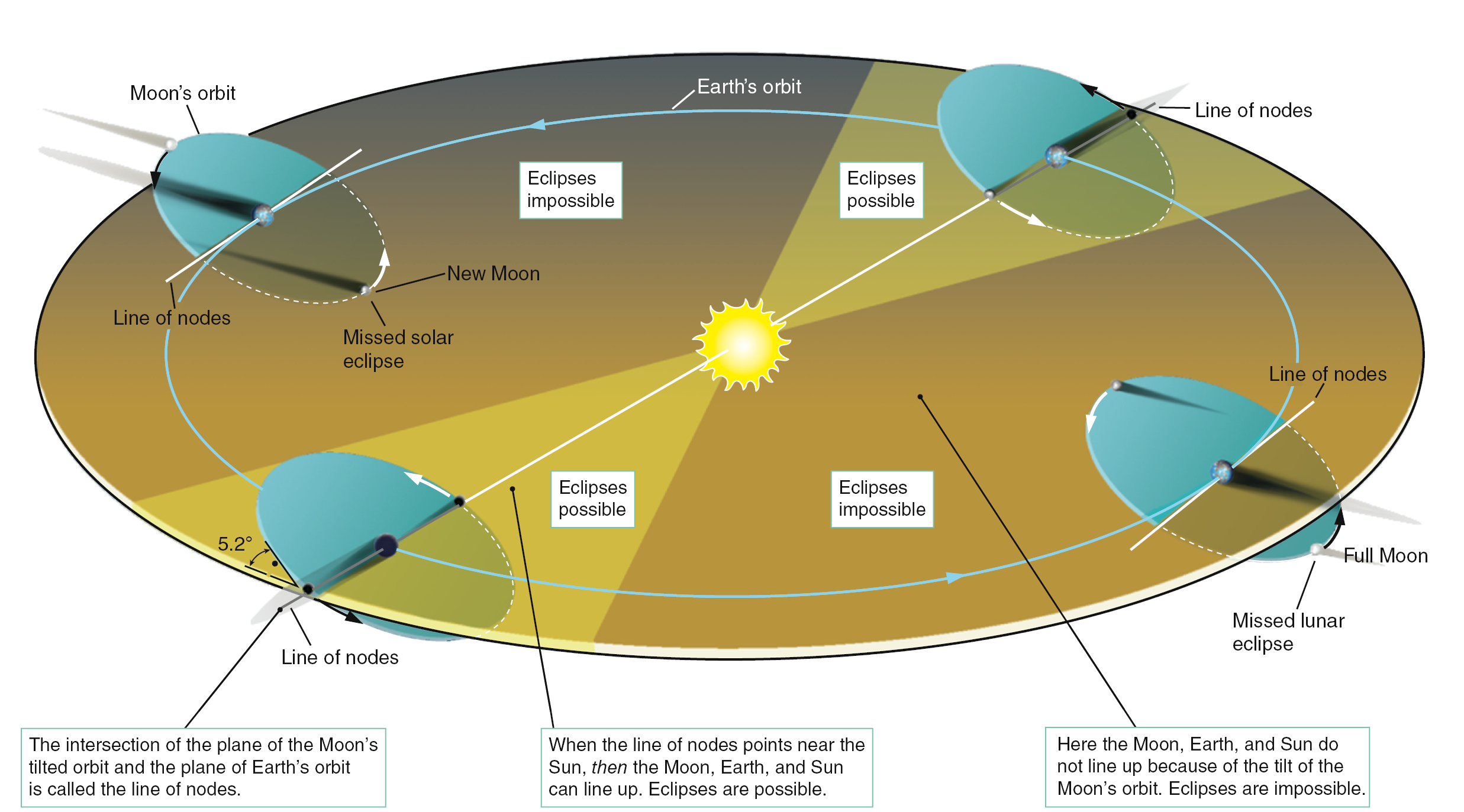
If the plane of the Moon’s orbit always had the same orientation, eclipse seasons would occur twice a year, as suggested in Figure 2.31. In actuality, eclipse seasons occur about every 5 months 20 days. The roughly 10-day difference occurs because the plane of the Moon’s orbit slowly wobbles, much like the wobble of a spinning plate balanced on the end of a circus performer’s stick. As the Moon’s orbital plane wobbles, the line of nodes changes direction. That wobble rotates in the direction opposite the direction of the Moon’s motion in its orbit. That is, the line of nodes moves clockwise as viewed from above Earth’s orbital plane. One wobble of the Moon’s orbit takes 18.6 years, so we say that the line of nodes regresses by 360° every 18.6 years, or 19.4° per year. That rate amounts to about a 20-day regression each year. If January 1 marks the middle of an eclipse season, the next eclipse season will be centered around June 20, and the one after that around December 10.
CHECK YOUR UNDERSTANDING 2.5
If the Moon were in its same orbital plane but twice as far from Earth, which of the following would happen? (a) The Moon would not go through phases. (b) Total eclipses of the Sun would not be possible. (c) Annular eclipses of the Sun would not be possible. (d) Total eclipses of the Moon would not be possible.
 Answer
 Answer
b
Glossary
- eclipse
- 1. The total or partial obscuration of one celestial body by another. 2. The total or partial obscuration of light from one celestial body as it passes through the shadow of another celestial body.
- solar eclipse
- An eclipse that occurs when the Moon partially or entirely blocks the Sun. Compare lunar eclipse.
- umbra
- (pl. umbrae) 1. The darkest part of a shadow, where the source of light is blocked. Compare penumbra (definition 1). 2. The darkest, innermost part of a sunspot. Compare penumbra (definition 2).
- total solar eclipse
- The type of eclipse that occurs when Earth passes through the umbra of the Moon’s shadow, so that the Moon blocks the disk of the Sun. Compare annular solar eclipse and partial solar eclipse.
- penumbra
- penumbra (pl. penumbrae) 1. The outer part of a shadow, where the source of light is only partially blocked. Compare umbra (definition 1). 2. The region surrounding the umbra of a sunspot. The penumbra is cooler and darker than the surrounding surface of the Sun but is not as cool or dark as the umbra. Compare umbra (definition 2).
- partial solar eclipse
- The type of eclipse that occurs when Earth passes through the penumbra of the Moon’s shadow, so that the Moon blocks only a portion of the Sun’s disk. Compare annular solar eclipse and total solar eclipse.
- annular solar eclipse
- The type of solar eclipse that occurs when the apparent diameter of the Moon is less than that of the Sun, leaving a visible ring of light (“annulus”) surrounding the dark disk of the Moon. Compare partial solar eclipse and total solar eclipse.
- Lunar eclipses
- An eclipse that occurs when the Moon is partially or entirely in Earth’s shadow. Compare solar eclipse.
- total lunar eclipse
- A lunar eclipse in which the Moon passes through the umbra of Earth’s shadow. Compare penumbral lunar eclipse.
- penumbral lunar eclipse
- A lunar eclipse in which the Moon passes through the penumbra of Earth’s shadow. Compare total lunar eclipse.
- partial lunar eclipse
- An eclipse that occurs when the Moon is partially in Earth’s shadow.
- line of nodes
- 1. A line defined by the intersection of two orbital planes. 2. The line defined by the intersection of Earth’s equatorial plane and the plane of the ecliptic.
- eclipse seasons
- Any time during the year when the Moon’s line of nodes points towards the Sun and eclipses can occur.