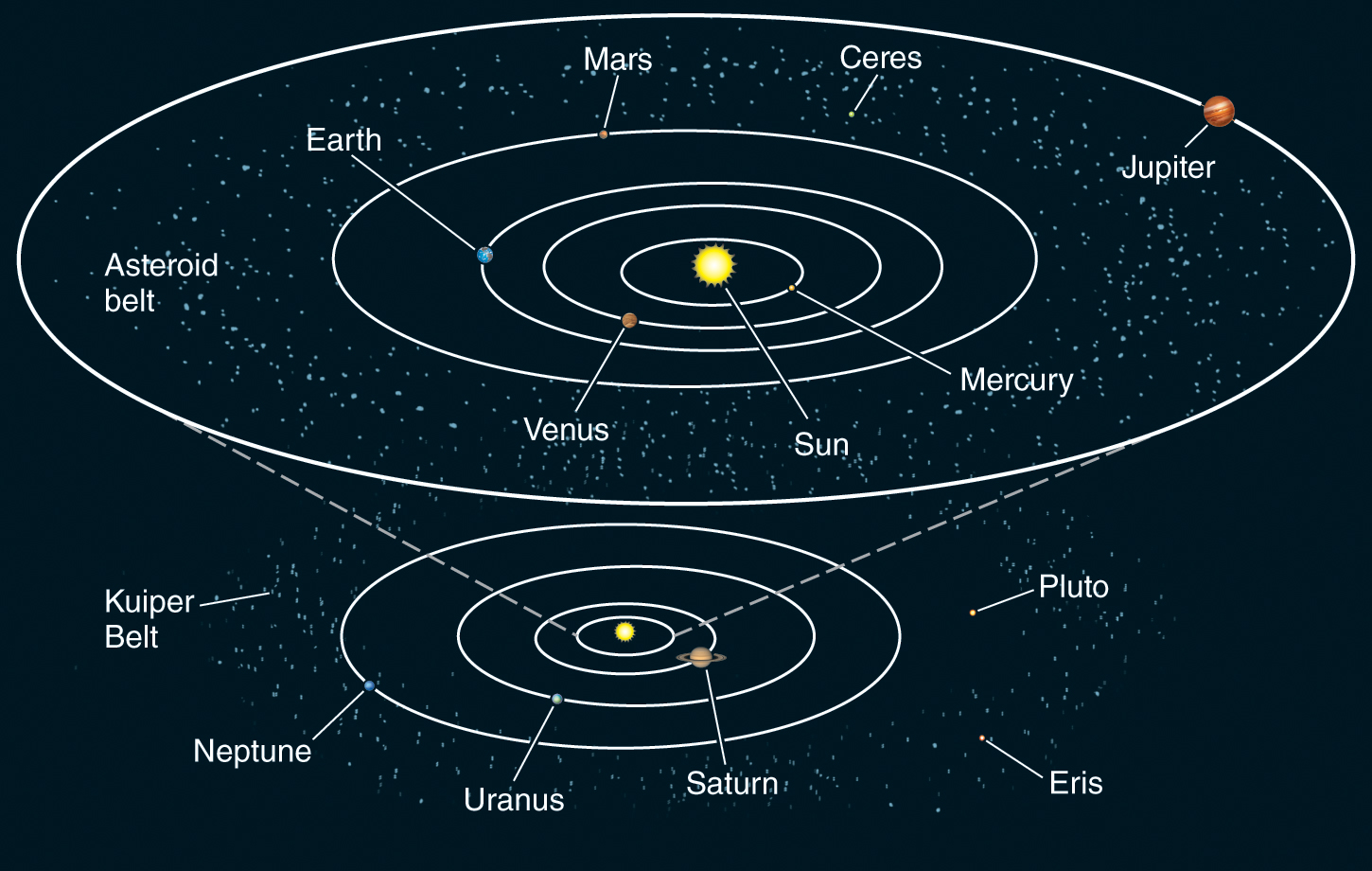
Earth is part of a collection of planets—large, round isolated bodies that orbit a star. Astronomers call a system of planets surrounding a star a planetary system. The Solar System, shown in Figure 7.1, is the planetary system that includes Earth, seven other planets, and the Sun. The system also includes moons that orbit planets and small bodies that occupy particular regions of the Solar System, such as the asteroid belt or the Kuiper Belt. Our Solar System is a tiny part of our galaxy, which is a tiny part of the universe. Review Figure 1.3 to remind yourself of the size scales involved. Light takes about 4 hours to travel to Earth from Neptune, the outermost known planet in the Solar System, but light from the most distant galaxies has taken more than 13 billion years to reach Earth.
Figure 7.1 Our Solar System includes planets, moons, and other small bodies. Sizes and distances shown are not to scale.
Until the latter part of the 20th century, the origin of the Solar System remained speculative. Over the past century, with the aid of spectroscopy, astronomers have determined that the Sun is an ordinary star, one of hundreds of billions in its galaxy, the Milky Way, and that the Milky Way is an ordinary galaxy, one of hundreds of billions in the universe. In the past few decades, stellar astronomers studying the formation of stars and planetary scientists analyzing clues about the history of the Solar System have arrived at the same picture of the early Solar System—but from two very different directions. That unified understanding provides the foundation for the way astronomers now think about the Sun and the objects that orbit it. In this section, we look at how the work of stellar and planetary scientists converged to inform our understanding of planetary system formation.
The first plausible theory for the formation of the Solar System, the nebular hypothesis, was proposed in 1755 by the German philosopher Immanuel Kant (1724–1804) and conceived independently in 1796 by the French astronomer Pierre-Simon Laplace (1749–1827). Kant and Laplace argued that a rotating cloud of interstellar gas, or nebula (Latin for “cloud”), gradually collapsed and flattened to form a disk with the Sun at its center. Surrounding the Sun were rings of material from which the planets formed. That configuration would explain why the planets orbit the Sun in the same direction in the same plane. The nebular hypothesis remained popular throughout the 19th century, and those basic principles of the hypothesis are still retained today.
Our modern theory of planetary system formation calculates the conditions required for a cloud of interstellar gas to collapse under the force of its own self-gravity to form stars. Recall from Chapter 4 that self-gravity is the gravitational attraction between the parts of an object, such as a planet or star, that pulls all the parts toward the object’s center. That inward force is opposed by either structural strength (for rocks that make up terrestrial planets) or the outward force resulting from gas pressure and radiation pressure within a star. If the outward force is less than self-gravity, the object contracts; if it is greater, the object expands. In a stable object, the inward and outward forces are balanced.
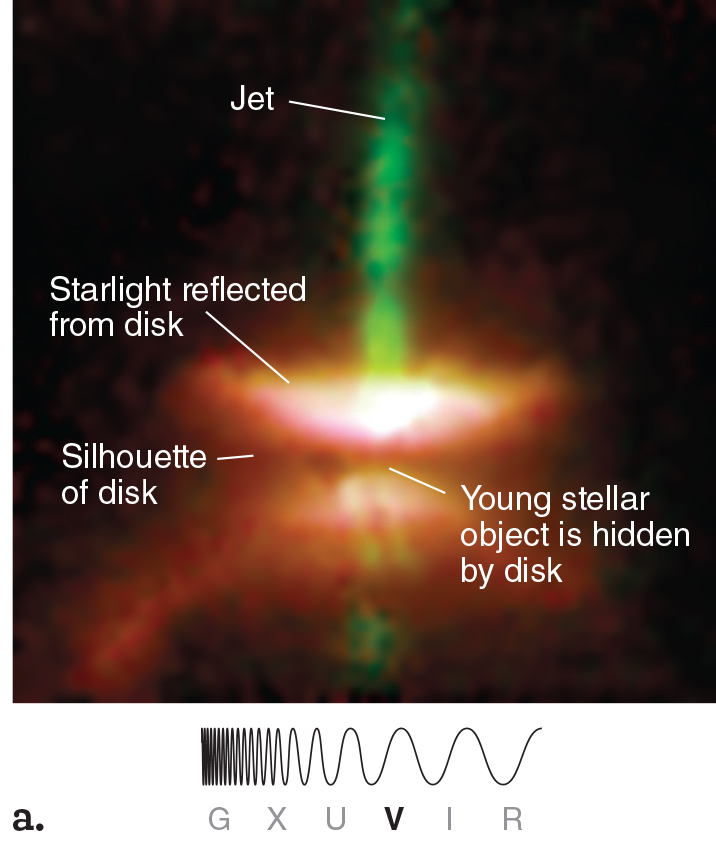
In support of the nebular hypothesis, disks of gas and dust have been observed surrounding young stellar objects (Figure 7.2). From that observational evidence, stellar astronomers have shown that, much as a spinning ball of pizza dough spreads out to form a flat crust, the cloud that produces a star—the Sun, for example—collapses first into a rotating disk. Material in the disk eventually suffers one of three fates: it travels inward onto the forming star at its center, it remains in the disk itself to form planets and other objects, or it is ejected back into interstellar space.
Figure 7.2a. Hubble Space Telescope image of a disk around newly formed stars. The dark band is the silhouette of the disk seen edge on. Bright regions are dust illuminated by the star’s light. The jets are shown in green. b. The Atacama Large Millimeter/submillimeter Array (ALMA) obtained this image of a protoplanetary disk around the star HL Tau. This image shows substructures and possibly planets in the system’s dark patches.
what if . . .
What if astronomers find another planetary system where the planets orbit the central star but align in two separate planes which are oblique to each other? What would such an observation tell you about the nebular hypothesis?
Planetary Scientists and the Convergence of Evidence
While astronomers were working to understand star formation, other groups of scientists with very different backgrounds were piecing together the history of the Solar System. Planetary scientists, geochemists, and geologists looking at the current structure of the Solar System inferred what some of its early characteristics must have been. The orbits of all the planets lie very close to a single plane, so the early Solar System must have been flat. In addition, all the planets orbit the Sun in the same direction, so the material from which the planets formed must have been orbiting the Sun in the same direction as well.
unanswered questions
How typical is the Solar System? Only within the past decade have astronomers found other systems containing four or more planets, and so far, the observed distributions of large and small planets in those multiplanet systems have looked different from those of the Solar System. Computer simulations of planetary system formation suggest that a system with stable orbits and a planetary distribution like those of the Solar System may develop only rarely. Improved supercomputers can run more complex simulations, which can be compared with the observations to better understand how solar systems are configured.
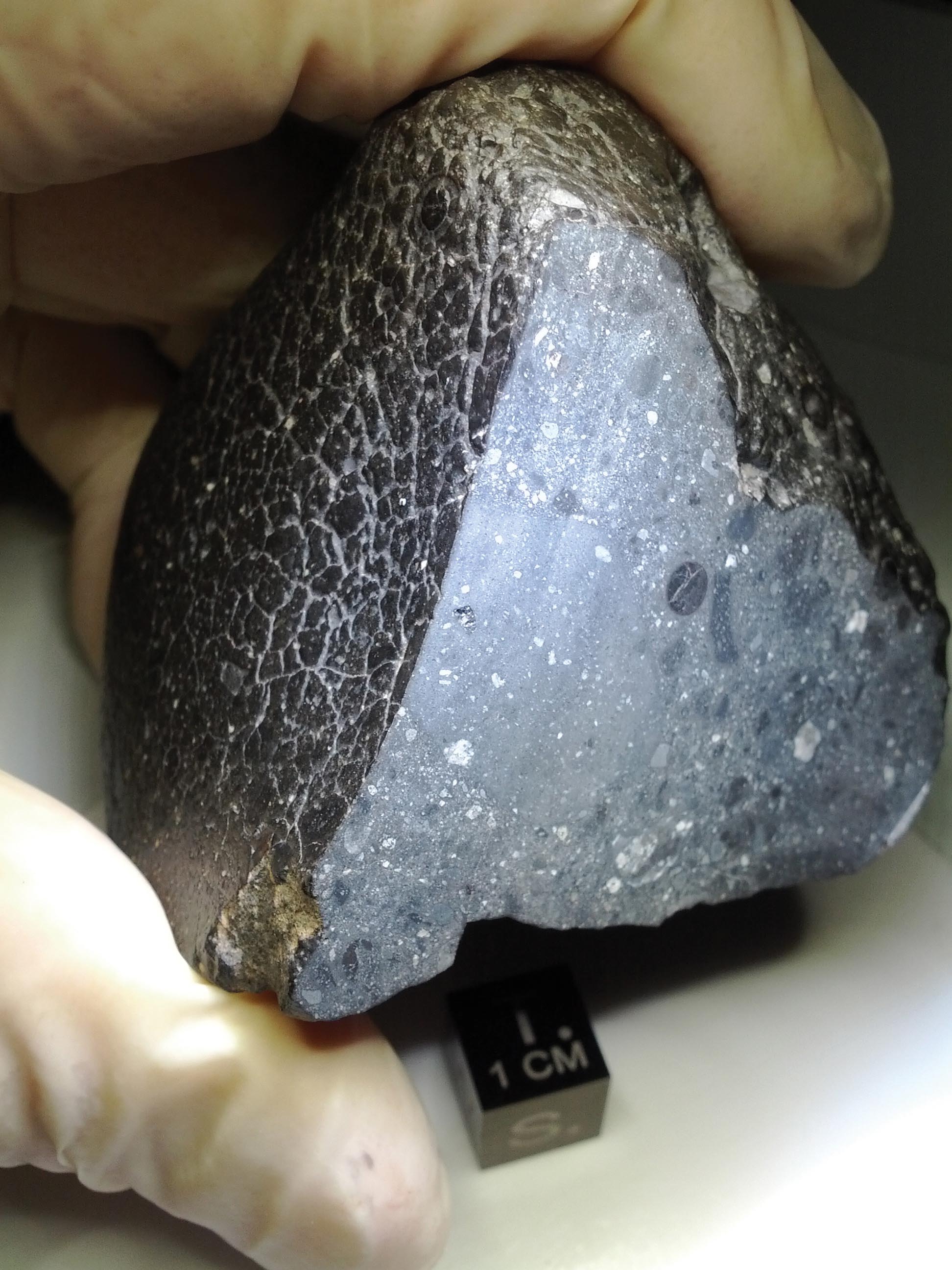
To find out more, scientists study samples of the very early Solar System. Rocks that fall to Earth from space, known as meteorites, include pieces of material left over from the Solar System’s youth. Many meteorites, such as the one in Figure 7.3, resemble a piece of concrete in which pebbles and sand are mixed with a much finer filler, suggesting that the larger bodies in the Solar System must have grown from the aggregation of smaller bodies. That finding suggests an early Solar System in which the young Sun was surrounded by a flattened disk of both gaseous and solid material. Our Solar System formed from that swirling disk of gas and dust.
Figure 7.3 Meteorites are the surviving pieces of Solar System fragments that land on planets. This meteorite formed from many smaller components that stuck together.
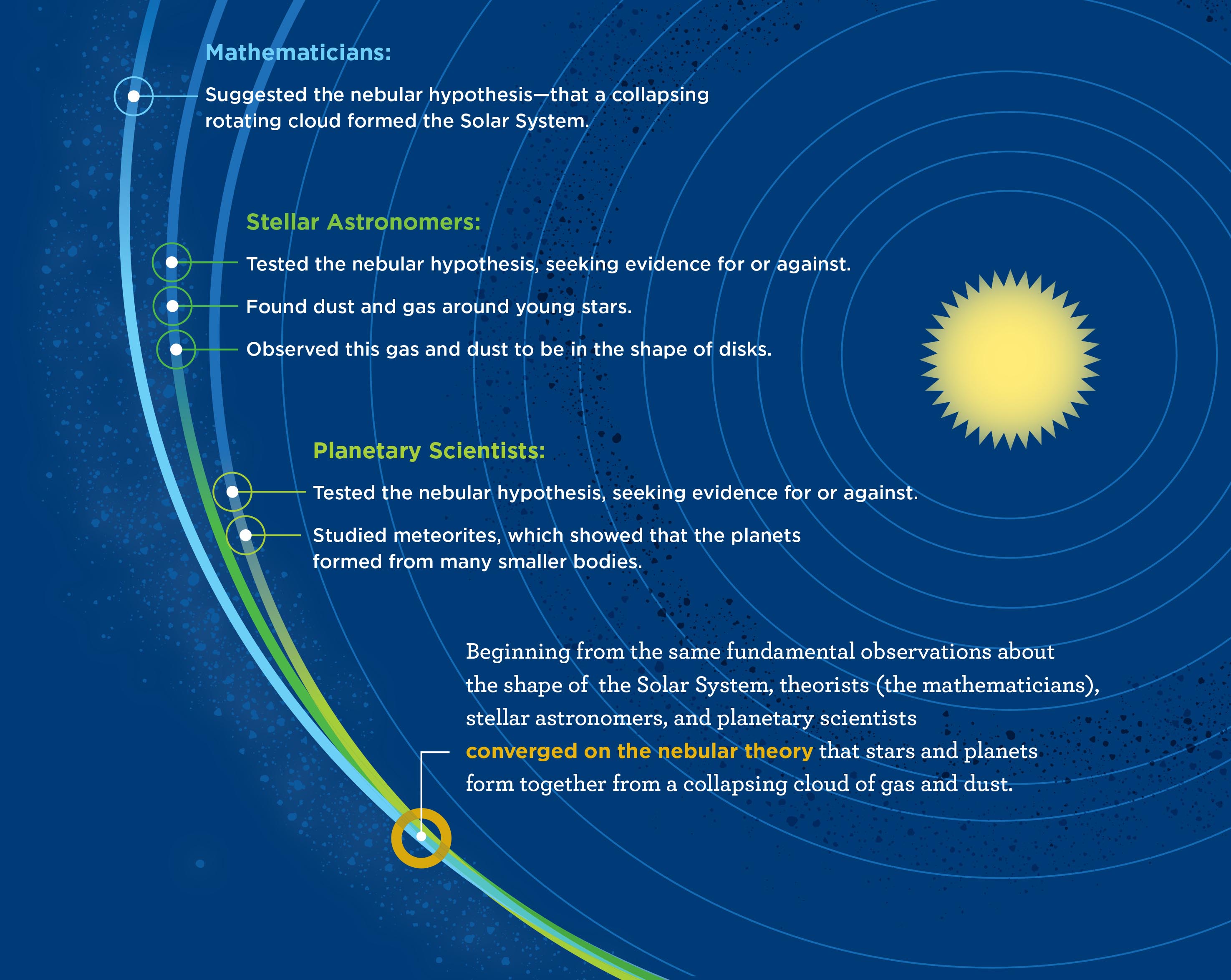
As astronomers and planetary scientists compared notes, they realized they had arrived at the same picture of the early Solar System from two completely different directions. The rotating disk from which the planets formed was the remains of the disk that had accompanied the formation of the Sun. Earth, along with all the other orbiting bodies that make up the Solar System, formed from the remnants of an interstellar cloud that collapsed to form the local star, the Sun. The connection between the formation of stars and the origin and later evolution of the Solar System is one of the cornerstones of both astronomy and planetary science—a central theme of our understanding of our Solar System (see the Process of Science Figure).
PROCESS of SCIENCEConverging Lines of Inquiry
Why is the Solar System a disk, with all planets orbiting in the same direction? Scientists from different disciplines often contribute to the solution to a problem. These scientists approach the problem from different directions and perspectives, so when they arrive at the same conclusion, that is compelling evidence that they are all on the right track.
CHECK YOUR UNDERSTANDING 7.1
Which of the following pieces of evidence support the nebular hypothesis? (Choose all that apply.) (a) Planets orbit the Sun in the same direction. (b) The Solar System is relatively flat. (c) Earth has a large Moon. (d) We observe disks of gas and dust around other stars.
1. A large body that orbits the Sun or other star that shines only by light reflected from the Sun or star. 2. In the Solar System, a body that orbits the Sun, has enough mass for self-gravity to overcome rigid body forces so that it assumes a spherical shape, and has cleared smaller bodies from the neighborhood around its orbit. Compare dwarf planet.
The first plausible theory of the formation of the Solar System, proposed by Immanuel Kant in 1755, which stated that the Solar System formed from the collapse of an interstellar cloud of rotating gas.
A cloud of interstellar gas and dust, either illuminated by stars (for bright nebulae) or seen in silhouette against a brighter background (for dark nebulae).



 Answer
 Answer