Astronomy in Action: Angular Momentum
7.2 The Solar System Began with a Disk
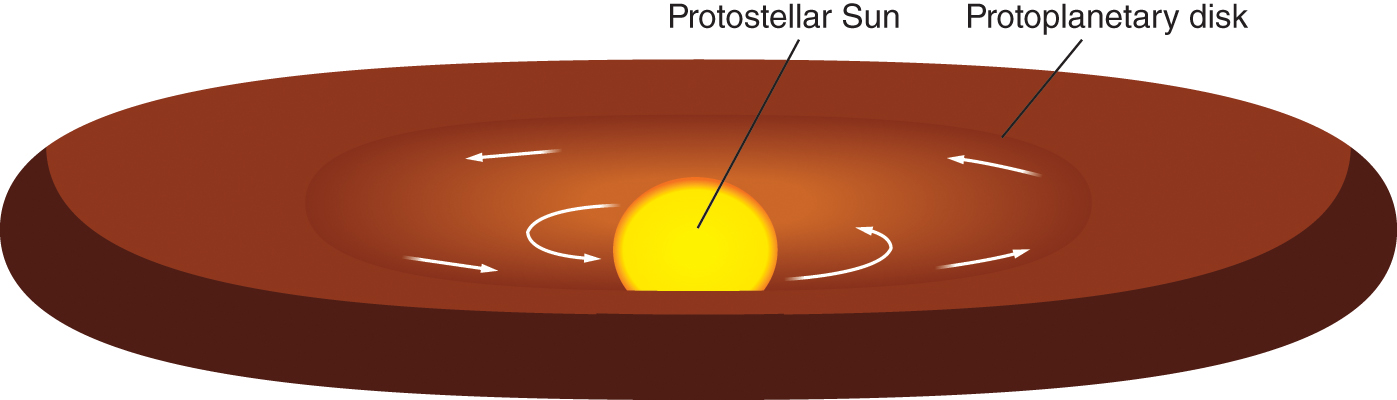
Planets form in a disk around young stars, but what are some of the specifics of the process? Figure 7.4 illustrates the young Solar System as it appeared roughly 5 billion years ago. At that time, the Sun was still a protostar—a large ball of gas but not yet hot enough in its center to be a star. As the cloud of interstellar gas collapsed to form the protostar, its gravitational energy was converted into heat energy and radiation. Surrounding the protostellar Sun was a flat, orbiting disk of gas and dust. Each bit of the material in that thin disk orbited the Sun in accordance with the same laws of motion and gravitation that govern the orbits of the planets. The disk around the Sun—like the disks that astronomers see today surrounding protostars elsewhere in our galaxy—is called a protoplanetary disk. The disk is so “fluffy” and low-density compared to the protostar that it probably contained less than 1 percent of the mass of the star forming at its center, but that amount was more than enough to account for the bodies that make up the Solar System today.
The Collapsing Cloud and Angular Momentum
Conservation of angular momentum causes protoplanetary disks to form. Angular momentum is a conserved quantity associated with a revolving or rotating system and depends on both the velocity and distribution of the system’s mass. The angular momentum of an isolated system is always conserved; that is, it remains unchanged unless acted on by an external force. A figure-skater spinning on the ice (Figure 7.5), like any other rotating object, has some amount of angular momentum. Unless frictional forces act to reduce her angular momentum, she will always have the same amount of angular momentum.

The amount of angular momentum depends on three factors:
- How fast the object is rotating. The faster an object is rotating, the more angular momentum it has.
- The mass of the object. If a similarly sized bowling ball and a basketball are spinning at the same speed, the bowling ball has more angular momentum because it has more mass.
- How the mass of the object is distributed relative to the spin axis—that is, how spread out the object is. For an object of a given mass and rate of rotation, the more spread out it is, the more angular momentum it has. A spread-out object rotating slowly might have the same angular momentum as a compact object rotating rapidly.
Both an ice-skater and a collapsing interstellar cloud are subject to the conservation of angular momentum: the angular momentum must remain the same in the absence of an external force. For angular momentum to be conserved, a change in one of the three quantities (the rate of spin, mass, or distribution of mass) must be accompanied by a compensating change in another quantity. Because an ice-skater’s mass doesn’t change, for example, she can control how rapidly she spins by pulling in or extending her arms or legs. As she pulls in her arms to become more compact, she changes her distribution of mass and must spin faster to maintain the same angular momentum. When her arms are held tightly in front of her and one leg is wrapped around the other, the skater’s spin becomes a blur. She finishes with a flourish by throwing her arms and leg out—an action that abruptly slows her spin by spreading out her mass. The skater’s angular momentum remains constant throughout the maneuver. Similarly (see Figure 7.6), the cloud that formed our Sun rotated faster and faster as it collapsed, just as the ice-skater speeds up when she pulls in her arms.
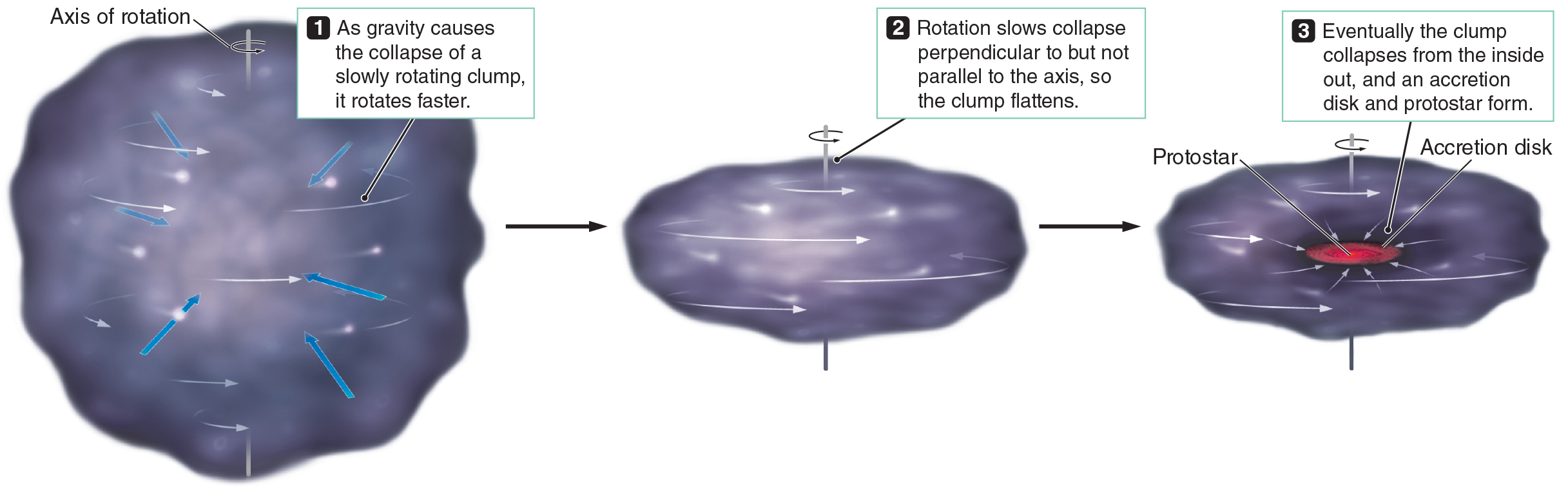
That description, however, presents a puzzle. Suppose the Sun formed from a typical cloud—one about a light-year across and rotating so slowly that completing one rotation took a million years. By the time the cloud collapsed to the size of the Sun today, it would have been spinning so fast that one rotation would occur every 0.6 second. That rate is more than 3 million times faster than our Sun actually spins. At that rate of rotation, the Sun would tear itself apart. It appears that angular momentum was not conserved in the actual formation of the Sun—but that can’t be right because angular momentum must be conserved. We must be missing something. Where did the angular momentum go?
The Formation of an Accretion Disk
To understand how angular momentum is conserved in disk formation, we must think in three dimensions. Imagine that the ice-skater bends her knees, compressing herself downward instead of bringing her arms toward her body. As she does so, she again makes herself less spread out, but her rate of spin does not change because no part of her body has become any closer to the axis of spin. Similarly, as shown in Figure 7.6, a clump of a molecular cloud can flatten out without speeding up by collapsing parallel to its axis of rotation. Instead of collapsing into a ball, the interstellar cloud flattens into a disk. As the cloud collapses, its self-gravity increases and the inner parts begin to fall freely inward, raining down on the growing disk at the center. The outer portions of the cloud lose the support of the collapsed inner portion, and they start falling inward, too. As that material makes its final inward plunge, it lands on a thin, rotating disk—called an accretion disk—that forms from the accretion of material around a massive object.

The formation of accretion disks, shown in Figure 7.7, is common in the universe. As material falls onto the disk at an angle, it impacts material coming up to the disk from below. Over time, as more collisions occur, these perpendicular motions gradually cancel out. But the part of the motion parallel to the disk remains unchanged. This is much like two football players approaching from opposite sides and colliding as they jump for the ball. Their motion across the field cancels out, but their motion down the field remains, so they fall to the ground closer to the goal. In the case of accretion disks, the material flattens out and continues to rotate, which conserves angular momentum.
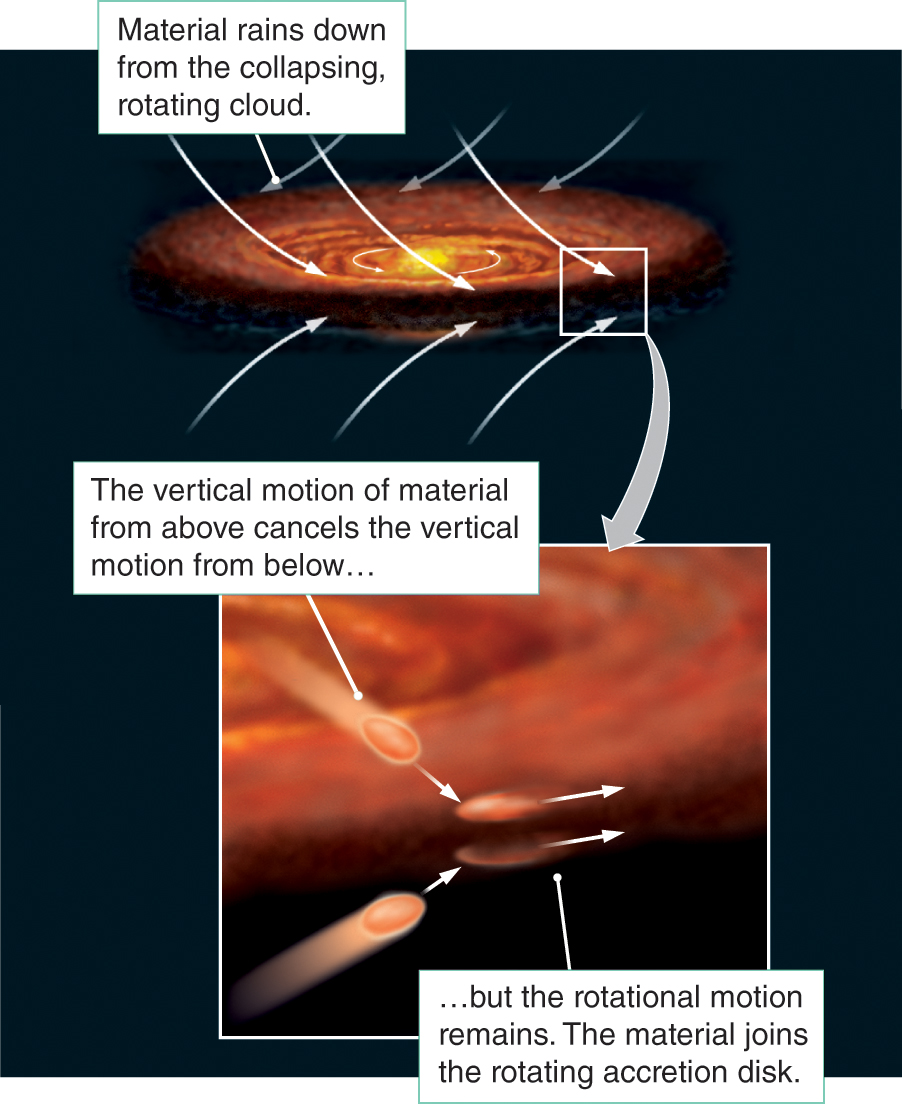
Thus, the angular momentum of the infalling material is transferred to the accretion disk. The rotating accretion disk has a radius of hundreds of astronomical units, and that is thousands of times greater than the radius of the star that will eventually form at its center. Therefore, most of the angular momentum in the original interstellar cloud ends up in the accretion disk rather than in the central protostar (see Working It Out 7.1 for an example of the relevant calculation).
working it out 7.1


Angular Momentum
In its simplest form, the angular momentum (L) of a system is given by
L = m × v × r
where m is the mass, v is the speed at which the mass is moving, and r represents how spread out the mass is.
Let’s apply this relationship to the angular momentum of Jupiter in its orbit about the Sun. The angular momentum from one body orbiting another is called orbital angular momentum, Lorbital. The mass (m) of Jupiter is 1.90 × 1027 kilograms (kg), the speed of Jupiter in orbit (v) is 1.31 × 10⁴ meters per second (m/s), and the radius of Jupiter’s orbit (r) is 7.79 × 10¹¹ meters. Putting all that together gives
Lorbital = (1.90 × 1027 kg) × (1.31 × 10⁴ m/s) × (7.79 × 10¹¹ m)
Lorbital = 1.94 × 1043 kg m2/s
Calculating the spin angular momentum of a spinning object, such as a skater, a planet, a star, or an interstellar cloud, is more complicated. Here, we must add up the individual angular momenta of every tiny mass element within the object. For a uniform sphere, the spin angular momentum is
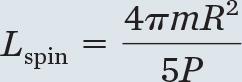
where R is the radius of the sphere and P is the rotation period of its spin.
Let’s compare Jupiter’s orbital angular momentum with the Sun’s spin angular momentum to investigate the distribution of angular momentum in the Solar System. The Sun’s radius is 6.96 × 10⁸ meters, its mass is 1.99 × 1030 kg, and its rotation period is 24.5 days = 2.12 × 10⁶ seconds. If we assume that the Sun is a uniform sphere, the spin angular momentum of the Sun is
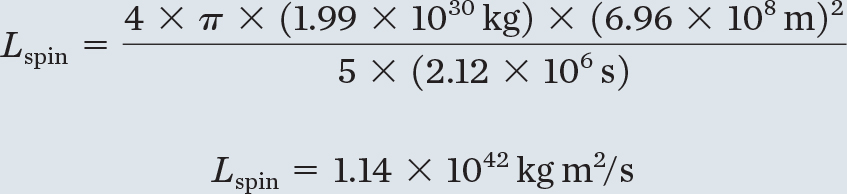
Lorbital of Jupiter is about 17 times greater than Lspin of the Sun. Thus, most of the angular momentum of the Solar System now resides in the orbits of its major planets.
For a collapsing sphere to conserve Lspin, its rotation period P must be proportional to R2. As with the skater, when a sphere decreases in radius, its rotation period decreases; that is, it spins faster.
 what if . . .
What if you observe a close pair of stars forming a binary system? How would you expect the disk around such a pair of stars to differ from the disk around a single star?
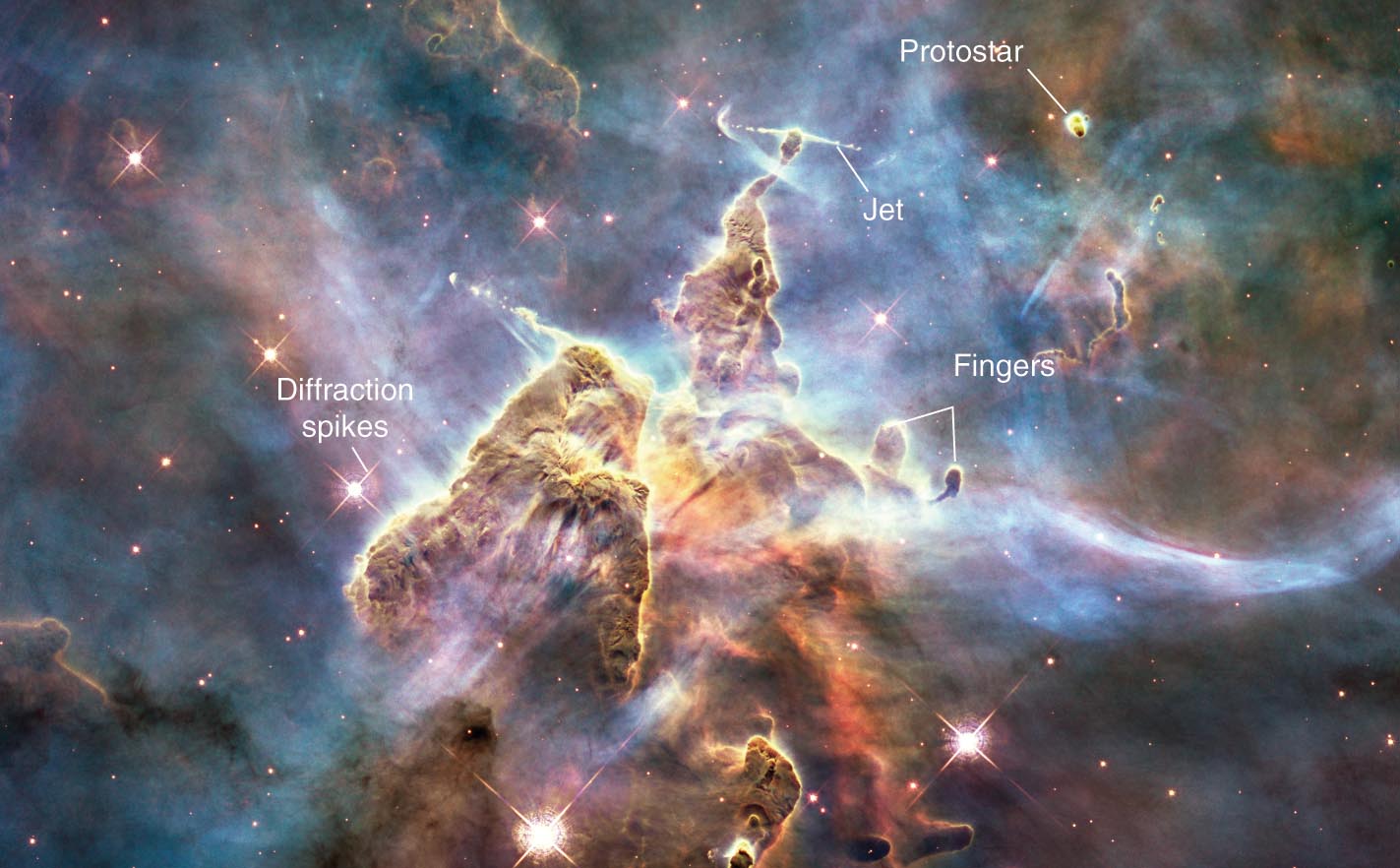
Most of the matter that lands on the accretion disk either becomes part of the star or is ejected back into interstellar space in the form of jets or other outflows (Figure 7.8). Those jets are bipolar—they come in pairs aligned along an axis. Material swirling in the bipolar jets carries angular momentum away from the accretion disk in the general direction of the poles of the rotation axis. However, a small amount of material is left behind in the disk. The objects in that leftover disk—the dregs of the process of star formation—form planets and other objects that orbit the star.
Formation of Large Objects
Random motions of the gas within the protoplanetary disk eventually push the smaller grains of solid material toward larger grains. As that happens, the smaller grains stick to the larger grains. The “sticking” process among smaller grains is due to the same static electricity that causes dust bunnies to grow under your bed. Starting out at only a few microns (μm) across—about the size of particles in smoke—the slightly larger bits of dust grow to the size of pebbles and then to clumps the size of boulders, which are not as easily pushed around by gas (Figure 7.9). When clumps grow to about 100 meters across, the objects are so far apart that they collide less often, and their growth rate slows down but does not stop. Within a protoplanetary disk, the larger dust grains become larger at the expense of the smaller grains.
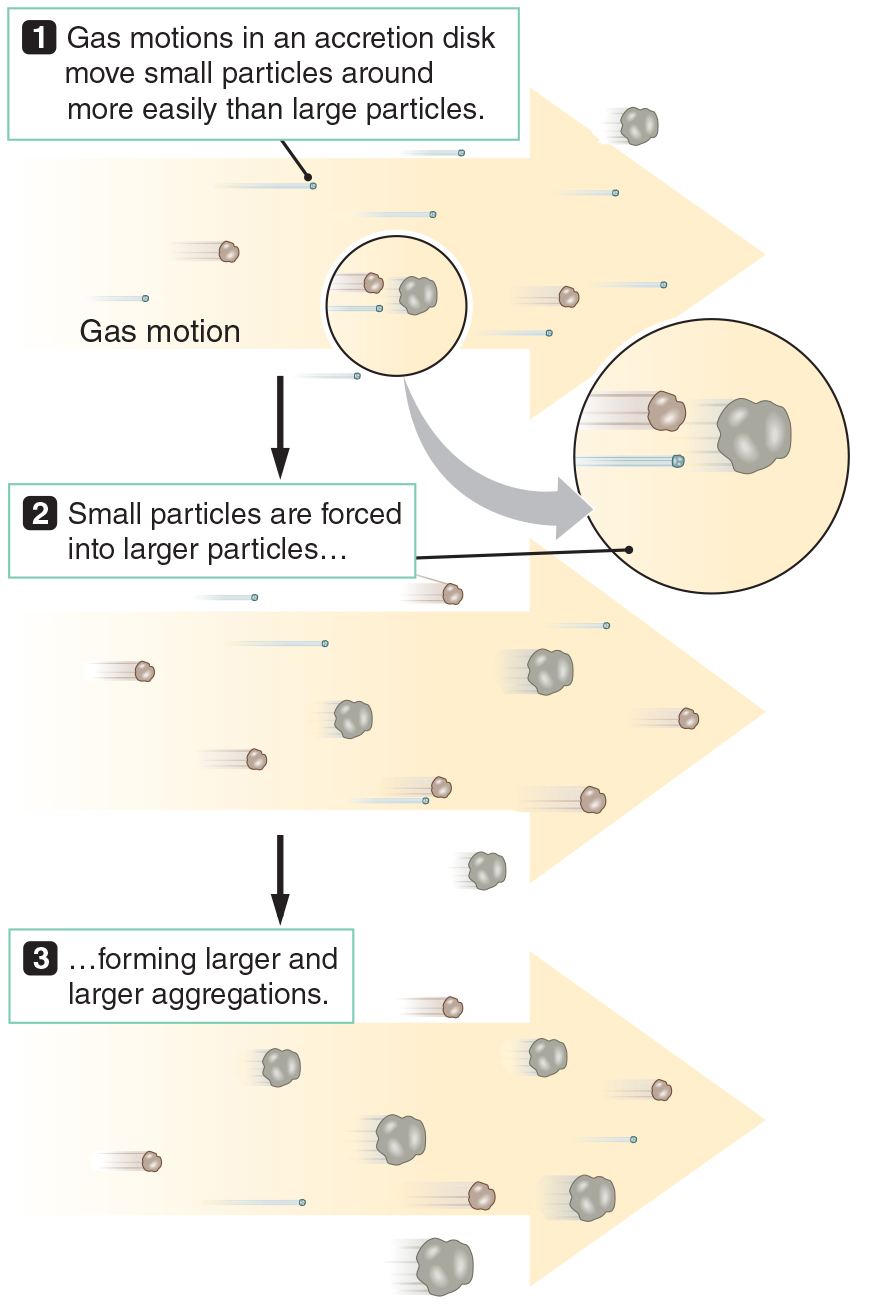
For two large clumps to stick together rather than explode into many small pieces, they must bump into each other very gently: collision speeds must be about 0.1 m/s or less. If your stride is about a meter long, a collision speed of 0.1 m/s would correspond to only one step every 10 seconds. The process does not yield larger and larger bodies with every collision. When violent collisions occur in an accretion disk, larger clumps break back into smaller pieces. But over a long time, large bodies do form.
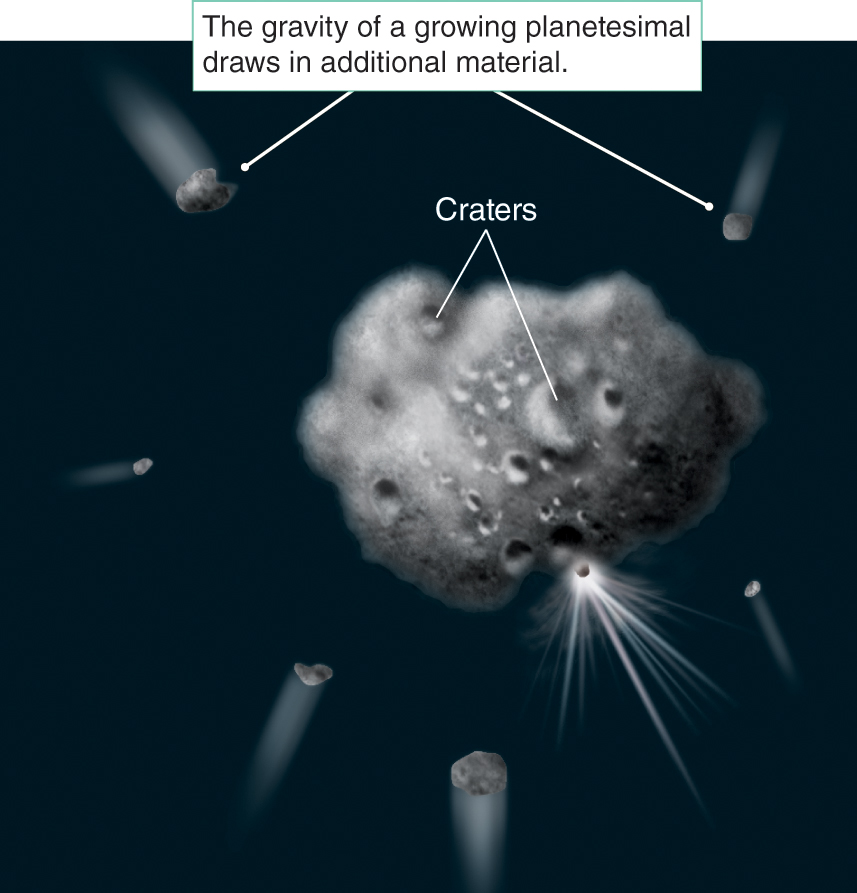
Objects continue to grow by “sweeping up” smaller objects that get in their way. Those objects can eventually measure up to several hundred meters across. As the clumps reach the size of about a kilometer, a different process becomes important. Those kilometer-sized objects are massive enough that their gravity pulls on nearby bodies, as shown in Figure 7.10. Those bodies of rock and ice are known as planetesimals (“tiny planets”) and eventually combine with one another to form planets. Besides chance collisions with other objects, a planetesimal’s gravity can now pull in and capture small objects outside its direct path. That process speeds up the growth of planetesimals, so larger planetesimals quickly consume most of the remaining bodies near their orbits. The final survivors of that process are large enough to be called planets. As with the major bodies in orbit around the Sun, some of the planets may be relatively small and others quite large.
CHECK YOUR UNDERSTANDING 7.2
Where does most of the angular momentum of the original cloud go? It (a) goes into the orbital angular momentum of planets; (b) goes into the star; (c) goes into the spin of the planets; (d) is lost along the jets from the star.
 AnswerAnswer
a
Glossary
- protostar
- A young stellar object that derives its luminosity from converting gravitational energy to thermal energy rather than from nuclear reactions in its core.
- protoplanetary disk
- The remains of the accretion disk around a young star from which a planetary system may form. Sometimes called circumstellar disk.
- Angular momentum
- In a rotating or revolving system, a conserved property whose value depends on the velocity and distribution of the system’s mass.
- conservation of angular momentum
- The physical law stating that the amount of angular momentum of an isolated system does not change.
- accretion disk
- A flat, rotating disk of gas and dust surrounding an object, such as a young stellar object, a forming planet, a collapsed star in a binary system, or a black hole.
- planetesimals
- A primitive body of rock and ice, 100 meters or more in diameter, that combines with others to form a planet. Compare meteoroid and zodiacal dust.