7.3 The Inner Disk and Outer Disk Formed at Different Temperatures
In the Solar System, the inner planets are small and mostly rocky, whereas the outer planets are very large and mostly gaseous. That distinct difference between the inner and outer Solar System can be explained by how the local disk environment affects the formation process. In this section, we examine these differences.
Energy in the Disk
The accretion disks surrounding young stars form from interstellar material that may have a temperature of only a few kelvins, but the disks themselves reach temperatures of hundreds of kelvins or more. Astronomers want to understand what heats up the disk around a forming star so that we can calculate how hot those disks get.
According to the law of conservation of energy, the total amount of energy in a system must remain constant unless energy is added to or taken away from the system from the outside. The form the energy takes, however, can change. With that concept in mind, why does gas falling on the disk make the disk hot? Imagine you are working against gravity by lifting a heavy object, such as a bowling ball. Lifting the bowling ball takes energy, and the law of conservation of energy states that energy is never lost. Where does that energy go? The energy is stored and changed into a form called gravitational potential energy. If you drop the bowling ball, it falls, and as it falls, it speeds up. The gravitational potential energy that was stored is converted to energy of motion, which is called kinetic energy. When the bowling ball hits the floor, it stops suddenly. The bowling ball loses its energy of motion, so what form does that energy take now? Some of the energy is converted into the sound the bowling ball makes when it hits the floor, and some goes into heating and distorting the floor. But much of the energy is converted into thermal energy. The atoms and molecules that make up the bowling ball are moving around within the bowling ball a bit faster than they were before the bowling ball hit, so the bowling ball and its surroundings, including the floor, grow a tiny bit warmer. Similarly, as gas falls toward the disk surrounding a protostar, gravitational potential energy is converted first to kinetic energy, causing the gas to pick up speed. When the gas hits the disk and stops suddenly, that kinetic energy turns into thermal energy.
Material falling onto the accretion disk around a forming star causes the disk to heat up, too (Figure 7.11). The amount of heating depends on where the material hits the disk. Material hitting the inner part of the disk (the inner disk) has fallen farther and picked up greater speed within the gravitational field of the forming star than material hitting the disk farther out. Like a brick dropped from a tall building, material striking the inner disk is moving quite rapidly when it hits, so it heats the inner disk to high temperatures. In contrast, material falling onto the outer part of the disk (the outer disk) is moving much more slowly, like a brick dropped from just a foot or so above the ground. As a result, the temperature at the outermost parts of the disk is not much higher than that of the original interstellar cloud. Stated another way: material falling onto the inner disk has more gravitational potential energy to convert into thermal energy than does material falling onto the outer disk.
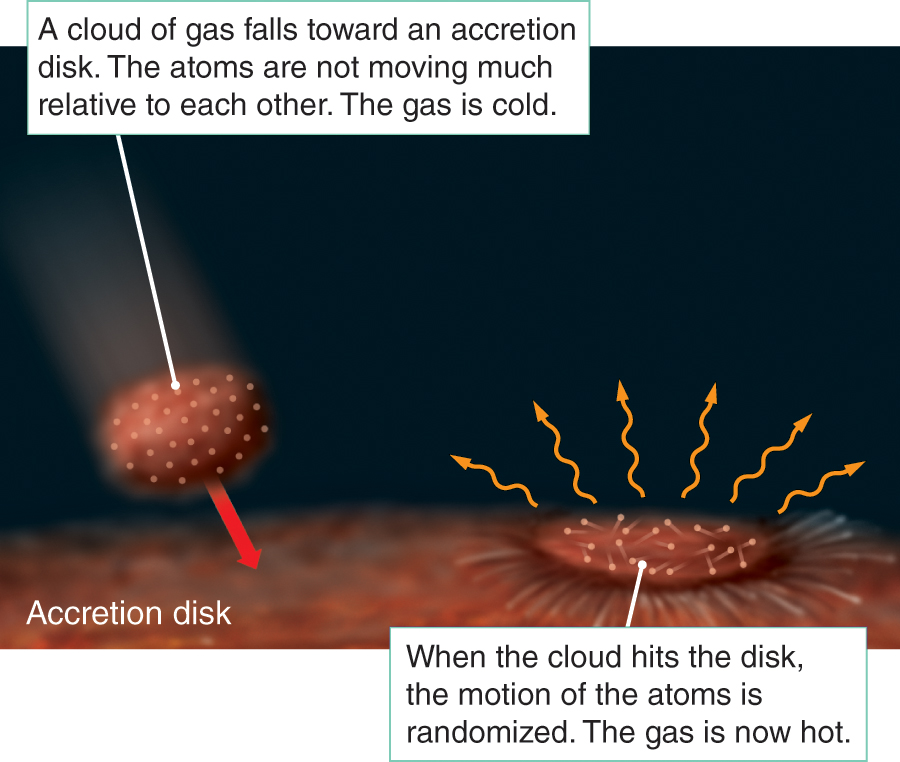
The energy released as material falls onto the disk is not the only source of thermal energy in the disk. Even before the nuclear reactions that will one day power the new star have ignited, the conversion of gravitational energy into thermal energy drives the temperature at the surface of the protostar to several thousand kelvins, and it drives the luminosity of the huge ball of glowing gas to many times the luminosity of the present-day Sun. For the same reasons why Mercury is hot whereas Pluto is not (see Chapter 5), the radiation streaming outward from the protostar at the center of the disk drives the temperature in the inner parts of the disk even higher, increasing the difference in temperature between the inner and outer parts of the disk.
The Compositions of Planets
Temperature affects whether a material exists as a solid, a liquid, or a gas. On a hot summer day, ice melts and water quickly evaporates; on a cold winter night, water in your breath freezes into tiny ice crystals. Metals and rocky materials, such as iron, silicates (minerals containing silicon and oxygen), and carbon, remain solid even at high temperatures. Substances that can withstand high temperatures without melting or being vaporized are called refractory materials. Other materials, such as water, ammonia, and methane, remain in a solid form only if their temperature is very low. Those materials, which become gases at moderate temperatures, are called volatile materials (or volatiles for short). Astronomers generally call the solid form of any volatile material an ice.
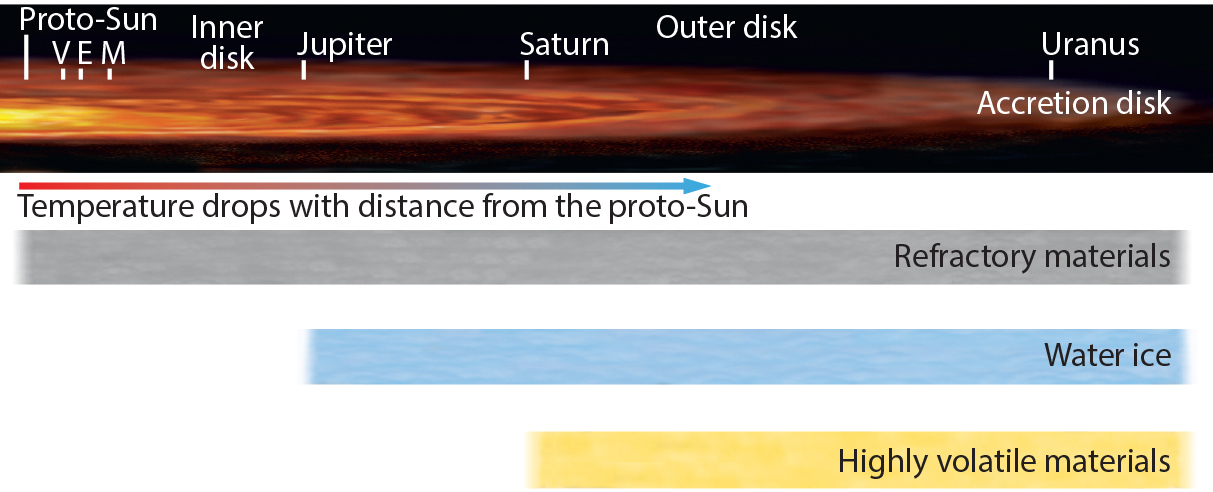
Differences in temperature from place to place within the protoplanetary disk significantly affect the makeup of the dust grains in the disk. Figure 7.12 illustrates that only refractory substances exist in the hottest parts of the disk—the area closest to the protostar. In the inner disk, dust grains are composed almost entirely of refractory materials. Some substances can survive in solid form somewhat farther out, including some hardier volatiles, such as water ice and certain chemical compounds that are organic (meaning that they contain molecules with a carbon–hydrogen bond). Those solids add to the materials that make up dust grains. In the coldest, outermost parts of the accretion disk, far from the central protostar, highly volatile components such as methane, ammonia, and carbon monoxide ices and other organic molecules survive only in solid form. The differences in composition of dust grains within the disk are reflected in the composition of the planets formed from that dust. Planets that form closer to the central star tend to be made up mostly of refractory materials, such as rock and metals, but are deficient in volatiles. Planets that form farther from the central star contain not only refractory materials but also large quantities of ices and organic materials.
 what if . . .
What if you observed an Earth-mass planet that is far from its central star, but has almost no atmosphere at all? What could you conclude about this planet’s formation history?
In the Solar System, the inner planets are composed of rocky material surrounding metallic cores of iron and nickel. Objects in the outer Solar System, including moons, giant planets, and comets, are composed largely of ices of various types. But not all planetary systems are so neatly organized as our Solar System. When planets around other stars were first discovered, they appeared to be very different, with large planets close to their respective stars. Astronomers now think that chaotic encounters—in which a small change in the initial state of a system can lead to a large change in the final state of the system—may change the organization of planetary compositions. In a process called planet migration, the force of gravity from all the nearby objects can move some planets so that they end up far from the place of their birth. In our Solar System, for example, Uranus and Neptune originally may have formed nearer to the orbits of Jupiter and Saturn but were then driven outward to their current locations by gravitational encounters with Jupiter and Saturn. A planet also can migrate when it gives up some of its orbital angular momentum to the disk material that surrounds it. Such a loss of angular momentum causes the planet to slowly spiral inward toward the central star. Thus, the order of planets in a system can change.
Formation of an Atmosphere
Once a solid planet has formed, it may continue to grow by capturing gas from the protoplanetary disk. To do so, it must act quickly. Young stars and protostars emit fast-moving particles and intense radiation that can quickly disperse the gaseous remains of the accretion disk. Gaseous planets such as Jupiter probably have only about 10 million years to form and to grab whatever gas they can. Because of their strong gravitational fields, more massive young planets can capture more of the hydrogen and helium gases that makes up the bulk of the disk. What follows is much like the formation of a star and protoplanetary disk, but on a smaller scale—namely, gas from a mini accretion disk moves inward and falls onto the planet.
The gas that a planet captures when it forms—primarily hydrogen and helium—is called the planet’s primary atmosphere. The primary atmosphere of a large planet can be more massive than the solid body, as with Jupiter. Some of the solid material in the mini accretion disk might stay behind to coalesce into larger bodies in much the same way that particles of dust in the protoplanetary disk came together to form planets. The result is a mini “solar system”—a group of moons that orbit about the planet.
A less massive planet also may capture some gas from the protoplanetary disk, only to lose it later. The gravity of small planets may be too weak to hold low-mass gases such as hydrogen or helium. Even if a small planet can gather some hydrogen and helium from its surroundings, that primary atmosphere will not last long. In the inner solar system, the temperatures are higher, so the hydrogen and helium atoms are moving faster than in the outer solar system and will escape from a small planet. The atmosphere that remains around a small planet such as Earth is a secondary atmosphere, which forms later in the life of a planet. Volcanism is one important source of a secondary atmosphere because it releases heavier and thus slower-moving gases, such as carbon dioxide, water vapor, and other gases trapped in the planet’s interior. In addition, volatile-rich comets that formed in the outer parts of the disk fall inward toward the new star long after its planets have formed, and they sometimes collide with planets. Comets are icy planetesimals that survive planetary accretion. They may serve as a significant source of water, organic compounds, and other volatile materials on planets close to the central star.
CHECK YOUR UNDERSTANDING 7.3
In our Solar System, the inner planets are rocky because: (a) the original cloud had more rocky material near the center; (b) warm temperatures in the inner disk caused the inner planetesimals to be formed of only rocky material; (c) the inner disk filled a smaller volume, and so it was denser; (d) the hydrogen and helium atoms were too low mass to remain in the inner disk.
 Answer
 Answer
b
Glossary
- conservation of energy
- The physical law stating that the amount of energy of an isolated, closed system does not change.
- gravitational potential energy
- The stored energy in an object that is due solely to its position within a gravitational field.
- silicates
- One of the family of minerals composed of silicon and oxygen in combination with other elements.
- refractory materials
- Material that remains solid at high temperatures. Compare volatile material.
- volatile materials
- Generally called ice in its solid form. Material that remains gaseous at moderate temperature. Compare refractory material.
- ice
- The solid form of a volatile material; sometimes the volatile material itself, in any form.
- organic
- Containing the element carbon.
- chaotic
- Behavior in complex systems in which a small change in the initial state of a system can lead to a large change in the final state of the system.
- planet migration
- The theory that a planet can move to a location away from where it formed, through gravitational interactions with other bodies or loss of orbital energy from interaction with gas in the protoplanetary disk.
- primary atmosphere
- An atmosphere, composed mostly of hydrogen and helium, that forms at the same time as its host planet. Compare secondary atmosphere.
- secondary atmosphere
- An atmosphere that forms—as a result of volcanism, comet impacts, or another process—sometime after its host planet has formed. Compare primary atmosphere.
- Comets
- A complex object consisting of a small, solid, icy nucleus; an atmospheric halo; and a tail of gas and dust.
- kinetic energyEK)
- The energy of an object resulting from its motions.
 Possible units include joules (J).
 - thermal energy
- The energy that resides in the random motion of atoms, molecules, and particles, by which we measure their temperature.