7.4 The Formation of Our Solar System
Nearly 5 billion years ago, the Sun was still a protostar surrounded by a protoplanetary disk of gas and dust. During the next few hundred thousand years, much of the dust in the disk had collected into planetesimals—clumps of rock and metal near the emerging Sun, and aggregates of rock, metal, ice, and organic materials farther from the Sun. In this section, we look at the formation of the types of planets in our own Solar System.
The Terrestrial Planets
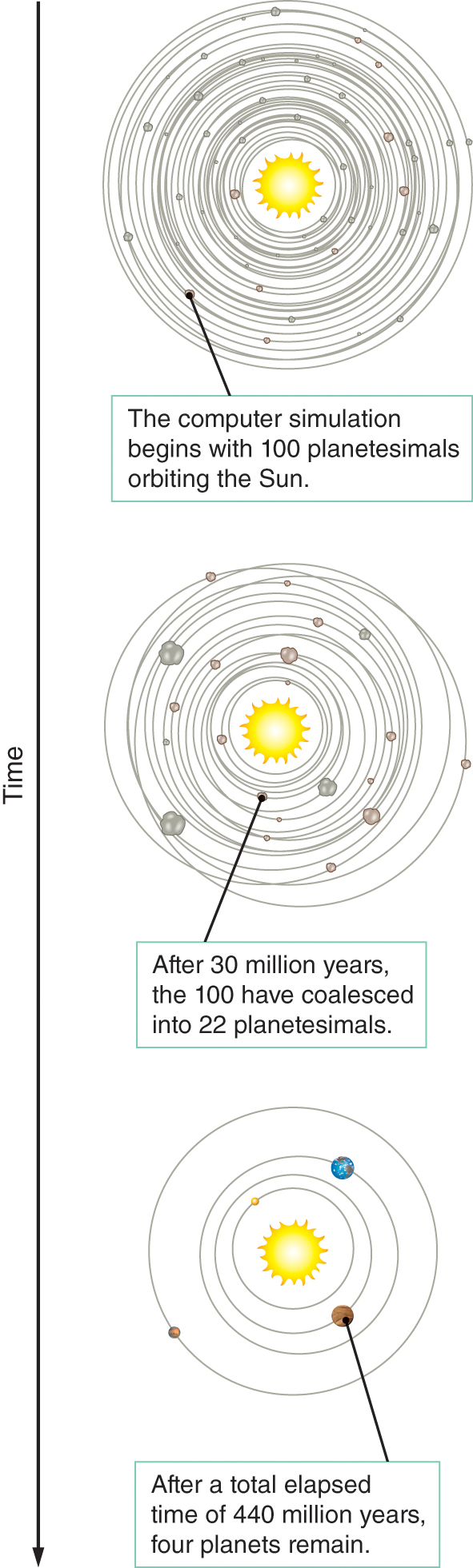
Within the inner 5 astronomical units (AU) of the disk, several rock and metal planetesimals quickly grew larger to become the dominant masses in their orbits. With their ever-strengthening gravitational fields, they either captured most of the remaining planetesimals or ejected them from the inner part of the disk. Figure 7.13 shows some results from a computer simulation of how that might have happened. The dominant planetesimals became planet-sized bodies with masses ranging between 5 percent and 100 percent of Earth’s mass. Those dominant planetesimals evolved into the terrestrial planets, which are rocky, Earth-like planets. Today, the surviving terrestrial planets are Mercury, Venus, Earth, and Mars. Earth’s Moon is often grouped with those terrestrial planets because of its similar physical and geological properties, even though it is not a planet itself and formed differently. It is possible that one or two other planets or large moons formed in the young Solar System but were later destroyed.
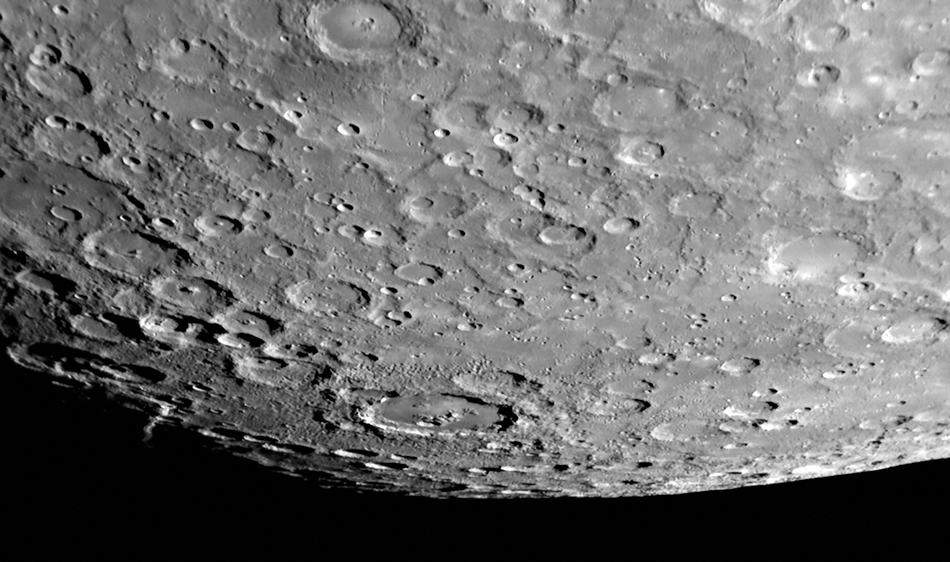
For several hundred million years after the four surviving terrestrial planets formed, leftover pieces of debris still in orbit around the Sun continued to rain down on the surfaces of those planets. Today, we can still see the scars of those early impacts on the cratered surfaces of all the terrestrial planets (Figure 7.14). That rain of debris continues even today, but at a much lower rate.
Before the proto-Sun became a true star, gas in the inner part of the protoplanetary disk was still plentiful. During that early period the two larger terrestrial planets, Earth and Venus, may have held on to weak primary atmospheres of hydrogen and helium, but those thin atmospheres were soon lost to space. The terrestrial planets did not develop thick atmospheres until the formation of the secondary atmospheres that now surround Venus, Earth, and Mars. Mercury’s size and proximity to the Sun and the Moon’s small mass prevented those bodies from retaining significant secondary atmospheres.
The Giant Planets
Beyond 5 AU from the Sun, in a much colder part of the accretion disk, planetesimals combined to form several bodies with masses about 5–20 times that of Earth (5–20 MEarth). Those planet-sized objects formed from planetesimals containing volatile ices and organic compounds in addition to rock and metal. In a process astronomers call core accretion–gas capture, mini accretion disks formed around those planetary cores, capturing massive amounts of hydrogen and helium and funneling that material onto the planets. Four such massive bodies became the cores of the giant planets—Jupiter, Saturn, Uranus, and Neptune. Those giant planets are many times the mass of any terrestrial planet.
Jupiter’s massive solid core captured and retained the most gas—roughly 300 MEarth. The other outer planetary cores captured less hydrogen and helium, perhaps because their cores were less massive or because less gas was available to them. Saturn ended up with less than 100 MEarth of gas, and Uranus and Neptune grabbed less than 20 MEarth of gas.
The core accretion model indicates that a Jupiter-like planet could take up to 10 million years to accumulate. Some planetary scientists think that our protoplanetary disk could not have survived long enough to form gas giants such as Jupiter through the general process of core accretion. All the gas may have dispersed in roughly half that time, cutting off Jupiter’s supply of hydrogen and helium. An alternative explanation is a process called disk instability, in which the protoplanetary disk suddenly and quickly fragments into massive clumps equivalent to those of a large planet. Both core accretion and disk instability may have played a role in the formation of our own and other planetary systems.
During the formation of the planets, gravitational energy was converted into thermal energy as individual atoms and molecules moved faster. That conversion warmed the gas surrounding the cores of the giant planets. Proto-Jupiter and proto-Saturn probably became so hot that they glowed a deep red color, similar to the heating element on an electric stove. Their internal temperatures may have been even higher.
In the mini accretion disks surrounding the giant planets, some of the remaining material combined into small bodies, which became moons. A moon is any natural satellite in orbit about a planet or asteroid. The composition of the moons that formed around the giant planets followed the same trend as that of the planets that formed around the Sun: the innermost moons formed under the hottest conditions and therefore contained the smallest amounts of volatile material. For example, the closest of Jupiter’s many moons may have experienced high temperatures from nearby Jupiter’s glowing so intensely that it would have evaporated most of the volatile substances in the inner part of its mini accretion disk.
Remaining Planetesimals
 what if . . .
What if astronomers had observed that all other systems were similar to our own, with rocky planets closer to the star and gas giants farther away? What would that tell us about star formation in general?
Not all planetesimals in the disk became planets. For example, dwarf planets orbit the Sun but have not cleared other, smaller bodies from their orbits. Ceres and Pluto (Figure 7.1) are dwarf planets. More dwarf planets, along with many smaller bodies, are found in the Kuiper Belt, beyond Pluto’s orbit. Asteroids are small bodies found inside Jupiter’s orbit around the Sun; most are located in the main asteroid belt between the orbits of Mars and Jupiter. Jupiter’s gravity kept the region between Jupiter and Mars so stirred up that most planetesimals there never formed a large planet.
Planetesimals persist to this day in the outermost part of the Solar System as well. Formed in a deep freeze, those objects have retained most of the highly volatile materials found in the grains present when the accretion disk formed. Unlike the crowded inner part of the disk, the outermost parts had planetesimals too sparsely distributed for large planets to grow. Icy planetesimals in the outer Solar System that survived planetary accretion remain today as comet nuclei. The frozen, distant dwarf planets Pluto and Eris are especially large examples of those residents of the outer Solar System.
Many Solar System objects show evidence of cataclysmic impacts that reshaped worlds, suggesting that the early Solar System must have been a remarkably violent and chaotic place. The dramatic difference in the terrain of the northern and southern hemispheres on Mars, for example, has been interpreted as the result of one or more colossal collisions. The leading theory for the origin of our Moon is that it resulted from the collision of an object with Earth. Mercury has a crater on its surface from an impact so devastating that it caused the crust to buckle on the opposite side of the planet. In the outer Solar System, one of Saturn’s moons, Mimas, has a crater roughly one-third the diameter of the moon itself. Uranus suffered one or more collisions violent enough to knock it on its side. As a result, its equatorial plane is tilted at almost a right angle to its orbital plane. Other examples are discussed in later chapters.
CHECK YOUR UNDERSTANDING 7.4
Suppose that astronomers found a rocky, terrestrial planet beyond the orbit of Neptune. What is the most likely explanation for its origin? (a) It formed close to the Sun and migrated outward. (b) It formed in that location and was not disturbed by migration. (c) It formed later in the Sun’s history than other planets. (d) It is a captured planet that formed around another star.
 Answer
 Answer
a
Glossary
- terrestrial planets
- An Earth-like planet, made of rock and metal and having a solid surface. In the Solar System, the terrestrial planets are Mercury, Venus, Earth, and Mars. Compare giant planet.
- core accretion–gas capture
- A process for forming giant planets, in which large amounts of surrounding hydrogen and helium gas are gravitationally captured onto a massive rocky core.
- giant planets
- Also called Jovian planet. One of the largest planets in the Solar System (Saturn, Jupiter, Uranus, or Neptune), typically 10 times the size and many times the mass of any terrestrial planet and lacking a solid surface.
- moon
- A less massive satellite orbiting a more massive object. Moons are found around planets, dwarf planets, asteroids, and Kuiper Belt objects. The term is usually capitalized when referring to Earth’s Moon.
- comet nuclei
- A primitive planetesimal composed of ices and refractory materials that has survived planetary accretion. The “heart” of a comet, containing nearly the entire mass of the comet. A “dirty snowball.”