CELL DIVISION
Humans have two different types of cells: somatic cells and gametes. Somatic cells are also called body cells because they are the cells that make up our different body parts. Hair, organs, bone, fat, and other body parts are made of somatic cells. Gametes are called sex cells because they are the cells involved in sexual reproduction. Males have sperm, and females have ova (eggs). New cells are produced through a process called cell division. Generally, cell division in somatic cells occurs through mitosis, and cell division in gametes happens through meiosis.
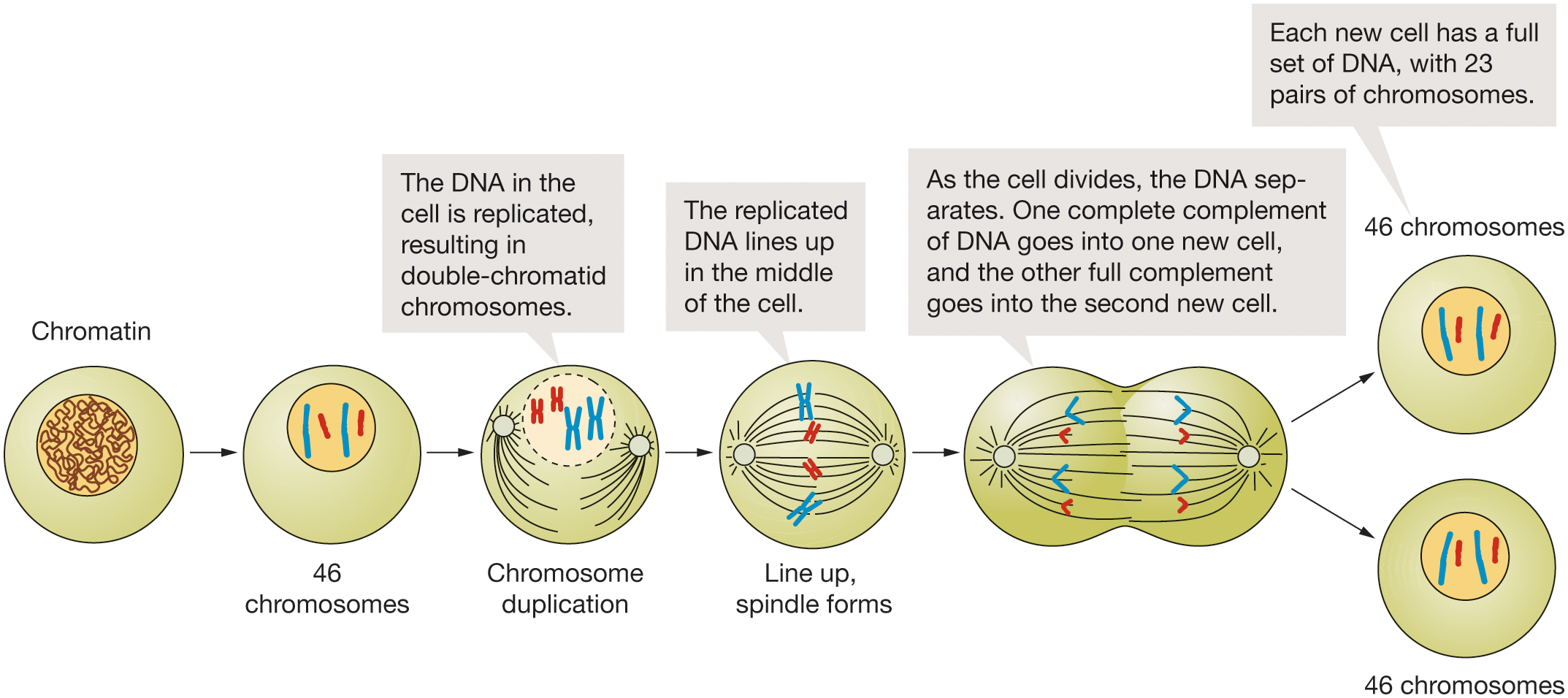
The process of cell division that takes place in somatic cells is called mitosis. It involves one cell division, and it results in two daughter cells that are exact copies of the original cell.
In humans, mitosis begins with the 46 single-chromatid chromosomes in a somatic cell. The chromosomes duplicate via DNA replication to form double-chromatid chromosomes. These chromosomes align in the middle of the cell in single file. Then, the chromosomes split apart at their centromeres, and each chromatid goes to a different side of the cell. The cell then pinches in at the middle, leaving two daughter cells that each have a complete set of 46 single-chromatid chromosomes. This process begins with one cell and ends with two daughter cells that are both exact replicas of the original cell (FIGURE 2.8). The process of mitosis creates new somatic cells, which allows for growth and repair of damaged tissue in the body.
Meiosis is a little different (FIGURE 2.9A). Meiosis begins with a gamete-forming cell containing 46 single-chromatid chromosomes that replicate to form double-chromatid chromosomes. As in mitosis, these chromosomes then line up in the center of the cell, this time with their homologous partners. In this stage of meiosis, each chromosome can exchange genetic information with its homologous partner. This process is called crossing-over because genetic information is exchanged between one chromosome and the other (Figure 2.9B). After crossing-over, the chromosomes separate for the first time. The double-chromatid chromosomes do not split apart, as they do in mitosis at this stage. Instead, the chromosomes remain intact, and the two members of each homologous pair move to different sides of the cell. Then, the cell pinches in and creates two daughter cells. Remember that because of the crossing-over that occurred earlier, some genetic information has been exchanged, leading to new combinations of genes that were not present before. This means that the daughter cells are not identical to each other or to the original cell. The two daughter cells then undergo a second division. The double-chromatid chromosomes move to the center of the cell. The double-chromatid chromosomes then split apart at their centromeres, as in mitosis. The now single-chromatid chromosomes move to opposite sides of the cell, and the cell pinches in at the middle, leaving two daughter cells. Because there were two daughter cells after the first division that then divided again, meiosis results in a total of four daughter cells. Each of the four cells has 23 single-chromatid chromosomes (half the genetic information of the original cell) (see Figure 2.9A). The process of meiosis creates gametes (sperm and ova in humans), which are necessary for sexual reproduction.
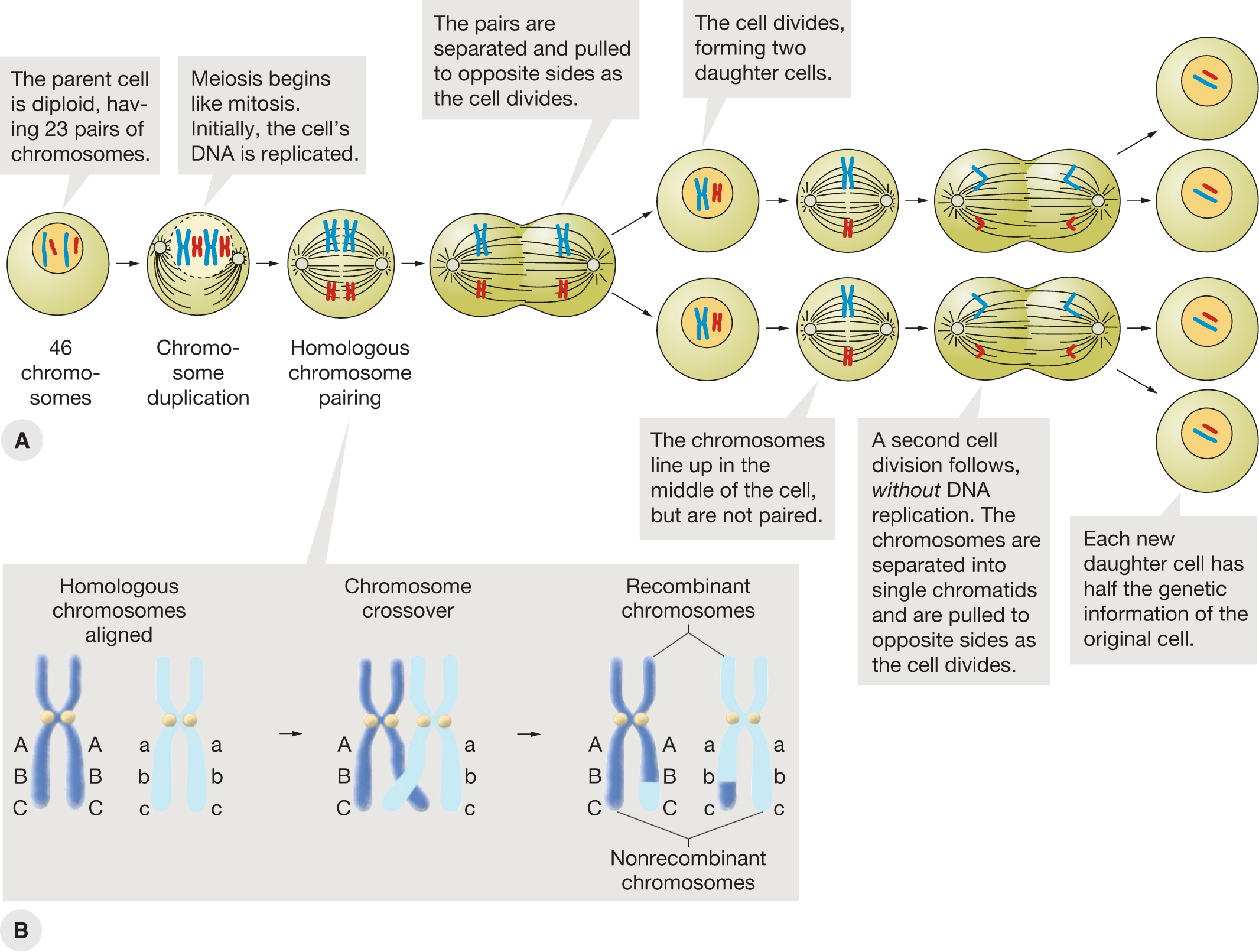
FIGURE 2.9 Meiosis and Crossing-Over(A) The process of cell division that takes place to make gametes is called meiosis. It involves two cell divisions, and it results in four daughter cells that have half the genetic information of the original cell. (B) Early in meiosis, homologous pairs of chromosomes line up in the middle of the cell and swap genetic information during a process called crossing-over.1
Meiosis is very important to evolution because it results in genetic recombination. This does not mean that entirely new genes are created. It means that the existing genes are mixed up in new combinations. As the chromosomes cross over and the cell is divided, new combinations of genetic information are formed. For example, even if two traits are carried on the same chromosome, they may not necessarily be inherited together. If one of those traits is exchanged with the homologous chromosome during crossing-over, the two traits become separated. When the cell divides, the two traits will end up in different daughter cells and will not be inherited together. This process leads to genetic variation, and genetic variation plays a key role in evolution. At the same time, each daughter cell created by meiosis carries only half of a parent’s possible genes. So, if a person has only one offspring, only half of their genes will be passed to the next generation. If a person has two offspring, there is a greater likelihood of passing on more of their possible genes; however, it is not guaranteed that the parent’s entire genome is represented in those two offspring. Remember, the parent’s genes are recombined during each meiosis event. There will be some overlap in genes that are passed to both of the offspring, and there will be some genes that are passed to only one offspring and not the other. Even if a person had 100 offspring, some of their genes would never be passed to their children. This variation in genetic recombination and genetic representation across generations is central to evolution.
Glossary
- somatic cell
- a non-sex cell that makes up different body parts; also called a body cell
- gamete
- a sex cell (in humans, sperm or egg)
- mitosis
- the process of cell division that occurs in somatic cells
- meiosis
- the process of cell division that produces gametes
- crossing-over
- the stage in meiosis during which genetic information is exchanged between the two chromosomes in a homologous pair
- genetic recombination
- the mixing of genetic information into new combinations that occurs during meiosis
Footnotes
- Adapted from OpenStax College. 2014. Concepts of biology. OpenStax CNX. cnx.org/contents/b3c1e1d2-839c-42b0-a314-e119a8aafbdd@8.49. Textbook content produced by OpenStax College is licensed under a Creative Commons Attribution License 3.0 license. Return to reference