RHYTHMIC DURATIONS
QUARTER NOTES, HALF NOTES, AND WHOLE NOTES
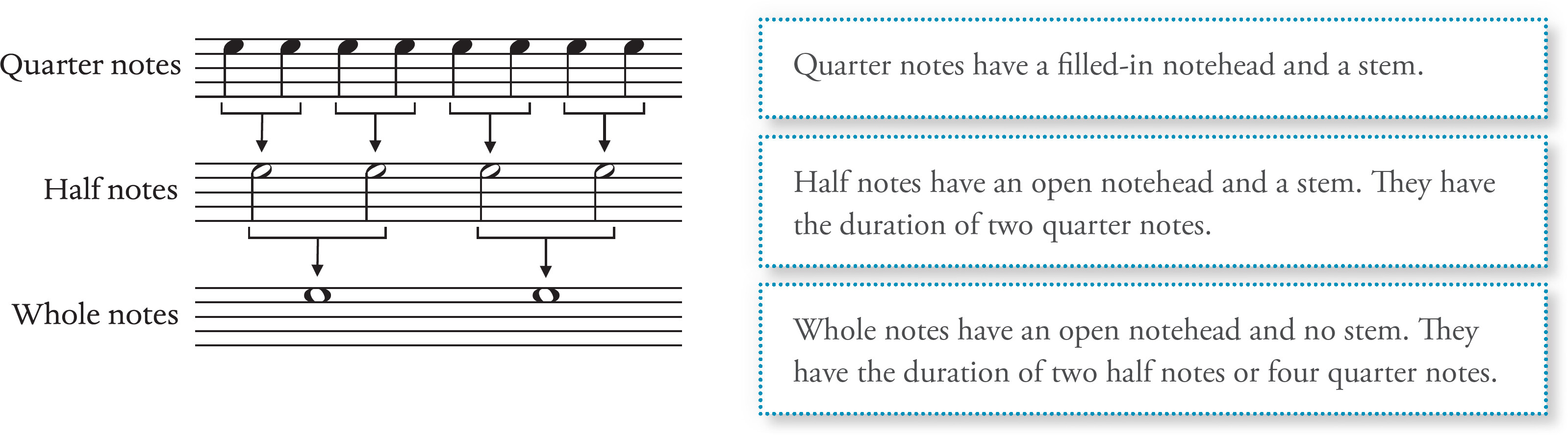
The basic unit of musical duration is a quarter note, written with a filled-in notehead and a stem. Two quarter notes together make a half note, written as an open notehead with a stem. Two half notes combine to make a whole note, written as an open notehead with no stem.
More information
The staff marked Quarter notes has eight quarter notes, each with a filled-in notehead and a stem. The staff marked with Half notes has four half notes, each with an open notehead and a stem. Brackets connect pairs of quarter notes above, with arrows pointing down to single half notes below, depicting the duration equivalence. The staff marked Whole notes has two whole notes, each with an open notehead and no stem. Brackets connect pairs of half notes above, with arrows pointing down to single whole notes below, showing the duration equivalence. Text reads, Quarter notes have a filled-in notehead and a stem. Half notes have an open notehead and a stem. They have the duration of two quarter notes. Whole notes have an open notehead and no stem. They have the duration of two half notes or four quarter notes.
0.11
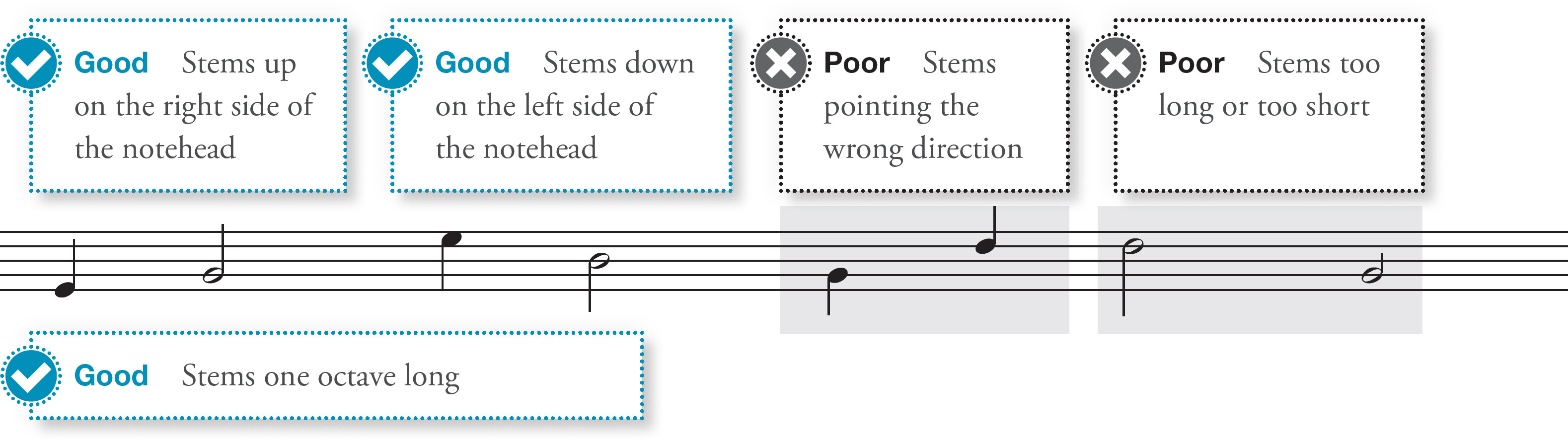
When writing quarter notes and half notes, make the stem an octave in length. When the note is on or below the second space of the staff, the stem goes to the right and points up. When the note is on or above the third line of the staff, the stem goes to the left and points down.
More information
The staff has eight notes. The notes 1 to 4 are labeled under good and notes 5 to 8 are labeled under poor. Note 1 is a quarter note on the bottom line with a stem on the right pointing up. A box marked Good reads, Stems up on the right side of the notehead. Note 2 is a half note on the second line from the bottom with a stem on the right pointing up. Note 3 is a quarter note on the top space inside the staff with a stem on the left pointing down, and note 4 is a half note on the middle line with a stem on the left pointing down. A box marked Good reads, Stems down on the left side of the notehead. Another box marked Good reads, Stems one octave long. The notes 5 to 8 are in shaded regions. Note 5 is a quarter note on the second line from the bottom with a stem on the left pointing down. Note 6 is a quarter note on the second line from the top with a stem on the right pointing up. A box marked Poor reads, Stems pointing the wrong direction. Note 7 is a half note on the second line from the top with a stem on the left pointing down but extending more than an octave, and note 8 is a half note on the second line from the bottom with a stem on the right pointing up but extending less than an octave. A box marked Poor reads, Stems too long or too short.
0.12
EIGHTH NOTES AND SIXTEENTH NOTES
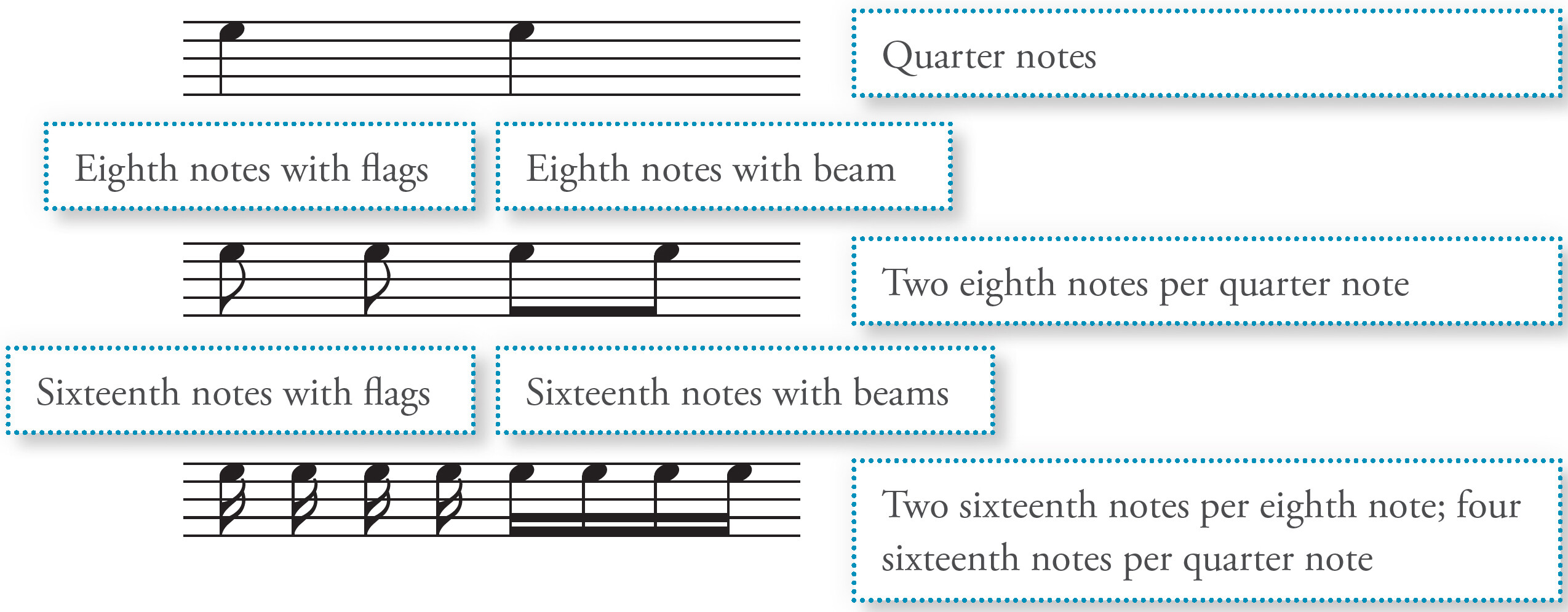
Just as quarter notes can be combined to create longer durations, they can be divided to create shorter ones. A quarter note can be divided into two eighth notes, each written with a filled-in notehead and a stem with a flag. When two eighth notes occur together as a pair, join them with a beam instead of using flags. An eighth note can be divided into two sixteenth notes, each written as a filled-in notehead with a double flag or, in pairs or groups of four, joined together with a double beam. (Further subdivisions—thirty-second notes and sixty-fourth notes—are also possible.)
More information
The first staff has two quarter notes. A box reads, Quarter notes. The second staff has four eighth notes, where the first two notes have flags and a box reads, Eighth notes with flags, and the second two notes are beamed together with a box reading, Eighth notes with beam. Another box reads, Two eighth notes per quarter note. The third staff has eight sixteenth notes, where the first four notes have flags. A box reads, Sixteenth notes with flags. The second four notes are beamed together with a box reading, Sixteenth notes with beams. Another box reads, Two sixteenth notes per eighth note; four sixteenth notes per quarter note.
0.13
DOTS AND TIES
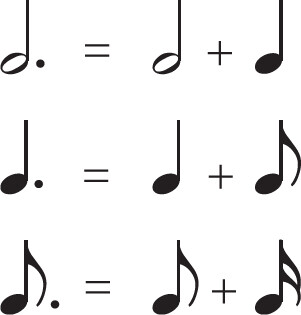
So far, all of the durations that we have considered involve halving or doubling the quarter note. We can create additional rhythmic values by using the augmentation dot. A dot placed directly after a note increases the duration of that note by one half.
More information
The first row shows a dotted half note equal to a half note plus a quarter note. The second row shows a dotted quarter note equal to a quarter note plus an eighth note. The third row shows a dotted eighth note equal to an eighth note plus a sixteenth note.
0.14
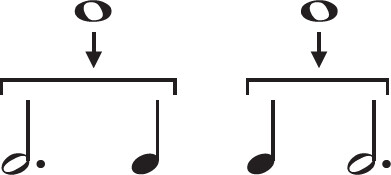
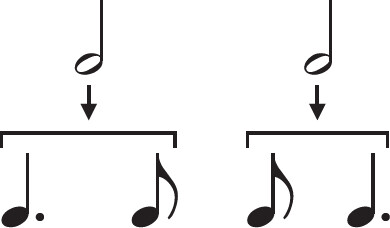
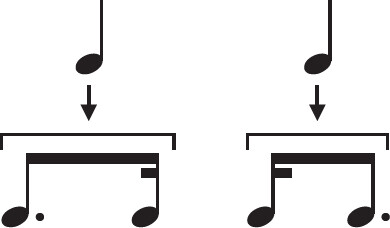
Dotted rhythms often divide a duration into two unequal parts.
0.15
Dotted-half + quarter = whole
More information
The diagram features a whole note with an arrow pointing to a bracket containing a dotted half note and a quarter note. Another bracket reverses their order, showing a quarter note followed by a dotted half note. This represents that a dotted half note plus a quarter note equals a whole note.
Dotted-quarter + eighth = half
More information
The diagram features a half note with an arrow pointing to a bracket containing a dotted quarter note and an eighth note. Another bracket reverses their order, showing an eighth note followed by a dotted quarter note. This represents that a dotted quarter note plus an eighth note equals a half note.
Dotted-eighth + sixteenth = quarter
The dotted-eighth and sixteenth are frequently beamed together.
More information
The diagram features a quarter note with an arrow pointing to a bracket containing a dotted eighth note and a sixteenth note beamed together. Another bracket reverses their order, showing a sixteenth note followed by a dotted eighth note. This represents that a dotted eighth note plus a sixteenth note equals a quarter note.
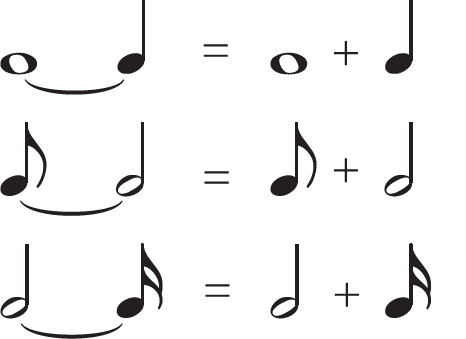
Still more rhythmic values become available with ties. A tie connecting two notes combines them into a single duration.
0.16
A tie combines two notes into a single duration.
More information
The first row illustrates a whole note tied to a quarter note, which equals a whole note plus a quarter note. The second row shows an eighth note tied to a half note, equal to an eighth note plus a half note. The third row demonstrates a half note tied to a sixteenth note, equal to a half note plus a sixteenth note.
RESTS
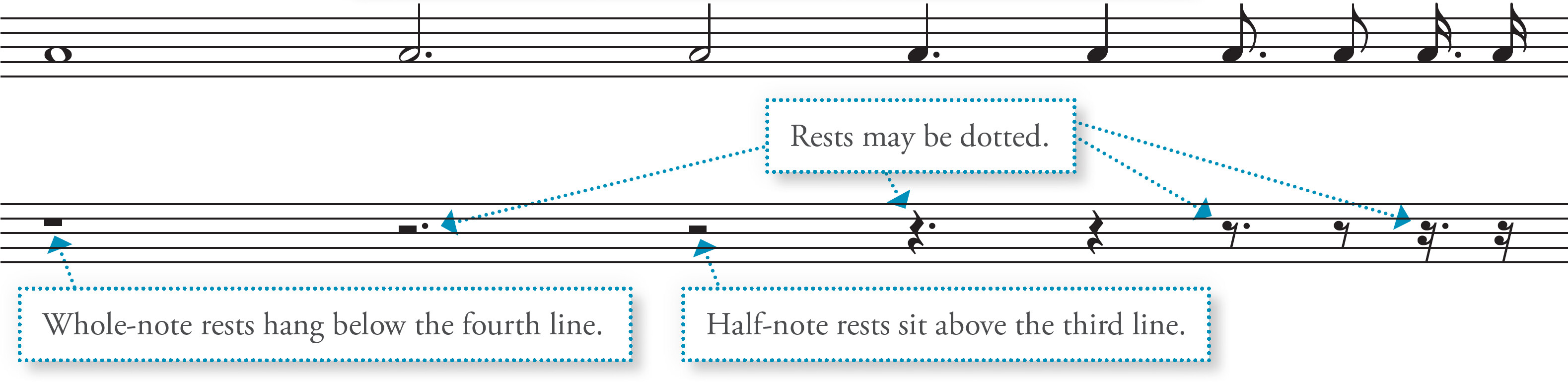
A rest indicates a duration of silence. Rests can correspond to any rhythmic value. They are written in the middle of the staff.
0.17
Shown are notes and corresponding rests of the same duration.
More information
The diagram has two staves, one with notes and one with corresponding rests. The durations presented are whole, dotted half, half, dotted quarter, quarter, dotted eighth, eighth, dotted sixteenth, and sixteenth. Whole note rests hang below the fourth line, and half note rests sit above the third line. A box points to several rests and reads, Rests may be dotted. Whole note rest is a solid, filled rectangle that hangs below the fourth line of the staff. A dotted half note rest is a solid, filled rectangle that sits above the third line of the staff, with a single dot placed to its right. Half note rest is a solid, filled rectangle that sits above the third line of the staff. Dotted quarter note rest is a small, jagged, wavy line followed by a backward c shape, with a single dot placed to its right. Quarter note rest is a small, jagged, wavy line followed by a backward c shape. Dotted eighth note rest is a short diagonal slash with a small oval at the end, with a single dot placed to its right. Eighth note rest is a short diagonal slash with a small oval at the end. Dotted sixteenth note rest is a short diagonal slash with two small ovals at the end, with a single dot placed to its right. Sixteenth note rest is a short diagonal slash with two small ovals at the end.
Glossary
- quarter note
- Note written as a solid notehead with a stem, and most often used to represent one beat; its duration is half as long as a half note and twice as long as an eighth note.
- half note
- Note written as an open notehead with a stem, representing the duration half as long as a whole note and twice as long as a quarter note.
- whole note
- Note written as an open notehead with no stem, representing the duration twice as long as a half note.
- eighth notes
- Note written as a solid notehead with a stem and a flag or beam, representing the duration half as long as a quarter note and twice as long as a sixteenth note.
- flag
- Short line attached to an individual note stem indicating a duration shorter than a quarter note: a single flag indicates an eighth note, a double flag indicates a sixteenth note, and so forth.
- beam
- Horizontal line connecting the stems of two or more notes to indicate durations shorter than a quarter note: a single beam indicates eighth notes, a double beam indicates sixteenth notes, and so forth.
- sixteenth notes
- Note written as a solid notehead with a stem and a double flag or beam, representing the duration half as long as an eighth note and twice as long as a thirty-second note.
- augmentation dot
- Dot following a notehead that increases the duration by one half the value of the note.
- ties
- A curved sign between two noteheads indicating the addition of the time values; can be used to create durations that last across barlines or for which there is no single-note representation.
- rest
- A duration of silence; notated with signs equivalent to whole note, half note, and so forth.