TRIADS
TRIAD CONSTRUCTION
A triad consists of three different pitches: a fifth divided into two thirds, or two thirds stacked to make a fifth. Triads can appear on three consecutive lines or spaces on the staff. When a triad is stacked in thirds, the lowest note is the root, the middle note is the third, and the highest note is the fifth.

More information
On the staff, each triad has three notes: the lowest note is labeled Root, the middle note is labeled Third, and the top note is labeled Fifth. The interval from Root to Third is a third, from Third to Fifth is a third, and from Root to Fifth is a fifth.
3.1
TRIAD QUALITIES
Triads are classified by quality: depending on the qualities of the thirds and fifths they contain, triads may be diminished, minor, major, or augmented. Refer to a triad by its name and quality, for example, C♯ major triad or D minor triad.

More information
The first measure has an E diminished triad with notes E, G, and B flat. Intervals are E to G minor third, G to B flat minor third, and E to B flat diminished fifth. The second measure has an F sharp minor triad with notes F sharp, A, and C sharp. Intervals are F sharp to A minor third, A to C sharp major third, and F sharp to C sharp perfect fifth. The third measure has a C major triad with notes C, E, and G. Intervals are C to E major third, E to G minor third, and C to G perfect fifth. The fourth measure has a G augmented triad with notes G, B, and D sharp. Intervals are G to B major third, B to D sharp major third, and G to D sharp augmented fifth.
3.2
Chord symbols identify the root and quality of a triad. Diminished triads are indicated with a degree symbol (°) after the root, minor triads with a lowercase m, and augmented triads with a plus sign (+). Major triads are indicated with just their root.
NATURAL (WHITE-KEY) TRIADS
Knowing the natural triads—without accidentals—can be helpful in identifying triad quality.
3.3
Every triad uses one of these seven groups of letter names: CEG, DFA, EGB, FAC, GBD, ACE, BDF.

More information
On the treble staff, the chords have letter names and qualities. C E G forms the C major triad. D F A forms the D minor triad. E G B forms the E minor triad. F A C forms the F major triad. G B D forms the G major triad. A C E forms the A minor triad. B D F forms the B diminished triad.

More information
Left: On the bass staff, the D minor triad is marked as a reference. Other triads that use the letters D F A include D flat augmented with notes D flat F A, D major with notes D F sharp A, D augmented with notes D F sharp A sharp, D diminished with notes D F A flat, and D sharp minor with notes D sharp F sharp A sharp. Right: On the bass staff, the F major triad is marked as a reference. Other triads that use the letters F A C include F minor with notes F A flat C, F sharp major with notes F sharp A sharp C sharp, F augmented with notes F A C sharp, F diminished with notes F A flat C flat, and F sharp minor with notes F sharp A C sharp.
3.4
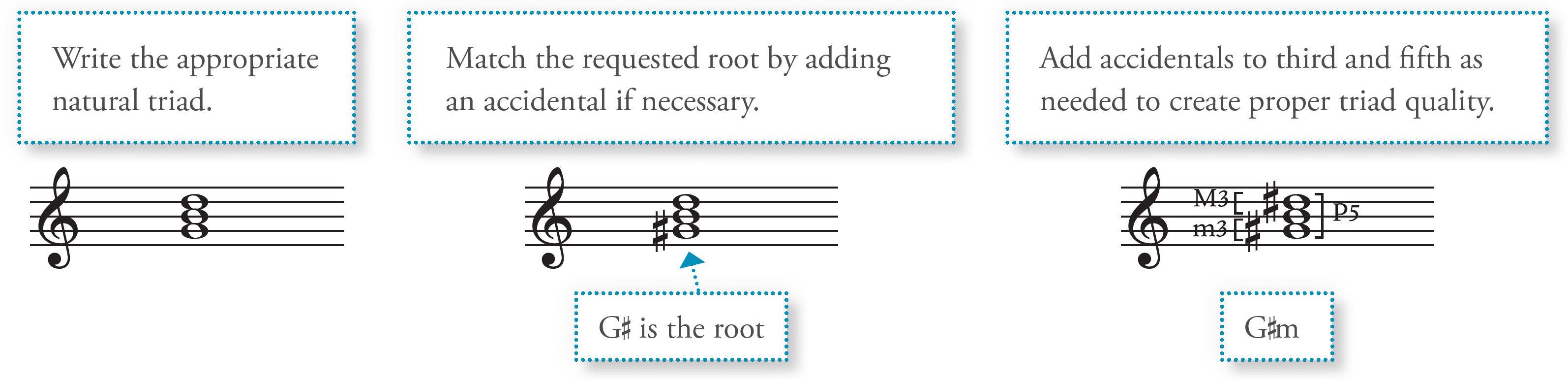
To spell a triad, start with a white-key triad and, if necessary, add an accidental to match the root requested. Then check the intervals of the triad, adding accidentals as needed for the proper quality of the third and the fifth.

More information
First, the natural triad is E, G, B on the treble staff. Text reads, Write the appropriate natural triad. Next, the root E is labeled. Text reads, Match the requested root by adding an accidental if necessary. Finally, accidentals are added: E, G sharp, and B. The interval from E to G sharp is a major third, from G sharp to B is a minor third, and from E to B is a perfect fifth, forming the E major triad. Text reads, Add accidentals to third and fifth as needed to create proper triad quality.
3.5 Task: Write an E major triad (E).
More information
First, the natural triad is G, B, D on the treble staff. Text reads, Write the appropriate natural triad. Next, the root G sharp is labeled. Text reads, Match the requested root by adding an accidental if necessary. Finally, accidentals are added: G sharp, B, and D sharp. The interval from G sharp to B is a minor third, from B to D sharp is a major third, and from G sharp to D sharp is a perfect fifth, forming the G sharp minor triad. Text reads, Add accidentals to third and fifth as needed to create proper triad quality.
3.6 Task: Write a G♯ minor triad (G♯m).
TRIADS IN INVERSION
Triads can be arranged in a variety of ways, from three notes played with one hand at the piano to being spread out over an entire orchestra. However they are arranged, the lowest-sounding note of a triad is called the bass; any one of a triad’s three notes can sound in the bass. The bass note of a triad determines its position. When the root of a triad is in the bass, the triad is in root position. When the third of a triad is in the bass, the triad is in first inversion. When the fifth of a triad is in the bass, the triad is in second inversion. It does not matter which notes are on the top or in the middle of the chord: the position is determined solely by the bass.

More information
The E major triad is labeled as root position with E in bass, G sharp in alto, B in soprano. It is labeled as first inversion with G sharp in bass, E in alto, B in soprano. It is labeled as second inversion with B in bass, E in alto, G sharp in soprano. The F minor triad is marked as root position with F in bass, C in alto, A flat in soprano. It is marked as first inversion with A flat in bass, C in alto, F in soprano. It is marked as second inversion with C in bass, A flat in alto, F in soprano.
3.7
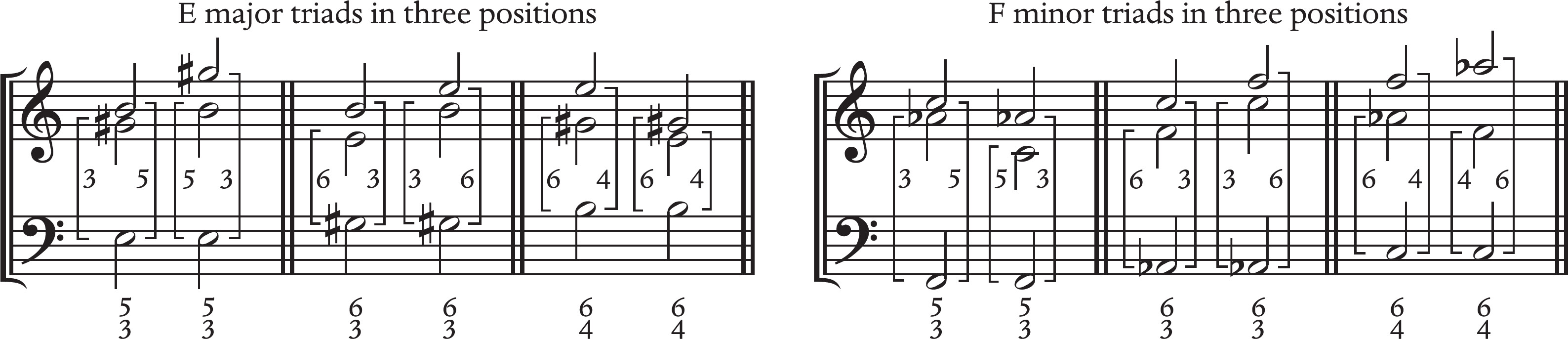
Triad positions are commonly labeled with a stack of two Arabic numbers, or a figure: = root position; = first inversion; = second inversion. These numbers correspond to the intervals formed above the lowest-sounding note.
More information
Left: The E major triad is in three positions. In root position, E in bass, G sharp in alto, B in soprano is labeled with brackets three and five, and the figure below is five over three. The alternate voicing E in bass, B in alto, G sharp in soprano carries the same labeling. In first inversion, G sharp in bass, E in alto, B in soprano is labeled with brackets three and six, and the figure below is six over three. The alternate voicing G sharp in bass, B in alto, E in soprano carries the same labeling. In second inversion, B in bass, G sharp in alto, E in soprano is labeled with brackets four and six, and the figure below is six over four. The alternate voicing B in bass, E in alto, G sharp in soprano carries the same labeling. Right: The F minor triad is in three positions. In root position, F in bass, A flat in alto, C in soprano is labeled with brackets three and five, and the figure below is five over three. The alternate voicing F in bass, C in alto, A flat in soprano carries the same labeling. In first inversion, A flat in bass, F in alto, C in soprano is labeled with brackets three and six, and the figure below is six over three. The alternate voicing A flat in bass, C in alto, F in soprano carries the same labeling. In second inversion, C in bass, A flat in alto, F in soprano is labeled with brackets four and six, and the figure below is six over four. The alternate voicing C in bass, F in alto, A flat in soprano carries the same labeling.
3.8
Arabic numbers indicate the position of the triad:
= root position
= first inversion
= second inversion
Glossary
- triad
- Harmonic element consisting of three pitches: a root pitch and a third and fifth above it.
- root
- The pitch on which a triad or other chord is built.
- third
- Interval between two tones spanning three scale steps (letter names), as C–E or – in a chord, the third above the root (in a triad, the middle note).
- fifth
- Interval between two tones spanning five scale steps (letter names), as C–G or – in a chord, the fifth above the root.
- quality
- Quality of a triad: major, minor, augmented, or diminished.
- diminished
- Triad built of a minor third and a diminished fifth.
- minor
- Triad built of a minor third and a perfect fifth above a root.
- major
- Triad built of a major third and a perfect fifth above a root.
- augmented
- Triad built of a major third and an augmented fifth.
- natural triads
- Any triad built on white keys (naturals).
- bass
- The lowest voice; the bottom note of a chord.
- position
- The arrangement of a chord depending on which note is in the bass.
- root position
- The arrangement of a chord in which the root is in the bass; indicated or no figures for a triad, or 7 for a seventh chord.
- first inversion
- Chord position in which the third is in the bass; indicated or 6 for a triad, for a seventh chord.
- second inversion
- Chord position in which the fifth is in the bass; indicated for a seventh chord, for a triad (and considered dissonant in this form).
- figure
- Arabic numerals, written vertically below bass note, used to indicate chords or intervals above the bass note.