Seokguram Grotto
Vairochana Buddha
Seokguram Grotto
Vairochana Buddha
Near the southeast coast of the Korean peninsula at Mount Toham is the Seokguram Grotto, commissioned by a government official of the Unified Silla kingdom and completed between 751 and 774. This temple complex houses the Seated Buddha, an extraordinary granite sculpture of the Buddha (Fig. 13.7). The “earth-touching” gesture made by the figure’s right hand (on the left as the viewer looks at the sculpture) suggests he is the historical Buddha at the moment of enlightenment, but the statue may also depict Vairochana, the cosmic Buddha from whom all other buddhas emanate.
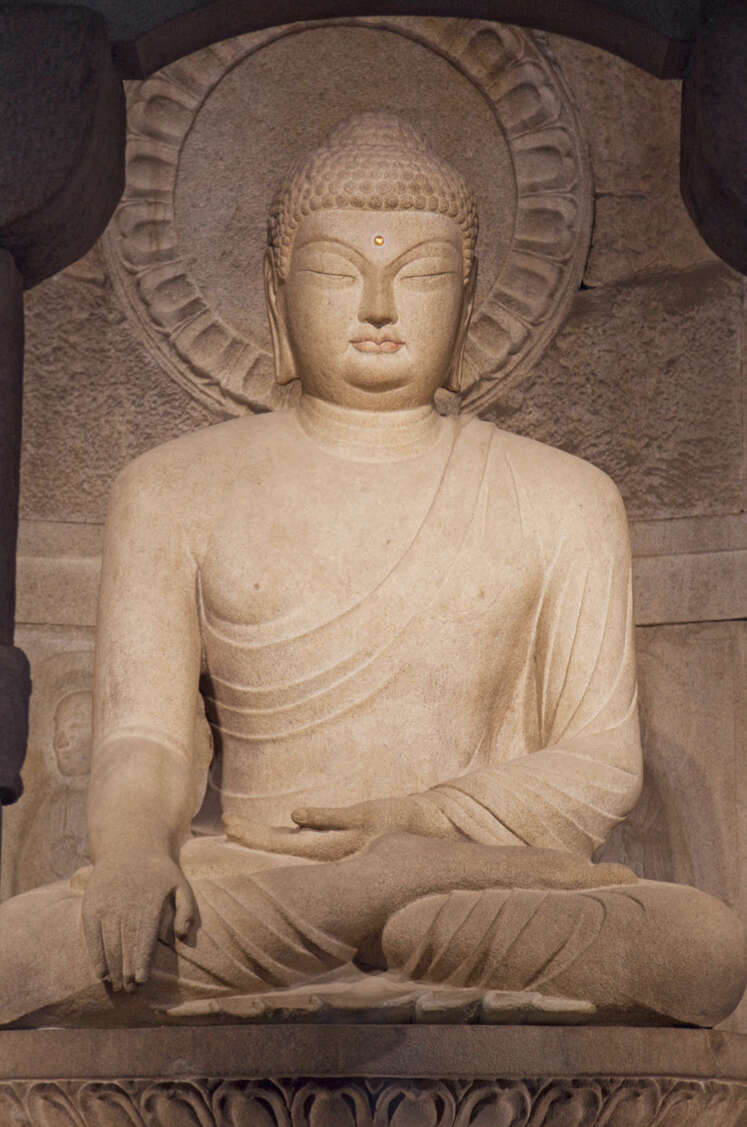
The eyes are closed in meditation. A relatively simple halo circles the head. The left hand rests in the Buddha’s lap. The right hand gestures toward the ground.
In trying to analyze and understand the Seokguram Grotto and the Seated Buddha, art historians might look for the influence of earlier works. For example, they might ask if the Tang dynasty Colossal Vairochana carved into the Longmen Caves in China’s Henan province (Fig. 20.6) influenced the Seokguram Buddha. However, the search for influence often reflects an implicit bias, in that it implies a preferred model acting on a supposedly lesser follower. Such thinking can help establish chronological relationships, but it can overlook local circumstances and inventions.
The concepts of appropriation and adaptation are useful alternatives to the idea of influence. Both recognize that artists and cultures make choices rather than adhere strictly to established forms, styles, subject matter, or conventions. In art history, appropriation means the use of preexisting images, objects, or ideas, typically by less powerful groups or individuals, and so it does not have the negative connotation of taking unjustly, as often implied in the popular usage of the word. In the context of the Seokguram Grotto, the term appropriation refers to (among other things) how sculptors, architects, and patrons on the Korean peninsula chose to employ (or not to employ) aspects of Tang dynasty art to suit their goals, just as their counterparts in the Tang dynasty did or did not choose to embrace aspects of the Buddhist art and architecture of South Asia. Use of the term adaptation further emphasizes the introduction of local alterations and adjustments. For example, in Fig. 13.5, the Dvaravati sculptors added ornate floral decoration to the center and edge of the Dharmachakra wheel, thereby adapting its design to fit local stylistic preferences.
The concepts of appropriation and adaptation suggest that imitation of earlier models cannot be explained as a lack of creativity by later artists. Rather, local conditions determine whether the appropriation and adaptation of foreign styles are religiously effective, politically expedient, or culturally prestigious. Recognizing an artistic source thus becomes less an answer (“Aha, it looks like the Colossal Vairochana!”) and more an inquiry (“How and why did the artists at Seokguram appropriate and adapt the practice of building Buddhist cave temples?”).