ANTHROPOLOGISTS ENGAGE THE WORLD


William UryNegotiating Anthropologically
Anthropologist William Ury specializes as a mediator and negotiation advisor in conflicts from workplace disputes to labor strikes to ethnic wars in the Middle East, the Balkans, and the former Soviet Union. More recently, he has been involved in helping to end a civil war in Indonesia and to prevent one in Venezuela. An author of numerous books, including Getting to Yes (Fisher, Ury, and Patton 2012) and The Power of a Positive No (Ury 2007), Ury co-founded Harvard University’s Program on Negotiation and is currently a Distinguished Fellow of the Harvard Negotiation Project.
In his work on conflict resolution, Ury sees a deep connection between anthropology and mediation and negotiation: “At the heart of anthropology is the ability to put yourself in the shoes of someone whose culture on the surface seems quite different from your own. That is the essential competence of mediation as well. Mediators need the ability to put themselves in the shoes of both parties, or all parties, to try to understand how they see the world and what their interests and needs are. We need to try to understand ‘the other’ from within their frame of reference, and then try to understand the rules of the game as they see them.”
Central to Ury’s conflict resolution strategy is the concept of the “third side.” Although many conflicts involve two opposing sides, Ury works to resolve conflicts by mobilizing the surrounding community—the third side—around the conflict. The third side plays a constructive role in the negotiations by reminding the arguing parties what is really at stake, thus helping to restore a sense of perspective to an often emotionally charged situation.
“Yes, we’re capable of violence. We’re also capable of cooperating and resolving our differences. Each of us has the ability to exert peer pressure and use the power of community to prevent conflicts, to resolve conflicts that arise, and to contain those conflicts that might escalate.
More information
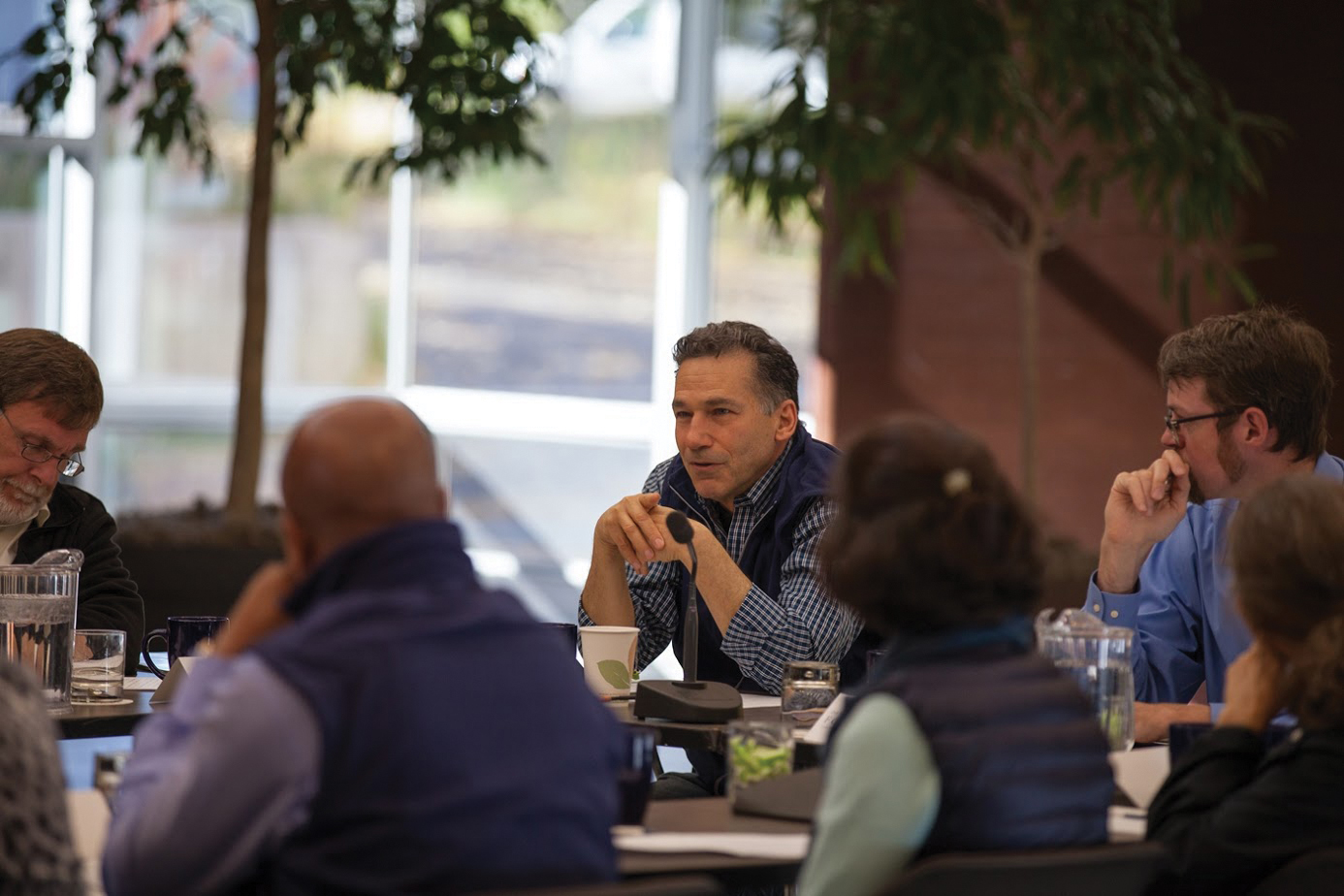
People in business casual attire sit around a table having a discussion. A man with his hands clasped is in focus.
“That to me is the essential challenge today in this world: How do we mobilize a third side powerful enough to become a container for the conflicts that exist in today’s world? How do we transform those conflicts from destructive forms such as violence to constructive forms such as cooperation? But the third side is not new. It is actually an articulation of patterns that humans have developed over our evolutionary trajectory to survive, function, and thrive—patterns that our cultures have forgotten or moved away from. We’re having to rediscover the third side. That’s what’s interesting. We’re having to reinvent what is actually our most ancient of human heritages for dealing with conflict. The challenge before us is to translate the third side into forms that work in today’s system.
“I’ve had the privilege over the last thirty-five years of having a front-seat view of a revolution taking place around the planet—a revolution in the way that human beings make decisions. I think of it as the negotiation revolution. A generation or two ago, the principal method for making decisions in most areas in life was pretty much top-down. The people on the top of the pyramid gave the orders, and the people on the bottom followed them. But there’s been a process, a trend, that goes back several centuries in some cases, but is most evident in the past thirty years, toward a flattening of those pyramids of power into organizational forms that resemble networks. As this happens, decision-making changes gradually from vertical to horizontal, from top-down orders to joint problem-solving. Today, in order to get something done, we are more and more reliant on people over whom we exercise no direct control. This is increasingly true in politics in democracies, in work, and at home. So, effectively, what we’re doing is negotiating all the time—restoring negotiation as one of the preeminent forms of making decisions. And because there’s often no clear authority that enforces what to do, it means we need to turn to the third side, with the use of mediation and community councils, for example, to help resolve issues that can’t be resolved by both sides alone.
“Amazingly, this heritage comes from our hunter-gatherer ancestors. Hunting and gathering was the dominant form of human subsistence for 99 percent of our history. Today this way of life is disappearing from the face of the planet. I find it fascinating that we are experiencing at just this time a phenomenon I like to think of as ‘the great recurrence.’ There’s a way in which many of the older patterns and organizational forms, particularly of cooperation, are reemerging in a new way. Acknowledging the huge difference in conditions today, there are some striking similarities between the world we are now entering and the world that our hunter-gatherer ancestors faced. Today you see humans roaming around the globe again, increasingly nomadic, and also being dependent upon resources that aren’t concentrated as land and crops are. Today our principal resource appears to be information, which is also scattered and requires a lot of cooperation to produce. The basic organizational form that increasingly seems to work in today’s information society is more horizontal and less hierarchical. In this time of horizontal relationships, we need to reinvent the third side, which is our oldest human heritage for transforming conflict.”
“
”
The ability to understand others and to negotiate in this diverse world depends crucially on the basic competencies that you learn in anthropology.
In thinking about the significance of anthropology, Ury offers this insight: “In a macro sense, right now we are living in an era in which, for the first time in the human story, thanks to the communications revolution, thanks to the internet, thanks to other processes of globalization, all the human tribes on the planet are in touch with each other. Thousands of language groups—call them tribes if you like—are all in touch. Future anthropologists may look back one day and call it the era of the ‘human family reunion.’ Like many family reunions, this one is not all peace and light. There are a lot of injustices and resentments. So the question is: How are we going to get along? How are we going to understand each other? Anthropology is a key discipline to understand what’s going on at this macro level.
“Then at a micro level, because the classroom is becoming more and more multicultural, students are going to see evidence of the human family reunion right there in the classroom. How do you understand ‘the other’? How do you understand other cultures, other ways of seeing the world? This ability to understand the other is actually critical to success at work, whether you work in the nonprofit sector, in business, or in government. It’s the essential perspective you need to be able to negotiate for what you want and need, because you’re likely going to be dealing with people who come from very different backgrounds. The ability to understand others and to negotiate in this diverse world depends crucially on the basic competencies that you learn in anthropology.”