How Have Fieldwork Strategies Changed in Response to Globalization?
- Analyze the impact of globalization on fieldwork strategies today.
The increased movement of people, information, money, and goods associated with globalization has transformed ethnographic fieldwork in terms of both its process and its content.
Changes in Process
Changes in communication and transportation have altered the ongoing relationship between the anthropologist and the community being studied. Global communication allows the fieldworker and the community to maintain contact long after the anthropologist has left the field, facilitating a flow of data, discussions, and interpretation that in the past would have been very difficult to continue. The expansion of global transportation networks further increases the opportunities for personal interactions between an anthropologist and someone from the researched community outside the original research setting.
Rise of Digital Ethnography
Before COVID-19, only a small percentage of anthropological research projects focused on digital worlds, including online gaming, virtual communities, and social networking sites. For example, in the aftermath of the killing of Michael Brown in Ferguson, Missouri, in 2014, anthropologists Yarimar Bonilla and Jonathan Rosa (2015) explored the use of social media as a powerful platform for political activism. What they described as “hashtag activism” on Twitter, YouTube, Instagram, and Vine created shared digital moments across a large and disparate population of activists and helped document and challenge police brutality and the misrepresentation of Black bodies in the mainstream media.
In an era of intensifying globalization, most ethnographic projects have included at least some digital component, as our interlocutors send texts, post on Facebook, and send money online. But COVID-19 upended anthropological research by limiting our primary research methods, including in-person participant observation and interviews. Research strategies requiring social proximity became not only impractical but also potentially dangerous for those we work with. The global pandemic has pushed us to further adapt our research strategies to include digital components like Zoom interviews; participant observation in online chat groups, Facebook pages, and Twitter feeds; and observation of online communities and virtual activism even from halfway around the world. The extent and durability of these shifts over time is still uncertain.
Changes in Content
Globalization has also deeply affected fieldwork content. No longer can an anthropologist study a local community in isolation from global processes. As even the most remote areas are affected by intensifying globalization—whether through media, tourism, investment, migration, or global warming—ethnographers are increasingly integrating the local with the global in their studies. In some cases, particularly in studies of migration, ethnographic fieldwork is now multisited, encompassing research in two or more locations to more fully represent the scope of the issue under study.
Nancy Scheper-Hughes’s career reflects many recent changes in ethnographic fieldwork. Her earliest research, introduced at the beginning of this chapter, focused on local life in the Brazilian shantytown Alto do Cruzeiro. She has carefully monitored changes in the community in the ensuing years, including dramatic recent improvements in infant mortality rates stemming from Brazilian economic growth and direct government promotion of local health-care services (Scheper-Hughes 2013), and she is reporting these changes in a revised and updated version of her classic ethnography Death Without Weeping.
Scheper-Hughes’s other recent work places Alto do Cruzeiro in the middle of an illicit global trade in harvested human organs (Scheper-Hughes 2002). While she continues to explore the richness of local life in Brazil, she has expanded her scope to examine how the experiences of the poor in one community are mirrored in the lives of poor people in many other countries and are linked by a gruesome global trade driven by demand from the world’s economic elite.
For many years I have been documenting the violence of everyday life—the many small wars and invisible genocides—resulting from the structural violence of poverty and the increasing public hostility to the bodies, minds, children, and reproductive capacities of the urban poor. Here I will be addressing an uncanny dimension of the usual story of race and class hatred to which we have become so accustomed. This is the covert violence occurring in the context of a new and thriving global trade in human organs and other body parts for transplant surgery.
Descend with me for a few moments into that murky realm of the surreal and the magical, into the maelstrom of bizarre stories, fantastic allegations and a hideous class of rumors that circulate in the world’s shantytowns and squatter camps, where this collaborative research project had its origins. The rumors were of kidnapping, mutilation, and dismemberment—removal of blood and organs—for commercial sale. I want to convey to you the terror and panic that these rumors induce in the nervous and hungry residents of urban shantytowns, tent cities, squatter camps, and other “informal settlements” in the Third World.
I first heard the rumor in the shantytowns of Northeast Brazil in the mid-1980s, when I was completing research for my book, Death Without Weeping, on maternal thinking and practice in the context of extremely high infant and child mortality. The rumors told of the abduction and mutilation of poor children who were eyed greedily as fodder for an international traffic in organs for wealthy transplant patients in the first world. Residents of the ramshackle hillside favela of Alto do Cruzeiro, the primary site of my research, reported multiple sightings of large blue and yellow combi-vans [the so-called “gypsy taxis” used by the poor the world over] driven by American or Japanese “agents” said to be scouring poor neighborhoods in search of stray youngsters, loose kids and street children, kids that presumably no one would miss. The children would be grabbed and shoved into the van. Later their discarded and eviscerated bodies—minus certain organs—heart, lungs, liver, kidneys, and eyes—would turn up on roadsides, between rows of sugarcane, or in hospital dumpsters. “They are looking for donor organs. You may think this is just nonsense,” said my friend and research assistant, “Little Irente” in 1987. “But we have seen things with our own eyes in the hospitals and the morgues and we know better.” . . .
Soon after I began writing articles that interpreted the Brazilian organ-stealing rumors in terms of the normal, accepted, everyday violence practiced against the bodies of the poor and the marginal in public medical clinics, in hospitals, and in police mortuaries, where their ills and afflictions were often treated with scorn, neglect, and general disrespect, I began to hear other variants of the organ-theft stories from anthropologists working in Argentina, Colombia, Peru, Guatemala, Honduras, Mexico, India and Korea. Though most of the stories came from Central and South America, organ-theft rumors were also surfacing in Poland and Russia, where it was reported that poor children’s organs were being sold to rich Arabs for transplant surgery. Luise White recorded blood-sucking/blood-stealing vampire stories from East and Central Africa, and South African anthropologist Isak Niehaus recorded blood- and organ-stealing rumors in the Transvaal collected during fieldwork in 1990–93. The African variants told of “firemen” or paramedics driving red combi-vans looking to capture unsuspecting people to drug and to kill in order to drain their blood or remove their organs and other body parts—genitals and eyes in particular—for magical medicine (muti) or for more traditional medical purposes. The Italian variants identified a black ambulance as the kidnap vehicle.
The rumors had powerful effects, resulting in a precipitous decline in voluntary organ donation in some countries, including Brazil and Argentina. What does it mean when a lot of people around the world begin to tell variants of the same bizarre and unlikely story? How does an anthropologist go about interpreting the uncanny and the social imaginary of poor, third-world peoples?
To the anthropologist . . . working closely with the urban poor, the rumors spoke to the ontological insecurity of people “to whom almost anything could be done.” They reflected everyday threats to bodily security, urban violence, police terror, social anarchy, theft, loss and fragmentation. Many of the poor imagined, with some reason as it turns out, that autopsies were performed to harvest usable tissues and body parts from those whose bodies had reverted to the state: “Little people like ourselves are worth more dead than alive.” At the very least the rumors were “like the scriptures” metaphorically true, operating by means of symbolic substitution. The rumors express the existential and ontological insecurities of poor people living on the margins of the postcolonial global economies where their labor, their bodies, and their reproductive capacities are treated as spare parts to be bought, bartered, or stolen. Underlying the rumors was a real concern with a growing commodification of the body and of body parts in these global economic exchanges. (Scheper-Hughes 2002, 33–36)
More information
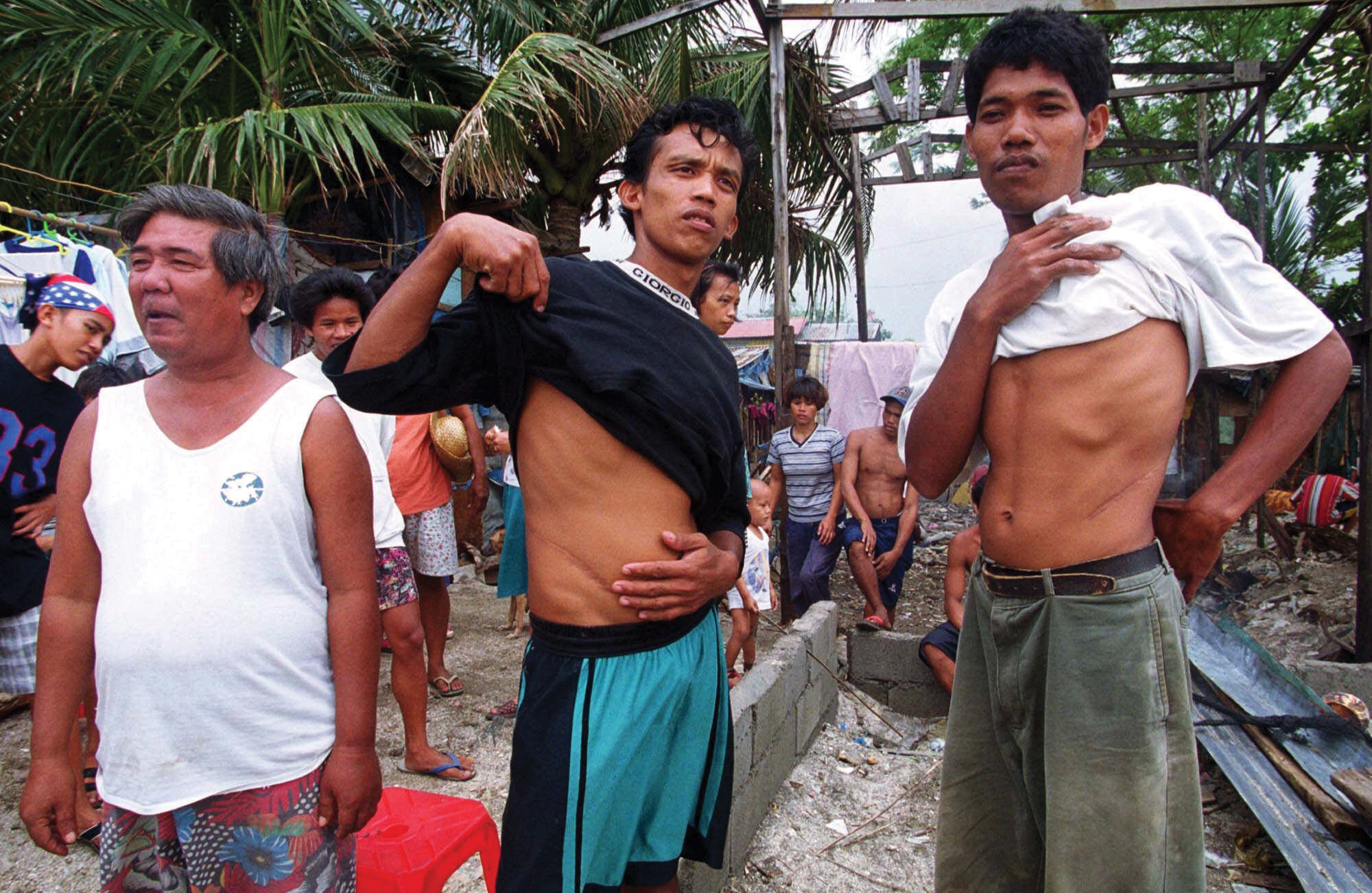
A man in a white tank top stands beside two young Filipino men holding up their T-shirts to show scars on their abdomens. In the background are people and trees.
As an engaged medical anthropologist, Scheper-Hughes has spent countless hours investigating the extensive illegal international trade in smuggled human organs. Contemporary globalization, especially the time-space compression of transportation and communication, enables trafficking networks to spread across national boundaries and around the world. These same cornerstones of globalization have allowed Scheper-Hughes and her organization, Organs Watch, based at the University of California, to develop an extensive global network of anthropologists, human rights activists, transplant surgeons, journalists, and government agencies that have collaborated to address issues of human organ trafficking in India, Pakistan, Israel, South Africa, Turkey, Moldova, Brazil, the Philippines, and the United States.
As a member of two World Health Organization panels on transplant trafficking and transplant safety, Scheper-Hughes has seen firsthand the global search for kidneys: the often-poor kidney sellers, the kidney hunters who track them down, and the kidney buyers willing to cross borders, break laws, and pay as much as $150,000 in advance to the organ brokers for a chance at a new kidney and a new life. In 2009, the U.S. Federal Bureau of Investigation arrested a Brooklyn rabbi who had been arranging kidney sales, highlighting the deep integration of illegal international organ trafficking into developed-country markets where, for example, more than 100,000 Americans linger on a kidney waiting list, struggling through dialysis to stay alive, and where the wait times for a donor in some parts of the country are as long as nine years.
The trajectory of Scheper-Hughes’s career from fieldwork in a small favela in Brazil to fieldwork in international organ-trafficking networks reflects many of the transformations that have shaped anthropological fieldwork over the last forty years. No local community can be viewed as isolated. Anthropologists must consider each local fieldwork site in light of the myriad ways in which local dynamics link to the world beyond. Today, fieldwork includes attention to global flows, networks, and processes as anthropologists trace patterns across national and cultural boundaries while keeping one foot grounded in the lives of people in local communities.