1.6 |
The Biological Hierarchy |
The biological hierarchy is essentially a linear concept map for visualizing the breadth and scope of life, from the smallest structures that are meaningful in biology to the broadest interactions between living and nonliving systems that we can comprehend (FIGURE 1.19). The biological hierarchy has many levels of organization, ranging from atoms at the lowest level up to the entire biosphere at the highest level. In scale, the hierarchy ranges from less than one ten-billionth of a meter (the approximate size of an atom) to 12 million meters (the diameter of Earth).
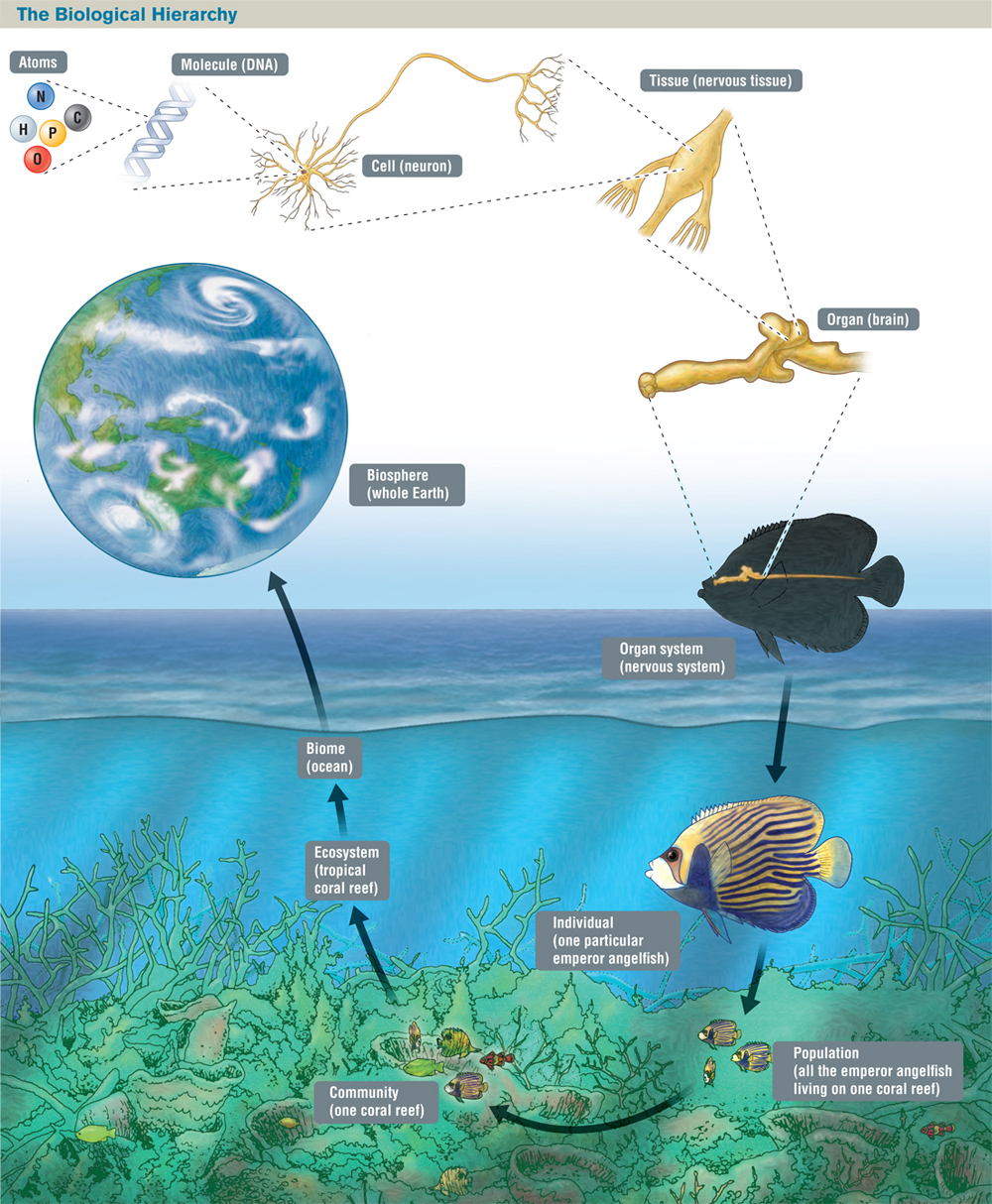
FIGURE 1.19 The Biological Hierarchy Extends from the Atom to the Biosphere
Levels of biological organization can be traced from atoms and molecules found in organisms all the way up to the biosphere, which includes all living organisms and their nonliving environment.
At its lowest level, the biological hierarchy begins with atoms, which are the building blocks of matter, the material of which the universe is composed. Two or more atoms held together by strong chemical bonds become a molecule, the next level in the hierarchy. We use the term biomolecules to refer to molecules that are found in living cells. Carbon atoms are prominent in biomolecules, which is why we say that life on Earth is carbon based. DNA, the genetic material that carries the code for building an organism, is an example of a biomolecule.
As noted earlier, the cell is the basic unit of life; and some organisms, such as bacteria, consist of only a single cell. Multicellular organisms also form tissues, the next level in the biological hierarchy. A tissue is a group of cells that performs a unique but fairly narrow set of tasks in the body. Plants and animals have many different types of tissues, each with unique functions. Nervous tissue, for example, performs the important function of transmitting electrical signals in the animal body. Muscle tissue can contract, enabling animals to move their bodies.
Plants and animals have organs, which are body parts composed of different types of tissues functioning in a coordinated manner. Organs perform a broader range of functions than any one tissue can carry out on its own. An organ has a discrete boundary and a specific location in the body. The heart and brain are examples of organs in vertebrate animals, those that have a backbone.
 Helpful to Know
There are many academic disciplines within biology. Physiology is the study of how organisms function. Anatomy is the study of body structures. Biochemistry focuses on the chemistry of life. Ecology studies interactions among organisms and their surroundings.
●●●
In animals, groups of organs are networked into organ systems, which extend through large regions of the body instead of being confined to a particular region. An organ system performs a greater range of functions than a single organ does. The stomach, liver, and intestines are organs within the organ system known as the digestive system. All the organ systems come together to work as a well-knit whole that we recognize as a single individual.
Each individual is a member of a population. As noted earlier, a population is composed of individuals of a single species that interact and interbreed in a shared environment. Populations of different species that live in a shared environment form a biological community. Together, a particular physical environment and all the communities in it make up an ecosystem. For example, a subalpine ecosystem includes boulder fields, avalanche tracks, glacial streams, and thin air, together with a variety of hardy organisms adapted for life at high altitude (FIGURE 1.20).

FIGURE 1.20 An Ecosystem Includes All Living Organisms in a Habitat Plus the Nonliving World around Them
The photo shows a subalpine ecosystem in North Cascades National Park in Washington state. An ecosystem is composed of communities of living organisms and their environment functioning as a distinct ecological unit. Environmental characteristics—short growing season, bitter cold, avalanches, thin air, and intense UV radiation, for example—govern the communities that are found in an ecosystem. There are several distinct communities in this ecosystem, including forest clumps dominated by subalpine fir (Abies lasiocarpa), wet seeps dominated by sedges, and drier meadows dominated by heather. Animal life includes mountain goats and rodents such as pikas and mountain marmots.
At the next level are biomes, which are large regions of the world defined by shared physical characteristics, especially climate, and a distinctive community of organisms. The Arctic tundra is an example of a land-based (terrestrial) biome, and coral reefs are an example of an aquatic (in this case, marine or oceanic) biome. Finally, at the highest level of the biological hierarchy, all biomes become part of the biosphere, which is defined as all the world’s living organisms and the places where they live.
Concept Check
1. How is a population different from a biological community?
A population is composed of members of the same species in a shared habitat. a community refers to all members of all species that share a common habitat.
2. Unscramble this scrambled biological hierarchy: community, organ system, ecosystem, atom, tissue, individual, biosphere, organ, cell, biome, population, molecule.
Atom, molecule, cell, tissue, organ, organ system, individual, population, community, ecosystem, biome, biosphere.
APPLYING WHAT WE LEARNED
Researchers Wrangle over Bacteria
NASA’s announcement about the arsenic-loving bacterium was the science sensation of the year. Felisa Wolfe-Simon and her colleagues at the U.S. Geological Survey had found a bacterium that could survive what for most organisms would be deadly amounts of toxic arsenic. In the lab, Wolfe-Simon grew the bacteria in increasing amounts of arsenic with almost no phosphorus. Without phosphorus, cells cannot make new DNA; and without new DNA, cells cannot divide and multiply. Yet despite being deprived of phosphorus, these particular bacterial cells continued to multiply. How were they doing it?
Arsenic has chemical properties like those of phosphorus, and Wolfe-Simon hypothesized that the bacteria were simply substituting arsenic for phosphorus. And if bacteria on Earth could pull off such a switch, there was no telling what life on other planets might do. Biologists say that all life on Earth requires six major elements: carbon, hydrogen, nitrogen, oxygen, sulfur, and phosphorus. If a bacterium could do without phosphorus, maybe none of the six were absolutely required for life. Such a conclusion meant that life might flourish on many more planets than previously thought.
It seemed like an eye-opening discovery, and the media played it up (despite the lack of actual extraterrestrials). But a number of scientists challenged Wolfe-Simon’s conclusions, which were published at the same time in a peer-reviewed scientific journal. They wanted more evidence and wrote letters, tweets, and blogs that openly criticized Wolfe-Simon’s work.
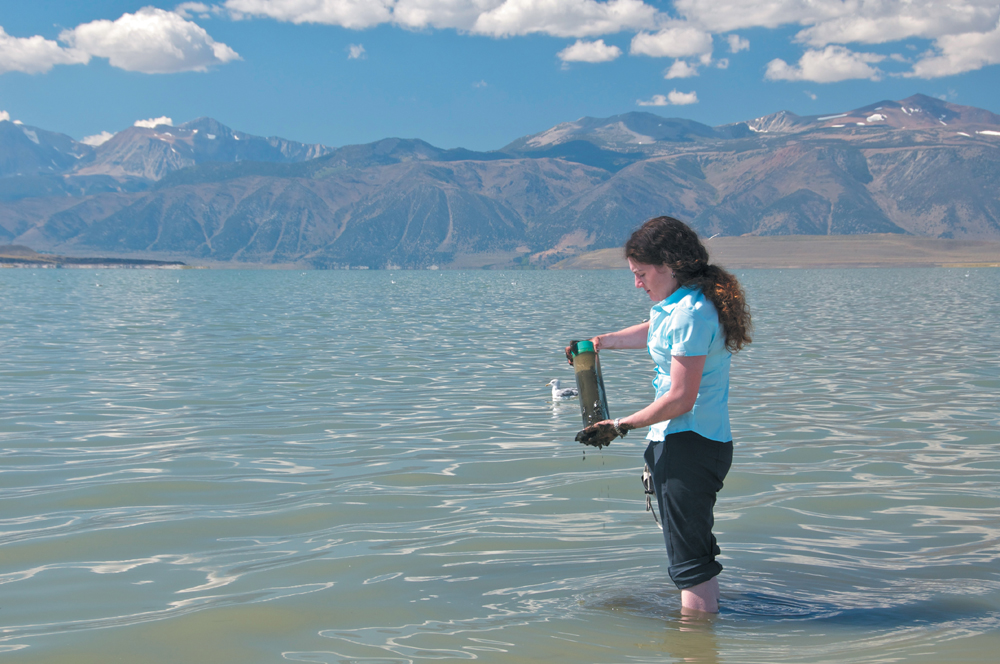
Critics argued that Wolfe-Simon’s team had not ruled out the possibility that the bacteria still had enough phosphorus to build new DNA. For example, they pointed out that the “phosphorus-free” test tubes actually contained small amounts of phosphorus from dying bacteria and other sources. Wolfe-Simon’s team needed to determine whether that was enough phosphorus for the bacteria to multiply, they said. Mono Lake, the lake where the bacteria live, contains large amounts of phosphorus (FIGURE 1.21). With such a rich supply of phosphorus, some scientists said, there could be no evolutionary advantage to evolving the unique ability to live without it.

FIGURE 1.21 Mono Lake at Sunset
The Rim Fire lights up the horizon in this 2013 photo. The wildfire consumed more than 250,000 acres, including parts of Yosemite National Park. Despite the severity of such wildfires, some burrowing animals and the seeds and roots of many plants survive the scorching temperatures, highlighting the toughness and tenacity of life.
In 2012, Rosie Redfield at the University of British Columbia claimed that careful analysis by her team showed there wasn’t a trace of arsenic in the DNA of this strange bacterium. The arsenic monster has typical DNA, she said: it contains phosphorus, not arsenic. The dust did not settle right away, because Redfield and her colleagues chose to present their findings in an online research blog instead of a peer-reviewed journal. But studies by other microbiologists published later that year also refuted the claim that the bacterium contains arsenic, not phosphorus, in its DNA. As for growing in a completely phosphorus-free test tube, none of these microbiologists could coax the bacterium to do that. Repeatability of the test, as you have seen, is a crucial criterion in showing that a hypothesis is valid.
Science is a process of asking questions and trying to answer those questions through hypothesis testing. Wolfe-Simon and her colleagues took a chance on an interesting question: What do organisms actually need to live? Although the DNA chemistry of these bacteria turned out to be ordinary, their strategies for flourishing in an arsenic-rich habitat continue to boggle the mind. How do they manage to extract phosphorus from their environment to build into their DNA, when they are awash in great quantities of a very similar chemical, arsenic? Wolfe-Simon has the last word when she points out that many questions about this Mono Lake inhabitant have yet to be answered.
BIOLOGY IN THE NEWS
Curbing the Enthusiasm on Daily Multivitamins
BY RONI CARYN RABIN ● New York Times, October 10, 2012
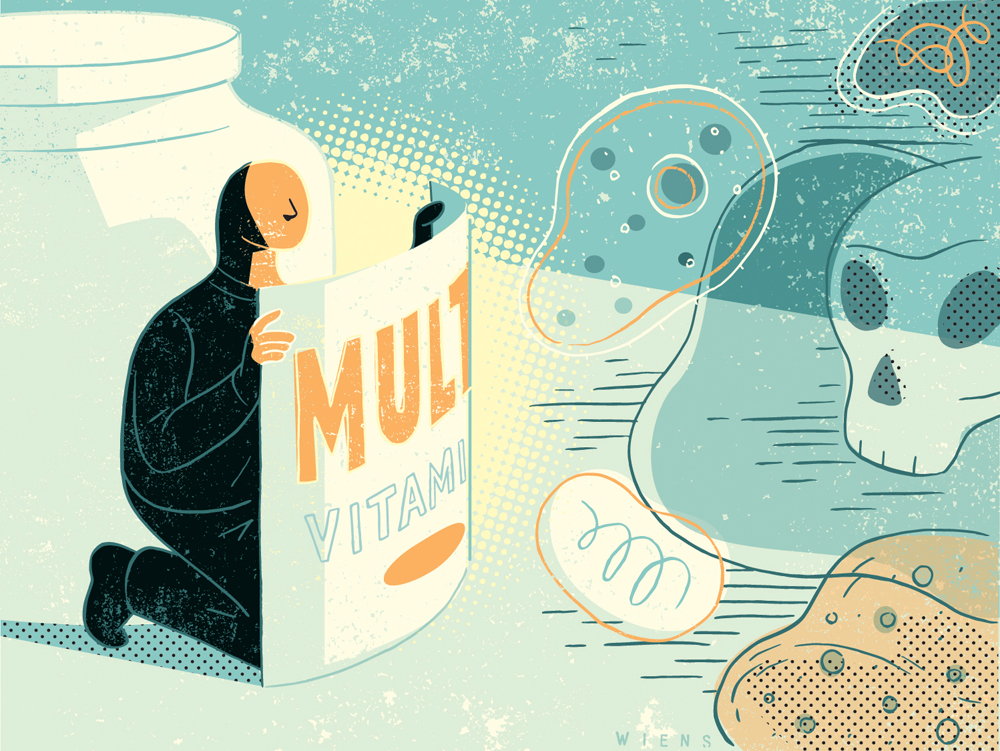
Can you reduce your risk of cancer by taking a multivitamin every day?
Last week, Boston researchers announced that one of the largest long-term clinical trials of multivitamins in the United States—encompassing 14,000 male physicians 50 and older, and lasting over a decade—found that taking a common combination of essential vitamins and minerals every day decreased the incidence of cancer by 8 percent, compared with a placebo pill.
Men who had already had cancer earlier in life were most likely to benefit, the study found. Cancer deaths also were lower among those who took vitamins, though that may have been a chance finding. Curiously, the vitamin regimen did not reduce the rate of prostate cancer, the most common cancer affecting men.
The researchers also looked for side effects and found that daily vitamins caused only minor problems, like occasional skin rashes.
Even though an 8 percent reduction in the overall cancer rate is fairly modest, Dr. Demetrius Albanes, senior investigator at the National Cancer Institute, said the potential public health implications were vast. “If you think of the hundreds of thousands of new cases of cancer every year, 8 percent can add up quite a bit,” he said.
Yet no one is rushing out to urge more Americans to take multivitamins. Although half the population already takes some kind of supplement, previous studies have yielded decidedly mixed results. Some trials of high doses of nutrients believed to be cancer-fighters were shut down prematurely when they backfired, driving up cancer rates instead of reducing them.
Current federal dietary guidelines and American Cancer Society recommendations encourage people to eat a balanced diet rich in fruits and vegetables. Until now, the consensus has been that there is insufficient scientific evidence to justify taking a multivitamin to prevent cancer or other chronic diseases.
“Curbing the Enthusiasm on Daily Multivitamins.” From The New York Times, October 22, 2012 © 2012 The New York Times. All rights reserved. Used by permission and protected by the Copyright Laws of the United States. The printing, copying, redistribution, or retransmission of this Content without express written permission is prohibited.
Here we go again, you might say in frustration. Why can’t scientists make up their minds? Why do these studies say opposite things?
Of all the 1.7 million organisms known to science, humans are the most difficult to study. For ethical reasons, an ideal experimental design may not be allowed when human subjects are involved. For example, scientists cannot test a substance that is suspected of being harmful in human patients. Nonhuman animals, most commonly rats and mice, are often used as surrogates in such experiments because their metabolism is similar in many ways.
The type of large-scale double-blind controlled experiments we described as the gold standard for establishing causality are, in practice, difficult with human subjects. Some types of blinding are not possible—for example, when a treatment is impossible to mask because of its strong taste. Longitudinal studies—in which researchers track a cohort of participants over many years—run afoul of inaccurate reporting by the participants. Investigations show that participants commonly misremember, and sometimes tell outright fibs (about how many cookies they actually ate, for example). On top of that, large-scale studies are enormously expensive, and the logistics of sustaining them over decades are so great that repeating such studies with the benefit of hindsight is rarely feasible.
The studies that produced the conflicting results—frighteningly higher rates of cancer in supplement takers—used very high doses of single vitamins (vitamin E or folic acid). In contrast, the physicians clinical trial cited in the news story used standard brand-name multivitamins. This trial avoided some of the common pitfalls of long-term studies by concentrating on a well-educated group—physicians—who are likely to follow directions and give accurate reports. It was a double-blind study in which participants were randomly assigned to take either a multivitamin or a placebo.
A limitation of this study is that all the participants were older white males. Therefore, study results may not apply to younger people, women, and nonwhites. The participants also had a healthier lifestyle than the average person; most ate four servings of fruits and vegetables every day and consumed little red meat. Would the beneficial effects of multivitamin supplementation be more pronounced in the average person, who may not eat as healthy a diet? We don’t know. But the study suggests that taking a standard multivitamin does no harm and may do some good, at least for people similar to the study subjects.
Evaluating the News
1. Is the physicians clinical trial an example of an observational test or an experimental test of a hypothesis? State the hypothesis that the researchers were testing. Is the hypothesis refutable? Explain.
2. Some people are inclined to say that nutritional science is so error prone that we should simply ignore all of it. Explain your viewpoint, giving reasons.