LISTEN AS YOU READ
LITERATURE OF THE EARLY MIDDLE AGES
From the first to the fifth century, England was a province of the Roman Empire and was named “Britannia” after its Celtic-speaking inhabitants, the Britons, who adapted themselves to Roman occupation. The withdrawal of the Roman legions in 410, in a vain attempt to protect Rome itself from the threat of Germanic conquest, left Britain and Britons vulnerable to Germanic occupiers. These belonged primarily to three related ethnic groups: the Saxons, the Angles, and the Jutes. The name “England” derives from the word “Englaland,” the land of the Angles; the names of the counties Essex, Sussex, and Wessex refer to the territories occupied by the East, South, and West Saxons.
The occupation of Angles and Saxons was no sudden conquest, but extended over decades of engagement with the native Britons. The latter were, finally, largely confined to the extremities of Britain, such as the mountainous region of Wales, where the modern form of a Celtic language is spoken alongside English to this day.
The Britons had become Christians by the late fourth century, after Christianity had become the official religion of the Roman Empire in the year 380. For about 150 years after the beginning of the Germanic occupation, Christianity was maintained only in the remoter regions, where the polytheistic Saxons and Angles had failed to penetrate. In the year 597, however, a Benedictine monk (afterward St. Augustine of Canterbury) arrived, sent from Rome by Pope Gregory as a missionary to King Ethelbert of Kent, the most southerly of the kingdoms into which England was then divided. At about the same time missionaries from Ireland began to preach Christianity in the north. Within seventy-five years the island was once more predominantly Christian. By the time of the Synod of Whitby (664), the English Church adopted the rites of the Roman Church, over Celtic Christianity. That allegiance to Rome would survive until 1534, when Henry VIII rejected papal authority and declared himself, as king, head of the English Church.
Christianity is a religion of the book. The impact of Christianity on literacy is evident from the fact that the first extended written specimen of the Old English language is a code of laws promulgated by Ethelbert (ca. 560–616), the first English Christian king. Indeed, Christianity brought an institutionalized commitment to book production and preservation, in the Full p. A-8Shorter p. 8form of monasteries, founded and renewed with royal support. Here we briefly define three major periods in which the promotion of learning was monastic, royal, or both.
The first great period of monastic learning occurred in northern England (Northumbria) in a period of great instability in the Mediterranean basin—the time of the Islamic occupation of the eastern Mediterranean, North Africa, and the Iberian Peninsula—and in Europe generally. On the northeastern coast of England, however, scholarship flourished. Beginning in the mid-seventh century, Benedictine monasteries, some for women, were founded, including Whitby and Wearmouth-Jarrow. The greatest scholar of this period and place is Bede, whose Latin Ecclesiastical History of the English People (731) tells the story of the conversion of England to Roman Christianity. This great book remains one of our most important sources of knowledge about the period.
From 797, the now Christian Saxons and Angles of England were themselves subjected to new Germanic invasions by polytheistic Scandinavians we know as Vikings—called variously Vikings, Danes, and Northmen in early medieval England—who in their longboats repeatedly ravaged the coast, sacking Bede’s monastery among others. (Such a raid late in the late tenth century inspired The Battle of Maldon, the last of the Old English heroic poems.) The Danes also occupied the northern part of the island, threatening to overrun the rest. They were contained by Alfred, king of the West Saxons from 871 to 899, who for a time united all the kingdoms of southern England.
This most active king was also responsible for a second great period of textual production in early medieval England. Alfred was an enthusiastic patron of translating sophisticated philosophical, historical, and pastoral works into the vernacular. He himself translated, or had translated, various key works, mostly written originally between the fourth and sixth centuries in the period of Roman conversion to Christianity, which he considered necessary to know in the period of English conversion and consolidation (for the motivating ideas of his textual program, see his Preface to the Pastoral Care in this anthology, p. 119). The most important of these works was Boethius’s Consolation of Philosophy (523). Alfred probably also instigated a translation of Bede’s History and the beginning of the Anglo-Saxon Chronicle: this year-by-year record in Old English of important events in England was maintained at one monastery until the middle of the twelfth century. Practically all Old English poetry is preserved in copies made in the West Saxon dialect after the reign of Alfred.
The third great period for institutions of learning in pre-Conquest England is known as the Benedictine Reform, a tenth-century movement designed to reaffirm in English monasticism the Benedictine practice (the monastic rule introduced into Europe by St. Benedict in 516). The movement had royal support from King Edgar (r. 959–975) and was strong in the south of England. The greatest scholars to emerge from this movement, a generation later than the original reformers, were as follows: Aelfric of Eynsham (ca. 955–ca. 1010), who produced vernacular hagiography (that is, lives of saints), doctrinal homilies, and biblical translation; and Wulfstan, archbishop of York (d. 1023), one of whose vigorous sermons, written in the face of Viking invasion, is reproduced in this anthology (p. 132).
Full p. A-9Shorter p. 9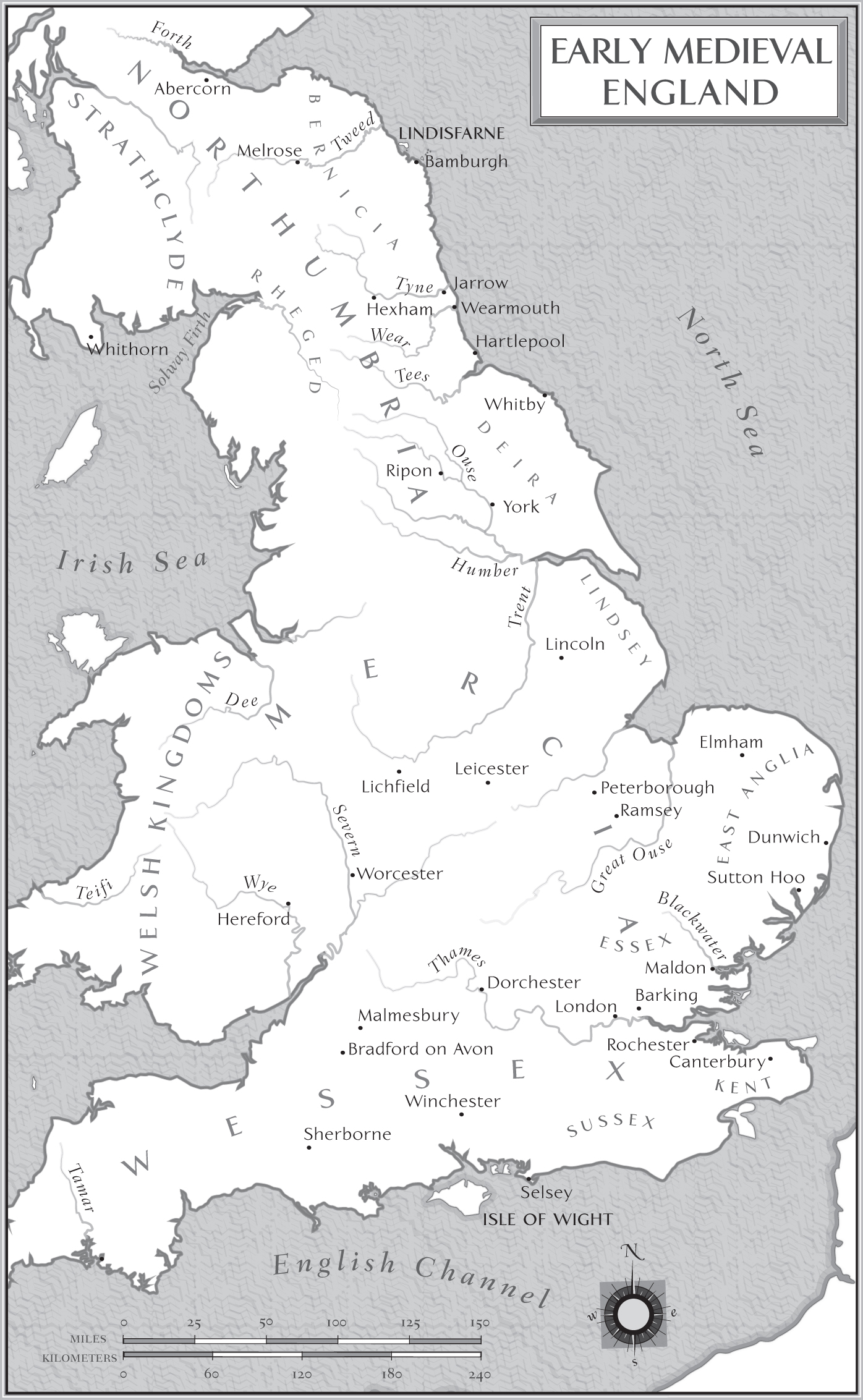
Old English Poetry
The invading Angles and Saxons brought with them a tradition of oral poetry (see “Bede and Cædmon’s Hymn,” p. 30). Because nothing was written down before the conversion to Christianity, we have only circumstantial evidence of what that poetry must have been like. Aside from a few short inscriptions on small artifacts, the earliest records in the English language are in manuscripts produced at monasteries and other religious establishments, beginning in the seventh century. Literacy was mainly restricted to servants of the church, and so it is natural that the bulk of Old English literature deals with religious subjects and is mostly drawn from Latin sources. Under the expensive conditions of manuscript production, few texts were written down that did not pertain directly to the work of the church. Most of Old English poetry is contained in just four manuscripts.
Germanic heroic poetry continued to be performed orally in alliterative verse and was at times used to describe current events. The Battle of Brunanburh, which celebrates an English victory over the Danes in traditional alliterative verse, is preserved in the Anglo-Saxon Chronicle. The Battle of Maldon commemorates a Viking victory in which the Christian English invoke the ancient code of honor that obliges a warrior to avenge his slain lord or to die beside him.
These poems show that the aristocratic, heroic, and kinship values of Germanic society continued to inspire both clergy and laity in the Christian era. As represented in the relatively small body of Old English heroic poetry that survives, this world shares many characteristics with the heroic world described by Homer. Nations are reckoned as groups of people related by kinship rather than by geographical areas, and kinship is the basis of the heroic code. The tribe is ruled by a chieftain who is called king, a word that has “kin” for its root. The lord (a word derived from Old English hlaf, “loaf,” plus weard, “protector”) surrounds himself with a band of retainers (many of them his blood kindred) who are members of his household. He leads his men in battle and rewards them with the spoils; royal generosity was one of the most important aspects of heroic behavior. In return, the retainers are obligated to fight to the death for their lord, and if he is slain, to avenge him or die in the attempt. Blood vengeance is regarded as a sacred duty, and in poetry, everlasting shame awaits those who fail to observe it.
Even though the heroic world of poetry could be invoked to rally resistance to the Viking invasions, it was already remote from the Christian world of early medieval England. Nevertheless, Christian writers like the Beowulf poet were fascinated by the distant culture of their pagan ancestors and by the inherent conflict between the heroic code and a religion that teaches that we should “forgive those who trespass against us” and that “all they that take the sword shall perish with the sword.” The Beowulf poet looks back on that ancient world with admiration for the courage of which it was capable and at the same time with elegiac sympathy for its inevitable doom.
For Old English poetry, it is difficult and probably futile to draw a line between “heroic” and “Christian,” for the best poetry crosses that boundary. Much of the Christian poetry is also cast in the heroic mode: although the Saxons and Angles adapted themselves readily to the ideals of Christianity, they did not do so without adapting Christianity to their own heroic ideal. Thus Full p. A-11Shorter p. 11Moses and St. Andrew, Christ and God the Father are represented in the style of heroic verse. In The Dream of the Rood, the Cross speaks of Christ as “this young man, . . . strong and courageous.” In Cædmon’s Hymn the creation of heaven and earth is seen as a mighty deed, an “establishment of wonders.” Early medieval heroines, too, are portrayed in the heroic manner. St. Helena, who leads an expedition to the Holy Land to discover the true Cross, is described as a “battle-queen.” The biblical narrative related in the Old English poem Judith is recast in the terms of Germanic heroic poetry. Christian and heroic ideals are poignantly blended in The Wanderer, which laments the separation from one’s lord and kinsmen and the transience of all earthly treasures. Love between man and woman, as described by the female speaker of The Wife’s Lament, is disrupted by separation, exile, and the malice of kinfolk.
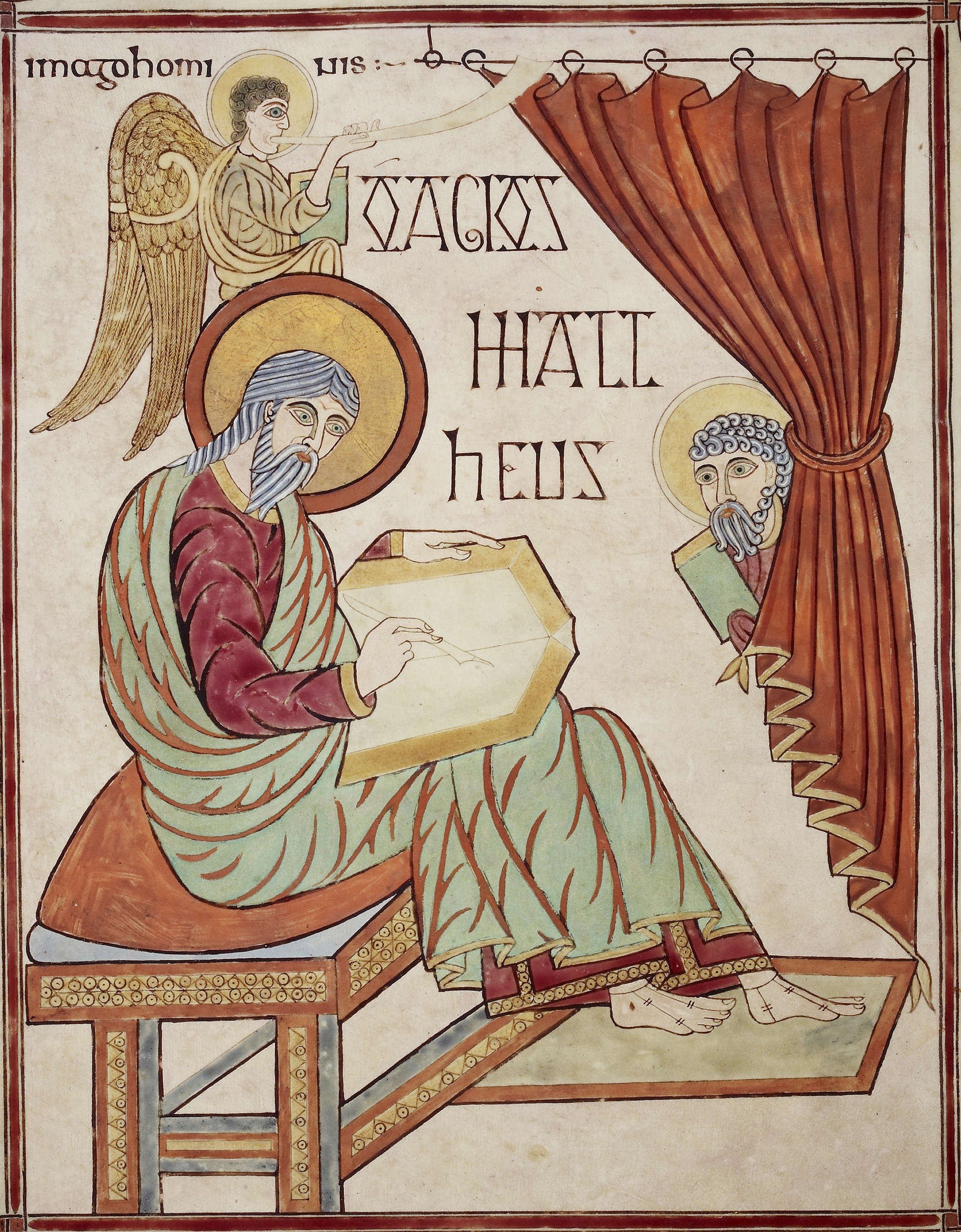
The world of Old English poetry is often elegiac. Men are said to be cheerful in the mead hall, but even there they think of war, of possible triumph but probable failure. Romantic love—one of the principal topics of later literature—appears hardly at all. Even so, at some of the bleakest moments, the poets powerfully recall the return of spring. The blade of the magic sword with which Beowulf has killed Grendel’s mother in her sinister underwater lair begins to melt, “as ice melts / when the Father eases the fetters off the frost / and unravels the water-ropes, He who wields power.”
The poetic diction, formulaic phrases, and repetitions of parallel syntactic structures, which are determined by the versification, are difficult to reproduce in modern translation. A few features may be anticipated here and studied in the text of Cædmon’s Hymn, printed below (pp. 31–33) with interlinear translation.
Poetic language is created out of a special vocabulary that contains a multiplicity of terms for lord, warrior, spear, shield, and so on. Synecdoche and metonymy are common figures of speech, as when “keel” is used for ship or “iron” for sword. A particularly striking effect is achieved by the kenning, a compound of two words in place of another as when sea becomes “whale-road” or body is called “life-house.” The figurative use of language finds playful expression in poetic riddles, of which about one hundred survive. Common (and sometimes uncommon) creatures, objects, or phenomena are described in an enigmatic passage of alliterative verse, and the reader must guess their identity. Sometimes they are personified and ask, “What is my name?”
Because special vocabulary and compounds are among the chief poetic effects, the verse is constructed in such a way as to show off such terms by creating a series of them in apposition. In the second sentence of Cædmon’s Full p. A-12Shorter p. 12Hymn, for example, God is referred to five times appositively as “he,” “holy Creator,” “mankind’s Guardian,” “eternal Lord,” and “Master almighty.” This use of parallel and appositive expressions, known as variation, gives the verse a highly structured and musical quality.
The overall effect of the language is to formalize and elevate speech. Instead of being straightforward, it moves at a slow and stately pace with steady indirection. A favorite mode of this indirection is irony. A grim irony pervades heroic poetry even at the level of diction, where fighting is called “battle-play.” A favorite device, known by the rhetorical term litotes, is ironic understatement. After the monster Grendel has slaughtered the Danes in the great hall Heorot, it stands deserted. The poet observes, “It was easy then to meet with a man / shifting himself to a safer distance.”
More than a figure of thought, irony is also a mode of perception in Old English poetry. In a famous passage, the Wanderer articulates the theme of Ubi sunt? (where are they now?): “Where did the steed go? Where the young warrior? Where the treasure-giver? . . .” Beowulf is full of ironic balances and contrasts—between the aged Danish king and the youthful Beowulf, and between Beowulf, the high-spirited young warrior at the beginning, and Beowulf, the gray-haired king at the end, facing the dragon and death.
The formal and dignified speech of Old English poetry was always distant from the everyday language of the people, and this poetic idiom remained remarkably uniform throughout the roughly three hundred years that separate Cædmon’s Hymn from The Battle of Maldon. This clinging to old forms—grammatical and orthographic as well as literary—by the early medieval church and aristocracy conceals from us the enormous changes that were taking place in the English language and the diversity of its dialects. The dramatic changes between Old and Middle English did not happen overnight or over the course of a single century. The Normans displaced the English ruling class with their own barons and clerics, whose native language was a dialect of Old French that we call Anglo-Norman. Without a ruling literate class to preserve English traditions, the custom of transcribing vernacular texts in an earlier form of the West-Saxon dialect was abandoned, and both language and literature were allowed to develop unchecked in new directions.