The component units of a melody are like parts of a sentence. A phrase in music, as in language, is a unit of meaning within a larger structure. The phrase ends in a resting place, or cadence, which punctuates the music in the same way that a comma or period punctuates a sentence. The cadence may be inconclusive, leaving you with the impression that more is to come, or it may sound final, giving you the sense that the melody has reached the end. The cadence is where a singer or instrumentalist pauses to draw a breath.
Melodic Examples
Ode to Joy
(Beethoven, Symphony No. 9)
Range: narrow (5-note span)
Contour: wavelike
Motion: conjunct
More information
An excerpt from “The Ode to the Joy,” by Beethoven, Symphony number 9, depicts four measures of music in common time in the key of D major.
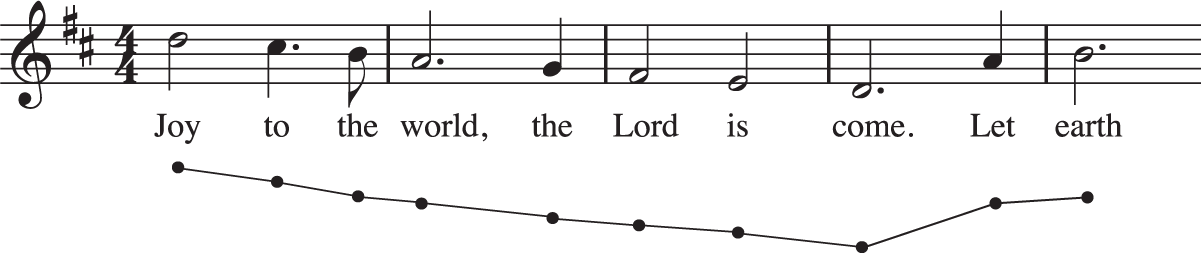
Joy to the World (Christmas carol)
Range: medium (8-note span)
Contour: descending
Motion: conjunct, then a few leaps
More information
An excerpt of the Christmas Carol song “Joy to the World” depicts four measures of music in 4 over 4 times in the key of D major with the lyrics “Joy to the world, the Lord is come. Let earth.” A dotted line beneath it shows a descending contour in a conjunct motion with a few leaps.
Ride of the Valkyries
(Wagner, opera Die Walküre)
Range: wide (10-note span)
Contour: wavelike
Motion: disjunct (many leaps)
More information
An excerpt of the song “Ride of the Valkyries” depicts musical notes in nine-eighths time. A dotted line beneath it shows a wavelike contour in a disjunct motion with many leaps.
Melodic Phrases and Cadences
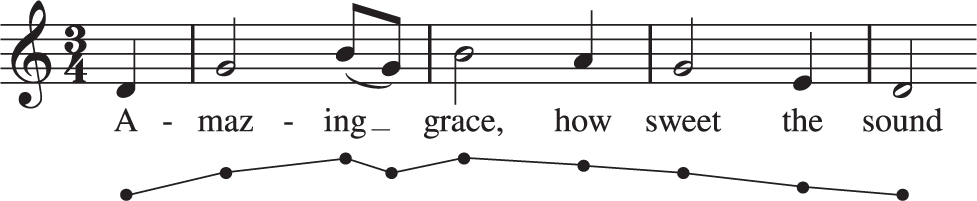
Amazing Grace (traditional hymn)
Four text phrases = four musical phrases
Final cadence = end of verse
Phrase 1 (incomplete, turns downward)
More information
Phrase 1 consists of five measures in three-fourths times in the key of C major with the lyrics “Amazing grace, how sweet the sound.” A dotted line beneath the musical notation shows the contour of the melody. Phrase 1 is incomplete and turns downward.
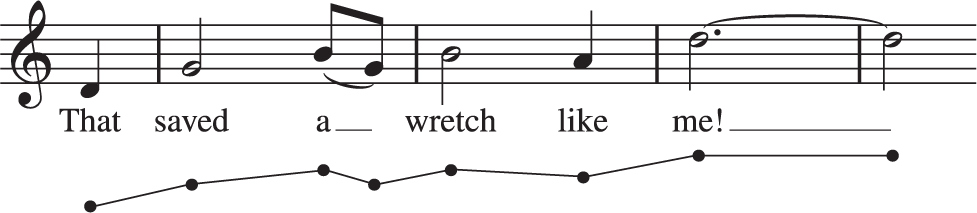
Phrase 2 (incomplete, upward inflection and climax)
More information
Phrase 2 consists of five measures in the key of C major with the lyrics “That saved a wretch like me!” A dotted line beneath the musical notation shows the contour of the melody. Phrase 2 is incomplete and shows an upward inflection and the climax.
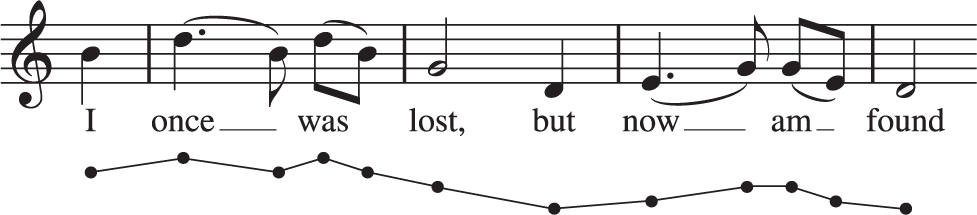
Phrase 3 (incomplete)
More information
Phrase 3 consists of five measures in the key of C major with the lyrics “I once was lost, but now am found.” A dotted line beneath the musical notation shows the contour of the melody. Phrase 3 is incomplete.
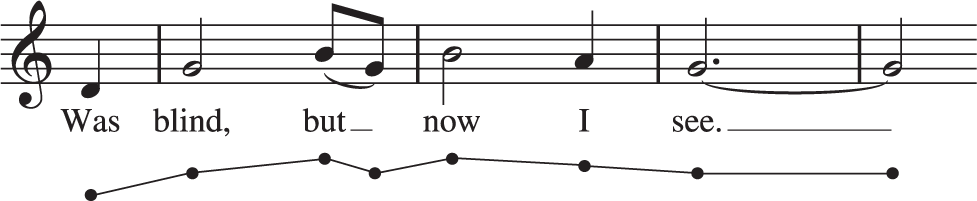
Phrase 4 (complete, sense of rest)
More information
Phrase 4 consists of five measures in the key of C major with the lyrics “Was blind, but now I see.” A dotted line beneath the musical notation shows the contour of the melody. Phrase 4 is complete and shows a sense of rest.
(Note: Our recording elaborates on the original tune.)
If the melody has words, the text lines and the musical phrases will usually coincide. Consider the well-known hymn Amazing Grace (above). Its four musical phrases are of equal length, and the rhyme scheme of the text (the way the last syllables in each line rhyme) is a-b-a-b. The first three cadences (at the end of each of the first three phrases) are inconclusive, or incomplete; notice the upward inflection like a question at the end of phrase 2. Phrase 4, with its final downward motion, provides the answer; it gives you a sense of closure.
Amazing Grace
In order to maintain the listener’s interest, a melody must be shaped carefully, either by the composer or by the performer who invents it on the spot. What makes a striking effect is the climax, the high point in a melodic line, which usually represents a peak in intensity as well as in range. Sing through or listen to Amazing Grace (music above) and note its climax at the end of the second phrase, when the line reaches its highest point on the text “a wretch like me!”
Stars and Stripes Forever
More complex music can feature several simultaneous melodies. Sometimes the relative importance of one over the other is clear, and the added tune is called a countermelody (literally, “against a melody”). You may have heard the high-range countermelody played by the piccolos in the famous Stars and Stripes Forever march by John Philip Sousa (see p. 22). In other styles, each melodic line is of seemingly equal importance. For much of the music we will study, melody is the most basic element of communication between the composer or performer and the listener. It’s what we remember, what we whistle and hum.