The short answer to this question is: biological anthropology is the study of human biological evolution and human biocultural variation. Two key concepts underlie this definition.
First, every person is a product of evolutionary history, or all the biological changes that have brought humanity to its current form in the twenty-first century. The remains of past humanlike beings, or hominins, indicate that the earliest human ancestors, first appearing in Africa, date to around 6–8 million years ago (mya). Since that time, the physical appearance of hominins and their descendants, including modern humans, has changed dramatically. Our physical appearance, our intelligence, and everything else that makes us distinctive biological organisms evolved in our predecessors, whose genes led to the species we are today. (Genes and species are among the subjects of chapters 3 and 4.) Second, each of us is the product of our own individual life history. From the moment you were conceived, your biological makeup has been determined mostly by your genes. (The human genome—that is, all the genetic material in a person—includes some 20,000 or so genes.) Your biological makeup is also strongly influenced by your environment. Environment here refers not just to the obvious factors, such as climate, but also to everything that has affected you—the physical activities you have engaged in (which have placed stress on your muscles and bones), the foods you have eaten and the nutrition these foods provide, exposure to infectious diseases and the pathogenic viruses and bacteria that cause them, and many other factors that affect overall health and well-being. Environment also includes social and cultural factors. A disadvantaged social environment, such as one in which infants and children receive poor-quality nutrition, can result in negative consequences such as poor health, reduced growth and height, and shortened life expectancy. The people who lived at Çatalhöyük lived at a time when their diets were dominated by domesticated plant dietary carbohydrates, such as wheat and barley, following the times when their ancestors ate nondomesticated plants subsequent to the shift from foraging to farming. Because of the carbohydrate-enriched diet, people had a significant number of cavities. Therefore, each person’s condition reflects two key circumstances: namely, the millions of years of human evolution and the more immediate circumstances, such as their individual diet, exposure to disease, and the stresses of day-to-day living.
What Do Biological Anthropologists Do?
Biological anthropologists routinely travel to places throughout the United States and around the world to investigate populations, both living and deceased. Some biological anthropologists study living people, whereas others study extinct and living species of our nearest biological relatives, primates such as lemurs, monkeys, and apes. I am among the biological anthropologists who travel to museum collections and archaeological localities to study human biology in past societies. When I tell people outside the field what I do for a living, they often think biological anthropology is quite odd, bizarre even. Frequently they ask, “Why would anyone want to study dead people and old bones and teeth?” American biological anthropologist Tiffiny Tung provides a good answer to this question: “Skeletons tell us a considerable amount about a person when they were alive. Biological anthropologists study bones and teeth because they are a time capsule, telling the story of the person’s life experiences, including the age of a person when they died, their sex, their diet, their stresses, injuries, and where they were from. Biological anthropologists place that person in their larger society and living circumstances.” Everyone has heard of physics, chemistry, and biology, but the average person has never heard of biological anthropology. Compared with other areas of science, biological anthropology is small. But smallness does not mean unimportance. Biological anthropology is practical and significant, providing answers to fundamental questions that scholars and scientists have asked for centuries, such as Who are we as a species? What does it mean to be human? Where did we come from? Why are some populations relatively healthy, whereas others are not? Why is there inequality, especially in the ability to access nutritious foods and other resources, for humans living in the past and the present? Moreover, biological anthropology plays a vital role in addressing questions that are central to our society, sometimes involving circumstances that all of us wish had never come about. For example, the tragedy that Americans identify as 9/11 called immediately for the assistance of specialists from a branch of biological anthropology called forensic anthropology.
Anthropology at Work
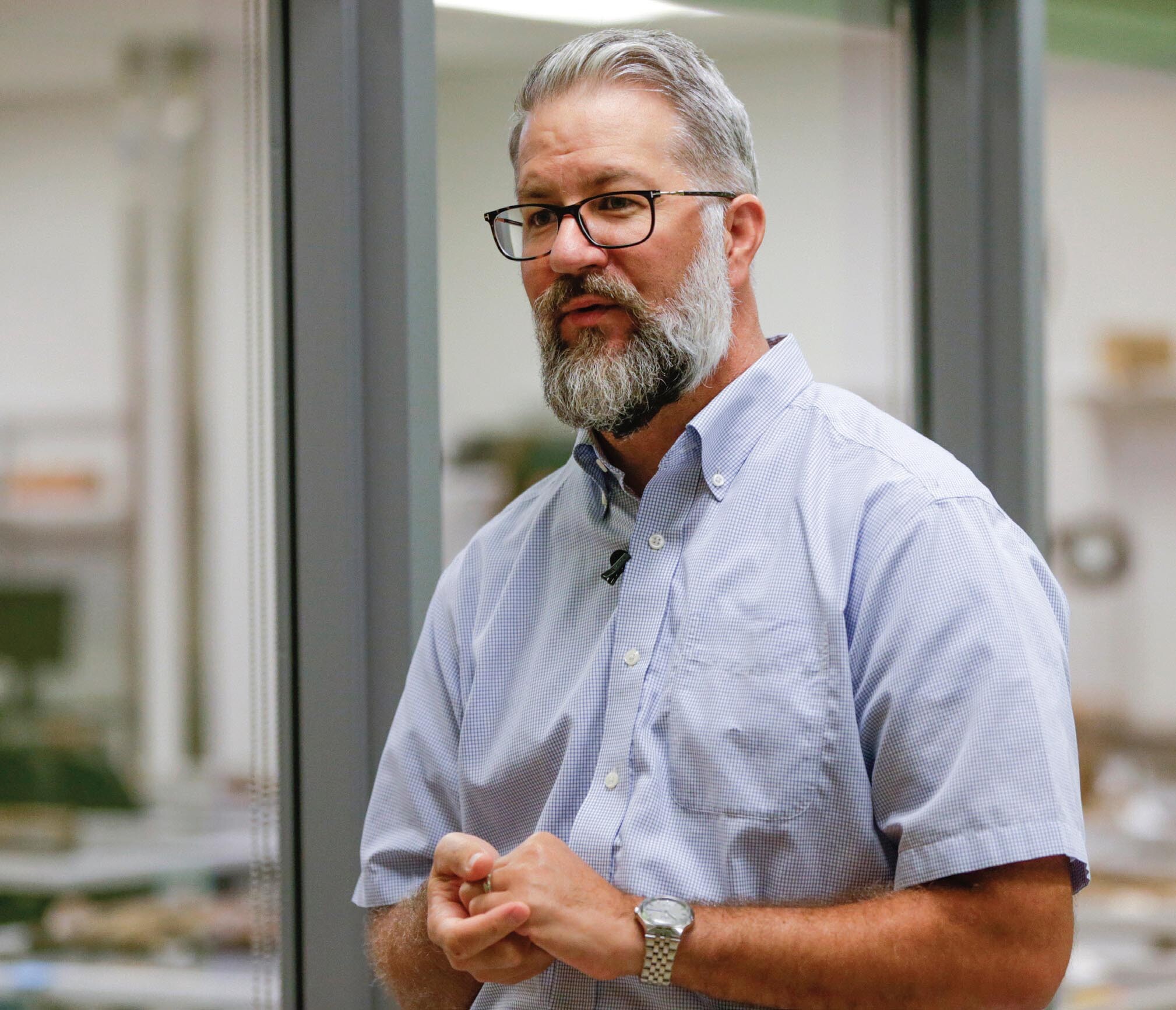
Franklin Damann, PhDDefense POW/MIA Accounting Agency
Franklin Damann
More information
A photo of Franklin Damann, deputy lab director of the Defense P O W / M I A Accounting Agency (D P A A) Identification laboratory. He has short grey hair, dark framed glasses, a short sleeve button up shirt and a grey and black beard.
What do I do? As a forensic anthropologist, I apply my skills in human skeletal biology to identify the remains of missing U.S. service members. In my current position, I direct the Defense POW/MIA Accounting Agency (DPAA) Laboratory at Offutt Air Force Base, Nebraska. The DPAA mission is to conduct the fullest possible accounting of the 83,000 missing U.S. service members from World War II, the Korean War, the Cold War, and the Vietnam War. In order to recover and identify the remains of missing service members, I work with historians, researchers, forensic anthropologists, archaeologists, and molecular biologists to sort through various types of evidence recovered from the historical record, antemortem and postmortem biological profile data, DNA, and all available information on the circumstances of the loss in order to provide a recommendation of identity to the DPAA Medical Examiner.
What excites me most about my work? I enjoy the diverse nature of my job and the opportunity to provide answers to families of missing service members, who have waited a long time. I cross-reference many different types of collected data that are used to identify a missing service member, such as sex, age, ancestry, stature, and trauma collected by a forensic anthropologist from a skeleton; mitochondrial and nuclear DNA data collected by the molecular biologist; and historical loss information collected by researchers and historians from primary source documentation. When our team makes a solid link between all the collected evidence—historical, archaeological, skeletal, dental, and DNA—and a named person, it is one of the greatest unifying moments of this profession. Additionally, I enjoy developing new ways of doing our work, which focuses on gaining efficiencies, and thus effectiveness, in the processes. For example, by moving our data into more sophisticated computing environments, we gain data standardization and the ability to visualize relationships, which are defined by the methods used, among individual bone specimens in ways that were not previously possible. By operating in these new ways, we can work cases more quickly while also establishing a registry of case data that can be used to refine our methods for our specific population of missing people.
Why did I study biological anthropology? At first, biological anthropology wasn’t a consideration for me as a career path. In fact, during my early undergraduate years I wasn’t even sure I wanted to be in school, but eventually I realized that all I was doing was postponing the decision about what career path I was going to choose when so many interested me. Eventually, I decided that I just needed to pick something. Following a positive experience in one Intro to Archaeology and Physical Anthropology course, I committed to anthropology based on the simple premise that there isn’t much in this world that humans do not or have not influenced. In short, I found a discipline where I could explore multiple facets of being human and see how they relate to one another. To me, this meant I could chart my own course, as long as I could maintain a passion for learning. It was this freedom as an anthropologist that allowed me the opportunity to be a forensic anthropologist, to research microbial ecology of skeletal remains, and to also promote interdisciplinary approaches among forensic scientists and data scientists for improving data analytics and visualizations.
Biological anthropology as practiced in the United States began in the first half of the twentieth century, especially under the guidance of three key figures: German-born Franz Boas (1858–1942) for American anthropology generally; Czech-born Aleš Hrdlička (1869–1943), who started the professional scientific journal and professional society devoted to the field; and Earnest Hooton (1887–1954), who trained most of the first generation of biological anthropologists during the first half of the twentieth century. Theories and methods of biological anthropologists today have changed greatly since the early 1900s. Whereas early biological anthropologists were interested in human biology, the field is very different today than it was even 20 years ago. Although there are similarities in the subjects explored, contemporary research brings fresh perspectives on genetic diversity, the availability of food and resources, patterns of migration, and the history of our biological lineage. These modern topics reflect a significant departure from the initial concepts and expectations of the field’s pioneers. In large part, the current field is based on evolutionary biology, much of which is studied in cultural, social, and behavioral contexts.
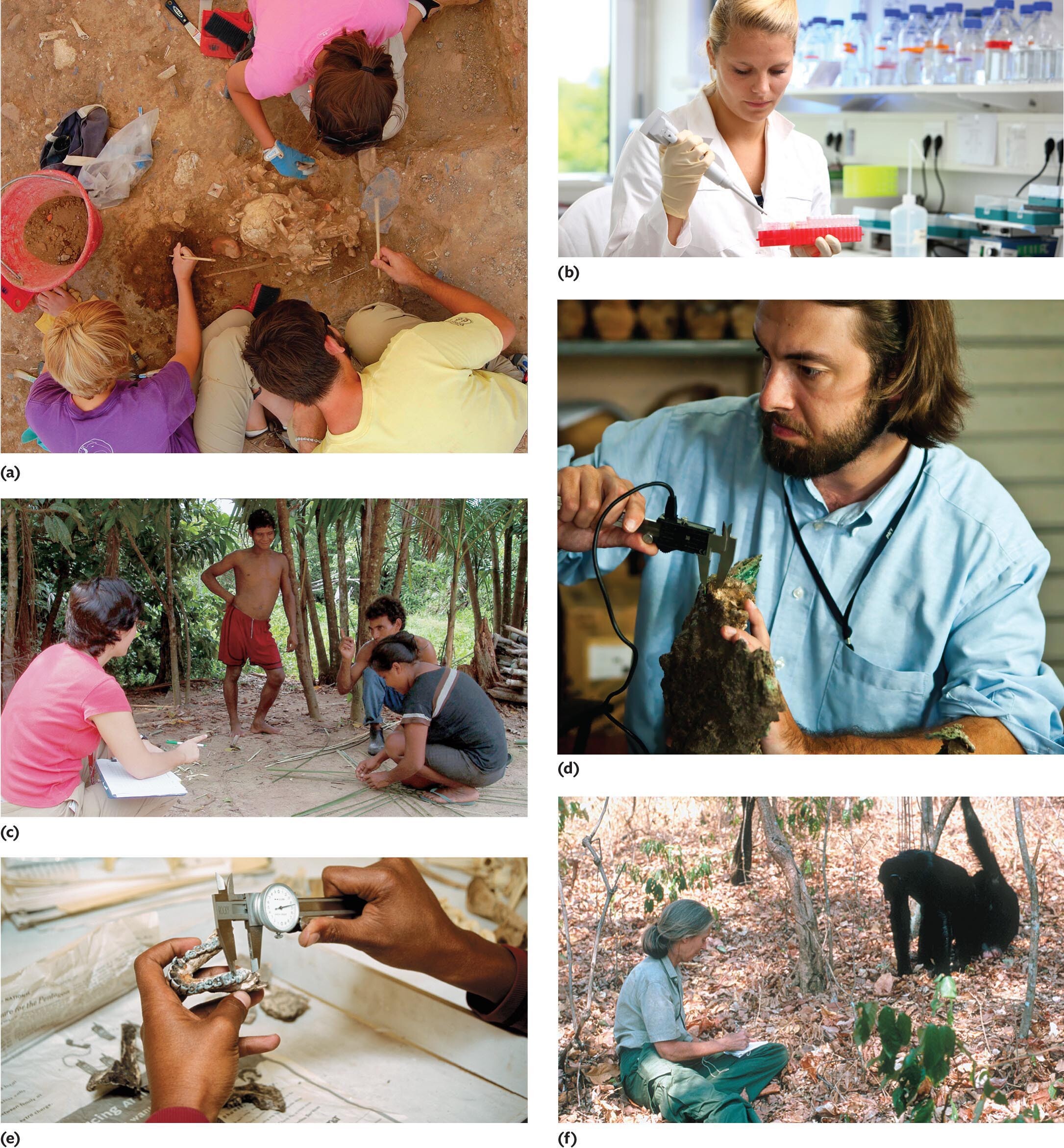
Biological anthropologists study all aspects of human biology, specifically looking at the evolution and variation of human beings and their living and past relatives. This focus on biology means that biological anthropologists practice a biological science. But they also practice a social science, in that they study biology within the context of culture and behavior. Depending on their areas of interest, biological anthropologists might examine molecular structure, bones and teeth, blood types, breathing capacity and lung volume, genetics and genetic history, infectious and other types of disease, origins of language and speech, nutrition, reproduction, growth and development, aging, primate origins and evolution, primate social behavior, biomechanics of bones, brain biology, migration, and many other topics dealing with variation in both the living and the dead—sometimes the bones and teeth of the very long dead (Figure 1.2).
More information
A six-part figure illustrating things biological anthropologists do. Part A is a photo of three people at a dig site using small sticks to remove human remains from the earth. Part B is a photo of a woman wearing a white lab coat holding a pipette and a tray of test tubes. Part C is a photo of an anthropologist speaking to a group of basket weavers. Part D is a photo of a man in a laboratory holds a large bone in his hand while using tools to examine it. Part F is a close up photo of an individual’s hands using a caliper to measure fossilized upper teeth. Part F is a photo of Jane Goodall studying chimpanzees.
Figure 1.2A Sample of What Biological Anthropologists Do(a) Human remains excavated at Badia Pozzeveri, a medieval church cemetery in Tuscany, Italy, provide a window through which to view health and living conditions in Europe. (b) Geneticists analyze samples of human DNA for various anthropological purposes. DNA studies are used to determine how closely related humans are to other primate species, to examine human origins, and to determine individual identities. (c) Biological anthropologist Barbara Piperata records the physical activities of a lactating woman (right, weaving basket) living in a rural community in the eastern Amazon, Brazil. These data will be used to calculate the woman’s energy expenditure and to understand how she copes with reproduction’s great energy demands. (d) In a laboratory setting, bioarchaeology—a subfield of anthropology that combines biological anthropology and archaeology—focuses on the study of human remains in social, behavioral, health, and lifestyle contexts. (e) Laboratory investigations of human ancestors’ bones help paleoanthropologists to determine where these ancestors fit in the human family tree. (f) Primatologists, such as the British researcher Jane Goodall (1934–), study our closest living relatives, nonhuman primates. The behavior and lifestyle of chimpanzees, for example, help biological anthropologists to understand our evolutionary past.
In dealing with such topics, biological anthropologists apply methods and theories developed in other disciplines as well as in their own as they answer questions that help us understand who we are, a point that I will raise and that you will see throughout this book. The very nature of the discipline and the constant borrowing from other disciplines means that biological anthropologists practice an interdisciplinary science. For example, they might draw on the work of geologists who study the landforms and layering of deposits of soil and rock that tell us when earlier humans lived. Or they might obtain information from paleontologists, who study the evolution of plants and animals in the distant past and thus provide the essential context for understanding the world in which earlier humans lived. Some biological anthropologists are trained in chemistry, so they can analyze the chemical properties of bones and teeth to determine what kinds of foods those earlier humans ate. Or, to learn how living humans adapt to reduced-oxygen settings, such as in the high altitudes of the Peruvian Andes, biological anthropologists might work with physiologists who study the ability of the lungs to absorb oxygen. Some biological anthropologists study ancient genomes and draw conclusions about transmission patterns of infectious diseases or migration of humans. The firm yet flexible identity of their science allows biological anthropologists to gather data from other disciplines in order to address key questions. Questions drive what they do.
A group of mammals in the order Primates that have complex behavior, varied forms of locomotion, and a unique suite of traits, including large brains, forward-facing eyes, fingernails, and reduced snouts.