How Is Culture Created?
Culture does not emerge out of the blue. It is learned and taught through the process of enculturation. It is created over time, shaped by people and the institutions they establish in relationship to the environment around them. Culture is not fixed. It is invented, changed, contested, and negotiated. Nor is it bounded. It moves and flows across regions and between people. Just as we have examined the relationship between culture and power, we can analyze the processes through which culture is created. Let’s consider consumer culture that has become so central to contemporary life.
CREATING CONSUMER CULTURE
In many parts of the world, consumerism has become more than an economic activity. It is a way of life, a way of looking at the world—a culture. The culture of consumerism includes norms, values, beliefs, practices, and institutions that have become commonplace and accepted as normal and that cultivate the desire to acquire consumer goods to enhance one’s lifestyle (McCracken 1991, 2005).
Advertising, marketing, and financial services industries work to transform the cultural values of frugality, modesty, and self-denial of the old Protestant ethic into patterns of spending and consumption associated with acquiring the material goods of a middle-class lifestyle. Many key cultural rituals now focus on consumption. In the United States, holidays such as Christmas, Valentine’s Day, Mother’s Day, and Father’s Day all promote the purchase of gifts, as do birthdays, weddings, and anniversaries. The culture of consumerism has become so powerful that it successfully promotes spending and consumption even when people don’t have money.
More information
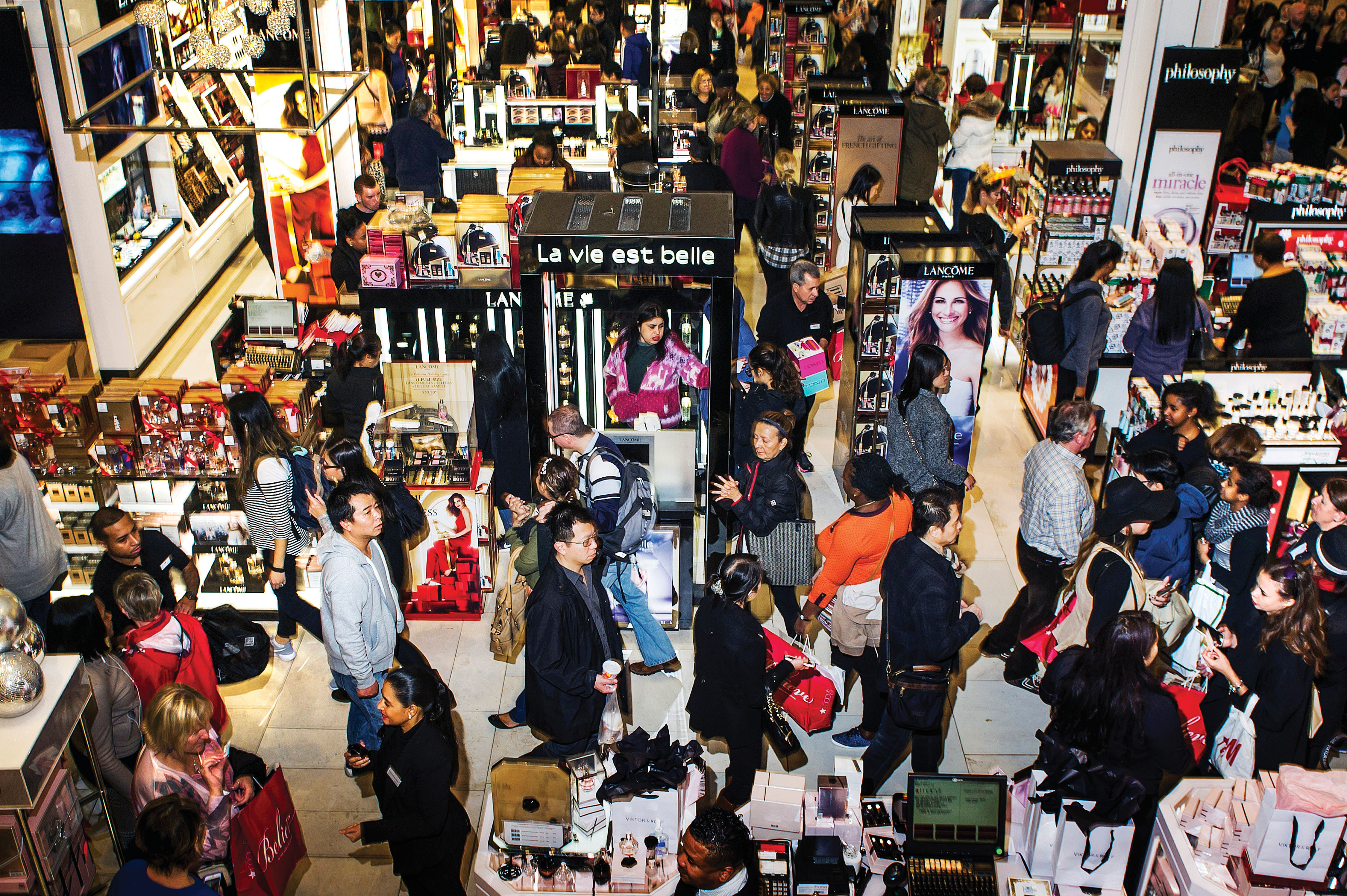
What stirs your desire to consume? Shopping on Black Friday at Macy’s flagship location in New York. Black Friday, the day after Thanksgiving, marks the start of the U. S. holiday shopping season.
Advertising. Advertising is a powerful tool of enculturation, teaching us how to be “successful” in consumer culture, how to be cool and normal. If only we could dress like the people in the advertisement and imitate their lifestyles, then we would be more desirable. The culture of consumerism tells us that having these things will bring us better friends, better sex, stronger families, higher-paying jobs, fancier houses, faster cars, sharper picture definition, and truer sound quality.
The advertising industry is key in shaping cultural norms and values around shopping while arousing our desires for goods and services. Consider that children in the United States watch up to 40,000 television commercials a year (Vitelli 2013). In addition, they are bombarded with advertising on the Internet, cell phones, mp3 players, video games, and YouTube videos. Many children’s television programs are themselves thinly disguised advertisements for products featuring their characters, from lunch boxes to clothing to action figures.
Advertising appears before and during movies in the theater, at sporting events, in department stores and shopping malls, on billboards, and in store windows. Your favorite websites and social media are covered with advertisements. So are your clothes. Even your classroom is full of advertisements that you most likely do not notice: all the labels and tags on computers, pens, notebooks, backpacks, food packaging, and soda cans. Owning certain products and brands becomes symbolic of happiness, love, beauty, success or at least the potential for upward social mobility.
Financial Services and Credit Cards. The financial services industry makes sure that once our desires are aroused, we have access to money to make our dreams a reality—at a small price. In 2018, the average American carried 2.25 credit cards, and U.S. credit card debt was $799 billion, an average of $8,733 per household (Latham 2019).
College students are a key target of the credit industry, which promotes credit cards on campus and through the mail regardless of students’ ability to repay. Credit cards grease the wheels of consumer culture. And so contemporary capitalism invests heavily to arouse our desire and promote the expansion of the culture of consumerism.