How Is Culture Created?
Analyze how a culture of consumerism is created.
Culture does not emerge out of the blue. It is learned and taught through the process of enculturation. It is created over time, shaped by people and the institutions they establish in relationship to the environment around them. Culture is not fixed. It is invented, changed, contested, and negotiated. Nor is it bounded. It moves and flows across regions and between people. You will help create many cultures over the course of your life, even if on a small scale. Humans create cultures every time we form a new group, whether a classroom, club, nonprofit, business, or family. How does a new group establish a set of norms, values, symbols, mental maps of reality, and relationships of power? Just as we have examined the relationship between culture and power, we can analyze the processes through which culture is created (Moussa, Newberry, and Urban 2021). Let’s consider the consumer culture that has become so central to contemporary life.
CREATING CONSUMER CULTURE
In many parts of the world, consumerism has become more than an economic activity. It is a way of life, a way of looking at the world—a culture. The culture of consumerism includes norms, values, beliefs, practices, and institutions that have become commonplace and accepted as normal and that cultivate the desire to acquire consumer goods to enhance one’s lifestyle (McCracken 1991, 2005).
Advertising, marketing, and financial services industries work to transform the cultural values of frugality, modesty, and self-denial into patterns of spending and consumption associated with acquiring the material goods of a middle-class lifestyle. Many key cultural rituals now focus on consumption. In the United States, holidays such as Valentine’s Day, Mother’s Day, and Father’s Day all promote the purchase of gifts, as do birthdays, weddings, and anniversaries. Christmas, which in early U.S. history featured public drinking, lewd behavior, and aggressive begging, by the nineteenth century was being transformed into a family-centered ritual of gift giving from parents to children. Moreover, the invented character of Santa Claus was promoted as the mythical mediator of gift exchange and the symbol of Christmas consumer marketing (Nissenbaum 1996). The culture of consumerism has become so powerful that it successfully promotes spending and consumption even when people don’t have money.
ADVERTISING
Used as a powerful tool of enculturation, advertising teaches how to be “successful” in consumer culture, how to be cool and normal. Social media influencers champion products assured to make us popular. Commercials promise that clothes, perfume, deodorant, haircuts, and expensive gifts will bring us love. Having our teeth straightened and whitened will help us network. A large, expensive car and proper insurance will protect our families and make us responsible and mature adults. Magazines, television shows, and films promote stars we are encouraged to emulate. If only we could dress like them and imitate their lifestyles, then we would be more desirable. The culture of consumerism tells us that having these things will bring us better friends, better sex, stronger families, higher-paying jobs, fancier houses, faster cars, sharper picture definition, and truer sound quality.
More information
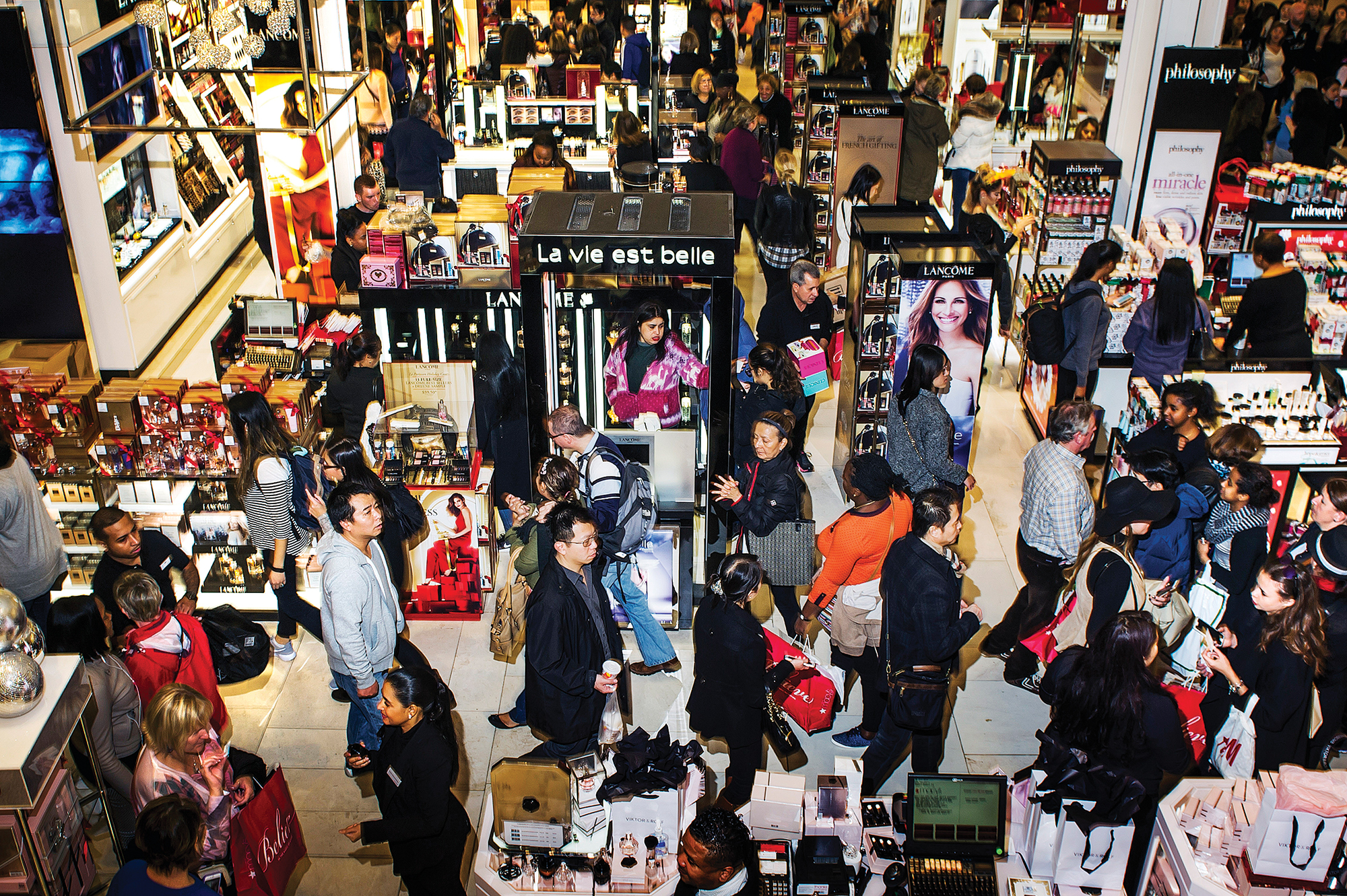
A high angle view of a department store crowded with shoppers.
The advertising industry is key in shaping cultural norms and values around shopping while arousing our desires for goods and services. Consider that children in the United States watch up to 40,000 television commercials a year (Vitelli 2013). In addition, they are bombarded with advertising on the Internet, social media, video games, and YouTube videos. Many children’s television programs are themselves thinly disguised advertisements for products featuring their characters, from lunch boxes to clothing to action figures.
Advertising appears before and during movies in the theater, at sporting events, in department stores and shopping malls, on billboards, and in store windows. Your favorite websites and social media are covered with advertisements. So are your clothes. Even your classroom is full of advertisements that you most likely do not notice: all the labels and tags on computers, pens, notebooks, backpacks, food packaging, and soda cans. Owning certain products and brands becomes symbolic of happiness, love, beauty, and success, or at least the potential for upward social mobility.
FINANCIAL SERVICES AND CREDIT CARDS
The financial services industry makes sure that once our desires are aroused, we have access to money to make our dreams a reality—at a small price. With the advent of computers and the deregulation of banking in the 1970s, credit cards burst on the scene, transforming the financial environment. Banks, chain stores, and financial services corporations carry out intensive marketing to promote their cards. In 2022, Americans carried $838 billion dollars of credit card debt (Latham 2022).
College students are a key target of the credit industry, which promotes credit cards on campus and through the mail regardless of students’ ability to repay any debts they accrue. Credit cards grease the wheels of consumer culture. To pay them off, we need to intensify our participation: Work harder. Make more money. Then we can shop more. As credit card limits max out, banks and mortgage companies encourage homeowners to refinance their homes, taking out second mortgages to pay for day-to-day expenses and speculating that housing prices will remain high and continue to increase. Underlying these shifts is the fundamental drive of contemporary capitalism toward perpetual growth. People need to buy, make, invest, and profit more and more each year if the economy is to keep growing. And so contemporary capitalism invests heavily to arouse our desire and promote the expansion of the culture of consumerism.