What Is Unique about Ethnographic Fieldwork, and Why Do Anthropologists Conduct This Kind of Research?
Define fieldwork and its fundamental principles.
Ethnographic fieldwork is the unique set of practices that anthropologists—particularly cultural anthropologists—have developed to put people first as we analyze how human societies work. Chemists conduct experiments in laboratories. Economists analyze financial trends. Demographers crunch census data. Historians pore over records and library archives. Sociologists, economists, and political scientists analyze trends, quantifiable data, official organizations, and national policies. But anthropologists start with people and their local communities. Even though the whole world is our field, our unique perspective first focuses on the details and patterns of human life in the local setting.
FIELDWORK BEGINS WITH PEOPLE
Through fieldwork, we try to understand people’s everyday lives, to see what they do, and to understand why. By living with others over an extended period, we seek to understand their experiences through their eyes. We participate in their activities, take careful notes, conduct interviews, take photographs, and record music. We make maps of communities, both of the physical environment and of family and social relationships. Although careful observation of the details of daily life is the first step, through intensive fieldwork anthropologists look beyond the taken-for-granted, everyday experience of life to discover the complex systems of power and meaning that people construct to shape their existence. These include the many systems discussed throughout this book: gender, sexuality, race, ethnicity, religion, kinship, and economic and political systems. Learning to ask good questions is key to successful fieldwork. This requires careful preparation and study before going to the field. It also requires careful listening once in the field to adjust one’s questions to new information and unexpected circumstances. As we extend our analysis as anthropologists, we try to see how local lives compare to the lives of others and fit into larger human patterns and global contexts.
FIELDWORK SHAPES THE ANTHROPOLOGIST
Fieldwork experience is considered an essential part of an anthropologist’s training. It is the activity through which we learn the basic tools of our trade, earn credibility as effective observers of culture, and establish our reputation as full members of the discipline. Engaging in fieldwork teaches us the basic research strategies of our discipline and hones those skills: careful listening and observation, asking meaningful questions, engagement with strangers, cross-cultural interaction, and deep analysis of human interactions and systems of power and inequality. We learn empathy for those around us, develop a more global consciousness, and uncover our own ethnocentrism. Indeed, fieldwork is a rite of passage, an initiation into our discipline, and a common bond among anthropologists who have been through the experience.
Fieldwork transforms us. In fact, it is quite common for anthropologists entering the field to experience culture shock—a sense of disorientation caused by the overwhelmingly new and unfamiliar people and experiences encountered every day. Over time, the disorientation may fade as the unfamiliar becomes familiar. But then, many anthropologists feel culture shock again when returning home, where their new perspective causes previously familiar people and customs to seem very strange. Through this cross-cultural training, anthropology provides the tools to unlock our cultural imaginations, to move beyond our ethnocentrism, to see the incredible diversity of the world’s cultures, and to consider the full potential of human life.
FIELDWORK AS SOCIAL SCIENCE AND AS ART
Fieldwork is a strategy for gathering data about the human condition, particularly through the life experiences of local people in local situations. Fieldwork is an experimental setting for testing hypotheses and building theories about the diversity of human behavior and the interactions of people with systems of power—a scientific method for examining how the social world really works. As such, anthropologists have developed techniques such as participant observation, field notes, interviews, kinship and social network analysis, life histories, and mapping—all of which we will discuss in this chapter.
But fieldwork is also an art. Its success depends on the anthropologist’s more intuitive abilities to negotiate complex interactions, usually in an unfamiliar cultural environment; to build relationships of trust; to make sense of patterns of behavior; and to be conscious of their own biases and particular vantage point. Ethnographic fieldwork depends on the ability of an outsider—the anthropologist—to develop close personal relationships over time in a local community and to understand the everyday experiences of often-unfamiliar people. It requires the anthropologist to risk being changed in the process—the risk of mutual transformation. Successful ethnographic fieldwork also depends on the anthropologist’s ability to tell the subjects’ stories to an audience that has no knowledge of them in ways that accurately reflect the subjects’ lives and shed light on the general human condition.
FIELDWORK INFORMS DAILY LIFE
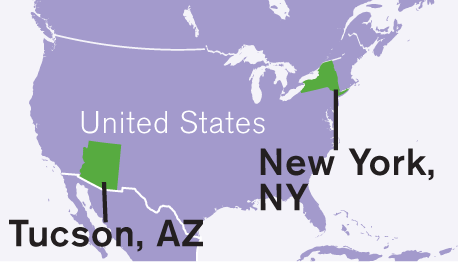
Anthropologist Brackette Williams suggests that fieldwork can even be a kind of “homework”—a strategy for gathering information that will help the anthropologist make informed decisions in order to act morally and to weigh in advance the likely consequences of their actions. Williams studied homelessness and begging in New York City and Tucson, Arizona, over a period of several years. She began with some very practical questions about whether to give to homeless people asking for money on the subway she took to work in New York City every day.
More information
The United States is labeled. New York State is highlighted, and Arizona is highlighted. New York, New York is labeled, and Tucson, Arizona is labeled.
Her research started with careful observation of all the people involved, including people experiencing homelessness and others on the subway, particularly those deciding to give or not to give. She continued with informal and formal interviews, careful note taking, and background reading. In the process, she began to identify a clear set of stories and begging styles and to examine the complicated set of responses made by people on the subway who were being asked for money.
Williams suggests that this approach to her daily dilemma was not only an interesting use of her ethnographic fieldwork skills and training but also “socially required homework” for anyone who confronts complex problems in daily life, whether with family, friends, school, work, or politics. Can you imagine using this strategy to explore a problem, puzzle, or question in your life?