Most international relations theorists locate the origins of the contemporary state system in Europe in 1648, the year the Treaties of Westphalia ended the Thirty Years’ War. These treaties marked the end of rule by religious authority in Europe and the emergence of secular authorities. With secular authority came the principle that has provided the foundation for contemporary international relations: the notion of the territorial integrity of states—legally equal and sovereign participants in an international system.
The formulation of sovereignty—a core concept in contemporary international relations—was one of the most important intellectual developments leading to the Westphalian revolution. Much of the development of the notion is found in the writings of the French philosopher Jean Bodin (1530–96). To Bodin, sovereignty is the “absolute and perpetual power vested in a commonwealth.”1 It resides not in an individual but in a state; thus, it is perpetual. It is “the distinguishing mark of the sovereign that he cannot in any way be subject to the commands of another, for it is he who makes law for the subject, abrogates law already made, and amends obsolete law.”2
Although, ideally, sovereignty is absolute, in reality, according to Bodin, it is not without limits. Leaders are limited by divine law and natural law: “All the princes on earth are subject to the laws of God and of nature.” They are also limited by the type of regime—“the constitutional laws of the realm”—be it a monarchy, an aristocracy, or a democracy. And lastly, leaders are limited by covenants, contracts with promises to the people within the commonwealth, and treaties with other states, though there is no supreme arbiter in relations among states.3 Thus, Bodin provided the conceptual glue of sovereignty that would emerge with the Westphalian agreement.
The Thirty Years’ War devastated Europe. The war began during the reign of the Holy Roman Empire as a religious dispute between Catholics and Protestants, ended due to mutual exhaustion and bankruptcy. Princes and mercenary armies ravaged the central European countryside, fought frequent battles, and plundered the civilian population to secure needed supplies. The treaties that ended the conflict had three key impacts on the practice of international relations.
First, the Treaties of Westphalia embraced the notion of sovereignty. With one stroke, virtually all the small states in central Europe attained sovereignty. The Holy Roman Empire was dead. Monarchs—and not a supranational church—gained the authority to decide which version of Christianity was appropriate for their subjects. With the pope and the emperor stripped of this power, the notion of the territorial state came increasingly to be accepted as normal. Not only did the Treaties legitimize territoriality and the right of states—as the sovereign, territorially contiguous principalities came to be known—to choose their own religion, but the Treaties also established that states had the right to determine their own domestic policies, free from external pressure and with full jurisdiction in their own geographic space. The Treaties thus introduced the principle of noninterference in the affairs of other states.
Second, because the leaders of Europe’s most powerful countries had seen the devastation wrought by mercenaries in war, after the Treaties of Westphalia, these countries sought to establish their own permanent national militaries. The growth of such forces led to increasingly centralized control, since the state had to collect taxes to pay for these militaries and leaders assumed absolute control over the troops. The state with a national army emerged as a powerful force—its sovereignty acknowledged and its secular base firmly established. And that state’s power increased. Larger territorial units gained an advantage as armaments became more standardized and more lethal.
More information
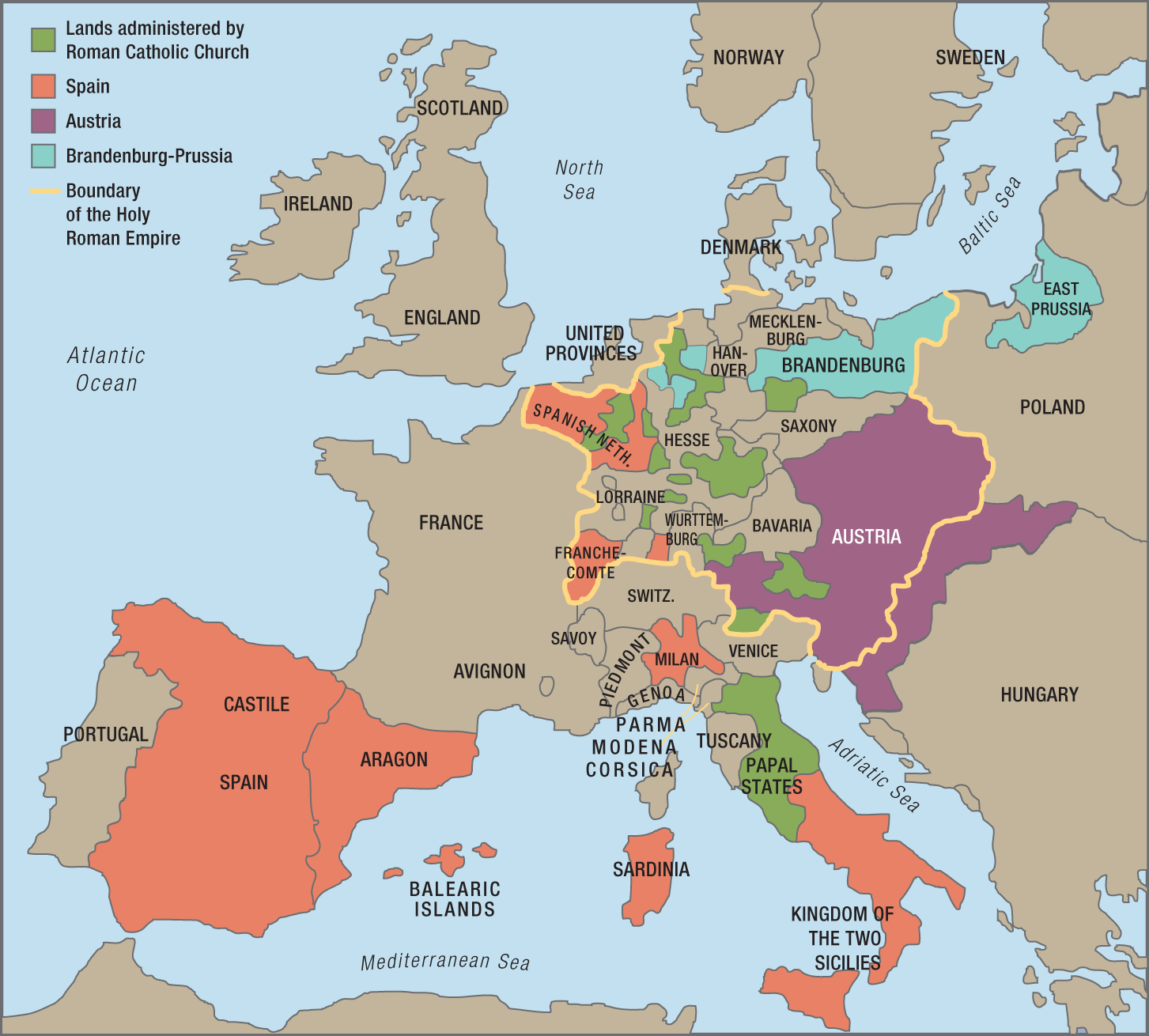
A map of Europe depicts lands administered by Roman Catholic Church, Spain, Austria, Brandenburg-Prussia, and Boundary of the Holy Roman Empire. The lands administered by the Roman Catholic Church are shown as tracts across central Europe including the Papal states in Italy. The lands administered by Spain include the Spanish mainland with Castile and the adjacent Aragon, Spanish-Netherlands and Franche-Comte in France, Wurttemberg in Germany, Milan, Kingdom of the Two Sicilies, and Sardinia in Italy, and the Balearic Islands in the Mediterranean Sea. The lands administered by Austria include the Austrian mainland extending into neighboring Hungary. The lands administered by Brandenburg-Prussia include Brandenburg, East Prussia in Poland, and small patches near Hanover in Germany. The boundary of the Holy Roman Empire is drawn to the north of the Adriatic Sea passing through Austria and Poland all the way to the Baltic Sea on the east, and moving westward through Switzerland, France, and north toward Spanish-Netherlands, United Provinces, and Denmark to the Baltic Sea. The map also identifies Portugal, France, Ireland, England, Scotland, Norway, Sweden, Poland, Hungary, and Venice among others. The caption reads, �Europe, c. 1648.�
Europe, c. 1648
Third, the Treaties of Westphalia established a core group of states that dominated the world until the beginning of the nineteenth century: Austria, Russia, Prussia, England, France, and the United Provinces (the Netherlands). Those in the west (England, France, and the United Provinces) experienced an economic revival under liberal capitalism. Private enterprise was encouraged. States improved their infrastructure to facilitate commerce, and great trading companies and banks emerged. That economic success occurred as those states enslaved indigenous peoples in the Americas and transported enslaved Africans to their new lands. While slavery was not unique to the Europeans—the Greeks, some Muslim states, the Ottoman Empire, and others engaged in the practice—the European slave trade had profound and lasting economic and social effects.
Meanwhile Prussia and Russia in the east reverted to feudal practices. Serfs remained on the land, and economic development was stifled. Yet in both regions, states led by a monarch with absolute power dominated, with Louis XIV ruling in France (1643–1715), Peter the Great in Russia (1682–1725), and Frederick II in Prussia (1740–86).
The most important social theorist of the time was the Scottish economist Adam Smith (1723–90). In An Inquiry into the Nature and Causes of the Wealth of Nations, Smith argued that the notion of a market should apply to all social orders. Individuals—laborers, owners, investors, consumers—should be permitted to pursue their own interests, unfettered by all but the most modest state regulations. According to Smith, each individual acts rationally to maximize her or his own interests. With groups of individuals pursuing their interests, economic efficiency is enhanced, and more goods and services are produced and consumed. At the aggregate level, the wealth of the state and that of the international system are similarly enhanced. What makes the system work is the so-called invisible hand of the market: when individuals pursue their rational self-interests, the system (the market) operates in a way that benefits everyone.4 Smith’s explication of how competing units enable market capitalism to thrive has had a profound effect on states’ economic policies and political choices, which we will explore in Chapter 8. But other ideas of the period would also dramatically alter governance in subsequent centuries.
IN FOCUS
Key Developments after Westphalia
Concept and practice of sovereignty develops.
Centralized control of institutions to facilitate the creation and maintenance of military; military power grows.
Capitalist economic system emerges (stable expectations facilitate long-term investment).
Check Your Understanding
Traditionally, international relations scholars trace the origin of the modern state system to which event?
the Treaties of Westphalia
the fall of the Roman Empire
the end of World War II
the Great Depression
AnswerAnswer:a
What best summarizes Adam Smith’s contribution to economic theory in the 1700s?
Smith argued in favor of government regulation of the economy.
Smith believed that the Treaties of Westphalia would bring renewed economic prosperity.
Smith wanted to see European nations grant their colonies independence.
Smith was one of the first proponents of free markets and capitalism.
treaties ending the Thirty Years War in Europe in 1648; in international relations represents the beginning of state sovereignty within a territorial space
the authority of the state, based on recognition by other states and by nonstate actors, to govern matters within its own borders that affect its people, economy, security, and form of government
Endnotes
Jean Bodin, Six Books on the Commonwealth, trans. M. J. Tooley (Oxford: Basil Blackwell, 1967), p. 25. Return to reference 1
 IN FOCUS
 Answer
 Answer: a