The nineteenth century in Europe was a turbulent time. The American Revolution (1773–85) against British rule and the French Revolution (1789) against absolutist rule ushered in the new century, followed by the Napoleonic Wars and the expansion of imperialism and colonialism to other continents. The balance of power among the European states that had stabilized the region during that time began to break down by the end of the century as key alliances solidified.
The Aftermath of Revolution: Core Principles
Two core principles emerged in the aftermath of the American and French revolutions. The first was that absolutist rule is subject to limits. In Two Treatises of Government, the English philosopher John Locke (1632–1704) attacked absolute power and the notion of the divine right of kings. Locke argued that the state is an institution created by rational individuals to protect both their natural rights (life, liberty, and property) and their self-interests. Individuals freely enter into this political arrangement, agreeing to establish government to ensure natural rights for all. The crux of Locke’s argument is that political power ultimately rests with the people, rather than with a leader or monarch. The monarch derives legitimacy from the consent of the governed.5
The second core principle was nationalism, wherein a people comes to identify with a common past, language, customs, and territory. Individuals who share such characteristics are motivated to participate actively in the political process as a nation.6 For example, during the French Revolution, a patriotic appeal was made to the people of France to defend the French nation and its new ideals. This appeal forged an emotional link between the people and the state—the “state” being France’s territory with a government—as explained in Chapter 4.
But these principles were being contested and undermined even at the time. Locke, for example, while arguing for a transfer of political power to the people, never saw slavery as a challenge to the principle. And the idea of nationalism was preserved for some, usually the elites, while the claims of others were contested. In the immediate aftermath of the French Revolution, enslaved individuals in the French colony of Santo Domingo (modern-day Haiti) rose up against the practice of racism, beginning what would become a two-century fight against slavery and racial discrimination—a struggle detailed in Chapter 10. Nevertheless, the two principles—legitimacy and nationalism—would provide the foundation for politics in the nineteenth and twentieth centuries.
The Napoleonic Wars
The political impact of nationalism in Europe was profound. The nineteenth century opened with war in Europe on an unprecedented scale. France’s status as a revolutionary power made it an enticing target of other European states intent on stamping out the contagious idea of government by popular consent. Thus, France became embroiled in an escalating series of wars with Austria, Britain, and Prussia. Weakened and disorganized from the years of internal conflict, a Corsican artillery officer named Napoleon Bonaparte rose to leader of the French military and, eventually, to the rank of emperor of France.
The dramatic successes and failures of France’s Napoleon Bonaparte illustrated both the power and the limits of nationalism, new military technology, and organization.
Napoleon, with help from other talented officers, set about reorganizing and regularizing the French military. Making use of French national zeal, Napoleon led large, well-armed, and passionately motivated armies. By changing technology like storing war supplies in pre-positioned locations along likely campaign routes, troops could avoid having to stop and forage for food. In combination with nationalism, that system made it possible for the French to field larger, more mobile, and more reliable armies that could employ innovative tactics unavailable to the smaller professional armies of France’s rivals like Prussia. Through a series of famous battles, Napoleon’s armies shattered those of “invincible” Prussia, conquering nearly the whole of Europe in a few short years.
In Spain and Russia, however, Napoleon’s armies met nationalists who fought a different sort of war. Spanish fighters used intimate local knowledge to mount hit-and-run attacks on French occupying forces. These fighters also enjoyed the support of Britain, whose unrivaled mastery of the seas meant the country could lend supplies and occasional forces. When local French forces attempted to punish the Spanish into submission through looting, torture, and executions, resistance to French occupation escalated. The cost to France was high, draining away talented soldiers and cash and damaging French morale. When Napoleon invaded Russia in 1812 with an army of 422,000, the Russians retreated, destroying all available food and shelter behind them in what came to be known as a “scorched earth” policy. The French began to suffer from severe malnutrition, with the entire army slowly starving to death as it advanced to Moscow.
By the time the French army reached the Russian capital, its size had dwindled to a mere 110,000. Napoleon waited in vain for the tsar to surrender. But realizing his vulnerability, Napoleon attempted to return to France before Russia’s harsh winter set in. It was already too late. By the time French troops crossed the original line of departure, Napoleon’s Grande Armeé had been reduced to a mere 10,000. The emperor was finally defeated in 1815 by English and Prussian forces at the Battle of Waterloo (in present-day Belgium).
Peace at the Core of the European System
Following the defeat of Napoleon in 1815 and the establishment of peace by the Congress of Vienna, the five powers of Europe—Austria, Britain, France, Prussia, and Russia—known as the Concert of Europe, ushered in a period of relative peace in the international political system. These great powers fought no major wars after the defeat of Napoleon until the Crimean War in 1854, and in that war, both Austria and Prussia remained neutral. Other local wars of brief duration were fought, and in these, too, some of the five major powers remained neutral. Meeting more than 30 times before World War I at a series of ad hoc conferences, the Concert became a club of like-minded leaders. Through these meetings, these countries legitimized both the independence of new European states and the division of Africa among the colonial powers.
The fact that peace among great powers prevailed during this time seems surprising since major economic, technological, and political changes were radically altering power relationships. All attention was focused on industrialization. Great Britain was the leader, outstripping all rivals in its output of coal, iron, and steel and the export of manufactured goods. In addition, Britain became the source of finance capital, the banker for the continent and later for the world. Industrialization spread through virtually all areas of Western Europe as the masses flocked to the cities and entrepreneurs and middlemen scrambled for economic advantage. Since the middle classes did not depend on land for wealth and power, their ability to invent, use, and improve industrial machines and processes gave them political power at the expense of the aristocratic class.
The population of Europe soared and commerce surged as transportation corridors across Europe and the globe were strengthened. Political changes were dramatic: Italy was unified in 1870; Germany was formed out of 39 different fragments in 1871; the United Kingdom of the Netherlands was divided into the Netherlands and Belgium in the 1830s; and the Ottoman Empire gradually disintegrated, leading to independence for Greece in 1829 and for Moldavia and Wallachia (Romania) in 1856. With such dramatic changes under way, what explains the absence of major war? At least three factors discouraged war.
First, Europe’s political elites were united in their fear of revolution among the masses. In fact, at the Congress of Vienna, the Austrian diplomat Count Klemens von Metternich (1773–1859), architect of the Concert of Europe, believed that returning to the age of absolutism was the best way to manage Europe. Others envisioned grand alliances that would bring European leaders together to fight revolution by the lower classes. And in 1848, all five powers did face demands for reform from the masses. That fear of revolt from below united European leaders, making war between them less likely.
More information
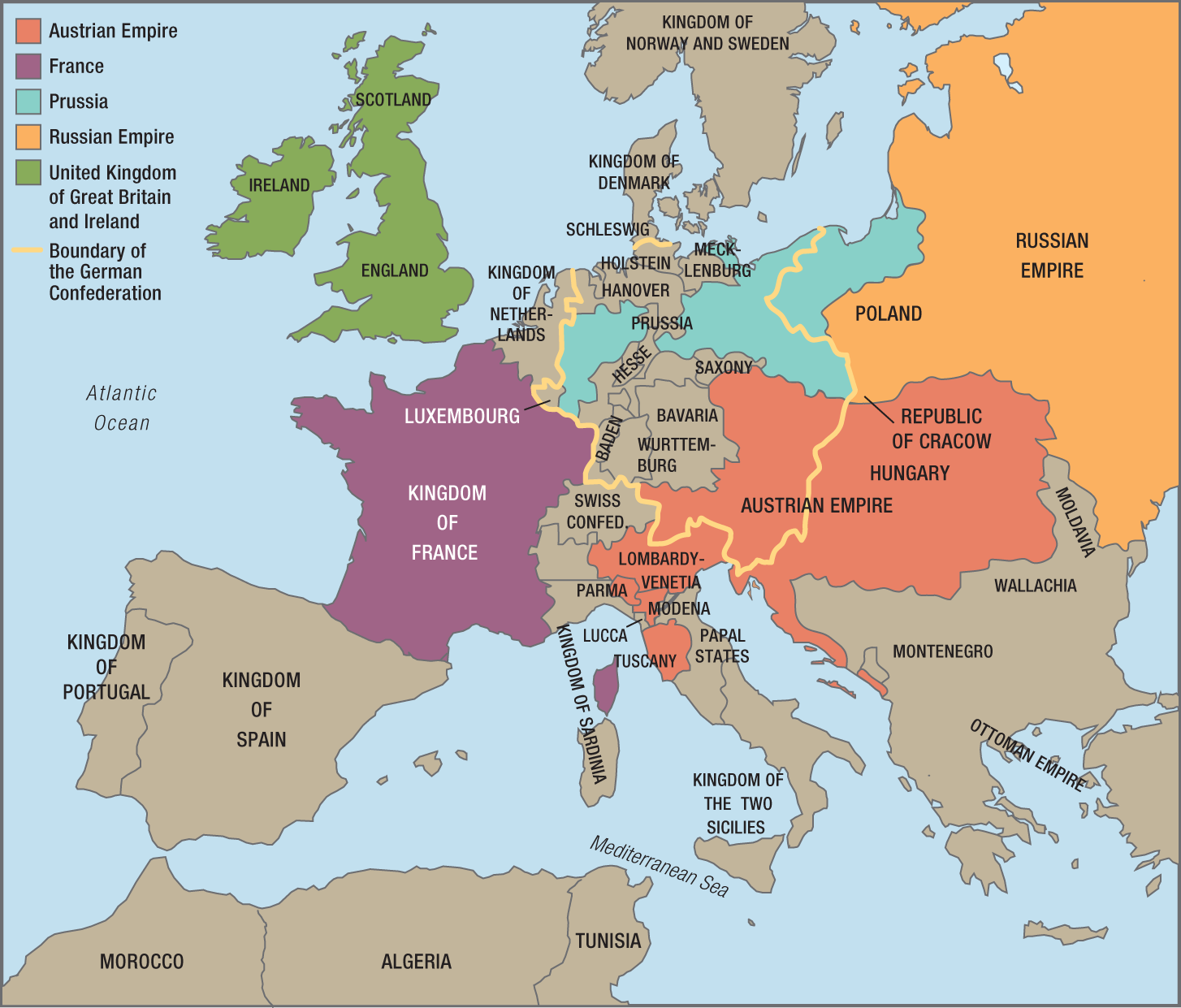
A map of Europe depicts Boundary of the German Confederation, Austrian Empire, France, Prussia, Russian Empire, United Kingdom of Great Britain and Ireland. The Austrian Empire extends across present day Hungary, Austria, Czech Republic, Croatia, and northern Italy Lombardy-Venetia, Modena and Tuscany. The kingdom of France occupies present-day France. Prussia extends into the north of Germany and Poland. The Russian empire includes present day Russia and Poland and the United Kingdom of Great Britain includes England, Ireland, and Scotland. A line representing the boundary of the German Confederation is drawn passing through central Austria and Prussia on the east, and through western Austria, Swiss Confederation, and Kingdom of Netherlands on the West. The map also identifies Kingdom of Spain, Kingdom of Portugal, Kingdom of Norway and Sweden, Ottoman Empire, Kingdom of two Sicilies, and several smaller states in central Europe. The caption reads, �Europe, c. 1815.�
Europe, c. 1815
Second, two of the major conflicts of interest confronting the core European states took place within, rather than between, culturally close territories: the unifications of Germany and Italy. Both German and Italian unification had powerful proponents. For example, Britain supported Italian unification, making possible Italy’s annexation of Naples and Sicily. German unification was acceptable to Russia, as long as Russian interests in Poland were respected. German unification also got support from Britain’s dominant middle class, which viewed a stronger Germany as a potential counterbalance to France. Thus, because the energies of Germans and Italians were concentrated on forming contiguous territorial states, and because the precise impact of the newly unified states on the European balance of power was unknown, a wider war was averted.
The third factor supporting peace in Europe was the complex and crucial phenomenon of imperialism-colonialism, wherein rivalries between European states were played out in distant places.
Imperialism and Colonialism in the European System
The discovery of the “New” World—as Europeans after 1492 called it—led to rapidly expanding communication between the Americas and Europe. The same advanced navigation technology also made contact with Asia less costly and more frequent. The first to arrive in the New World were explorers seeking discovery, riches, and personal glory; clerics seeking to convert the indigenous peoples to Christianity; and merchants seeking raw materials and trade relations. But some traders quickly realized that the potential wealth could be magnified by transporting enslaved peoples from Africa to the New World to clear the land and develop agriculture. This led to increasing competition among European powers for territories abroad in both the Western Hemisphere and Africa. Most of the European powers became empires and, once established, claimed as sovereign territory the lands indigenous peoples occupied. These empires are the origin of the term imperialism, the annexation of distant territory (most often by force) and its inhabitants to an empire. Colonialism, which often followed or accompanied imperialism, refers to the settling of people from a home country like Spain among indigenous peoples of a distant territory like Mexico. The two terms are thus subtly different, but most scholars use them interchangeably.
This process of annexation by conquest or treaty continued for 400 years. As the technology of travel and communications improved, and as Europeans developed vaccines and cures for tropical diseases, the costs to European powers of imposing their will on indigenous people and on transporting enslaved peoples to new territories continued to drop. In some places indigenous people welcomed Europeans; in other places, indigenous people put up resistance. In most cases, Europeans overcame that resistance with very little cost or risk. They met spears with machine guns and horses with heavy artillery, deliberately targeting indigenous civilians. By the close of the nineteenth century, almost the whole of the globe was “ruled” by European states. Great Britain was the largest and most successful of the imperial powers, but even small states, such as Portugal and the Netherlands, maintained important colonies abroad.
The Industrial Revolution provided the European states with the military and economic capacity to engage in territorial expansion. Some imperial states were motivated by economic gains, seeking new external markets for manufactured goods and obtaining, in turn, raw materials to fuel their industrial growth. For others, the motivation was cultural and religious—to spread the Christian faith and the ways of White “civilization” to the “dark” continent and beyond. For still others, the motivation was political. Since the European balance of power prevented direct confrontation in Europe, European state rivalries were played out in Africa and Asia.
More information
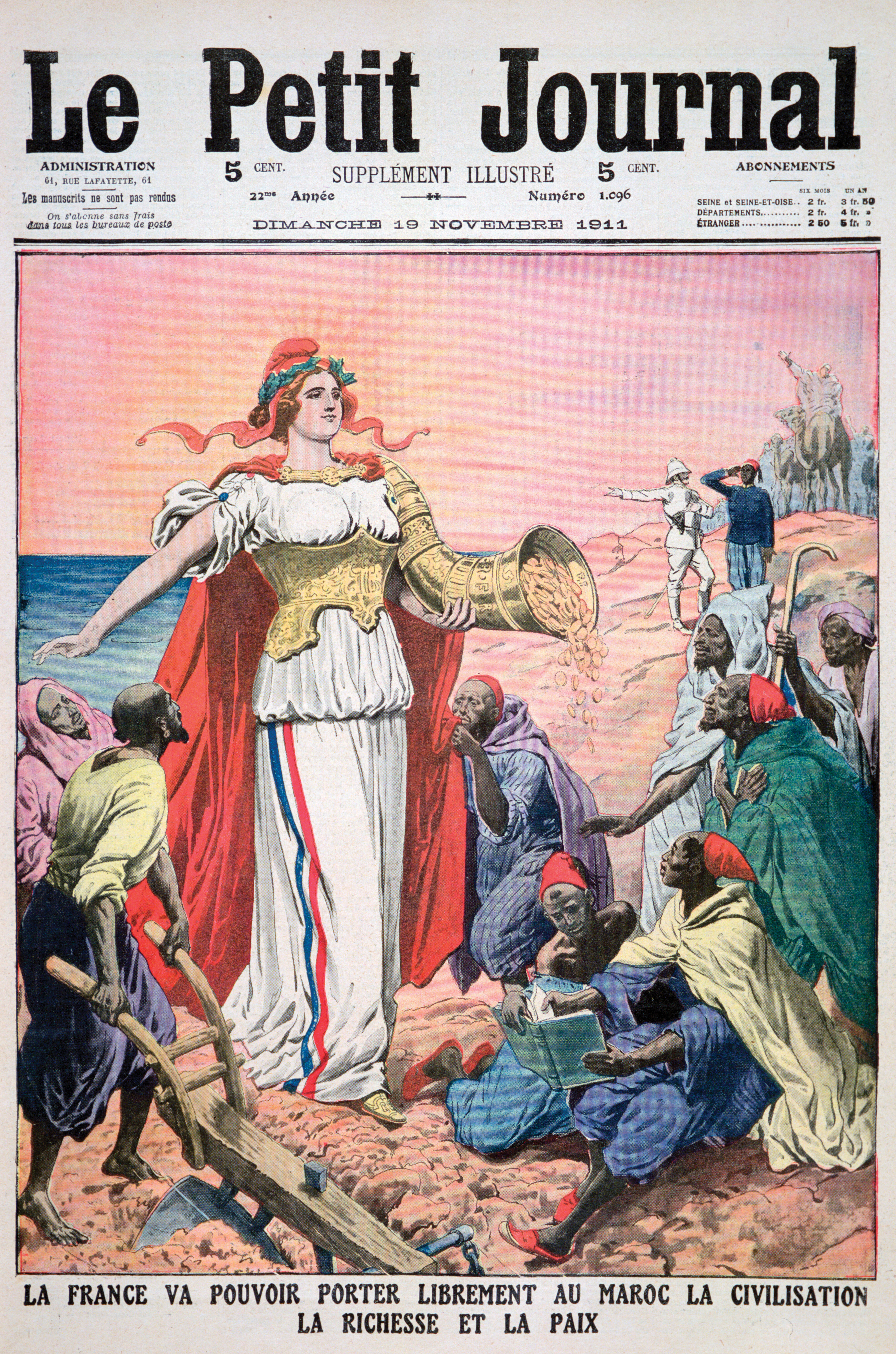
A painting on the front page of the French Le Petit Journal shows a woman walking on a beach among a group of Moroccans. The woman wears a white gown with blue and white trim, a red cape, and a gold breastplate. She holds a golden horn with coins pouring out of it. The woman is oversized in comparison to the Moroccans. One Moroccan is behind a plow, one kneels by the woman and holds her cape, and two hold a book and sit in front of the woman. In the background, a French soldier in white points to the sea and a Moroccan salutes.
In the early twentieth century, French authorities took control of Morocco. Here, a magazine suggests the popular ideal of colonialism as “civilized” nations bringing peace and prosperity to “uncivilized” Morocco.
Many leaders within the now-unified Italy and Germany felt that to have international respect and to guarantee cheap imports of raw materials, they “needed” to annex or colonize countries in Asia or Africa. Italy attempted to conquer and colonize Ethiopia, a Christian empire in the Horn of Africa, but suffered a humiliating defeat in 1896. To mollify Germany’s imperial ambitions, during the Congress of Berlin in 1885, the major powers divided up Africa, “giving” Germany a sphere of influence in east Africa (Tanganyika), west Africa (Cameroon and Togo), and southern Africa (Southwest Africa). European imperialism seemed to provide a convenient outlet for Germany’s aspirations as a great power, without endangering the delicate balance of power within Europe itself. By the end of the nineteenth century, 85 percent of Africa was under the control of European states.
In Asia, only Japan and Siam (Thailand) were not under direct European or U.S. influence. China is an excellent example of the extent of external domination. Under the Qing dynasty, which began in the seventeenth century, China had slowly been losing political, economic, and military power for several hundred years. During the nineteenth century, British merchants began to trade with China for tea, silk, and porcelain, often paying for these products with smuggled opium. In 1842, the British defeated China in the Opium War, forcing China to cede various political and territorial rights to foreigners through a series of unequal treaties. European states and Japan were able to occupy large portions of Chinese territory, claiming to have exclusive trading rights in particular regions. Foreign powers exercised separate “spheres of influence” in China. By 1914, Europeans had colonized four-fifths of the world, and still controlled much of it. The United States eventually became an imperial power as well, having won the 1898 Spanish-American War, pushing the Spanish out of the Philippines, Puerto Rico, Cuba, and other small islands.
More information
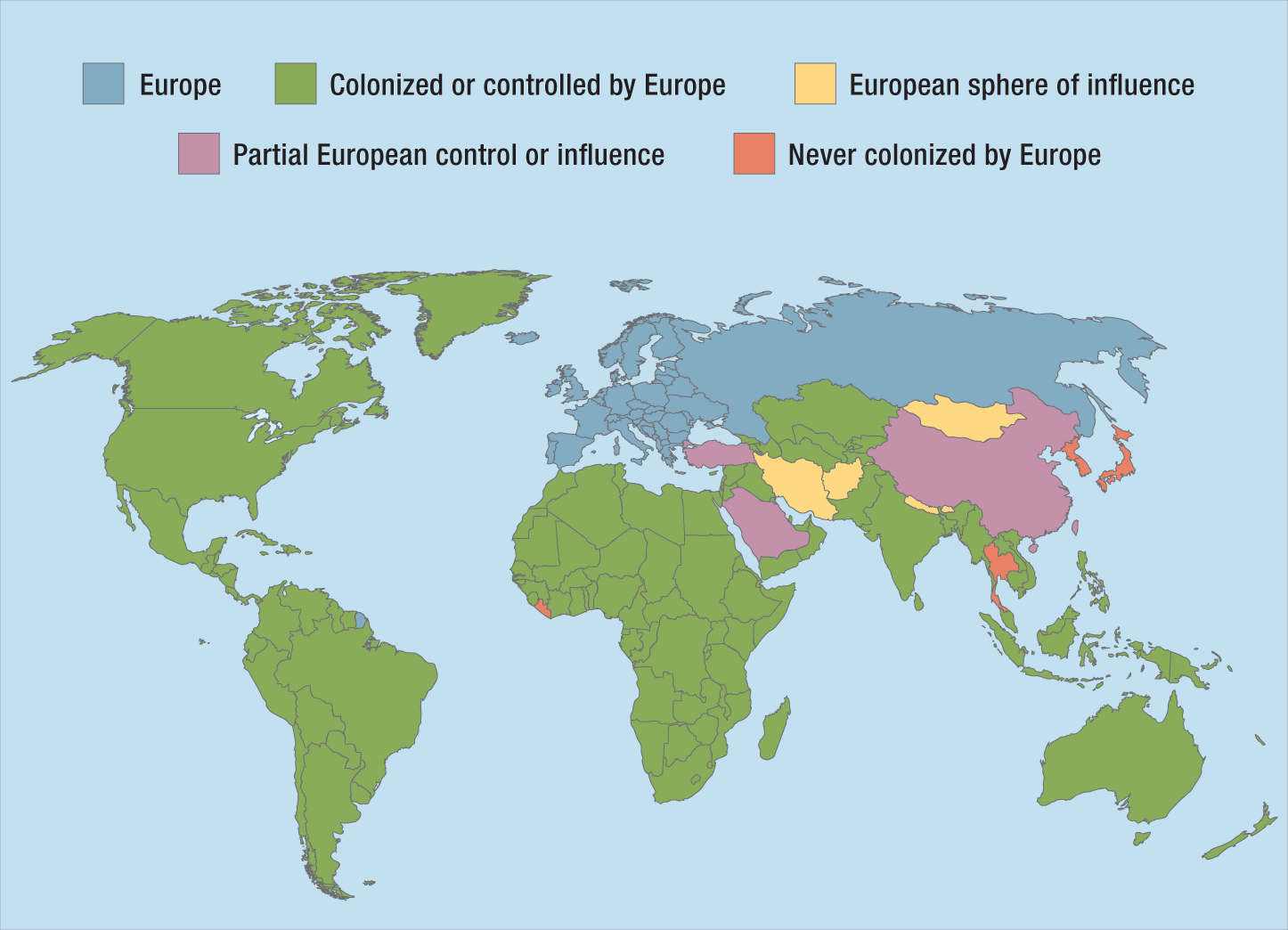
A world map shows countries that were under European control from 1500s to the 1960s. Europe includes all of Europe, including Russia. Colonized or controlled by Europe includes North America, Central America, South America, most of Africa, central Asia, south Asia, southeast Asia, Greenland, and Australia. European sphere of influence includes Mongolia, Afghanistan, Iran, and Nepal. Partial European control or influence includes Saudi Arabia, Turkey, and China. Never colonized by Europe includes Liberia, Japan, Korea, and Thailand. The caption reads, �Colonialism, 1500-1960.This map shows every country that had been under European control at any point from the 1500s to the 1960s. The United States, Mexico, and most of Latin America became independent of Europe in the eighteenth and nineteenth centuries, respectively, but much of the rest of the world remained under colonial control until after World War II.�
Colonialism, 1500–1960. This map shows every country that had been under European control at any point from the 1500s to the 1960s. The United States, Mexico, and most of Latin America became independent of Europe in the eighteenth and nineteenth centuries, but much of the rest of the world remained under colonial control until after World War II.
The process of colonial expansion led to the establishment of a “European” identity. European states enjoyed a solidarity among themselves, based on their being European, Christian, “civilized,” and White. These traits differentiated an “us”—White Christian Europeans—from an “other”—the rest of the world. This identity was, in part, a return to the same kind of unity felt under the Roman Empire, a secular form of medieval Christendom, and a larger Europe as Kant and Rousseau had envisioned.
But, as the nineteenth century drew to a close, there were increasing challenges to the notion that imperialist countries could cheaply control vast stretches of distant territory containing large numbers of aggrieved or oppressed people with only a few colonial officers and administrators. Nowhere was this system more in jeopardy than in South Africa. The Second Anglo-Boer War (1899–1902), in which British soldiers fought against Boer commandos, White descendants of Dutch immigrants to South Africa, ended up costing 230 million pounds and lasting over two years. It proved the most expensive war, by far, in British colonial history. The war was largely unpopular in Europe and led to increased tensions between Britain and Germany. Still, the five European powers had not yet fought major wars directly against each other.
Tensions, however, did gradually re-emerge and become destabilizing. Germany’s unification, rapid industrialization, and population growth led to an escalation of tension that could not be assuaged in time to prevent war. In 1870, France and Germany fought a major war, in which France suffered defeat. Through a humiliating peace treaty, France was forced to surrender the long-contested provinces of Alsace and Lorraine, which became part of the new Germany. The war and the simmering resentments to which it gave birth were mere harbingers of conflicts to come. In addition, the legacy of colonialism, which had served to defuse tension in Europe, laid the groundwork for enduring resentment of Europeans by many Asians and Africans. This resentment continues to complicate peace, humanitarian work, and development operations in these areas of the world today.
Balance of Power
During the nineteenth century, colonialism, the common interests of conservative European elites, and distraction over the troubled unifications of German and Italian principalities seemed to promote a long peace in Europe. But this condition of relative peace was underpinned by another factor: a balance of power. The independent European states, each with relatively equal power, feared the emergence of any predominant state (hegemon) among them. As a result, they formed alliances to counteract any potentially more powerful faction, thus creating a balance of power. The idea behind a balance of power is simple. States will hesitate to start a war with an adversary whose power to fight and win wars is relatively balanced or symmetrical, because the risk of defeat is high. When one state or coalition of states is much more powerful than its adversaries, asymmetrical war is relatively more likely (see Chapter 6).
The treaties signed after 1815 were designed not only to quell revolution from below but also to prevent the emergence of a hegemon, such as France had become under Napoleon. Britain or Russia, at least later in the century, could have assumed a dominant leadership position—Britain because of its economic capability and naval prowess, and Russia because of its relative geographic isolation and large population. However, neither sought to exert hegemonic power; the status quo was acceptable to both states.
Britain and Russia did play different roles, however, in the balance of power. Britain most often played the role of offshore balancer. For example, it intervened on behalf of the Greeks in their struggle for independence from the Turks in the late 1820s and on behalf of Turkey against Russia in the Crimean War in 1854–56, and again in the Russo-Turkish War in 1877–78. Thus, Britain ensured that power in Europe remained relatively balanced. Russia’s role was as a builder of alliances. The Holy Alliance of 1815 kept Austria, Prussia, and Russia united against revolutionary France, and Russia used its claim on Poland to build a bond with Prussia. Russian interests in the Dardanelles, the strategic waterway linking the Mediterranean Sea and the Black Sea, and in Constantinople (today’s Istanbul) overlapped with those of Britain. Thus, these two states, located at the margins of Europe, played key roles in making the balance-of-power system work.
During the last three decades of the nineteenth century, the Concert of Europe frayed, beginning with the Franco-Prussian War (1870) and the Russo-Turkish War (1877–78). Alliances began to solidify as the balance-of-power system began to weaken. Germany and Austria-Hungary gained strategic mobility with the railroad, equal to that of maritime Britain. This change reduced Britain’s ability to balance power on the continent. Russia, for its part, began to fall markedly behind in the industrialization race, and Russia’s power diminished compared with that of France, Germany, and Austria-Hungary.
IN FOCUS
Key Developments in Nineteenth-Century Europe
From revolutions emerge two concepts: the idea that legitimate rule requires (some) consent of the governed, and nationalism.
A system managed by the balance of power brings relative peace to Europe. Elites are united in fear of the masses, and domestic concerns are more important than foreign policy.
European imperialism in Asia and Africa helps maintain the European balance of power.
The balance of power breaks down due to imperial Germany’s too-rapid growth and the increasing rigidity of alliances, resulting in World War I.
The Breakdown: Solidification of Alliances
Whereas in most of the nineteenth century, alliances had been flexible and fluid, by the later years, alliances became more rigid. Two camps emerged: the Triple Alliance (Germany, Austria-Hungary, and Italy) in 1882 and the Dual Alliance (France and Russia) in 1893. In 1902, Britain broke from the “balancer” role, joining in a naval alliance with Japan. For the first time, a European state (Great Britain) turned to an Asian one (Japan) to thwart a European power (Russia). And, in 1904, Britain joined with France in an alliance called the Entente Cordiale.
In that same year, Russia and Japan went to war in a contest Europeans widely expected to result in a Japanese defeat. After all, the Japanese had come late to industrialization, and although Japan’s naval forces looked impressive on paper, their opponents would be White Europeans. But Russia’s industrial backwardness would affect it severely. Russia’s lack of sufficient railroads meant it could not reinforce its forces in the Far East, leaving it to send a naval flotilla from its Baltic home ports 18,000 miles away. In May 1905, the Russian and Japanese fleets clashed. In perhaps the greatest naval defeat in history, Russia lost eight battleships, some 5,000 sailors were killed, and another 5,000 captured. The Japanese lost three torpedo boats and 116 sailors. The impact of Japan’s victory would extend far beyond the defeat of Russia in the Far East. An Asian power’s defeat of a White colonial power seriously compromised a core ideological foundation of colonialism—that Whites were inherently superior to nonwhites. The Russian defeat spurred Japanese expansion and severely compromised the legitimacy of the tsar, setting in motion a revolution that, after 1917, was to topple the Russian empire and replace it with the Union of Soviet Socialist Republics (USSR, or the Soviet Union).
World War I
The final collapse of the balance-of-power system came with World War I. Germany’s rapid rise in power intensified the destabilizing impact of the hardening of alliances at the turn of the twentieth century. By 1912, Germany had exceeded France and Britain in both heavy industrial output and population growth. Germany also feared Russian efforts to modernize its relatively sparse railroad network. Being “latecomers” to the core of European power and having defeated France in the Franco-Prussian War (1870), many Germans felt that Germany had not received the diplomatic recognition and status it deserved. This lack of recognition in part explains why Germany encouraged Austria-Hungary to crush Serbia following the assassination of Archduke Franz Ferdinand (heir to the throne of the Austro-Hungarian Empire), who was shot in Sarajevo in June 1914. Like most of Europe’s leaders at the time, Germany’s leaders believed war made the state and its citizens stronger, and that backing down after a humiliation would only encourage further humiliations. Besides, the outcome of a local war between Austria-Hungary and Serbia was certain to be a quick victory for Germany’s most important ally.
But under the tight system of alliances, the fateful shot set off a chain reaction. What Germany had hoped would remain a local war soon escalated to a continental war, once Russia’s tsar ordered mobilization of forces. And once German troops crossed into Belgium, violating British-guaranteed Belgian neutrality, that continental war escalated to a world war when Britain sided with France and Russia. The Ottoman Empire (a Turkish-centered empire extending into the Middle East from the late thirteenth century), long a rival of Russia, entered the war on the side of Germany and Austria-Hungary. Both sides anticipated a short, decisive war, but this did not happen. Germany’s Schlieffen Plan—its strategy for a decisive victory in a two-front war against Russia and France—failed almost immediately, leading to a ghastly stalemate. Between 1914 and 1918, soldiers from more than a dozen countries endured the persistent degradation of trench warfare and the horrors of poison gas.
More information
A map shows European countries involved in World War I. They are divided into groups by color. Group: Sweden, Ireland, United Kingdom, Germany, Italy, Montenegro, Albania, Sicily, Arabia, and Serbia. Group: Finland, Austria-Hungary, Spain, Spanish Morocco, Tunisia, and Ottoman Empire. Group: Iceland, Norway, Belgium, Switzerland, Romania, Persia, Cyprus, Crete (G.R.), and French Morocco. Group: Russia, Bulgaria, Denmark, Luxembourg, France, Portugal, Algeria, and Sardinia. The caption reads, �Europe, c. 1914�
Europe, c. 1914
The “Great War,” as World War I came to be known, saw the introduction of aerial bombing and unrestricted submarine warfare as well. Britain’s naval blockade of Germany caused widespread suffering and deprivation for German civilians. More than 8.5 million soldiers and 1.5 million civilians lost their lives. Germany, Austria-Hungary, and the Ottoman Empire were defeated. Britain and France—two of the three “victors”—were seriously weakened. Only the United States, a late entrant into the war, emerged relatively unscathed. The defeat and subsequent dismemberment of the Ottoman Empire by France and Britain led to those countries’ management of core territory in the Middle East, including British control over Palestine. Previously, in 1917, under the Balfour Doctrine, Britain had pledged to facilitate the establishment in Palestine of a homeland for the Jewish people, a pledge that would be honored 30 years later.
Check Your Understanding
The French people share a common geography, history, and language and thus are often considered a
nation.
state.
government.
regime.
AnswerAnswer:a
What is true about industrialization and political power in Europe in the 1800s?
Farmers gained political power at the expense of factory workers.
Industrialization favored the middle classes at the expense of aristocrats.
Industrialization did not occur in such places as England and Germany.
Wealthy land owners gained influence from industrialization.
a sense of national consciousness where people identify with a common history, language, or customs, often placing primary emphasis on one’s own nation’s culture and interests over those of other nations
the practice of founding, maintaining, and expanding a state’s reach to territory abroad, motivated by expectation of economic gain, political agreement, or cultural supremacy
any system in which actors (e.g., states) enjoy relatively equal power, such that no single state or coalition of states is able to dominate other actors in the system
 IN FOCUS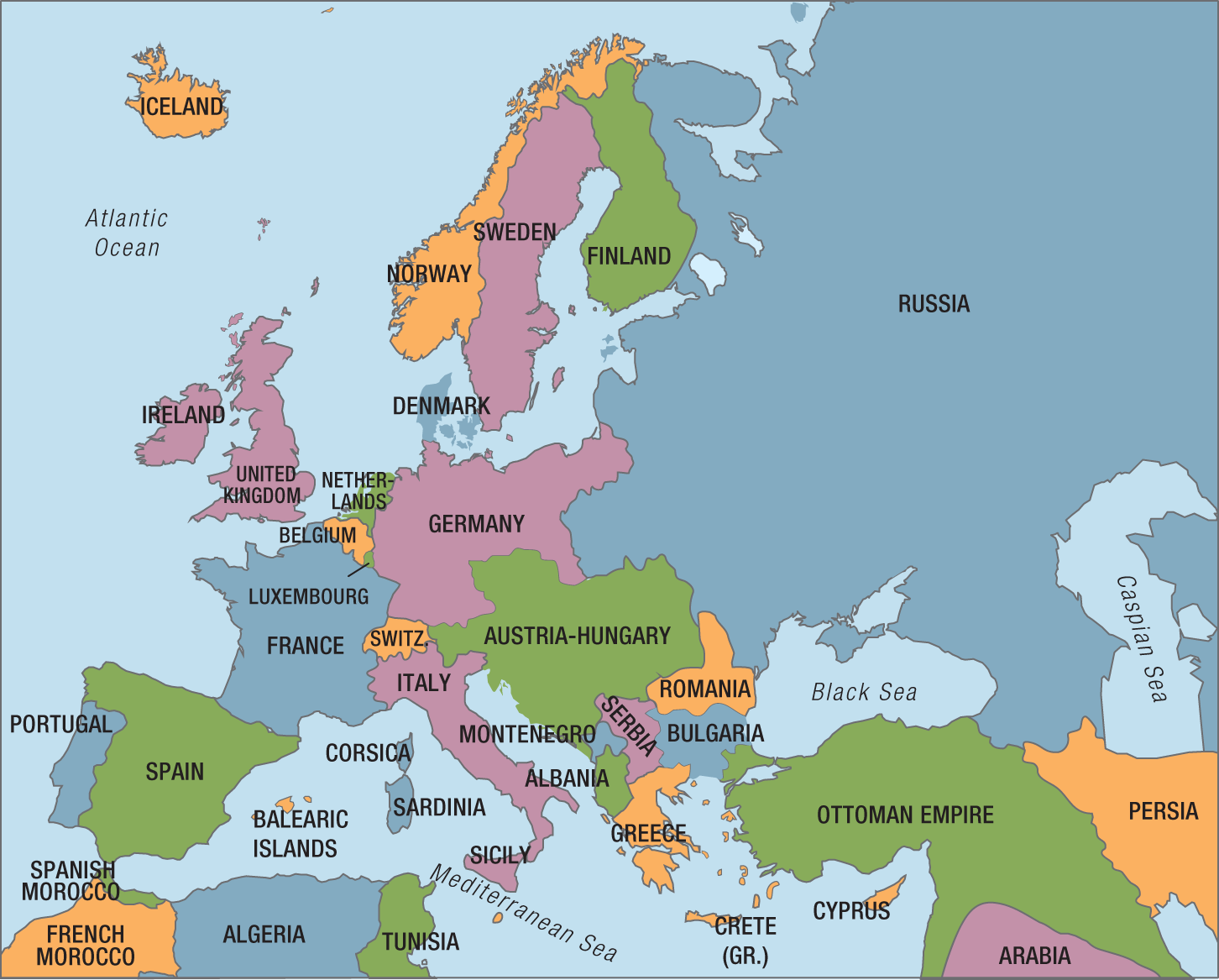

 Answer
 Answer: a