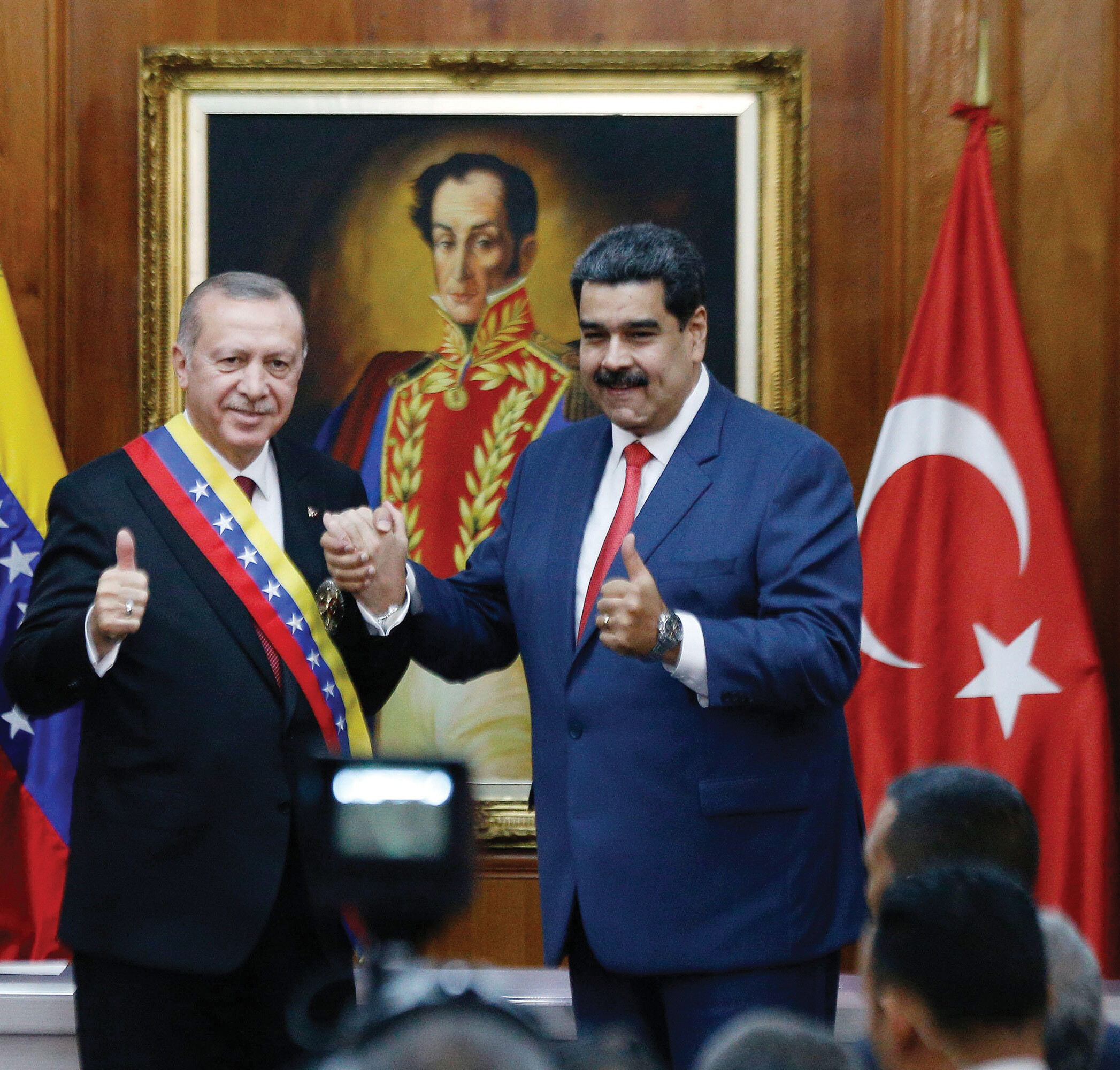
Turkish president Recep Tayyip Erdoğan (left) has voiced support for Nicolás Maduro (right), the disputed leader of Venezuela, despite historical alliances with countries like the United States that oppose Maduro’s rule. Why would two countries form a relationship without shared cultural or historical ties?
In January 2019, in defiance of Venezuela’s leader Nicolás Maduro’s repressive rule, more than 50 states including the United States recognized the leader of the opposition party, Juan Guaidó, as interim president of Venezuela. However, Turkey’s president, Recep Tayyip Erdoğan, voiced public support for Maduro as Venezuela’s legitimate president. Turkey has become the cornerstone of Venezuela’s gold trade, providing Venezuela much-needed revenue in the face of the comprehensive sanctions the United States has placed on it. But Turkey’s support for Maduro is puzzling given that Turkey shares membership with the United States in NATO, and Turkey’s support for Maduro is increasing tensions with Washington. Moreover, Turkey does not share historical or cultural ties with Venezuela. So why is Turkey pursuing this strategy of support for Maduro?
Some international relations scholars argue that this is an “alliance of convenience.”1 U.S.-Turkey relations had been deteriorating for a while, particularly following the 2016 coup attempt in Turkey and U.S. refusal to extradite the person considered responsible. As its relationship with Washington has worsened, Turkey has worked to position itself as an anti-imperialist actor that challenges U.S. policies against the countries it “oppresses.” A policy of allying with anti-American regimes such as Maduro’s helps to solidify its power position vis-à-vis the United States. Other scholars point to the domestic situation in Turkey. Turkish businesses have a strong interest in gaining access to Latin American markets, and Erdoğan is working to appease those interests by negotiating favorable investment and venture contracts in Venezuela. Still others point to the importance of the shared identity between Erdoğan and Maduro. Both share an anti-West sentiment and share common ground on questions revolving around independence, nonintervention in other states’ affairs, and democracy (both practice authoritarian-style rule).
So what explains Turkey’s support for Maduro in Venezuela? Is it Turkey’s desire to stand up against the United States? Are domestic politics at work? Is it a question of similar identities? Or are state efforts trying to help businesses expand? The facts are the same, but the explanations differ widely. Which one is right? Can several be right? In this chapter, we seek to answer these types of questions by better understanding the different perspectives that various scholars use to approach the explanation of international politics.
LEARNING OBJECTIVES
Explain the value of studying international relations from a theoretical perspective.
Explain the central tenets of realism, liberalism, constructivism, and radicalism, as well as the feminist critiques of them.
Analyze contemporary international events using different theoretical perspectives.
Endnotes
Imdat Oner, “Turkey and Venezuela: An Alliance of Convenience,” Wilson Center, March 2020, www.wilsoncenter.org/sites/default/files/media/uploads/documents/LAP_200317_ven%20turkey_v2%20%281%29.pdf (accessed 1/5/21). Return to reference 1