PROFESSORWAYNEBOOTH made this statement at a conference of scholars and teachers of writing held only months after the 9/11 attacks on the United States, and it quickly drew a range of responses. Just what did Booth mean by this stark statement? How could rhetoric—the art and practice of persuasion—act as a counter to war?
A noted critic and scholar, Booth explored these questions throughout his career, identifying rhetoric as an ethical art that begins with intense listening and that searches for mutual understanding and common ground as alternatives to violence and war. Put another way, two of the most potent tools we have for persuasion are language—and violence: when words fail us, violence often wins the day. It is language and rhetoric that provide the basis of negotiation, debate, and compromise—acts that de-escalate the kinds of confrontations that lead to divisiveness, separation, and, yes, violence. Booth sees the careful and ethical use of language as our best approach to keeping violence and war at bay.
Consider how Booth’s words resonate in light of the January 6, 2021, storming of the United States Capitol that led to injuries, deaths, and ultimately the arrest of hundreds of participants. Globally, think about how Booth’s words speak to the Russian war on Ukraine—ongoing as this book goes to print—which has led to the destruction of entire cities, and to the deaths and harm of innocent civilians trying to flee to safety. How could the careful and ethical use of rhetoric by all stakeholders have affected these events?
More information
The faces of George Floyd, Breonna Taylor, Trayvon Martin, and Ahmaud Arbery painted on the outside of a building in black and white, surrounded by blue flowers and set against a background of less detailed pink, turquoise, and blue leaves. Each face is backed by a painted, halo-like circle - Floyd’s is peach, Breonna’s is turquoise, Martin’s is light blue, and Arbery’s is yellow and orange.
A group of five people on a sidewalk participating in a protest and holding homeade signs. One person holds an American flag. The person all the way to the right is out of frame except for their hands, in which they are holding a sign that reads, “it’s MY CHOICE!” From left to right, the other signs read, “We don’t need no vaccination! I call my shots!” “UNMASK OUR KIDS!” “BUSINESS OWNERS SAY NO” and “HEALTHCARE WORKERS AGAINST MANDATES.”
A mural honoring George Floyd, Breonna Taylor, Trayvon Martin, and Ahmaud Arbery, painted on a barbershop in Tampa, Florida (left). People protest COVID-19 policies using homemade signs (right).
We didn’t burn down buildings. . . . You can do a lot with a pen and pad.
—ICE CUBE
In many countries, including the United States, protests are effective ways of making our views known to a wider audience. Organized marchers raise their voices against or for changes in voting rights legislation, controversial topics taught in schools, and the results of an election. Mural artists celebrate the lives of Breonna Taylor, George Floyd, and others. Concerned citizens publish opinion pieces on COVID-19 policies in their local newspapers. People on social media use hashtags to amplify causes—from #prolife and #plasticfree to #metoo and #blacklivesmatter. All of these are examples of rhetoric in action.
Note that while Booth speaks of rhetoric as an “ethical art,” rhetoric can also be used for unethical purposes, as Hitler and other dictators have done; in fact, rhetoric used in unethical ways can itself lead to violence. That’s why Aristotle cautioned that people need to understand rhetoric—both to get their own ethical messages across and to be able to recognize and resist unethical messages that others attempt to use against them. We take Aristotle’s point and focus in this book on how to think rhetorically both as readers and as writers. In addition, we define rhetoric as the art, theory, and practice of ethical communication—the ethical language use that Booth speaks of.
So how can you go about developing your own careful, ethical use of language? Our short answer: by learning to think and act rhetorically, that is, by developing habits of mind that begin with listening and searching for understanding before you decide what you yourself think, and by thinking hard about your own beliefs before trying to persuade others to listen to and act on what you say.
More information
The student leans on the windowsill and looks at two other students outside the building. A policeman stands beside the students. One of the posters stuck on the campus wall reads, “Living Wage Now.”
Students use posters and conversation to protest the low wages paid to campus workers.
REFLECT & WRITE.Why is it important in your career field to use language carefully and ethically? Use the NOTETAKING TOOL in this ebook to write a brief paragraph explaining how language might be used carelessly in your line of work and what the consequences of that carelessness might be.
Learning to think rhetorically can serve you well as you negotiate the complexities of life today. For example, many of us have engaged with classmates or colleagues who hold different opinions about COVID-19 vaccines. In spite of such disagreements, we aim to communicate well enough to get things done in a responsible and ethical way. In other words, we need to come to some consensus that moves us forward toward completing a project—and maybe even saving a relationship—despite differing views.
When a group of students became aware of how little the temporary workers on their campus were paid, for example, they met with the workers and listened to gather information about the issue. They then mounted a campaign using flyers, speeches, and sit-ins—in other words, using the available means of persuasion—to win attention and convince the administration to raise the workers’ pay. These students were thinking and acting rhetorically, and doing so responsibly and ethically. Note that these students worked together, both with the workers and with each other. In other words, none of us can manage such actions all by ourselves; we need to engage in conversation with others and listen hard to what they say. Perhaps that’s what philosopher Kenneth Burke had in mind when he created his famous “parlor” metaphor:
Imagine that you enter a parlor. You come late. When you arrive, others have long preceded you, and they are engaged in a heated discussion, a discussion too heated for them to pause and tell you exactly what it is about. . . . You listen for a while, until you decide that you have caught the tenor of the argument; then you put in your oar.
—KENNETH BURKE, The Philosophy of Literary Form
In this parable, each of us is the person arriving late to a room full of animated conversation; we don’t understand what is going on. Yet instead of butting in or trying to take over, we listen closely until we catch on to what people are saying. Then we join in, using language and rhetorical strategies to engage with others as we add our own voices to the conversation.
This book aims to teach you to think and act rhetorically—to listen carefully and respectfully and then to “put in your oar,” join conversations about important issues, and develop strong critical and ethical habits of mind that will help you engage with others in responsible ways. This chapter will help you develop the habit of thinking rhetorically.
VIDEO: Thinking Rhetorically
First, Listen
Thinking rhetorically begins with listening, with being willing to hear the words of others in an open and understanding way. It means paying attention to what others say before—and even as a way of—making your own contributions to a conversation. Think of the times you are grateful to others for listening closely to you: when you’re talking through a conflict with a family member, for instance, or even when you’re trying to explain to a salesperson what you’re looking for. On those occasions, you want the person you’re addressing to really listen to what you say.
We have two ears and one mouth so we may listen more and talk less.
—EPICTETUS
This is a kind of listening that rhetorician Krista Ratcliffe dubs “rhetorical listening,” opening yourself to the thoughts of others and making the effort not only to hear their words but also to take those words in and fully understand what people are saying. It means paying attention to what others say as a way of establishing good will and acknowledging the importance of their views. And yes, it means taking seriously and engaging with views that differ, sometimes radically, from your own.
Rhetorical listening is what middle school teacher Julia Blount asked for in a Facebook post following the 2015 uprisings in Baltimore after the death of Freddie Gray, who suffered fatal spinal injuries while in police custody:
Every comment or post I have read today voicing some version of disdain for the people of Baltimore—“I can’t understand” or “They’re destroying their own community”—tells me that many of you are not listening. I am not asking you to condone or agree with violence. I just need you to listen. . . . If you are not listening, not exposing yourself to unfamiliar perspectives . . . not engaging in conversation, then you are perpetuating white privilege. . . . It is exactly your ability to not hear, to ignore the situation, that is a mark of your privilege.
—JULIA BLOUNT, “Dear White Facebook Friends: I Need You to Respect What Black America Is Feeling Right Now”
Hear What Others Are Saying—and Think about Why
When you enter any conversation, whether academic, professional, or personal, take the time to understand what is being said rather than rushing to a conclusion or a judgment. Listen carefully to what others are saying and consider what motivates them: where are they coming from?
Developing such habits of mind will be useful to you almost every day, whether you are participating in a class discussion, negotiating with friends over what movie is most worth watching, or studying a local ballot issue to decide how you’ll vote. In each case, thinking rhetorically means being flexible and fair, able to hear and consider varying—and sometimes conflicting—points of view.
In ancient Rome, Cicero argued that considering alternative points of view and counterarguments was key to making a successful argument, and it is just as important today. Even when you disagree with a point of view—perhaps especially when you disagree with it—allow yourself to see the issue from the viewpoint of its advocates before you reject their positions. While you may be frustrated with family members who did or did not get a COVID-19 vaccine, don’t dismiss their views out of hand. Listen to their concerns, try to understand their fears. Think about their perspective and how you might carefully respond.
Thinking hard about others’ views also includes considering the larger context and how it shapes what they are saying. This aspect of rhetorical thinking goes beyond the kind of reading you probably learned to do in high school literature classes, where you looked very closely at a particular text and interpreted it on its own terms, without looking at secondary sources. When you think rhetorically, you go one step further and put that close analysis into a larger context—historical, political, or cultural, for example—to recognize and consider where the analysis is “coming from.”
In analyzing the issue of gun control, for instance, you would not merely consider your own thinking or do a close reading of texts that address the issue. In addition to these strategies, you would look at the whole debate in context by considering its historical development over time, thinking about the broader political agendas of both those who advocate for and those who oppose stricter gun control, asking what economic ramifications adopting—or rejecting—new gun restrictions might have, examining the role of constitutional rights in the debate, and so on. In short, you would try to see the issue from as many different perspectives and in as broad a context as possible before you formulate your own stance. When you write, you draw on these sources—what others have said about the issue—to support your own position and to help you consider counterarguments to it.
REFLECT & WRITE.Go to everyonesanauthor.tumblr.com and read “The ‘Other Side’ Is Not Dumb” by blogger Sean Blanda, who warns that many of us gravitate on social media to those who think like we do, which often leads to the belief that we are right and that those with other worldviews are “dumb.” He argues that we need to “make an honest effort to understand those who are not like us” and to remember that “we might be wrong.” Look at some of your own recent posts. How many different perspectives do you see represented? What might you do to listen—and think—more rhetorically? Use the NOTETAKING TOOL in this ebook to record your responses to these questions.
What Do You Think—and Why?
Examining all points of view on any issue will engage you in some tough thinking about your own stance—literally, where you are coming from on an issue—and why you think as you do. Such self-scrutiny can eventually clarify your stance or perhaps even change your mind; in either case, you stand to gain. Just as you need to think hard about the motivations of others, it’s important to examine your own motivations in detail, asking yourself what influences in your life lead you to think as you do or to take certain positions. Then you can reconsider your positions and reflect on how they relate to those of others, including your audience—those you wish to engage respectfully in conversation or debate.
In your college assignments, you probably have multiple motivations and purposes, one of which is to convince your instructor that you are a serious and hardworking student. But think about additional purposes as well: What could you learn from doing the assignment? How can doing it help you attain goals you have?
Examining your own stance and motivation is equally important outside the classroom. Suppose you are urging fellow members of a campus group to lobby for a rigorous set of procedures to deal with accusations of sexual harassment. On one level, you’re alarmed by the statistics showing a steep increase in cases of rape on college campuses and you want to do something about it. But when you think a bit more, you might find that you have additional motivations. Perhaps you’ve long wanted to become a leader of this group. You may have just seen The Hunting Ground, a documentary about rape on US college campuses, and found it deeply upsetting—and persuasive. These realizations shouldn’t necessarily change your mind about what action you want your group to take, but examining what you think and why will help you to challenge your own position—and to make sure that it is fair.
Do Your Homework
Rhetorical thinking calls on you to do some homework, to find out everything you can about what’s been said about your topic, to ANALYZE what you find, and then to SYNTHESIZE that information to inform your own ideas. To put it another way, you want your own thinking to be aware and deeply informed, to reflect more than just your own opinion.
Maybe you’ve heard about dramatic school board meetings where parents and school board members yell at one another about critical race theory (CRT) being taught in K–12 schools. You’ve seen local and state politicians on television arguing about whether CRT should be banned. You’ve seen headlines about principals and teachers being fired. Rather than immediately taking a position on whether critical race theory is dangerous to young people, rhetorical thinking moves you to do some careful research to find out more about the topic—and about why you want to know more. Do you have a sibling in school whose learning could be affected? Are you thinking about becoming a teacher? Maybe you are simply concerned about the nastiness of the debate in your community or state.
More information
Against a blurry background of snow-covered land, bare trees, and a road, a sign reads, “WELCOME TO THE CENTER OF THE USA” in a black military stencil style font. “USA” is written in red and blue. Below these words is an outline of the United States with a circle marking its center. Below the outline, the sign reads “LEBANON HAS SOUVENIRS” in the same black font as above, but smaller.
THINK BEYOND WORDS
TAKE A LOOK at the Jeep ad from the 2021 Super Bowl at everyonesanauthor.tumblr.com. You’ll see scenes of rural America and hear the voice of musician Bruce Springsteen, who says, “It’s no secret the middle has been a hard place to get to lately, between red and blue, between servant and citizen, between our freedom and our fear. . . . We just have to remember the very soil we stand on is common ground.” What kind of rhetorical thinking did the ad writers do? Who was their target audience, and how did they go about appealing to that group? How successful do you think this was as an ad? In other words, do you think it sold a lot of cars? If you were looking to buy a car, what would this ad tell you about Jeeps—and what would you have to find out from other sources?
So you get to work to find out just what critical race theory is. How did this theory emerge, and who are the theorists behind it? What were the historical, social, academic, and political contexts surrounding it? You’ll likely find out that it originated in legal studies at the university level, so then you check out writing by the original theorists as well as responses to those people and ideas over the decades. Your research will probably lead you to learn how and where CRT has been used, and by whom. Only after exploring such questions and understanding the rhetorical situation can you responsibly engage with the arguments on opposing sides of the issue. Who are the stakeholders on each side? How do stakeholders’ arguments hold up when fact-checked? Are there stakeholders who have not been heard?
This kind of rhetorical thinking prompts you to pay attention to the rhetorical strategies and appeals writers and speakers use to persuade. What kind of tone are they using? Are they using inclusive language? Are their examples factual? Are they relying on credible sources or unsubstantiated claims? Once you’ve read, synthesized, and analyzed all the material you’ve gathered, you may even talk with a classmate or friend, someone who will be a sounding board and ask tough but fair questions, as you figure out what you think. Then you will be ready to offer a well-informed opinion and to judge others’ perspectives. Doing this kind of research is an example of rhetorical thinking.
Rhetorical thinking is not meant just for such weighty topics as critical race theory. In your everyday life, you make decisions that require rhetorical thinking: buying a new computer, making a decision about a job, choosing a major, considering graduate school. Each of these decisions calls on you to do your homework, to do research, to be open-minded, and to engage in careful and ethical thinking. You want to be well informed to make the best decisions and to take thoughtful positions.
REFLECT & WRITE.Using the NOTETAKING TOOL in this ebook, make a list of a few times you have had to “do your homework” before making a decision. What kind of information did you have to gather and why?
Give Credit
As part of engaging with what others have thought and said, you’ll want to give credit where credit is due. Acknowledging the work of others will help build your own ethos, or character, showing that you have not only done your homework but also that you want to credit those who have influenced you. The great physicist Isaac Newton famously and graciously gave credit when he wrote to his rival Robert Hooke in 1676, saying:
What Descartes did was a good step. You have added much in several ways, and especially in taking the colours of thin plates into philosophical consideration. If I have seen a little further it is by standing on the shoulders of giants. —ISAAC NEWTON, letter to Robert Hooke
In this letter, Newton acknowledges the work of Descartes as well as of Hooke before saying, with a fair amount of modesty, that his own advancements were made possible by their work. In doing so, he is thinking—and acting—rhetorically.
You can give credit informally, as Newton did in this letter, or you can do so formally with a full citation. Which method you choose will depend on your purpose and context. Academic writing, for instance, usually calls for formal citations, but if you are writing for a personal blog, you might embed a link that connects to another’s work—or give an informal shout-out to a friend who contributed to your thinking. In each case, you’ll want to be specific about what ideas or words you’ve drawn from others, as Newton does in referring to Hooke’s consideration of the colors of thin plates. Such care in crediting your sources contributes to your credibility—and is an important part of ethical, careful rhetorical thinking.
REFLECT & WRITE.HIGHLIGHTat least three instances in this chapter where the authors give credit to others. How does each instance affect the way you read and understand the chapter?
Be Imaginative
Remember that intuition and imagination can often lead to great insights. While you want to think carefully and analytically, don’t be afraid to take chances. A little imagination can lead you to new ideas about a topic you’re studying and suggest how to approach it in a way that will interest others. Such insights and intuitions can often pay off big-time. Nova Thrasher, a writing tutor in training, opened their final project on gender inclusivity and pronoun usage in college writing centers with this personal reflection:
I wait for introductions with bated breath, hoping for and dreading what comes in the split second after “Tell everyone your name—” . . . Time drags on, suspense building in the space between exhale and inhale . . . “—and pronouns. We’ll go around the room . . .” and exhale. The question has been asked, and I am theoretically safe in this room.
—NOVA THRASHER, “Gender-Inclusivity and the Onus of Progress on the Writing Center”
This personal experience led Nova to examine writing center websites for statements on using inclusive pronouns. Before they knew it, Nova had a full-fledged research project that analyzed thirty college writing center websites, discussed writing center scholarship, and covered current debates about gender. Nova found that less than half of the thirty writing center websites addressed gender inclusive pronouns. Interested in becoming a tutor who will make the writing center safe and inviting for all, Nova conducted extremely valuable research. Like this student, you can benefit by using your imagination, reflecting on your own experiences, and listening to your intuition. You may discover something exciting and meaningful.
Put In Your Oar
So rhetorical thinking offers a way of entering any situation with a tool kit of strategies that will help you understand it and “put in your oar.” When you think rhetorically, you ask yourself certain questions:
How do you want to come across to your audience?
What can you do to represent yourself as knowledgeable and credible?
What can you do to show respect both for your audience and for those whose work and thinking you engage with?
How can you show that you have your audience’s best interests at heart?
This kind of rhetorical thinking will help ensure that your words will be listened to and taken seriously.
We can find examples of such a rhetorical approach in all fields of study. Take, for instance, the landmark essay by James Watson and Francis Crick deciphering the structure of DNA, published in Nature in 1953. This essay shows Watson and Crick to be thinking rhetorically throughout, acutely aware of their audience (major scientists throughout the world), including competitors who were simultaneously working on the same issue.
Here is Wayne Booth’s analysis of Watson and Crick’s use of rhetoric:
In [Watson and Crick’s] report, what do we find? Actually scores of rhetorical choices that they made to strengthen the appeal of their scientific claim. (Biographies and autobiographies have by now revealed that they did a lot of conscientious revising, not of the data but of the mode of presentation; and their lives were filled, before and after the triumph, with a great deal of rhetoric-charged conflict.) We could easily compose a dozen different versions of their report, all proclaiming the same scientific results. But most alternatives would prove less engaging to the intended audience. They open, for example, with
“We wish to suggest a structure” that has “novel features which are of considerable biological interest.” (My italics, of course)
Why didn’t they say, instead: “We shall here demonstrate a startling, totally new structure that will shatter everyone’s conception of the biological world”? Well, obviously their rhetorical choice presents an ethos much more attractive to most cautious readers than does my exaggerated alternative. A bit later they say
More information
The structure consists of two stands coiled together around a vertical line. Four horizontal lines appear in the spaces between the two strands. Two arrows, one beside each strand, point in opposite directions.
The original sketch showing the structure of DNA that appeared in Watson and Crick’s article.
“We have made the usual chemical assumptions, namely . . .”
Why didn’t they say, “As we all know”? Both expressions acknowledge reliance on warrants, commonplaces within a given rhetorical domain. But their version sounds more thoughtful and authoritative, especially with the word “chemical.” Referring to Pauling and Corey, they say
“They kindly have made their manuscript available.”
Okay, guys, drop the rhetoric and just cut that word “kindly.” What has that got to do with your scientific case? Well, it obviously strengthens the authors’ ethos: we are nice guys dealing trustfully with other nice guys, in a rhetorical community.
And on they go, with “In our opinion” (rather than “We proclaim” or “We insist” or “We have miraculously discovered”: again ethos—we’re not dogmatic); and Fraser’s “suggested” structure is “rather ill-defined” (rather than “his structure is stupid” or “obviously faulty”—we are nice guys, right?).
And on to scores of other such choices.
—WAYNE BOOTH, The Rhetoric of Rhetoric
Booth shows in each instance that Watson and Crick’s exquisite understanding of their rhetorical situation—especially of their audience and of the stakes involved in making their claim—had a great deal to do with how that claim was received. (They won the Nobel Prize!) However, Watson and Crick could have done better when it came to giving credit: scholars have pointed out that the work of Rosalind Franklin, a contemporary female scientist, greatly influenced Watson and Crick’s discovery, though they did not sufficiently acknowledge or credit her.
As the example of Watson and Crick illustrates, rhetorical thinking involves certain habits of mind that can and should lead to something—often to an action, to making something happen. And when it comes to taking action, those who think rhetorically are in a very strong position. They have listened attentively, engaged with the words and ideas of others, viewed their topic from many alternate perspectives, and done their homework. This kind of rhetorical thinking will set you up to contribute to conversations—and will increase the likelihood that your ideas will be heard and will inspire real action.
The need to think rhetorically has never been more important than in today’s global world. Rhetorician Jacqueline Jones Royster provides a clear guide to engaging in rhetorical thinking and acting:
My experiences tell me that we need to do more than just talk and talk back. I believe that in this model we miss a critical moment. We need to talk, yes, and to talk back, yes, but when do we listen? How do we listen? How do we demonstrate that we honor and respect the person talking and what that person is saying, or what the person might say if we valued someone other than ourselves having a turn to speak? How do we translate listening into language and action, into the creation of an appropriate response? How do we really “talk back” rather than talk also? The goal is not, “You talk, I talk.” The goal is better practices so that we can exchange perspectives, negotiate meaning, and create understanding with the intent of being in a good position to cooperate, when, like now, cooperation is absolutely necessary.
—JACQUELINE JONES ROYSTER, “When the First Voice You Hear Is Not Your Own”
In the long run, if enough of us learn to think rhetorically, we just might achieve Royster’s goals “to exchange perspectives, negotiate meaning, and create understanding” and avoid the violence and war, literal and figurative, that Booth speaks of.
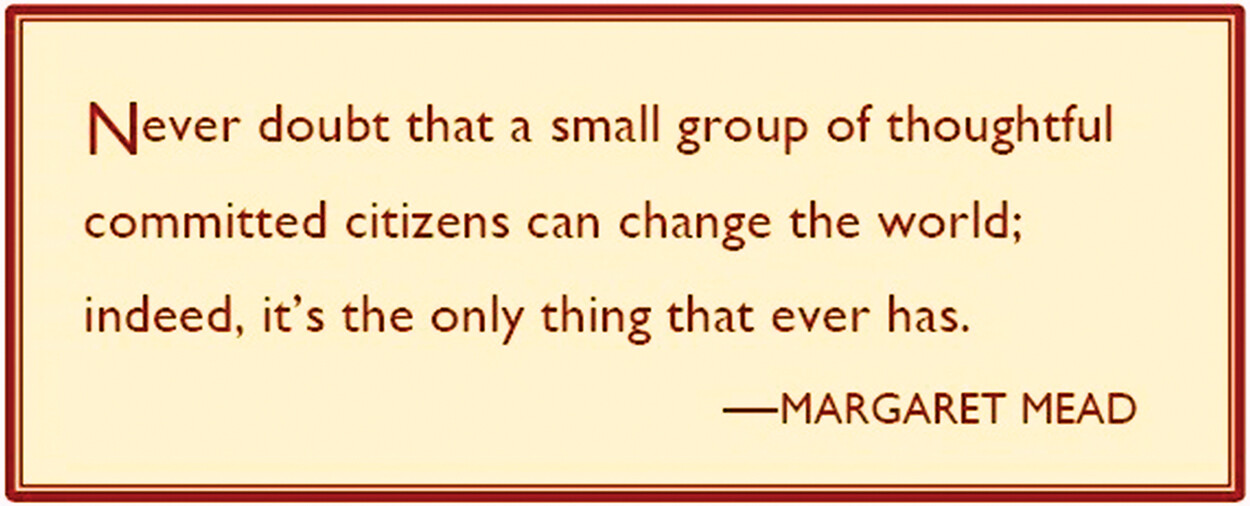
REFLECT & WRITE.Read the words often attributed to cultural anthropologist Margaret Mead below, and then think of at least one historical example in which a “small group of thoughtful citizens” has changed the world for the better. Then think about your own life and the ways in which you have worked with others to bring about some kind of change. Use the NOTETAKING TOOL in this ebook to write a few sentences reflecting on the ways you were called upon to think and act rhetorically in order to effect that change.
More information
The quote reads as follows: “Never doubt that a small group of thoughtful committed citizens can change the world; indeed, it’s only thing that ever has.”
A GENRE that breaks something down into its component parts so that those parts can be thought about methodically in order to understand the whole. Features: a question that prompts a closer look • some DESCRIPTION of the subject • EVIDENCE drawn from close examination of the subject • insight gained from your analysis • clear, precise language.
In the Norton Ebook Reader, select some text with your cursor or finger to open the annotation tools for highlighting and taking notes. These tools may function differently on other ebook platforms.
In the Norton Ebook Reader, select some text with your cursor or finger to open the annotation tools for highlighting and taking notes. These tools may function differently on other ebook platforms.
In the Norton Ebook Reader, select some text with your cursor or finger to open the annotation tools for highlighting and taking notes. These tools may function differently on other ebook platforms.
In the Norton Ebook Reader, select some text with your cursor or finger to open the annotation tools for highlighting and taking notes. These tools may function differently on other ebook platforms.
In the Norton Ebook Reader, select some text with your cursor or finger to open the annotation tools for highlighting and taking notes. These tools may function differently on other ebook platforms.
 VIDEO: Thinking Rhetorically
 PROFESSOR WAYNE BOOTH made this statement at a conference of scholars and teachers of writing held only months after the 9/11 attacks on the United States, and it quickly drew a range of responses. Just what did Booth mean by this stark statement? How could rhetoric—the art and practice of persuasion—act as a counter to war?

 REFLECT & WRITE. Why is it important in your career field to use language carefully and ethically? Use the NOTETAKING TOOL in this ebook to write a brief paragraph explaining how language might be used carelessly in your line of work and what the consequences of that carelessness might be.
 TAKE A LOOK at the Jeep ad from the 2021 Super Bowl at everyonesanauthor.tumblr.com. You’ll see scenes of rural America and hear the voice of musician Bruce Springsteen, who says, “It’s no secret the middle has been a hard place to get to lately, between red and blue, between servant and citizen, between our freedom and our fear. . . . We just have to remember the very soil we stand on is common ground.” What kind of rhetorical thinking did the ad writers do? Who was their target audience, and how did they go about appealing to that group? How successful do you think this was as an ad? In other words, do you think it sold a lot of cars? If you were looking to buy a car, what would this ad tell you about Jeeps—and what would you have to find out from other sources?