FIFTEEN“Let’s Take a Closer Look“
Writing Analytically
 REFLECT & WRITE. This chapter provides guidelines for writing analytically. Before you jump in, use the NOTETAKING TOOL in this ebook to quickly note why you’re reading this chapter. How do you expect to use this advice? What do you hope to learn?
 ANALYSIS IS A NECESSARY STEP in much of the thinking that we do, and something that we do every day. What should you wear today? T-shirt and flip-flops? A sweatshirt? Your new red sweater? You consider the weather forecast, what you will be doing, the people you will be with, and then decide based on those factors. You may not consciously think of it as analysis, but that’s what you’ve done.
When you analyze something, you break it down into its component parts and think about those parts methodically in order to understand it. Since our world is awash in information, the ability to read it closely, examine it critically, and decide how—or whether—to accept or act on it is essential. To navigate this sea of information, we rely on our ability to analyze.
Case in point: you want new headphones, but how do you choose? Do you want earbuds? over-the-ear? noise canceling? Bluetooth? As you consider your options, focus your analysis with questions: What’s most important to you—sound quality? comfort? price? look? When will you most often be wearing your headphones—at the gym? on your daily bus commute? while playing video games? You could ask your music-loving friends for their opinions, or you might check websites, like RTINGS.com, that provide expert analysis as well as price comparisons. Analyzing your options will enable you to understand what each offers and decide based on your goals.
You’ve probably analyzed literary texts in English classes. In many college classes, you’ll be expected to conduct different kinds of analyses—of texts, and also of events, issues, arguments, and more. Analysis is critical to every academic discipline and useful in every professional field. This chapter provides guidelines for conducting an analysis and writing analytically, with specific advice for rhetorical, causal, discourse, process, data, and visual analysis.
REFLECT & WRITE. Stop for a moment and use the NOTETAKING TOOL in this ebook to consider how many decisions—large and small—you have made in the last week, in the last month, and in the last year. From small (what to have for breakfast) to major (which college to attend), list a sample of these decisions and what areas of your life they affected. Then note the information you gathered in each case before you came to a final decision. What do these notes tell you about your interests, activities, and priorities? You’ve just completed an analysis.
Across Academic Disciplines
Some form of analysis can be found in every academic discipline. In a history class, you may be asked to analyze the causes of the US Civil War. In biology, you might analyze how the body responds to exercise. In economics, you might analyze the trade-off between unemployment and inflation rates. In a technical communication course, you might analyze a corporate website. In your composition course, you’ll analyze your own writing for many purposes, from thinking about how you’ve appealed to your audience to deciding how you need to revise a draft. So many courses require analysis because looking closely and methodically at something—a text, a process, a philosophy—helps you discover connections between ideas and think about how things work, what they mean, and why.
Across Media
Your medium affects the way you present your analysis. In print, you’ll be writing mostly in paragraphs, and you might include photos, tables, graphs, diagrams, or other images to make your analysis clear. If you’re making an oral presentation, you might show information on slides or handouts. A digital text allows you to blend words, images, and audio—and you can link to more information elsewhere. In an analysis of Serena Williams’s tennis serve published on TheTennisBros.com, note how the authors use links to videos so readers can see specific moves for themselves. If publishing in print, they might have included an image like the one below.
Whilst Serena is clearly a very complete tennis player, there is one shot in particular that stands out as her most lethal weapon. Her serve. . . . Serena has one of the most powerful serves out there, recording the 3rd fastest ever official serve by a woman at the 2013 Australian Open of 128.6 MPH. . . . Her trophy position is perfect and she is able to generate a lot of easy power using her pinpoint stance. She places her weight on her front foot as she steps up to serve behind the baseline, then rocks back on to her back foot to create more momentum before she brings both feet together and drives up into her serving motion.

More information
Williams looks up at the tennis ball, which is mid-air above her out-stretched arm and open hand. She holds her racket in her other hand and prepares to swing this arm up to hit the ball. Williams wears a mint green althetic outfit.
More information
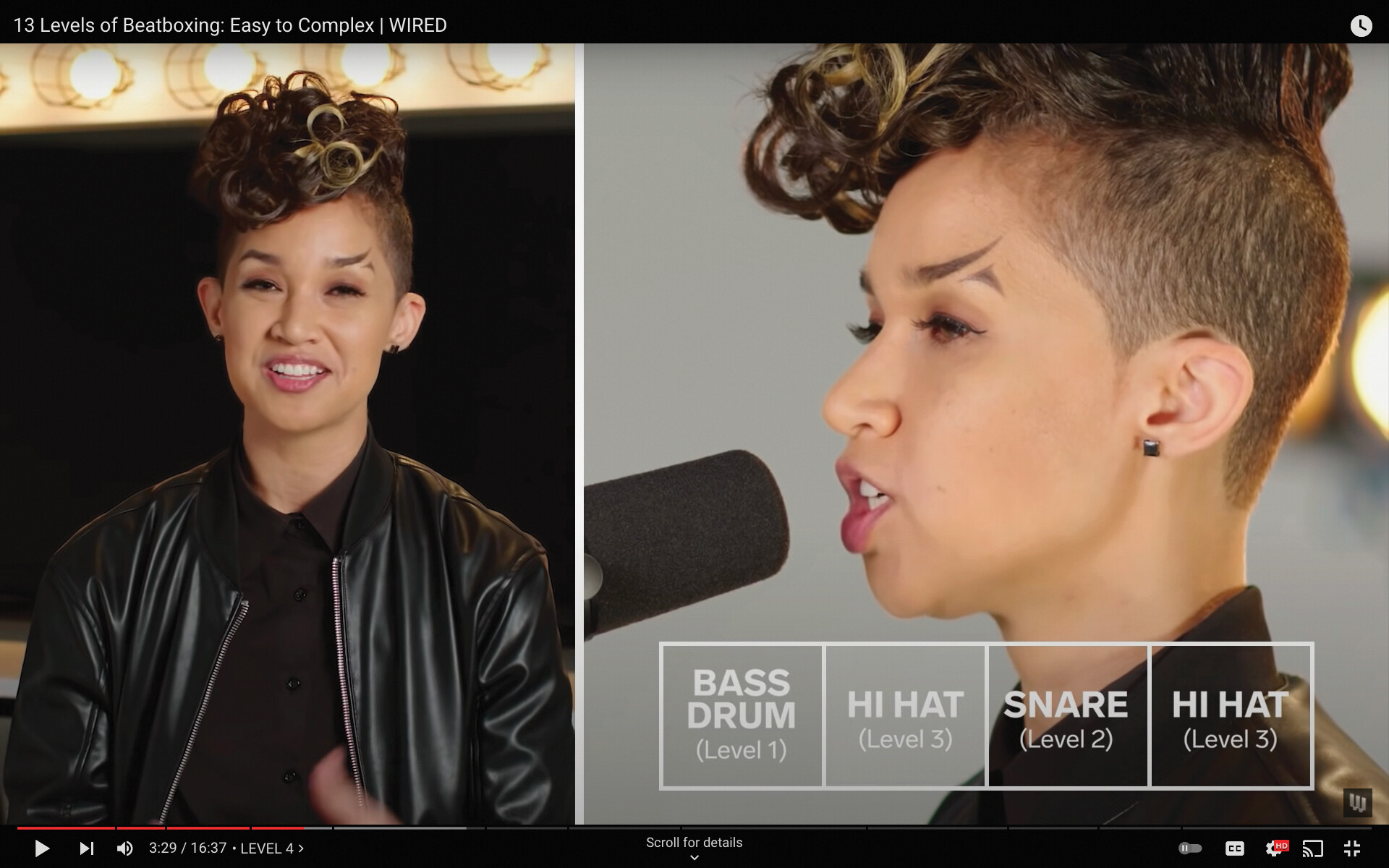
A paused YouTube video titled “13 Levels of Beatboxing: Easy to Complex | WIRED” showing a split screen. The video is paused on Level 4. On the left, Butterscotch is speaking to the camera. On the right, Butterscotch is in profile beatboxing into a microphone. On the right screen, a graphic made up of four boxes is displayed over the video. From left to right, the text in each box says: “BASS DRUM (Level 1),” “HI HAT (Level 3),” “SNARE (Level 2),” and “HI HAT (Level 3).”
THINK BEYOND WORDS
 WATCH THE VIDEO of 2005 Female Beatbox Battle World Champion Antoinette Clinton, who goes by the stage name Butterscotch, defining and explaining beatboxing in thirteen levels of complexity. Her video pairs verbal explanation with visual and auditory demonstrations for the moves of each “instrument” she’s mimicking. How do the visuals and sounds contribute to this analysis? Go to everyonesanauthor.tumblr.com to watch the video.
Across Cultures and Communities
Communicating with people from other communities or cultures challenges us to examine our assumptions and think about our usual ways of operating. Analyzing and understanding beliefs, assumptions, and practices that we are not familiar with may take extra effort. We need to be careful not to look at things only through our own frames of reference.
Sheikh Jamal Rahman, Pastor Don Mackenzie, and Rabbi Ted Falcon put in this extra effort in writing their book, Getting to the Heart of Interfaith: The Eye-Opening, Hope-Filled Friendship of a Pastor, a Rabbi and a Sheikh. In this book they take on the challenge of working toward interfaith understanding, saying that religion today “seems to be fueling hatred rather than expanding love” and that in order to heal the divisions, we must “find ways of entering into conversation with those different from us.” And they say that analysis—what they call “inquiring more deeply”—is essential to their ongoing journey toward understanding issues central to each faith.
All three agree that it is critical to discuss the difficult and contentious ideas in faith. For the minister, one “untruth” is that “Christianity is the only way to God.” For the rabbi, it is the notion of Jews as “the chosen people.” And for the sheikh, it is the “sword verses” in the Koran, like “kill the unbeliever,” which when taken out of context cause misunderstanding.
Their book embodies cultural sensitivity and describes the process of practicing analysis that’s respectful of difference. Reading a sentence that the sheikh had written about the security wall in Israel, the rabbi responded, “If that line is in the book, I’m not in the book.” Then they analyzed and discussed the sentence, and Sheikh Rahman revised the wording to be “respectful of [both] their principles.”
Having respect for the principles, values, and beliefs of others means recognizing and being sensitive to differences among cultures. The best way to demonstrate cultural sensitivity is to use precise language that avoids negative words or stereotypes about gender, religion, race, ethnicity, and such—in short, by carefully selecting the words you use.
Across Genres
Seldom does any piece of writing consist solely of one genre; in many cases, writers draw on multiple genres as the situation demands. Analysis is a crucial step in writing for many purposes. To ARGUE A POSITION on an issue, you’ll need to analyze that issue before you can take a stand on it. To compose a REPORT, you sometimes have to first analyze the data or the information that the report will be based on. And a REVIEW—whether it’s of a film, a website, a book, or something else—depends on your analyzing the material before you evaluate it. Likewise, you might use a short NARRATIVE as an introductory element in a process or causal analysis.
REFLECT AND WRITE. Look for analysis in everyday use. Find two websites that analyze something you’re interested in—laptops, cell phones, sneakers, places you want to go, or things you want to do. Use the NOTETAKING TOOL in this ebook to study the analyses and write down which one is more useful and why. Use these questions to develop your ideas: What makes it better? Is it the language? The images? The amount of detail? The format? Keep these observations in mind as you write and design your own analyses.
Glossary
- ARGUING A POSITION
- A GENRE that uses REASONS and EVIDENCE to support a CLAIM. Features: an explicit POSITION • a response to what others have said or done • useful background information • a clear indication of why the topic matters • good REASONS and EVIDENCE • attention to more than one POINT OF VIEW • an authoritative TONE and STANCE • an appeal to readers’ values
- REPORT
- A writing GENRE that presents information to inform readers on a subject. Features: a topic carefully focused for a specific AUDIENCE • definitions of key terms • trustworthy information • effective ORGANIZATION and DESIGN • a confident, informative TONE.
- REVIEW
- A writing GENRE that makes a judgment about something—a film, book, product, restaurant, whatever —based on certain CRITERIA. Features: relevant background information about the subject • criteria for the evaluation • a well-supported evaluation • attention to the AUDIENCE’S needs and expectations • an authoritative TONE • awareness of the ethics of reviewing.
- NARRATIVE
- A GENRE that tells a story for the PURPOSE of making a point. Features: a clearly identified event • a clearly described setting • vivid, descriptive details • a consistent POINT OF VIEW • a clear point.
- NOTETAKING TOOL
- In the Norton Ebook Reader, select some text with your cursor or finger to open the annotation tools for highlighting and taking notes. These tools may function differently on other ebook platforms.
- NOTETAKING TOOL
- In the Norton Ebook Reader, select some text with your cursor or finger to open the annotation tools for highlighting and taking notes. These tools may function differently on other ebook platforms.
- NOTETAKING TOOL
- In the Norton Ebook Reader, select some text with your cursor or finger to open the annotation tools for highlighting and taking notes. These tools may function differently on other ebook platforms.