KEYCONCEPT QUESTION
2.1 What does it mean for a hypothesis to be falsifiable?
Throughout recorded history, every human culture has cultivated a set of creation myths that purport to explain—literally or metaphorically—how the world was created and how it came to be the way that it is. Some of these mythologies address universal questions that stimulate the human imagination and gratify our need for explanations of our place in the world. Prior to the sixth or seventh century B.C.E., these creation myths provided the only answers that humankind had to the grand questions of our existence (Armstrong 2005). This approach to knowledge through mythmaking began to change with the early Greek philosophers.
The early Greeks had their own creation myths, but philosophers such as Anaximander (ca. 610–546 B.C.E.) were among the first to develop a philosophy of a natural world in which physical laws replaced supernatural powers. They sought to explain the world around them according to fixed laws of nature, rather than by the operation of divine whim.
At a time when heavenly bodies were often regarded as divine personages, Anaximander provided a mechanistic rather than divine conception of the Moon, Sun, and stars. He suggested that just like the earthly structures we experience with our senses, the celestial bodies were physical objects (Figure 2.1). Earth, he proposed, was a cylindrical disk. The Sun and the Moon rotated around it as if on wagon wheels. Beyond the Sun and the Moon, tiny holes in the firmament let through the light from a vast dome of fire; these pinpoints of light were the stars. Again, it is easy to look back on such ideas and laugh, but that would be a mistake. Anaximander got the details wrong, but given the state of scientific knowledge at the time, this is to be expected. Like Empedocles, Anaximander might have been correct; he just wasn’t. The important thing here is that Anaximander and other Greek philosophers who followed him developed explanations based on natural, rather than supernatural, phenomena.
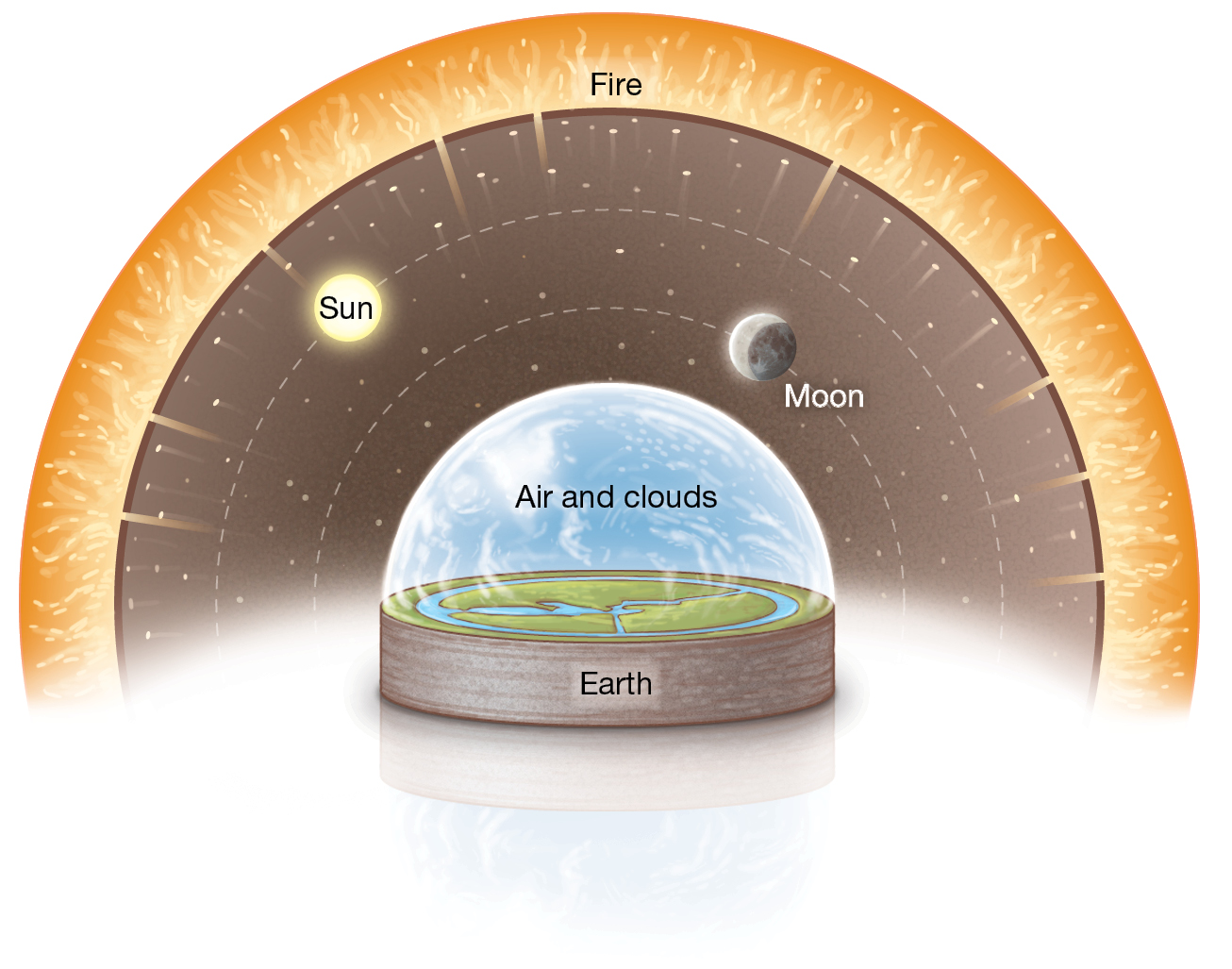
A diagram showing a theory of earth and the cosmos. The Earth is represented by a disc with a bubble of air and clouds on top of it. Outside the air and clouds is the moon in a close orbit and a sun on a farther one. These orbits are drawn in dotted lines and go all the way around the disc shaped Earth. Outside the orbits of the sun and moon is a layer of fire. The stars are represented as cinders from this wall of fire.
The strategy of trying to explain the world based solely on natural phenomena is fundamental to the scientific method and is at the heart of modern evolutionary biology. It is sometimes called methodological naturalism. We call it naturalism because of the focus on the natural rather than the supernatural. We use the adjective methodological because this strategy provides a method or procedure for seeking scientific explanations of the world. Although Western philosophers began using methodological naturalism as early as 600 B.C.E., this approach would not be solidified and universally embraced until the eighteenth century (Barzun 2001).
The development of natural explanations made it possible to pursue a scientific understanding of the world. If we propose an explanation of a phenomenon based on natural processes—that is, if we develop a hypothesis—we can then test this hypothesis because we can observe and often manipulate these processes. By contrast, we have no way to observe, let alone manipulate, the supernatural, and thus we cannot test supernatural explanations.
KEYCONCEPT QUESTION
2.1 What does it mean for a hypothesis to be falsifiable?
The use of logic was another important advance. Application of logical and mathematical laws allowed thinkers to move carefully from facts to general principles. In modern evolutionary biology, not only must one gather physical evidence, but one must also formulate and test hypotheses based on such evidence.
Profound as they were, advances in methodological naturalism and logic alone would not prepare the intellectual framework necessary for eventual breakthroughs in evolutionary biology. People also needed to become accustomed to the idea of a world that was both ancient and ever changing.