2.2Time and a Changing World
Darwin’s ideas of evolution by natural selection explain the form and diversity of living things as the consequence of gradual change over vast periods of time. As we will see in this section, Darwin was not the first to propose this idea, but the notion of change and huge expanses of time arrived late in the history of Western thought. This view was not the dominant one during most of Western history.
The view of the world as unchanging seems counterintuitive to anyone who has watched a storm roll in, a child grow up, or a candle burn. Yet, some Greek philosophers claimed that everything that exists has always existed and will always exist. The material world was permanent, unalterable, and unmoving. Although he recognized change over small timescales, even the great philosopher Aristotle (ca. 384–322 B.C.E.) thought of the world as static and unchanging over longer periods of time. In contrast, Empedocles proposed that historically, plant life preceded animal life, and Xenophanes (570–470 B.C.E.) studied fossils in sedimentary rocks in the mountains and concluded that at one time the rocks must have been underwater.
The ideas of Empedocles and Xenophanes implied that important changes in the biological world had occurred. What sorts of changes had occurred, however, remained contentious for nearly 2,000 years. Indeed, until the work of French natural historians Georges-Louis LeClerc, Count Buffon (1707–1788), and Georges Cuvier (1769–1832) in the eighteenth century, the idea that species had gone extinct was thought of as an absurd challenge to the notion of a flawless Creator.
Even if philosophers accept and study the importance of change, a full understanding of evolution by natural selection cannot exist without an appreciation of the vast expanses of time over which some changes take place. That knowledge would not come for almost 2,000 years after these early conjectures by the Greeks. Along the way, in the late Middle Ages, the written records of the Bible provided a starting place for estimating the age of Earth. Following similar endeavors by scholars before him, James Ussher (1581–1656), a seventeenth-century Anglican archbishop in Northern Ireland, performed complex calculations based on the Old Testament, and he concluded that the universe had been created on October 23, 4004 B.C.E. Though the precision of the date may sound ludicrous today, Ussher’s attempt to date the creation of the world was part of a serious research tradition at the time (Gould 1991). Famous scientific contemporaries of Ussher made similar attempts; for example, Isaac Newton dated the moment of creation at 3998 B.C.E.
At the same time as Archbishop Ussher was making his calculations, a radical shift was taking place in the way that other scholars viewed time and history. Inspired by the vastness of space that was revealed with the invention of the telescope and the discovery of countless stars beyond those visible to the naked eye, thinkers looked to an equally vast expanse of time.
Scientists began to suggest that both the universe and Earth were much, much older than the thousands of years suggested by a literal interpretation of religious texts such as the Old Testament. In the latter part of the eighteenth century, Buffon used physical laws about the rate at which objects as large as Earth both heat up and cool down to calculate the age of Earth at between 75,000 and 2 to 3 million years (Buffon 1778; Roger 1997). Around the same time, James Hutton (1726–1797), a Scottish geologist, naturalist, and chemist, argued that geological evidence—the way that rock strata were aligned, the processes of erosion and sedimentation, and the fossil data—suggested that the world was inconceivably old (Hutton 1795; Repcheck 2003). And in Darwin’s own time, Lord Kelvin used thermodynamic models to date the earth at between 20 and 100 million years old.
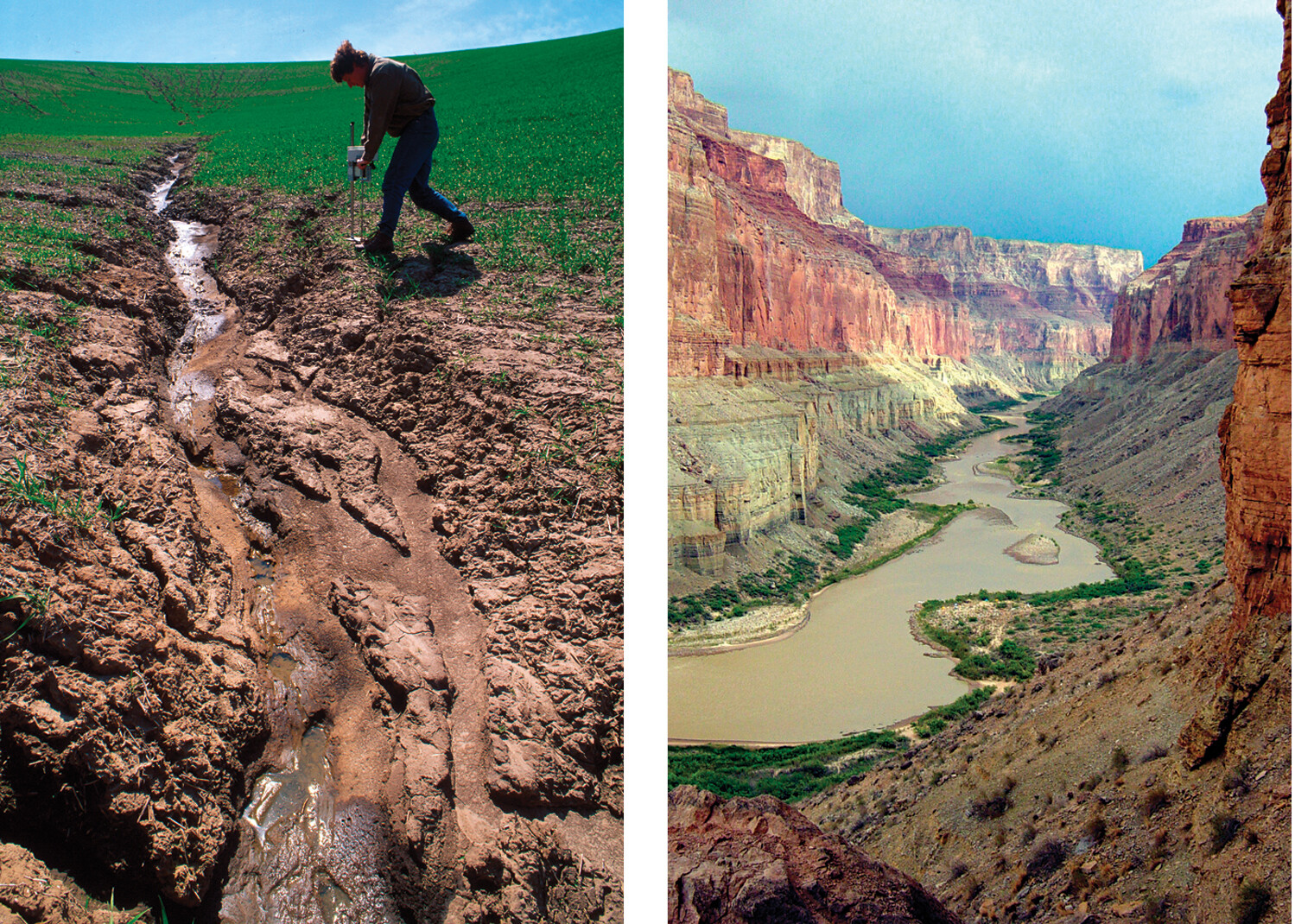
Once the idea of a changing world and vast stretches of time became established, the question became this: How can we fully use the power of observation, experimentation, and hypothesis testing to understand change over immense periods of time? To do so, we require explanations that not only turn to natural processes but also, more specifically, to natural processes that are ongoing and observable or otherwise somehow accessible to us. Historically, the method to do this emerged first in the field of geology and from there migrated to the biological sciences. To see how, we need to examine the work of Scottish geologist Charles Lyell (1797–1875) (Figure 2.2).
More information
Two photographs of erosion. The picture on the left shows a small rivulet in the middle of a green expanse while the picture on the right is of the Grand Canyon.
Building on ideas first proposed by Hutton, Lyell aimed to explain Earth’s geological features by appealing to the same geological processes currently observable. He argued that these same processes have operated over very long periods of time in a slow, gradual manner. From this, Lyell came up with the title of his famous book, Principles of Geology, Being an Attempt to Explain the Former Changes of the Earth’s Surface, by Reference to Causes Now in Operation (Lyell 1830). As we will see shortly, this approach, known as uniformitarianism, had a strong influence on Charles Darwin.
Uniformitarianism, in its broadest sense, postulates that the laws of nature are constant across time and space. Often coupled with gradualism—the idea that the current features of the world were formed slowly and continuously over vast periods of time—this notion differed radically from catastrophism, the prevailing view of the era. According to catastrophism, Earth’s major geological features arose through sudden cataclysmic, large-scale events involving different forces than those currently operating.
The shift from catastrophism to uniformitarianism was an important development not only for geology, but also for science as a whole. As the Reverend Baden Powell observed in 1838, without uniformity, generalization and inductive reason become impossible, no general model of cause and effect is possible, and natural processes cannot be linked to observable patterns (Powell 1838). In catastrophism, or at least in the most extreme versions of this idea, these processes are themselves neither observable nor subject to manipulative experiments, and they are not expected to occur again in the future, making it difficult to test hypotheses about how observed patterns have been generated. In the uniformitarian view, all of the processes that have generated the current geological patterns we see in the world around us can still be observed in operation now, providing scientists with much more power to test hypotheses.
Today we might view the nineteenth century embrace of uniformitarianism as an early step away from a theistic worldview, in that uniform and inviolable laws of nature offer little scope for a Creator to intervene in worldly events. But for scholars who developed this idea, it was quite the opposite. For them, the uniformity of physical law across time and space provided evidence of God’s wisdom, power, and foresight. And by providing a universe with uniform laws, the Creator demonstrated grace toward humanity by offering a comprehensible world that someday could be fully understood (Stanley 2016).
Ideas of gradual uniformitarian change would ultimately have an important role in the development of evolutionary biology. Darwin read Lyell’s Principles of Geology while serving as captain’s companion and ship’s naturalist aboard HMS Beagle, and he was profoundly affected by Lyell’s ideas (Recker 1990). Prior to publishing On the Origin of Species, Darwin wrote three books on geology, each of which drew heavily on Lyell’s work. And, as we will see later in this chapter, in many ways Darwin’s concept of evolution by natural selection is a biological interpretation of Lyell’s uniformitarianist ideas on geological processes. The diversity of life on Earth, Darwin proposed, can be explained by mechanisms that are in operation today, acting over very long periods of time.
By explaining the dramatic features of Earth’s geography through uniformitarianism, Lyell conceived the world as changing across enormous expanses of time. As such, by the time Darwin began his work, the approach to scientific inquiry had changed from mythmaking and supernatural explanations to methodological naturalism.
In the next section, when we explore theories of how new species come into existence, we will see that both uniformitarianism and the concept of deep time (vast periods of time) were essential in understanding the origins of the diversity of organisms on Earth.
Glossary
- uniformitarianism
- Charles Lyell’s theory that the same geological processes that we observe today have operated over vast stretches of time and explain the geology of the past and the present.
- gradualism
- The idea that current geological features of the planet were formed slowly and gradually over long periods of time and that the same geological processes that produced these features are still in operation today.
- catastrophism
- The theory that the geology of the modern world is the result of sudden, catastrophic, large-scale events.