2.4Organisms Are Well Suited to Their Environments
Although Vestiges presented the idea of new species gradually arising from existing species, the book did not explicitly consider the enormous influence of the environment on these slow changes. Any observer of nature will notice the remarkable degree of fit between the structures of organisms and their environments. The mammals of cold climates have thick coats and layers of insulating fat; swimming animals have shapes that allow them to move efficiently through the water; desert plants have thick waxy cuticles and low surface area that help them avoid water loss. How do we explain this seemingly marvelous fit? Prior to Darwin’s work, philosophers and scientists entertained a diverse array of answers to this question.
Paley’s Natural Theology
For the English naturalist and theologian William Paley (1743–1805), the fit of diverse species to their environments resulted from the planning of some supernatural deity. In his textbook, Natural Theology, Paley discussed the famous metaphor of this deity as a watchmaker (Paley 1802). If a single part of the clockwork within a watch were shaped differently or placed elsewhere, he observed, the watch would fail to function. Because living creatures are even more complex than watches, they could not have come to fit their habitats perfectly through chance, Paley argued, just as it is virtually impossible for a fully working watch to come into being simply by chance arrangement of clockwork parts. Organisms, then, must have been intentionally designed by a benevolent deity in order to thrive in their environments.
Years later, Darwin would read and admire Paley’s work, particularly his arguments on how the structures of organisms fit the functions they need to serve in order for individuals to survive. As we will see in greater detail below, however, Darwin would disagree with Paley’s explanation of the source of these adaptations. Darwin sought to explain adaptation by purely natural, rather than supernatural, causes.
Jean-Baptiste Lamarck and the Inheritance of Acquired Characteristics
With Jean-Baptiste Lamarck (1744–1829), we return fully to methodological naturalism as the explanation for species fitting their environments. Originally trained as a botanist at the French Jardin du Roi (King’s Garden) as a student of Buffon, Lamarck eventually became an animal systematist specializing in the study of invertebrates. His long-term studies of such organisms as mussels, which he compared to less complex fossil mussels, no doubt led him to think in terms of increasing complexity occurring in a group of organisms over time.
In his 1809 book, Zoological Philosophy, Lamarck rejected the idea that new species suddenly appeared after catastrophic events that caused large-scale extinctions. Instead he proposed that new, more complex species—humans being the most complex in Lamarck’s view—had descended, gradually, from older, less complex species. Because of this, Lamarck is often credited with developing the first truly evolutionary model for how organisms adapt to their different environments over vast periods of evolutionary time.
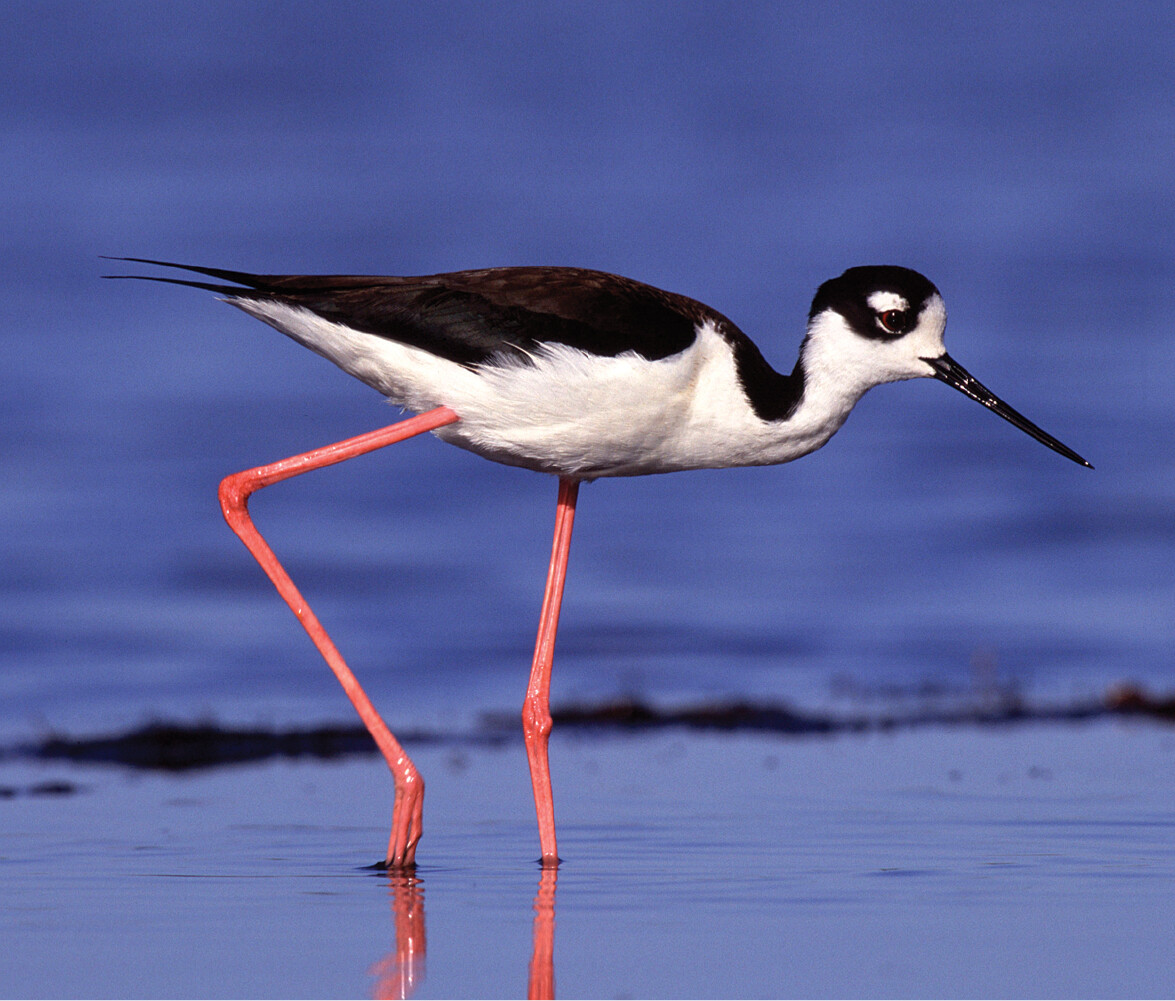
Lamarck suggested that evolutionary change occurs by the inheritance of acquired characteristics. During the lifetime of the organism, he proposed, the habits of the organism bring about changes in its structure, and such structural changes are passed down across generations (Lamarck 1809). Consider Lamarck’s description of this process in birds (Figure 2.3):
One may perceive that the bird of the shore, which does not at all like to swim, and which however needs to draw near to the water to find its prey, will be continually exposed to sinking in the mud. Desiring to avoid immersing its body in the liquid [the bird] acquires the habit of stretching and elongating its legs. The result of this for the generations of these birds that continue to live in this manner is that the individuals will find themselves elevated as on stilts, on naked long legs. (Lamarck 1801, cited in Burkhardt 1995, p. 172)
More information
A black and white bird with extremely long pink legs. The bird’s beak is black and very thin and long. It is wading through water which is around 6 inches deep.
FIGURE 2.3Lamarck’s hypothesis for long legs on shorebirds. Lamarck argued that the long legs of shorebirds such as this black-necked stilt (Himantopus mexicanus) are the result of birds stretching their legs as far as possible to avoid sinking in the mud. This stretching itself, Lamarck postulated, lengthened the legs of individuals doing the stretching, and their new trait of “longer legs” was then also passed down to offspring.
Lamarck observed that we find long-legged birds in environments in which long legs are beneficial. Rather than crediting a watchmaker deity for this perfect fit, he hypothesized a process of adaptation over time. Lamarck’s hypothesis that traits acquired during the lifetime of an individual are passed on to its progeny was interesting, plausible, and based on an idea that was universally accepted by scientists and nonscientists alike. After all, we are all aware of how our habits of life lead to changes in physiology; lifting weights, for example, leads to the development of increased muscle mass and lifting power. In the absence of evidence to the contrary, it is only a short leap from there to suppose that such changes could also be passed on to one’s offspring. Today, however, we have plenty of evidence to the contrary. We know that acquired characteristics are not ordinarily inherited—although epigenetic inheritance, which we discuss in later chapters, may allow for a kind of inheritance of acquired characteristics—and we now ground our ideas of how traits are passed from generation to generation in the laws of genetics, which were formulated about 100 years after Lamarck (Chapter 6).
Lamarck’s legacy, however, is not that he postulated the wrong processes for evolutionary change, but that he proposed a process in the first place, and that he connected it to environmental fit. As we will see, although Darwin did not completely reject the inheritance of acquired characteristics, his ideas on how and why evolutionary changes occur were quite different from those of Lamarck.
KEYCONCEPT QUESTION
2.2 A blacksmith’s muscles get larger the more he pounds his metals into shape. Suppose, as is likely the case, that the offspring of blacksmiths are on average more muscular than other individuals their age. Why might this mistakenly lead someone to think that muscle size here is an example of the inheritance of an acquired characteristic? How else could we explain this observation?
Patrick Matthew and Natural Selection
In the history of biology, we hear little about the developments in evolutionary thinking in the 50 years between Lamarck’s Zoological Philosophy (1809) and Charles Darwin’s On the Origin of Species. Yet, it was during this period that Patrick Matthew (1790–1874), a Scottish landowner and writer, proposed his own ideas on evolution by natural selection, predating the ideas laid out in On the Origin of Species by more than a quarter of a century (Matthew 1831; Mayr 1982; Dempster 1996). In an obscure 1831 work entitled On Naval Timber and Arboriculture, Matthew proposed a model that was very similar to Darwin’s on the interaction between environment and evolutionary change. In the notes at the end of On Naval Timber and Arboriculture, in a section only tangentially related to the rest of the book, Matthew outlined his ideas on both evolution and natural selection. He understood the idea that individuals best suited to their environments would be selected over others.
Matthew’s discussion of environmental fit and natural selection—what he dubbed “the circumstance-adaptive law”—is remarkably similar to what Darwin would discuss almost 30 years later. Matthew, for example, noted,
The self regulating adaptive disposition of organized life may, in part, be traced to the extreme fecundity of Nature, who . . . has in all the varieties of her offspring, a prolific power much beyond (in many cases a thousandfold) what is necessary to fill up the vacancies caused by senile decay. As the field of existence is limited and pre-occupied, it is only the hardier, more robust, better suited to circumstance, individuals who are able to struggle forward to maturity . . . from the strict ordeal by which Nature tests their adaptation to her standard of perfection and fitness to continue their kind by reproduction, . . . the breed gradually acquiring the very best possible adaptation. (Matthew 1831, pp. 384–385)
Matthew outlines three important evolutionary ideas here: (1) resources are limited, and only so many offspring can survive to the age of reproduction; (2) individuals will differ in terms of traits that allow them to garner such resources; and (3) over time, this will lead to organisms that are well adapted to their environments.
Matthew’s name is not readily associated with evolution by natural selection—despite the fact that on page 22 of the preface to the sixth edition of The Origin of Species, Darwin noted that Matthew presented “precisely the same view on the origin of species as that propounded by . . . myself . . . in the present volume.” There are many reasons for Matthew’s relative obscurity. His ideas were published in a book that no one interested in biological diversity would have been likely to read, and even there his ideas were hidden in his notes and appendix section rather than presented as a unified set of ideas. Moreover, Darwin discussed both natural selection and common descent, whereas Matthew mentioned only the former. Perhaps most important, Matthew presented scant evidence in support of his ideas. Darwin, in contrast, spent 20 years gathering evidence for evolution by natural selection before publishing On the Origin of Species. All of that said, Matthew’s work merits more attention than it has garnered (Weale 2015).
If we stop briefly to take stock, what we have seen in this chapter so far is that four major developments preceded and facilitated Darwin’s On the Origin of Species. These changes involved moving (1) from supernatural explanations to methodological naturalism, (2) from catastrophism to uniformitarianism, (3) from logic and pure reason alone to these plus observation, testing, and refutation, and (4) from an unchanging world to a world in flux.