KEYCONCEPT QUESTION
2.3 Choose another example of artificial selection and describe a breeding program that would produce the desired aim of the breeder.
We will begin our exploration of Darwin’s contributions with an overview of the major ideas that he presented in On the Origin of Species. Darwin presented two fundamental insights that he referred to as “two great laws” about the process of evolution.
The first of Darwin’s fundamental insights deals with the process of natural selection. Here, Darwin hypothesized that the environment selects on variation in the traits of individual organisms, because some variants are more successful than others at increasing the probability of survival and reproduction.
With this hypothesis, Darwin offered a mechanistic explanation both for how the characteristics of organisms change over time and for why organisms are well suited to their environments. Darwin dubbed that process natural selection. The effect that a given variant of a trait has on survival and ultimately reproductive success depends on the environment in which an organism finds itself. As Darwin noted, once the “conditions of existence” are determined, “natural selection acts by either now adapting the varying parts of each being to its organic and inorganic conditions of life; or by having adapted them during past periods of time” (Darwin 1859, p. 206). Here, when Darwin writes of the conditions of existence, he is referring to the living and nonliving environment that sets the stage on which natural selection operates.
The second of Darwin’s insights centers on the common ancestry of all living things. Darwin hypothesized that all species have descended from one or a few common ancestors. Species that share a recent common ancestor tend to resemble one another in many respects for the very reason that they share recent common ancestry. New species do not arise through independent acts of creation or spontaneous generation, but rather from preexisting species. This process generates a branching pattern of ancestry relating all life.
These two insights are major themes not only within this chapter, but throughout the textbook, and we will go into much more detail about them in other chapters. For now, we will look at how Darwin arrived at these ideas, at how he collected evidence to support them, and at how he chose to present his challenging conclusions to his nineteenth-century contemporaries.
Darwin begins On the Origin of Species as follows: “When on board H.M.S. ‘Beagle,’ as naturalist, I was much struck with certain facts in the distribution of the inhabitants of South America, and in the geological relations of the present to the past inhabitants of that continent. These facts . . . seemed to throw some light on the origin of species—that mystery of mysteries” (Darwin 1859, p. 1) (Figure 2.4). As we have seen, some of Darwin’s predecessors talked of evolutionary change and even of processes similar to natural selection. Darwin’s On the Origin of Species, however, was the first to present a complete theory of evolution by natural selection and to support that theory with an enormous body of evidence: evidence that included his observations of finches, tortoises, coral reefs, and so much more in the Galápagos Islands (Figure 2.5). We want to be clear about what we mean by describing Darwin’s work as a “theory.” In everyday usage, “theory” is sometimes used synonymously with “idea” or “hypothesis.” Not so in science. A report from the U.S. National Academy of Sciences explains that theories are not conjectures awaiting the evidence needed to establish them as fact. Rather, theories “are understandings that develop from extensive observation, experimentation, and creative reflection. They incorporate a large body of scientific facts, laws, tested hypotheses, and logical inferences” (National Academy of Sciences 1998). The report continues: “In this sense, evolution is one of the strongest and most useful scientific theories we have.”
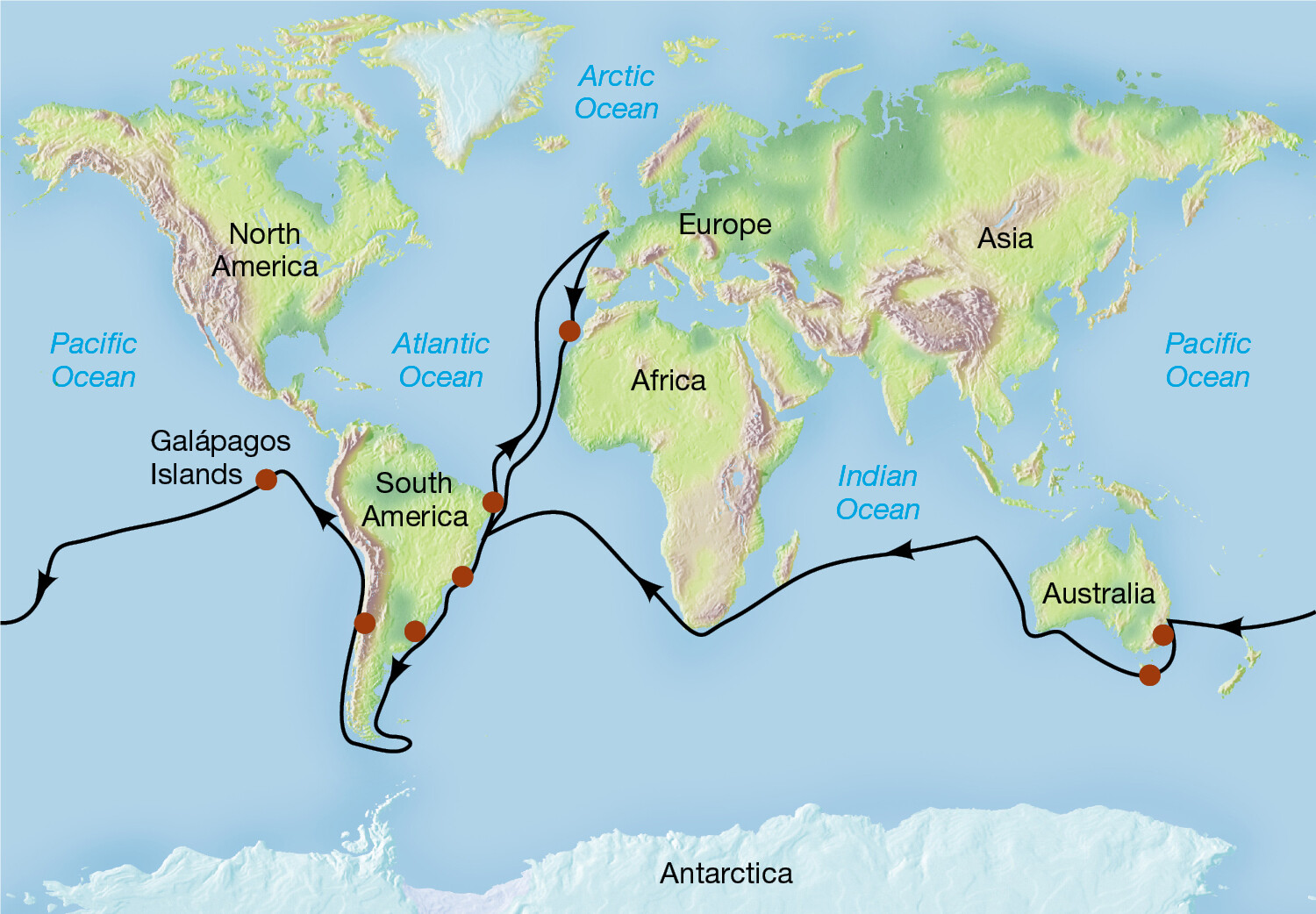
A map of the continents of Earth showing Darwin’s ocean travel routes. He started in England and stopped in West Africa, Brazil, Argentina, Chile, Galapagos Islands, Australia, Brazil again, and then returned to England.
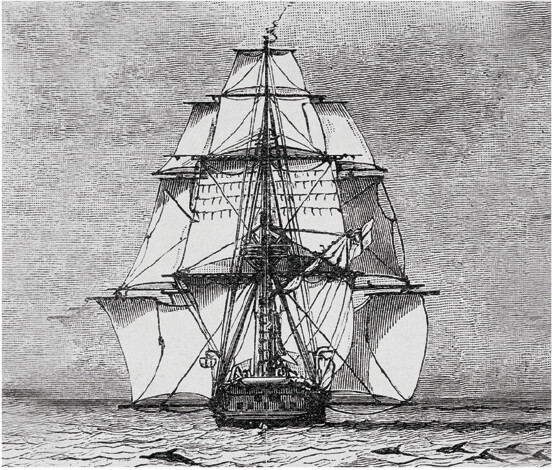
A drawing of a large sailing ship. It has over 8 sails on different masts. There are three tiers of sails with the largest on the bottom.
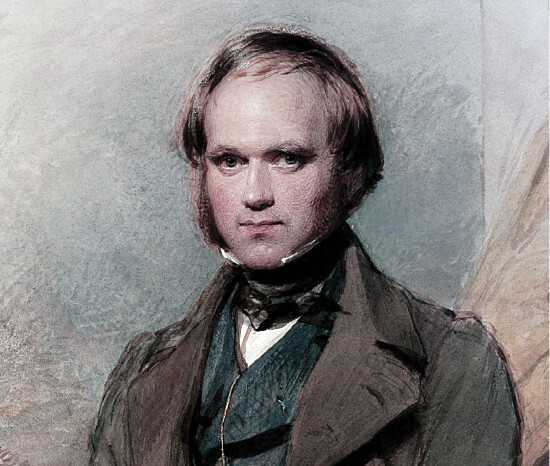
A painted portrait of Charles Darwin.
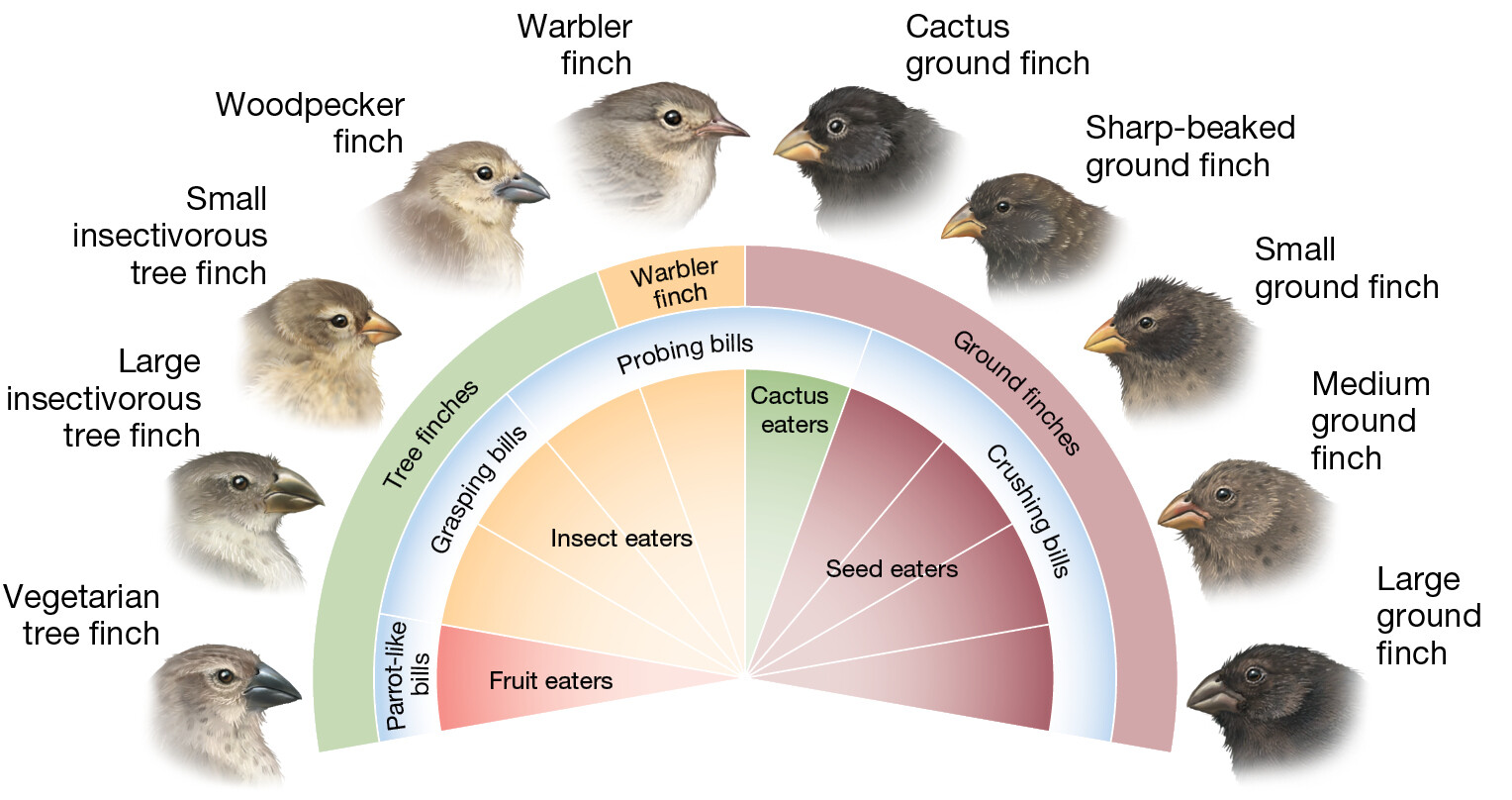
An infographic showing the spectrum of finch beaks from the Galapagos Islands. Each finch is grouped by what they eat, type of bill, and where they live. The vegetarian tree finch is a fruit eater, has a parrot-like bill, and is part of the tree finches group. The large insectivorous tree finch eats insects, has a grasping bill, and is part of the tree finches group. The small insectivorous tree finch eats insects, has a grasping bill, and is part of the tree finches group. The woodpecker finch eats insects, has a probing bill, and is part of the tree finches group. The warbler finch eats insects, has a probing bill, and is part of the warbler finches group. The cactus ground finch eats cactus, has a probing bill, and is part of the ground finches group. The sharp-beaked ground finch eats seeds, has a crushing bill, and is part of the ground finches group. The small ground finch eats seeds, has a crushing bill, and is part of the ground finches group. The medium ground finch eats seeds, has a crushing bill, and is part of the ground finches group. The large ground finch eats seeds, has a crushing bill, and is part of the ground finches group.
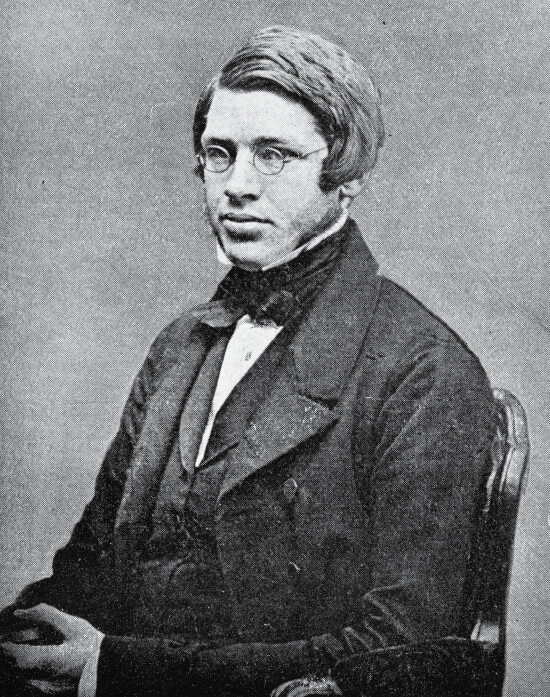
A black and white photo portrait of Alfred Russel Wallace.
Twenty-three years separated Darwin’s return from his time on HMS Beagle and the publication of On the Origin of Species. Darwin postponed releasing his work, in part because he knew that his ideas were revolutionary, and he wanted to have the strongest possible case before unveiling them to both the scientific world and the general public. But in the end, competition spurred Darwin to publish. In 1858, as part of an ongoing correspondence with Alfred Russel Wallace (1823–1913), Darwin received a manuscript in which Wallace proposed a theory very similar to his own (Figure 2.6).
Wallace was a brilliant natural historian, geographer, and collector; he identified many new species of birds and insects, and his collections can be seen today in natural history museums around the world. Wallace had written a paper in 1855 in which he speculated on the origin of species; there he concluded from the similarity of geographically nearby species that new species must arise from preexisting ones (Wallace 1855). Wallace’s concept of how species are formed led him to suggest the hierarchical branching relationship among species that is fundamental to our current understanding of the diversity of life (Van Wyhe 2016).
It was during a bout with malaria on the Spice Islands, however, as he suffered from fever, that Wallace figured out the mechanism that drives species to change (Raby 2001). As he recollected, “I at once saw that the ever present variability of all living things would furnish that material from which, by the mere weeding out of those less adapted to the actual conditions, the fittest alone would continue the race” (Wallace 1905, pp. 191–192). Darwin would call this process natural selection.
When Wallace wrote to Darwin outlining these ideas on evolution, Darwin yielded to pressure from friends and colleagues and publicized his own theories, first in a joint Darwin–Wallace paper that was read to the Linnaean Society in 1858 (with neither Darwin nor Wallace present), and later in longer form as On the Origin of Species. Wallace still holds a place in the pantheon of great evolutionary thinkers, but history primarily associates Darwin’s name with the theory of evolution by natural selection. In large part this is due to Wallace’s professional generosity. While his theory closely resembled Darwin’s, Wallace graciously agreed that Darwin deserved the credit. Darwin had worked for decades on developing the theory and had amassed huge amounts of data from many sources to provide evidence for his theory of evolution by natural selection.
In 1859, when Darwin finally published On the Origin of Species, he laid out his evidence and his argument carefully, cognizant of the criticism his ideas would draw. But before he could describe either his data or the process involved in generating a new species, Darwin first needed to prepare his reader for what was to come. He did so cautiously, but in a strategically brilliant fashion.
The opening chapter of On the Origin of Species may strike the modern reader as odd. Darwin opens not with his grand theory explaining the diversity of life on earth, but rather with an extended discussion of how to breed bizarre, if beautiful, pigeons (Figure 2.7). This was a deliberate choice on Darwin’s part. Although the subject matter appears unusual today, pigeon breeding was a popular pastime in Victorian England and would have been comfortingly familiar to Darwin’s audience. With this example, Darwin set out to help his readers of 1859 relate to the challenging ideas in the rest of his book.
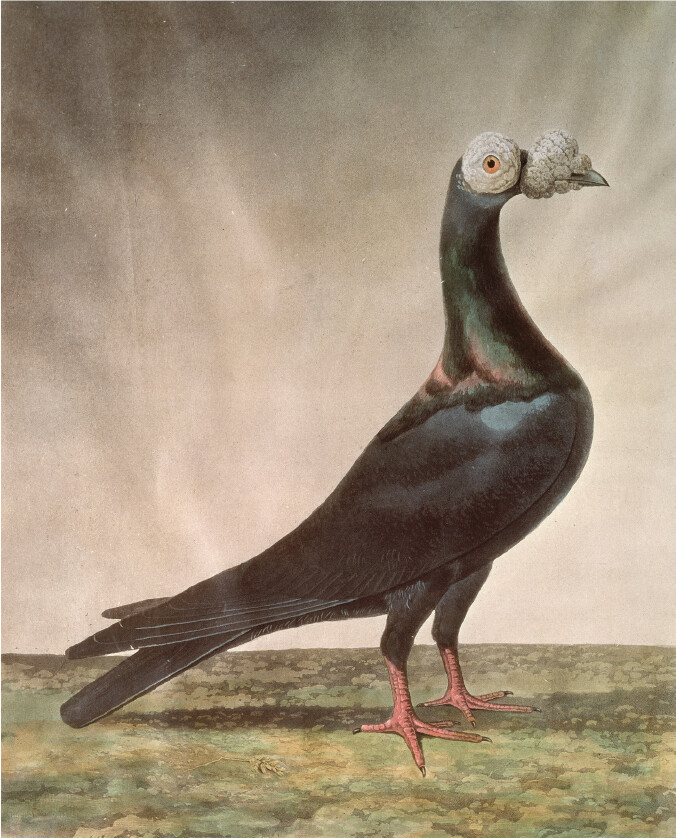
A drawing of a carrier pigeon, which is black, thin, and has unusual tubercle growths on its beak.
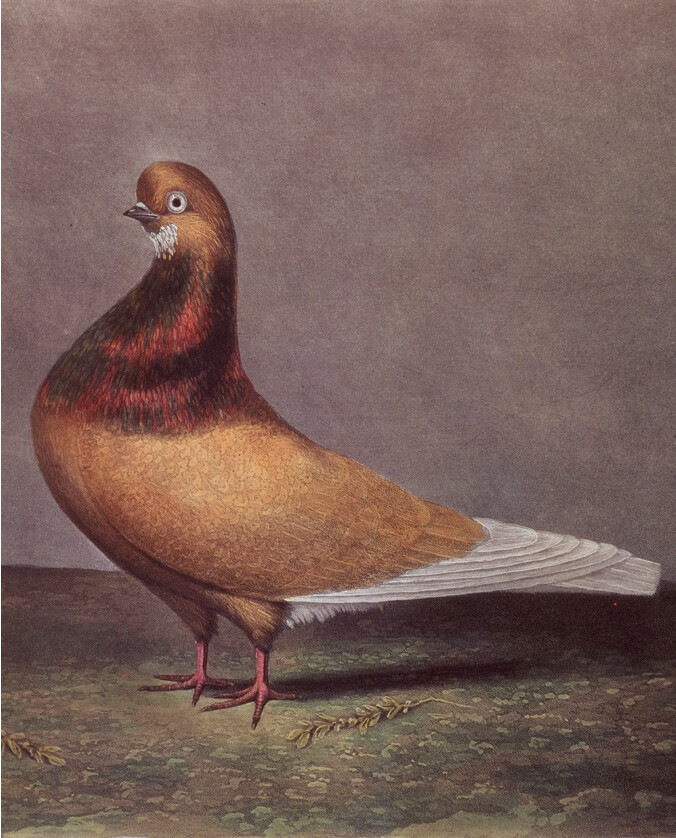
A drawing of a beard pigeon which is tan, white, and reddish. The red coloring is just below the beak to the upper chest while the white coloring is only on the tail feathers.
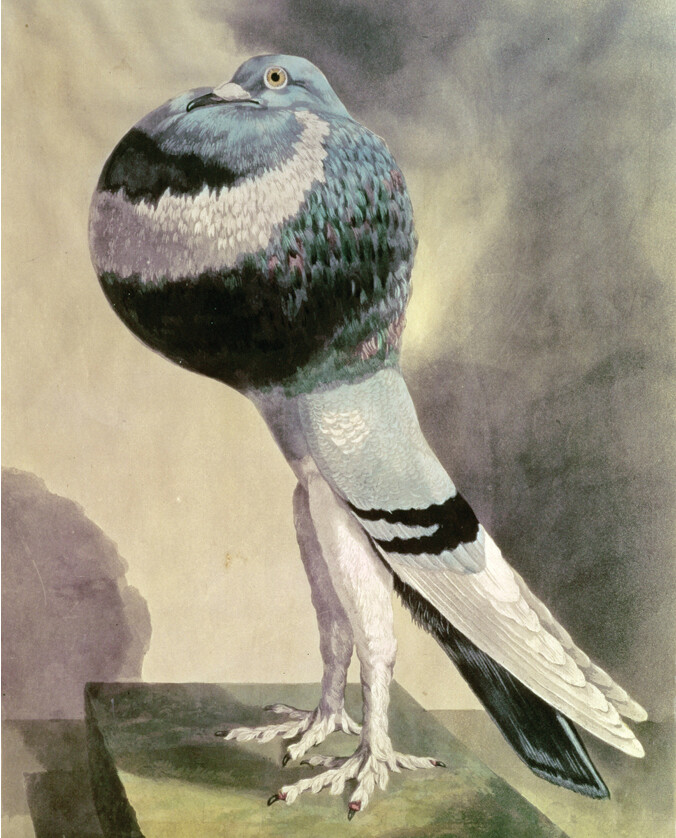
A drawing of a pouter pigeon which is white and different shades of blue. It has very thin legs and a very large chest below the beak that appears to be blown up like a balloon.
Darwin hoped to introduce readers to natural selection by first convincing them that the breeding programs that pigeon fanciers had developed—programs that had led to a wide range of extraordinary variation in pigeon color, flying habits, behavior, and so on—resembled the processes that led to differences within and between species in nature. In doing so, Darwin aimed first to illustrate the processes by which he thought species changed over time, and second to help his readers get beyond their preconceptions of species as eternal and immutable. We address these two aims in turn.
In artificial selection, humans systematically breed certain varieties of an organism over others. For thousands of years, humans have been shaping animals and plants by this process. Ever since our ancestors selected some varieties of wheat, maize, and rice over others, and systematically planted such seeds, humans have engaged in artificial selection. The same process describes our systematic breeding of certain types of dogs and our domesticated livestock. The process that pigeon breeders developed is an example of artificial selection, whereas the process leading to the wide variety of traits we see in nature is natural selection.
Suppose that like pigeon breeders in Victorian days, we want to produce a variety of pigeon with snow-white plumage. We would begin our artificial selection process by systematically allowing only those individuals in our population with the whitest plumage to breed. We would then continue this process generation after generation, in each generation sorting the birds based on plumage coloration, and allowing the whitest—those that are closest to the type we want to produce—to breed. If offspring resembled their parents in terms of plumage coloration, each generation of offspring would have whiter and whiter feathers. Eventually, we would exhaust all genetic variation for plumage coloration, and, so far as possible, we would have achieved our goal of a snow-white pigeon (Figure 2.8).
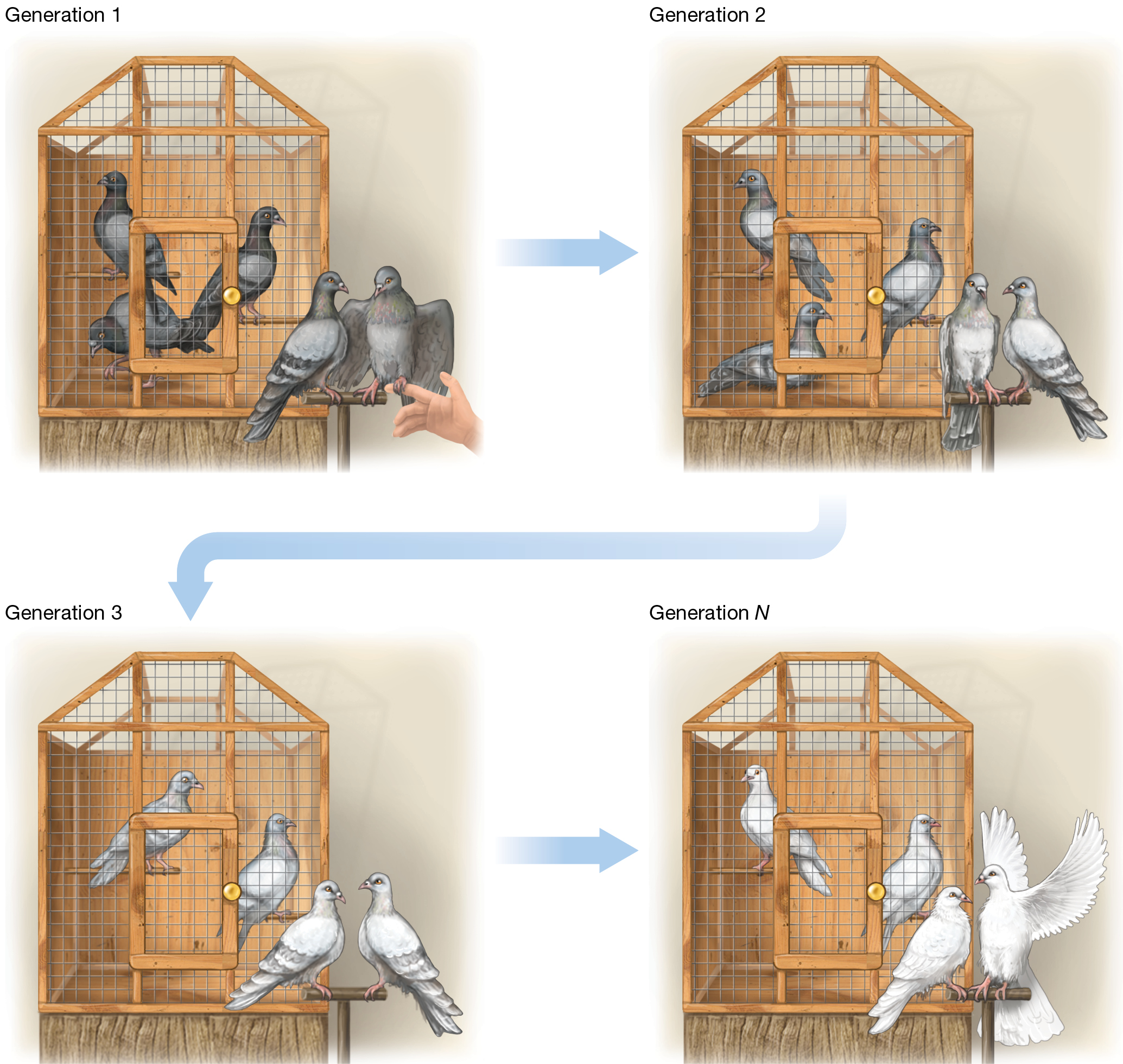
Four cages of pigeons showing four generations. Generation 1 is the darkest with a tan and black coat. Generation 2 is lighter with much more tan than black in their coats. Generation 3 is far whiter with no black showing on the birds. The last is called generation N and is almost fully white.
Domestication is a striking consequence of some, though not all, programs of artificial selection. For example, somewhere between 15,000 and 30,000 years ago our ancestors began the process of domesticating wolves into what today we call dogs. Exactly how this process unfolded is still not completely clear, but it likely involved humans selecting wolves that provided our ancestors protection, and perhaps helped in hunting prey. Over the last few hundred years (and even much earlier than that in some instances), humans have selected for hundreds of different breeds of dog that vary in their behavior, morphology, and genetics.
In order to study the process of domestication in real time, a fascinating experiment is taking place in Novosibirsk, Russia. It started over six decades ago, when under the leadership of Dmitri Belyaev (who died in 1985) and Lyudmila Trut, a team of researchers at the Institute of Cytology and Genetics began domesticating foxes (Vulpes vulpes) (Trut 1999, Trut et al.1999, Dugatkin and Trut, 2017, Kukekova et al. 2018, Wang et al. 2018). Like wolves and dogs, foxes are canids, and one goal of this experiment is to better understand dog domestication per se. But, at a broader level, the experiment is designed to shed light on what is called the domestication syndrome. Many domesticated mammals share a suite of traits—that together are called the domestication syndrome—that includes floppy ears, curly tails, reduced stress hormone levels, variation in fur or skin coloration, reduced skull size, juvenilized facial and body features, reduced sexual dimorphism in facial and body features, and relatively long reproductive periods. Why should that be?
Belyaev knew of the domestication syndrome both from Darwin’s book, The Variation of Animals and Plants under Domestication, and from his own work with domesticated animals. He also knew that humans have domesticated animals for many reasons, but regardless of what animals are domesticated for—transportation, food, companionship, or protection—domesticated animals, over time, begin to accumulate traits in the domestication syndrome. Belyaev proposed that selection for calm behavior toward humans was the key to understanding the process of animal domestication. He hypothesized that the early stages of all animal domestications centered on choosing the calmest, friendliest animals, because our ancestors always needed a species they were domesticating to interact relatively prosocially with them. He further hypothesized that many, if not all, of the traits domesticated animals share in common were somehow linked to genes associated with this behavior and that is why we see the domestication syndrome.
To test this idea, Belyaev and Trut—who joined the experiment in 1959 and continues to lead it to this day—devised a measure of prosocial behavior toward humans and used that as the sole criteria to select which foxes parent the next generation, with the top 10% of the foxes on this measure allowed to breed. Within six generations, their artificial selection protocol had resulted in some foxes that licked the hands of experimenters, whined when humans departed, and wagged their tails when humans approached. During the early years of the experiment, the calmest of the foxes made up 2% of the experimental population; today they make up more than 75%. In addition, as Belyaev predicted, selection for foxes that were friendly toward humans led to the emergence of traits in the domestication syndrome. In less than ten generations, some of the domesticated foxes had floppy ears and curly tails, and by generation 15, the foxes’ stress hormone levels were about half the stress hormone levels of wild foxes. The domesticated foxes also displayed more juvenilized facial and body shapes, such as rounder and shorter snouts and shorter, thicker limbs (Figure 2.9).
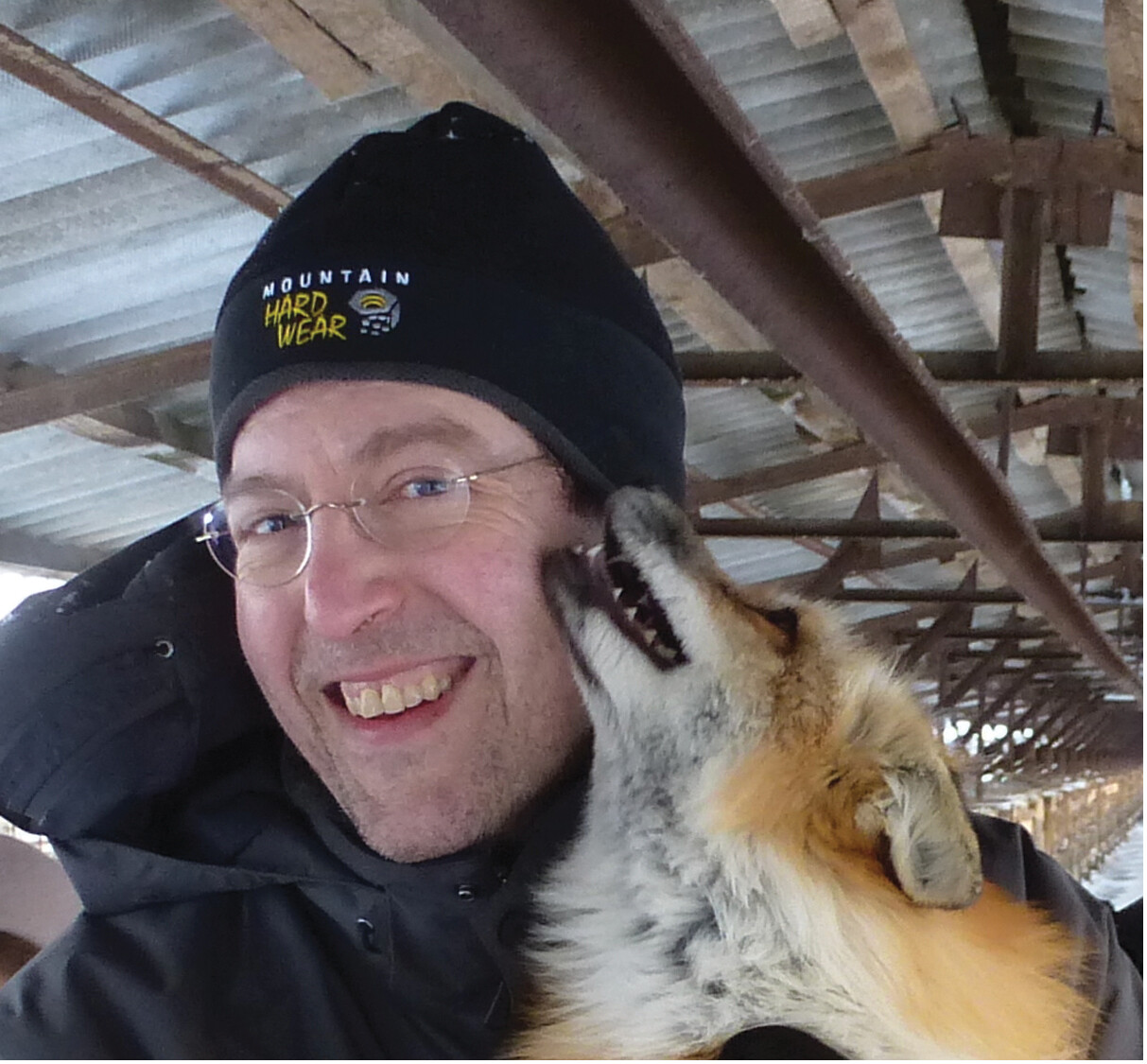
A man and a fox. The man is grinning as the fox nuzzles his ear.
In Chapter 13 we will explore the neural crest hypothesis that links prosocial behavior to the traits in the domestication syndrome, but for now, what this experiment shows us is one powerful way evolutionary biologists can study the process of artificial selection.
KEYCONCEPT QUESTION
2.3 Choose another example of artificial selection and describe a breeding program that would produce the desired aim of the breeder.
While many of Darwin’s contemporaries would have accepted the explanation of artificial selection as the mechanism producing new varieties—pigeons with new colors or tamer foxes—the claim that this process could generate new species was much more controversial. Darwin knew this all too well, and in Chapter 2 of On the Origin of Species, he seems almost obsessed with the definition of a variety versus a species and with the problems in distinguishing between these two categories.
Darwin presents example after example in which one naturalist calls a group of organisms “species 1,” while another classifies the same group as a “variety of species 2.” In Darwin’s eyes, the line between a variety and a species was arbitrary. He conceptualized species as merely “strongly marked and permanent varieties.” Conversely, when he saw varieties, he viewed them as “leading to subspecies and then to species,” and he often spoke of varieties as “incipient species”—species in the making.
Challenging the distinction between species and varieties was essential to Darwin’s overarching argument. Pointing to examples in plant and animal breeding, Darwin provided extensive evidence that new varieties often arise from a single stock through a branching mechanism of descent. Having established that varieties are similar to species, Darwin then explained that both probably respond to similar processes—most notably, the process of selection (artificial or natural). Like varieties, Darwin argued, species change over time, and new species arise from other species.
To explain how varieties were on the path to becoming new species, Darwin introduced the concept of descent with modification. For example, he hypothesized that if we want to understand how a species got to be what it is today, we need to recognize that its history was one of a branching pattern of descent from ancestral species, and that over evolutionary time, numerous modifications occurred. Darwin argued that these modifications resulted largely from the process of natural selection, a process analogous to the familiar technique of artificial selection that had been used by breeders for thousands of years.
Once Darwin had walked the reader of On the Origin of Species through the process of artificial selection and the concept of species as changing entities similar to varieties, he could move on to the details of the process of natural selection.