Darwin argued, over and over, that the process of natural selection resembles that of artificial selection. The two important differences between the processes are the selective agent and the traits being selected. With artificial selection, the selective agent is the human breeder, who chooses which traits to modify and attempts to modify them in a way that is beneficial to the breeder. In the case of natural selection, we can think of nature as the selective agent, though nature is not a conscious agent in the way that humans are.
With respect to what traits are selected, Darwin noted,
Man can act only on external and visible characters; nature cares nothing for appearances, except in so far as they may be useful to any being. She can act on every internal organ, on every shade of constitutional difference, on the whole machinery of life. (Darwin 1859, p. 83)
That is, the process of natural selection favors any variant of a trait that increases the survival and reproductive success of an individual, even if the difference is not easily detected by a human observer or if the increase in reproductive success is small.
Darwin, Variation, and Examples of Natural Selection
Taking Lyell’s ideas on uniformitarianism and applying them to biology, Darwin hypothesized that evolution by natural selection is a gradual but powerful process. He argued that the process of natural selection acts on small differences among individuals. If one variety of a trait leads to even a small reproductive advantage compared to other varieties, it will be favored by natural selection. These small differences can translate into much larger changes as they accumulate over evolutionary time.
For example, Darwin asked his reader to imagine the wolf that “preys on various animals, securing some by craft, some by strength, and some by fleetness” (Darwin 1859, p. 90). When prey animals are scarce—and prey are almost always scarce—natural selection acts strongly in such wolf populations. Wolves that possess the traits that best suit them for hunting (speed, stealth, and so on) tend to survive longer and produce more offspring. These offspring in turn are likely to possess the traits that benefited their parents in the first place. The repetition of this process for generation after generation produces wolves that are very efficient hunters. “Slow though the process of selection may be,” noted Darwin, the eventual outcome is a more effective wolf predator.
Once we see traits in terms of their effect on overall reproductive success—as Darwin did for wolves and myriad other examples—the concept of natural selection becomes a powerful tool for understanding the world around us.
The Power of Natural Selection
Darwin’s own writings demonstrate that he attributed enormous power to the process of natural selection. He ends the introductory chapter of On the Origin of Species by claiming, “I am convinced that natural selection has been the most important, but not the exclusive, means of modification” (Darwin 1859, p. 6). Darwin lays out his position in even more detail for the reader in a later passage:
It may be said that natural selection is daily and hourly scrutinising, throughout the world, every variation, even the slightest; rejecting that which is bad, preserving and adding up all that is good; silently and insensibly working, whenever and wherever opportunity offers, at the improvement of each organic being in relation to its organic and inorganic conditions of life. We see nothing of these slow changes in progress, until the hand of time has marked the long lapse of ages. (Darwin 1859, p. 84)
This is a very powerful statement. For Darwin, the process of natural selection operated 24 hours a day, every day, everywhere, over vast periods of time. Only a process of such magnitude could have shaped all the life that we see around us and, for that matter, all life that has ever lived. As long as offspring resemble their parents with respect to a trait, any differences in reproductive success associated with varieties of that trait—even differences so slight that even the most thorough and patient human investigator might struggle to detect them—will be acted on by natural selection.
An analogy might help here: The process of natural selection acts as an editor, removing what is not as well suited to its environment by increasing the frequency of what is better suited. Changes take place constantly, but usually they will not manifest in measurable differences until the passing of eons. In later chapters, we will see that Darwin underestimated the potential rate of evolutionary change in some cases. Under certain conditions the effects of the process of natural selection—particularly selection operating in species that reproduce very quickly—can be detected and measured in a span of years or even less.
Even in Darwin’s day, researchers found that they could observe evolutionary change on human timescales. From 1880 through 1886, clergyman, microscopist, and Royal Society member William Dallinger conducted a 7-year experimental evolution study in which he tracked changes in temperature tolerance in communities of three protozoan species in which cells reproduced on average every 4 minutes (Dallinger 1887; Haas 2000).
Dallinger began by placing large populations of his protozoan communities in an experimental device he built and setting the temperature at 16°C. Over time, he gradually raised the temperature. Each time he did so, many cells died, unable to survive at the higher temperature. But some cells, those with the highest thermal tolerance, survived. After the experiment had been going on for 7 years, the cells in Dallinger’s experimental device survived at temperatures in excess of 66°C. This adaptation to high temperatures came at a cost—cells that could survive at 66°C died when exposed to the 16°C in which their ancestors flourished.
Malthus and the Scope of Selection
Before his readers could accept the potency of evolutionary change, Darwin needed them to reconsider their beliefs about survival in the natural world. To do this, he used an analogy. Just as selective breeders must discard numerous individuals bearing undesirable traits in order for artificial selection to work, “nature” must “discard” numerous individuals in order for natural selection to be effective. Although it may seem obvious to us, in Darwin’s time this concept ran against the prevailing notion of an orderly, efficient, and harmonious operation of nature.
To persuade his readers that his mechanism of natural selection could shape the natural world, Darwin first had to convince them that nature was sufficiently “wasteful” for selection to operate. That is, he needed to demonstrate to his readers that many individuals did not survive to the age of reproduction, and of those that did, only a fraction actually reproduced. To do this, Darwin drew on the ideas of Thomas Robert Malthus (1766–1834), an English political economist and demographer.
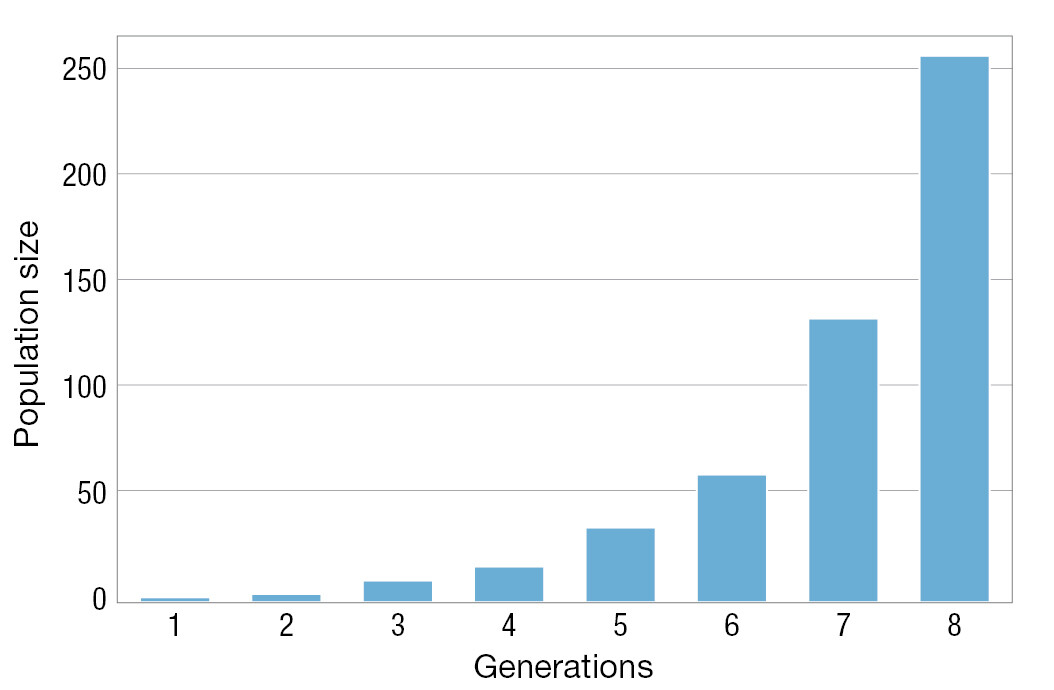
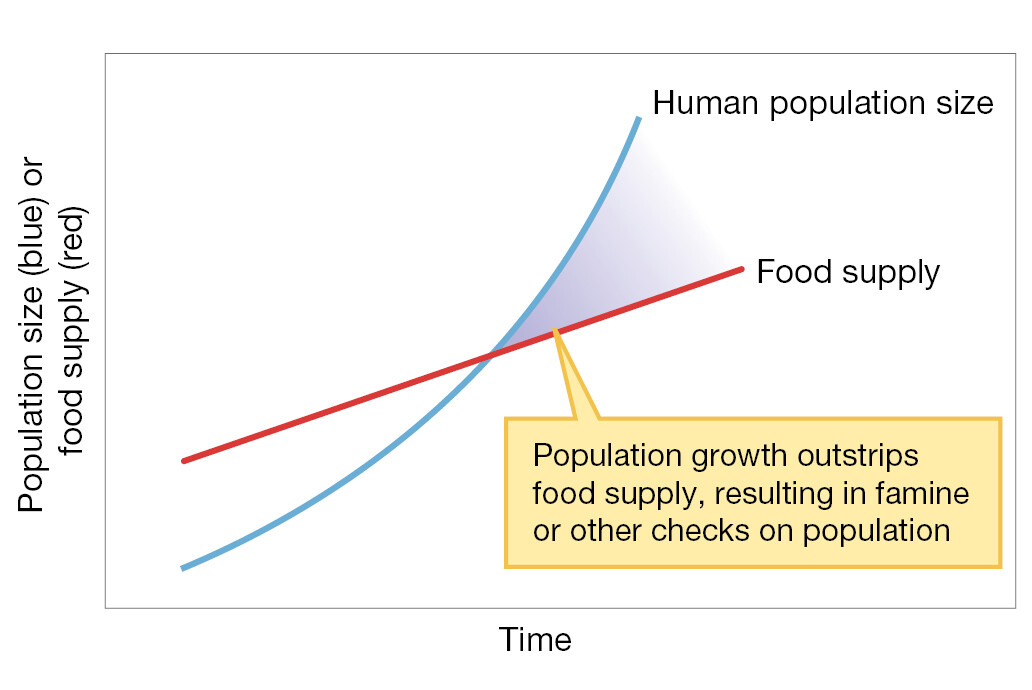
Malthus noticed that the human population, unless kept in check by war, famine, disease, or other causes, grows geometrically over time (Malthus 1798). He contrasted the geometric growth of unconstrained human populations with the growth of food production, which he believed could increase at best arithmetically (Figure 2.10). As a result, Malthus argued that humans would inevitably outstrip the available resources necessary to sustain themselves, and that population growth would inevitably be checked by famine, war, disease, or other forces.
A
More information
A bar graph showing the relationship between number of generations and population size. It shows exponential growth. One generation has a population of 2. The second generation has a population of 4. The third generation has a population of 8. The fourth generation has a population of 16. The fifth generation has a population of 32. The sixth generation has a population of 64. The seventh generation has a population of 128. The eighth generation has a population of 256.
B
More information
The line graph shows the relationship, according to Malthus, of food supply and human population size over time. The food supply line grows at a steady rate of around at around a 25% angle. The human population growth is exponential and soon crosses the food supply line. The area between the two lines after the population crosses the food supply line is shaded blue. The note reads “Population growth outstrips food supply, resulting in famine or other checks on population.”
FIGURE 2.10Malthus and population growth. Thomas Malthus argued that humans would outstrip the available resources necessary to sustain themselves, leading to population growth that would be checked by famine, war, and disease. Malthus’ writings were influential in helping Darwin develop his ideas on natural selection. (A) Geometric population growth is shown in this graph. If each mother produces two replacements for herself, a single mother at time 0 gives rise to 2 additional mothers after a single generation. There will then be 4 mothers after 2 generations, 8 after 3 generations, 16 after 4 generations, and so forth. (B) Malthus argued that the human population was geometrically increasing (blue curve) and thus would inevitably outstrip its food supply (red curve), which he believed to be arithmetically increasing.
Darwin recognized that Malthus’ argument applies to animal and plant populations as well as to human populations. For animal and plant populations in nature, food supply is usually not increasing at all, yet the power of reproduction would lead to a geometric increase in population size if growth were not checked by a struggle for existence. Darwin neatly summarized this as follows:
As many more individuals of each species are born than can possibly survive; and as, consequently, there is a frequently recurring struggle for existence, it follows that any being, if it vary however slightly in any manner profitable to itself, under the complex and sometimes varying conditions of life, will have a better chance of surviving, and thus be naturally selected. (Darwin 1859, p. 5)
Transformational and Variational Processes of Evolution
Darwin’s mechanism of evolutionary change differed radically from previous concepts of evolutionary change. Before Darwin, scientists had envisioned change as a transformational process, in which the properties of an ensemble change because every member of the ensemble itself changes. For example, a mountain range becomes less rugged and more rounded over geological timescales because each individual peak itself becomes more rounded.
Lamarck’s theory of evolution was a transformational theory. According to Lamarck, the properties of a lineage of organisms shift over time because of changes that each member undergoes during its lifetime and then passes along to its descendants. By contrast, Darwin’s theory of evolutionary change was a variational one. In a variational process of evolution, the properties of an ensemble change, not because the individual elements change, but rather because of the action of some process sorting on preexisting variation within the ensemble (Levins and Lewontin 1987). For Darwin’s theory, that sorting process was the process of natural selection.
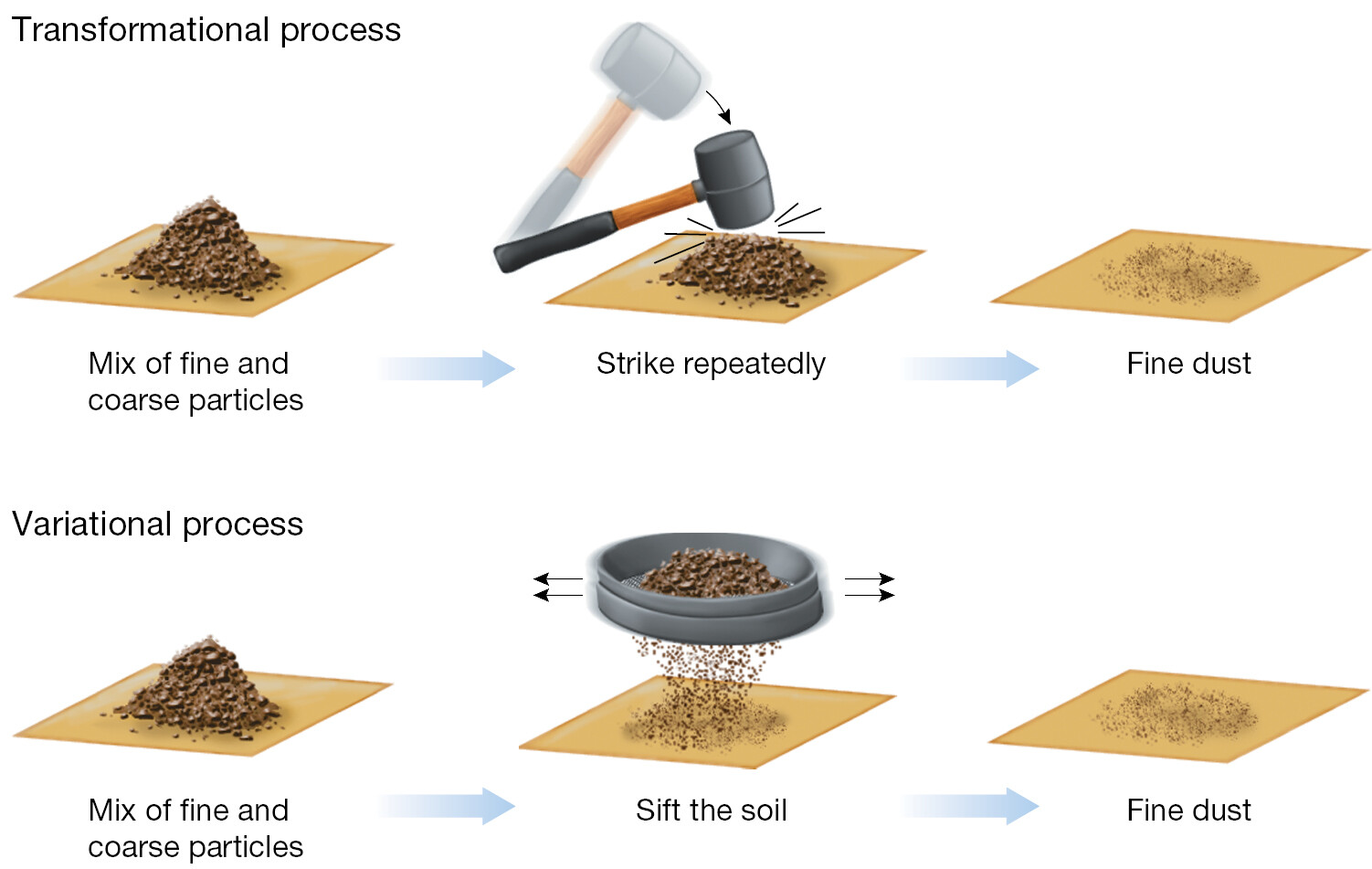
To see how such a sorting process operates, imagine sifting a bucket of soil with particles ranging in size from fine sand to small pebbles. After sifting, the soil particles remaining in the sifter will be considerably larger on average than those in the original soil mixture. This is not because of any change on the part of individual particles—no transformation in the size of soil particles has occurred—but rather it is because the sifter has sorted the members of the ensemble according to their characteristics (Figure 2.11).
More information
A diagram showing the transformational process and the variational process changing a mix of fine and coarse particles into fine dust. The transformational process involves repeatedly striking the mix with a mallet to create a fine dust. The variational process involves sifting the soil to separate the fine dust from the coarse particles.
FIGURE 2.11Different processes of change. In a transformational process, the ensemble changes because each individual member changes. In a variational process, the ensemble changes because something sorts among the variants in the original ensemble. In this example, crushing the soil particles is a transformational process—the ensemble shifts toward smaller particles because the individual particles are reduced in size. Sifting the soil is a variational process—the ensemble shifts toward smaller particles because the larger particles are sorted out.
This kind of sorting process is what takes place when we use artificial selection to change the characteristics of a breed of animals or plants. And just as a pigeon breeder sorts on variation when selecting breeding pairs so as to produce a snow-white pigeon, the conditions of existence in nature sort on variation within the members of species. Natural selection favors those variants that survive and produce more offspring than do other variants, while passing on their characteristics to those offspring.
To arrive at his theory of evolution by natural selection, Darwin needed not only to establish that the process of natural selection involves “wasteful” deaths within populations but also to dispel the belief in an eternally unchanging world. To arrive at a specifically variational theory of evolution, Darwin also had to reject the existing conception of nature that viewed any variation as aberrant and unimportant, and instead place variation itself in the forefront, as an absolute necessity for a sorting process without which variational evolutionary change cannot occur.
KEYCONCEPT QUESTION
2.4 Roberta wanted to build a collection of some of her favorite music on Spotify. It seemed like too much trouble to select her favorite albums, so she simply picked 50 of them at random as favorites on Spotify. Each month, she deleted any of the albums that she didn’t listen to over the past month; she added new ones, again selected randomly, in their place. At first, Roberta thought her collection on Spotify was so-so, but after a year, she thought the music it contained was really great. Is this a transformational or variational process of evolution? Explain.
A process of change in which the properties of an ensemble change, not because the individual elements change, but because of some sorting process. In evolutionary biology, the sorting process is natural selection.