 Reconstruction: Freedmen
What visions of freedom did the former slaves and slaveholders pursue in the postwar South?
THE MEANING OF FREEDOM
With the end of the Civil War, declared an Illinois congressman in 1865, the United States was a “new nation,” for the first time “wholly free.” The destruction of slavery, however, made the definition of freedom the central question on the nation’s agenda. “What is freedom?” asked Congressman James A. Garfield in 1865. “Is it the bare privilege of not being chained? If this is all, then freedom is a bitter mockery, a cruel delusion.” Did freedom mean simply the absence of slavery, or did it imply other rights for the former slaves, and if so, which ones: equal civil rights, the vote, ownership of property? During Reconstruction, freedom became a terrain of conflict, its substance open to different, often contradictory interpretations. Out of the conflict over the meaning of freedom arose new kinds of relations between black and white southerners, and a new definition of the rights of all Americans.
Blacks and the Meaning of Freedom
African-Americans’ understanding of freedom was shaped by their experiences as slaves and their observation of the free society around them. To begin with, freedom meant escaping the numerous injustices of slavery—punishment by the lash, the separation of families, denial of access to education, the sexual exploitation of black women by their owners—and sharing in the rights and opportunities of American citizens. “If I cannot do like a white man,” Henry Adams, an emancipated slave in Louisiana, told his former master in 1865, “I am not free.”
Blacks relished the opportunity to demonstrate their liberation from the regulations, significant and trivial, associated with slavery. They openly held mass meetings and religious services free of white supervision, and they acquired dogs, guns, and liquor, all barred to them under slavery. No longer required to obtain a pass from their owners to travel, former slaves throughout the South left the plantations in search of better jobs, family members, or simply a taste of personal liberty. Many moved to southern towns and cities, where, it seemed, “freedom was free-er.”
Families in Freedom
With slavery dead, institutions that had existed before the war, like the black family, free blacks’ churches and schools, and the secret slave church, were strengthened, expanded, and freed from white supervision. The family was central to the postemancipation black community. Former slaves made remarkable efforts to locate loved ones from whom they had been separated under slavery. One northern reporter in 1865 encountered a freedman who had walked more than 600 miles from Georgia to North Carolina, searching for the wife and children from whom he had been sold away before the war. Meanwhile, widows of black soldiers successfully claimed survivors’ pensions, forcing the federal government to acknowledge the validity of prewar relationships that slavery had attempted to deny.
But while Reconstruction witnessed the stabilization of family life, freedom subtly altered relationships within the family. Emancipation increased the power of black men and brought to many black families the nineteenth-century notion that men and women should inhabit separate “spheres.” Immediately after the Civil War, planters complained that freedwomen had “withdrawn” from field labor and work as house servants. Many black women preferred to devote more time to their families than had been possible under slavery, and men considered it a badge of honor to see their wives remain at home. Eventually, the dire poverty of the black community would compel a far higher proportion of black women than white women to go to work for wages.
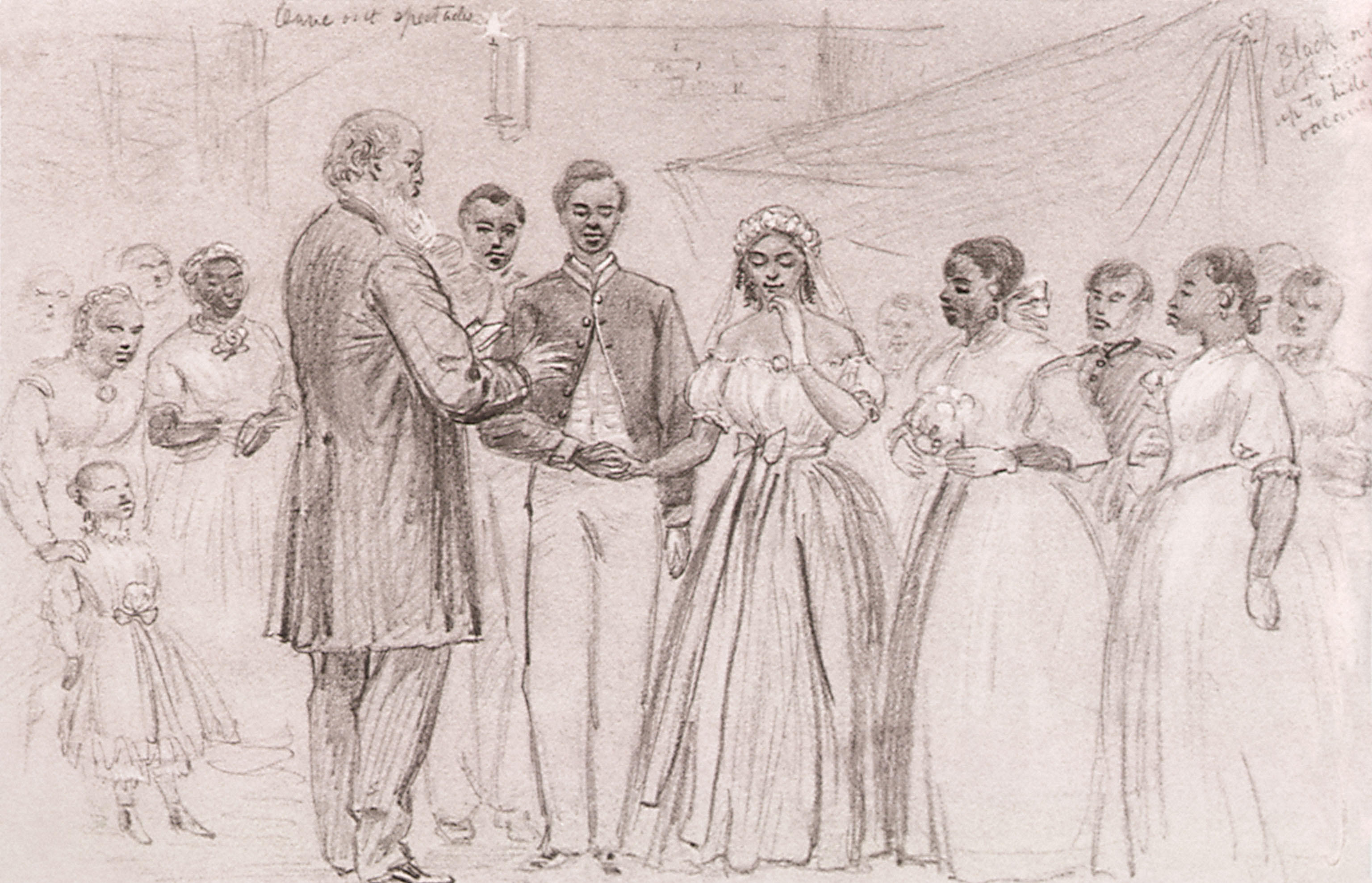
More information
“Marriage of a Colored Soldier at Vicksburg,” a sketch of a wedding ceremony by Alfred R. Waud soon after the end of the Civil War. A bride and her groom stand in front of a priest who reads from a small book. The bride wears an off-the-shoulder dress with a bow around her waist, a flower crown, and a veil, while the groom wears his unifroms. Around the couple are women, children, and soldiers. It appears that all are black, but because it is a black and white pencil sketch, it is hard to distinguish.Church and School
At the same time, blacks abandoned white-controlled religious institutions to create churches of their own. On the eve of the Civil War, 42,000 black Methodists worshiped in biracial South Carolina churches; by the end of Reconstruction, only 600 remained. The rise of the independent black church, with Methodists and Baptists commanding the largest followings, redrew the religious map of the South. As the major institution independent of white control, the church played a central role in the black community. A place of worship, it also housed schools, social events, and political gatherings. Black ministers came to play a major role in politics. Some 250 held public office during Reconstruction.
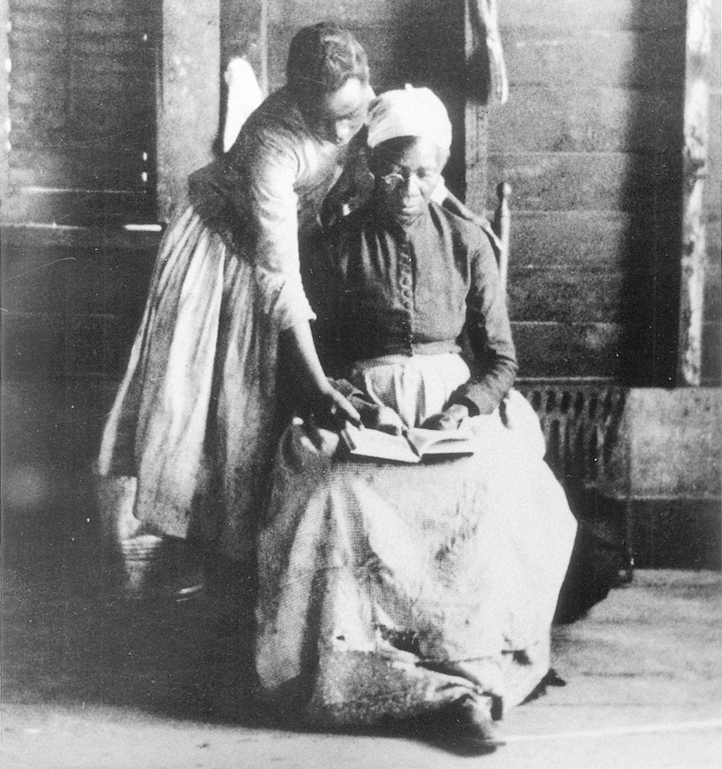
More information
Mother and Daughter Reading, Mt. Meigs, Alabama, an 1890 photograph by Rudolph Eickemeyer. During Reconstruction and for years thereafter, former slaves exhibited a deep desire for education, and learning took place outside of school as well as within.Another striking example of the freedpeople’s quest for individual and community improvement was their desire for education. Education, declared a Mississippi freedman, was “the next best thing to liberty.” The thirst for learning sprang from many sources—a desire to read the Bible, the need to prepare for the economic marketplace, and the opportunity, which arose in 1867, to take part in politics. Blacks of all ages flocked to the schools established by northern missionary societies, the Freedmen’s Bureau, and groups of ex-slaves. Northern journalist Sidney Andrews, who toured the South in 1865, was impressed by how much education also took place outside of the classroom: “I had occasion very frequently to notice that porters in stores and laboring men in warehouses, and cart drivers on the streets, had spelling books with them, and were studying them during the time they were not occupied with their work.” Reconstruction also witnessed the creation of the nation’s first black colleges, including Fisk University in Tennessee, Hampton Institute in Virginia, and Howard University in the nation’s capital.
Political Freedom
In a society that had made political participation a core element of freedom, the right to vote inevitably became central to the former slaves’ desire for empowerment and equality. As Frederick Douglass put it soon after the South’s surrender in 1865, “Slavery is not abolished until the black man has the ballot.” In a “monarchial government,” Douglass explained, no “special” disgrace applied to those denied the right to vote. But in a democracy, “where universal suffrage is the rule,” excluding any group meant branding them with “the stigma of inferiority.” As soon as the Civil War ended, and in some parts of the South even earlier, free blacks and emancipated slaves claimed a place in the public sphere. They came together in conventions, parades, and petition drives to demand the right to vote and, on occasion, to organize their own “freedom ballots.” Anything less than full citizenship, black spokesmen insisted, would betray the nation’s democratic promise and the war’s meaning.
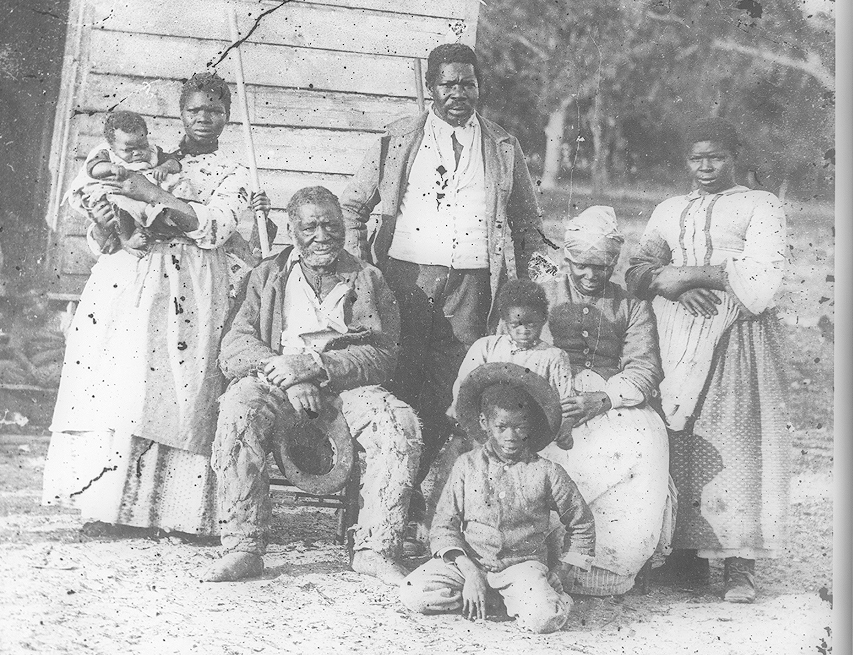
More information
Five Generations of a Black Family, an 1862 photograph that suggests the power of family ties among emancipated slavesLand, Labor, and Freedom
Former slaves’ ideas of freedom, like those of rural people throughout the world, were directly related to landownership. Only land, wrote Merrimon Howard, a freedman from Mississippi, would enable “the poor class to enjoy the sweet boon of freedom.” On the land they would develop independent communities free of white control. Many former slaves insisted that through their unpaid labor, they had acquired a right to the land. “The property which they hold,” declared an Alabama black convention, “was nearly all earned by the sweat of our brows.” In some parts of the South, blacks in 1865 seized property, insisting that it belonged to them. On one Tennessee plantation, former slaves claimed to be “joint heirs” to the estate and, the owner complained, took up residence “in the rooms of my house.”
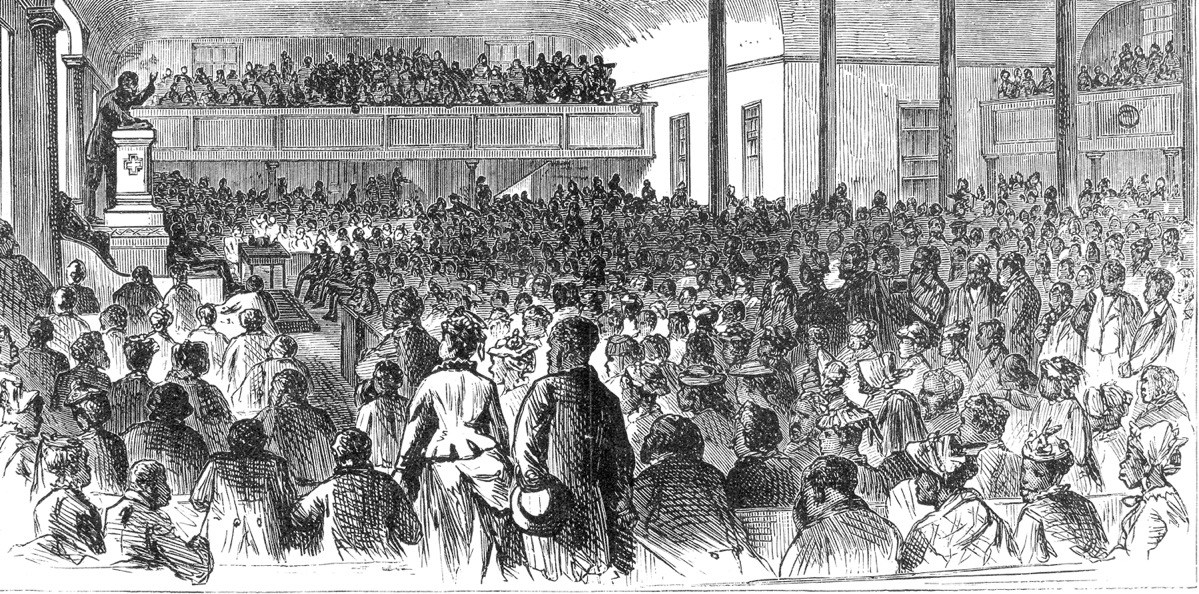
More information
The First African Church, Richmond, as depicted in Harper’s Weekly, June 27, 1874. The establishment of independent black churches was an enduring accomplishment of Reconstruction.THE BARROW PLANTATION
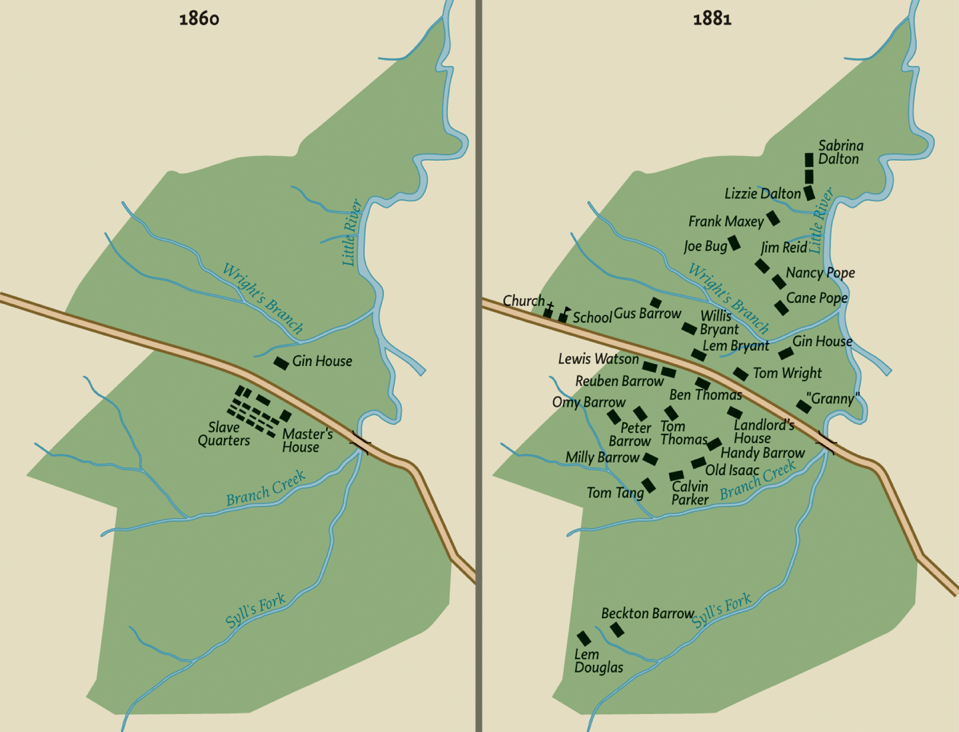
More information
THE BARROW PLANTATION Two maps of the Barrow plantation illustrate the effects of emancipation on rural life in the South. In 1860, slaves lived in communal quarters near the owner’s house. Twenty years later, former slaves working as sharecroppers lived scattered across the plantation and had their own church and school. The map of 1860 shows a large plot of land with a road going through the center. Along the road is a square labeled “Master’s House” and several rows of smaller rectangles labeled “Slave Quarters.” The master’s house, slave quarters, and large outbuildings are in close proximity. A rectangle labeled “Gin House” is on the other slide of the road. The rest of the plot shows lines where creeks and rivers are but no other dwellings or outbuildings. The map of 1881 shows the same plot of land and road dividing it. The square formerly labeled “Master’s House” is now labeled “Landlord’s House.” All of the former slave quarters and outbuildings are no longer shown. Thirteen rectangles on one side of the road show the residences of individuals, each labeled with a name. On the other side of the road there are thirteen more rectangles, also with name labels. None of these residences are in any particular proximity to the landlord’s house. The gin house has moved slightly and there are an additional two buildings labeled “School” and “Church.”In its individual elements and much of its language, former slaves’ definition of freedom resembled that of white Americans—self-ownership, family stability, religious liberty, political participation, and economic autonomy. But these elements combined to form a vision very much their own. For whites, freedom, no matter how defined, was a given, a birthright to be defended. For African-Americans, it was an open-ended process, a transformation of every aspect of their lives and of the society and culture that had sustained slavery in the first place. Although the freedpeople failed to achieve full freedom as they understood it, their definition did much to shape national debate during the turbulent era of Reconstruction.
Masters without Slaves
Most white southerners reacted to military defeat and emancipation with dismay, not only because of the widespread devastation but also because they must now submit to northern demands. “The demoralization is complete,” wrote a Georgia girl. “We are whipped, there is no doubt about it.” The appalling loss of life, a disaster without parallel in the American experience, affected all classes of southerners. Nearly 260,000 men died for the Confederacy—more than one-fifth of the South’s adult male white population. The wholesale destruction of work animals, farm buildings, and machinery ensured that economic revival would be slow and painful. In 1870, the value of property in the South, not counting that represented by slaves, was 30 percent lower than before the war.
More information
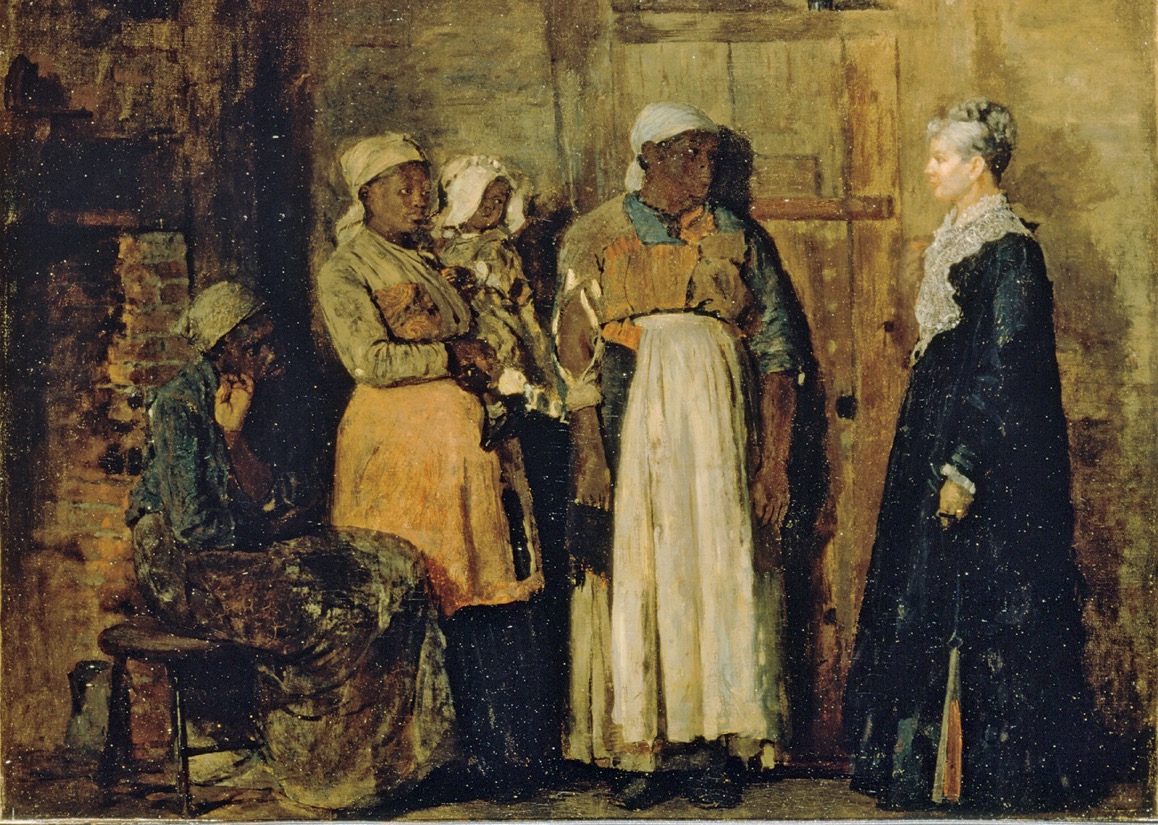
Winslow Homer’s 1876 painting, A Visit from the Old Mistress, depicts an imaginary meeting between a southern white woman and her former slaves. Their stance and gaze suggest the tensions arising from the birth of a new social order. Homer places his subjects on an equal footing, yet maintains a space of separation between them. He exhibited the painting to acclaim at the Paris Universal Exposition in 1878.Planter families faced profound changes in the war’s aftermath. Many lost not only their slaves but also their life savings, which they had patriotically invested in now-worthless Confederate bonds. Some, whose slaves departed the plantation, for the first time found themselves compelled to do physical labor. General Braxton Bragg returned to his “once prosperous” Alabama home to find “all, all was lost, except my debts.” Bragg and his wife, a woman “raised in affluence,” lived for a time in a slave cabin.
Southern planters sought to implement an understanding of freedom quite different from that of the former slaves. As they struggled to accept the reality of emancipation, most planters defined black freedom in the narrowest manner. As journalist Sidney Andrews discovered late in 1865, “The whites seem wholly unable to comprehend that freedom for the negro means the same thing as freedom for them. They readily enough admit that the government has made him free, but appear to believe that they have the right to exercise the same old control.” To southern leaders, freedom still meant hierarchy and mastery; it was a privilege not a right, a carefully defined legal status rather than an open-ended entitlement. Certainly, it implied neither economic autonomy nor civil and political equality. A Kentucky newspaper summed up the stance of much of the white South: the former slave was “free, but free only to labor.”
The Free Labor Vision
Along with former slaves and former masters, the victorious Republican North tried to implement its own vision of freedom. Central to its definition was the antebellum principle of free labor, now further strengthened as a definition of the good society by the Union’s triumph. In the free labor vision of a reconstructed South, emancipated blacks, enjoying the same opportunities for advancement as northern workers, would labor more productively than they had as slaves. At the same time, northern capital and migrants would energize the economy. The South would eventually come to resemble the “free society” of the North, complete with public schools, small towns, and independent farmers. Unified on the basis of free labor, proclaimed Carl Schurz, a refugee from the failed German revolution of 1848 who rose to become a leader of the Republican Party, America would become “a republic, greater, more populous, freer, more prosperous, and more powerful” than any in history.
With planters seeking to establish a labor system as close to slavery as possible, and former slaves demanding economic autonomy and access to land, a long period of conflict over the organization and control of labor followed on plantations throughout the South. It fell to the Freedmen’s Bureau, an agency established by Congress in March 1865, to attempt to establish a working free labor system.
The Freedmen’s Bureau
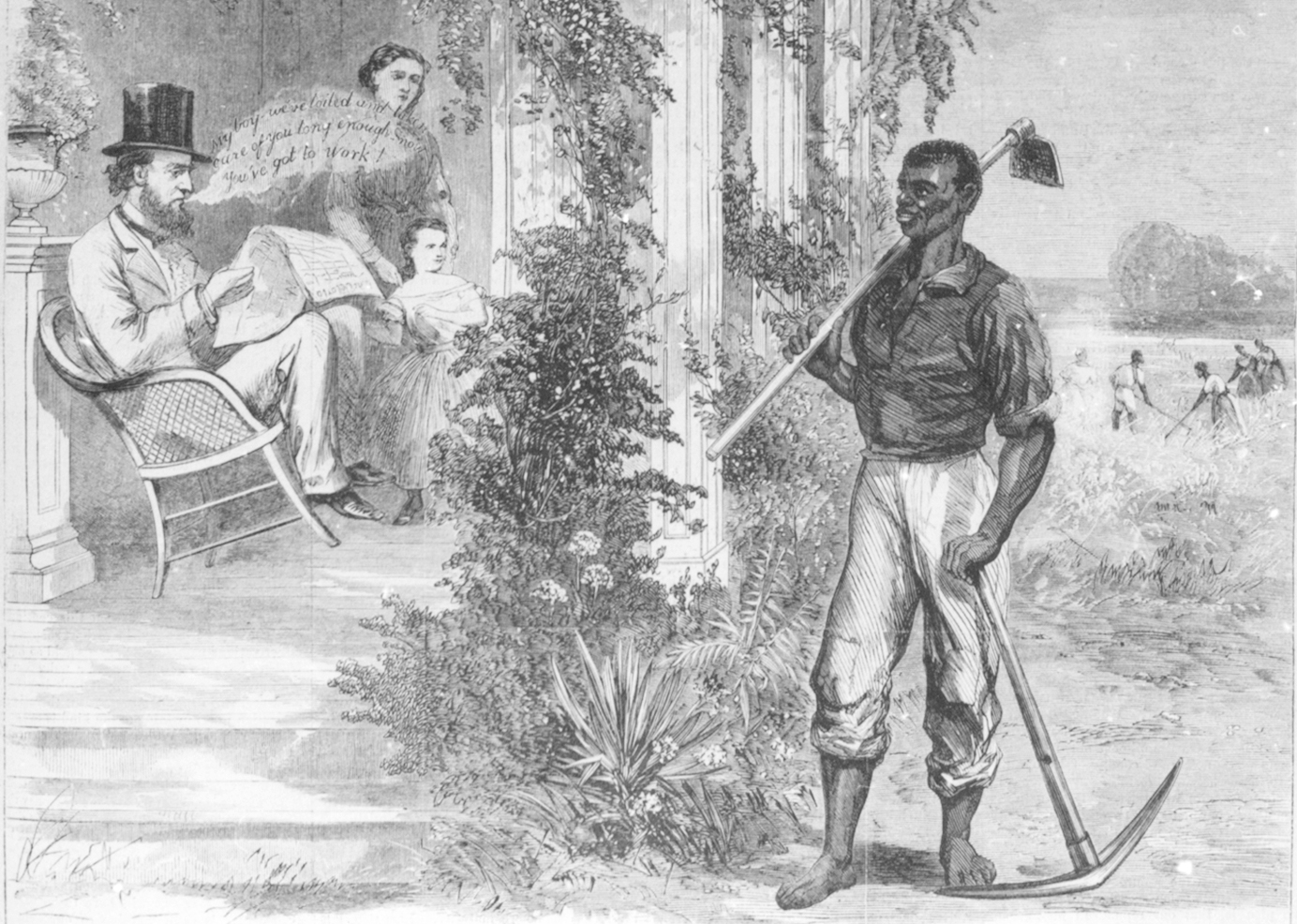
Under the direction of O. O. Howard, a graduate of Bowdoin College in Maine and a veteran of the Civil War, the Bureau took on responsibilities that can only be described as daunting. The Bureau was an experiment in government social policy that seems to belong more comfortably to the New Deal of the 1930s or the Great Society of the 1960s (see Chapters 21 and 25, respectively) than to nineteenth-century America. Bureau agents were supposed to establish schools, provide aid to the poor and aged, settle disputes between whites and blacks and among the freedpeople, and secure for former slaves and white Unionists equal treatment before the courts. “It is not . . . in your power to fulfill one-tenth of the expectations of those who framed the Bureau,” General William T. Sherman wrote to Howard. “I fear you have Hercules’ task.”
More information
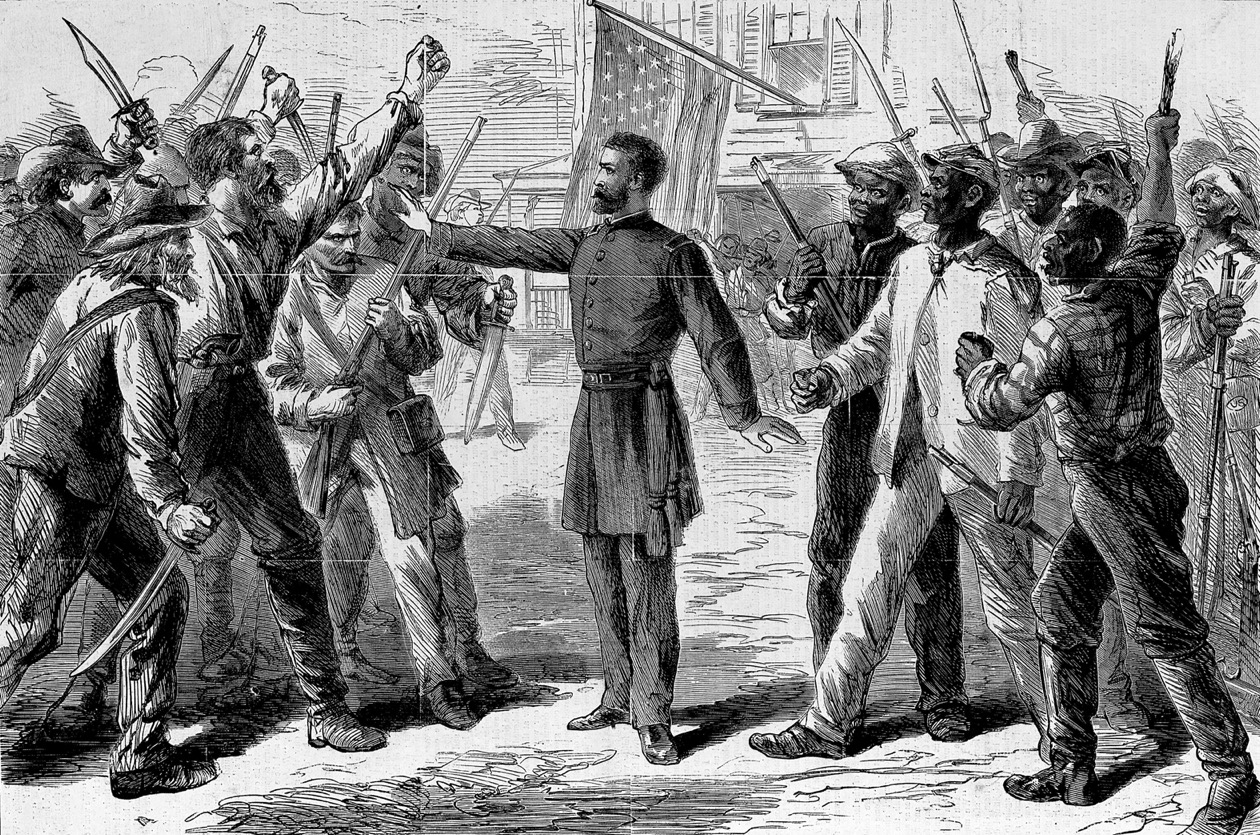
The Freedmen’s Bureau, an engraving from Harper’s Weekly, July 25, 1868, depicts the Bureau agent as a promoter of racial peace in the violent postwar South.The Bureau lasted from 1865 to 1870. Even at its peak, there were fewer than 1,000 agents in the entire South. Nonetheless, the Bureau’s achievements in some areas, notably education and health care, were striking. While the Bureau did not establish schools itself, it coordinated and helped to finance the activities of northern societies committed to black education. By 1869, nearly 3,000 schools, serving more than 150,000 pupils in the South, reported to the Bureau. Bureau agents also assumed control of hospitals established by the army during the war, and expanded the system into new communities. They provided medical care to both black and white southerners. In economic relations, however, the Bureau’s activities proved far more problematic.
More information
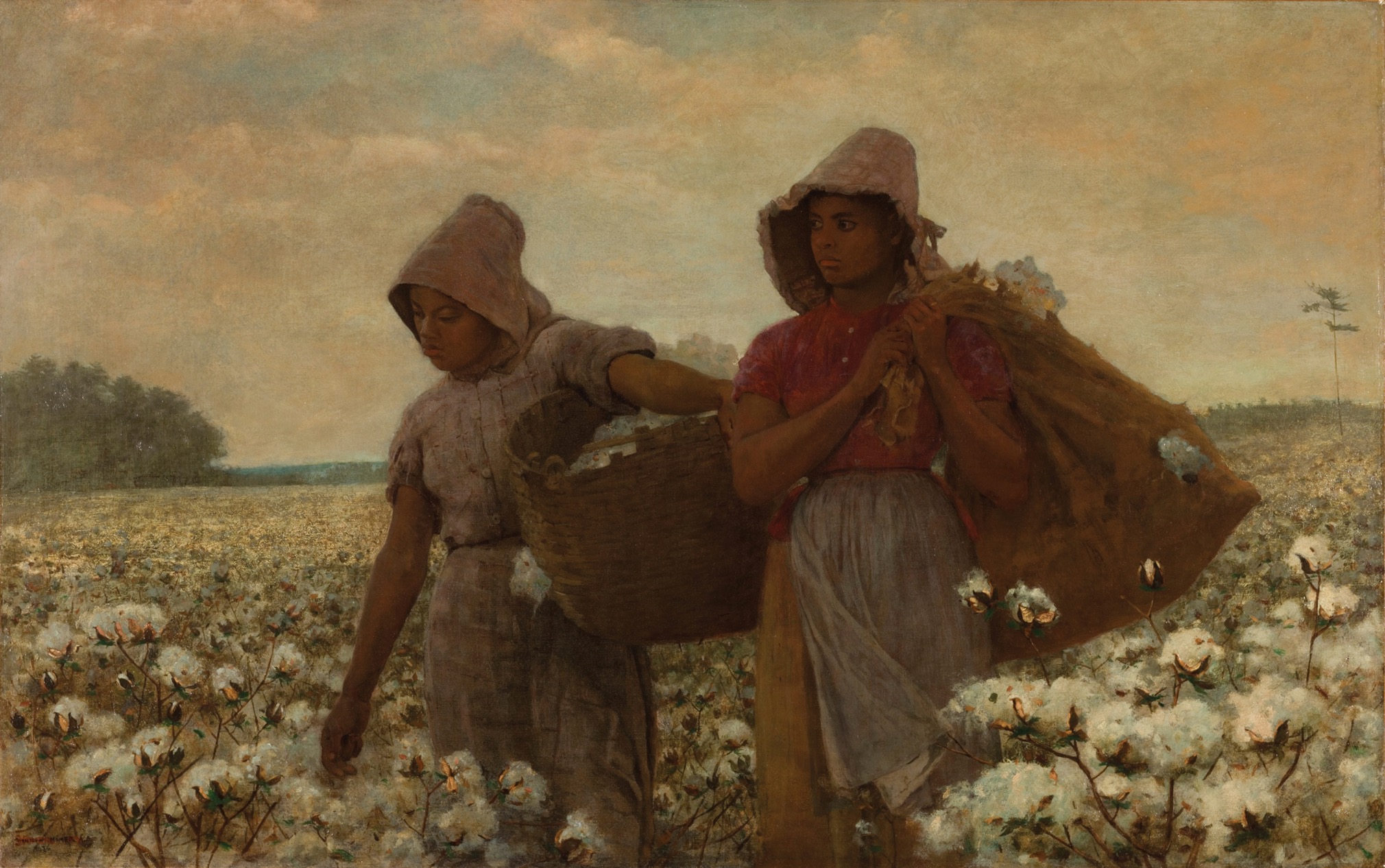
“he Cotton Pickers,” Winslow Homer. Oil on canvas, 1876. Depicts two African American women picking cotton. Homer is known for being the first artist to approach African Americans as subjects for paintings. The painting is in the realist style, contrasting to the caricature style of portraits being painted during and after the Civil War period.The Failure of Land Reform
The idea of free labor, wrote one Bureau agent, was “the noblest principle on earth.” All that was required to harmonize race relations in the South was fair wages, good working conditions, and the opportunity to improve the laborer’s situation in life. But blacks wanted land of their own, not jobs on plantations. One provision of the law establishing the Bureau gave it the authority to divide abandoned and confiscated land into forty-acre plots for rental and eventual sale to the former slaves.
More information
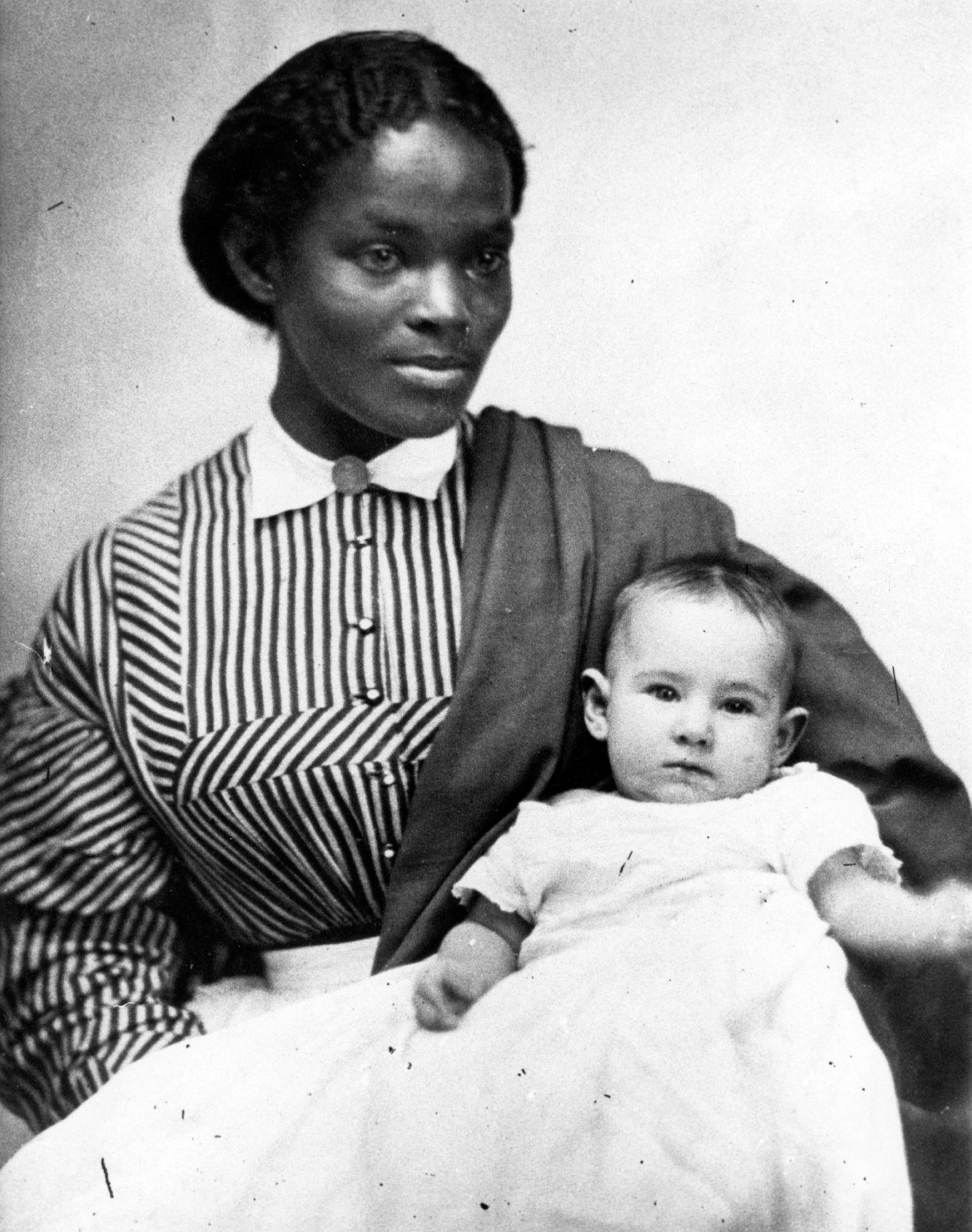
A nursemaid and her charge, from a daguerreotype around 1865.In the summer of 1865, however, President Andrew Johnson, who had succeeded Lincoln, ordered nearly all land in federal hands returned to its former owners. A series of confrontations followed, notably in South Carolina and Georgia, where the army forcibly evicted blacks who had settled on “Sherman land.” When O. O. Howard, head of the Freedmen’s Bureau, traveled to the Sea Islands to inform blacks of the new policy, he was greeted with disbelief and protest. A committee of former slaves drew up petitions to Howard and President Johnson. “We want Homesteads,” they declared, “we were promised Homesteads by the government.” Land, the freedmen insisted, was essential to the meaning of freedom. Without it, they declared, “we have not bettered our condition” from the days of slavery—“you will see, this is not the condition of really free men.”
Because no land distribution took place, the vast majority of rural freedpeople remained poor and without property during Reconstruction. They had no alternative but to work on white-owned plantations, often for their former owners. Far from being able to rise in the social scale through hard work, black men were largely confined to farm work, unskilled labor, and service jobs, and black women to positions in private homes as cooks and maids. Their wages remained too low to allow for any accumulation. By the turn of the century, a significant number of southern African-Americans had managed to acquire small parcels of land. But the failure of land reform produced a deep sense of betrayal that survived among the former slaves and their descendants long after the end of Reconstruction. “No sir,” Mary Gaffney, an elderly ex-slave, recalled in the 1930s, “we were not given a thing but freedom.”
SHARECROPPING IN THE SOUTH, 1880
More information
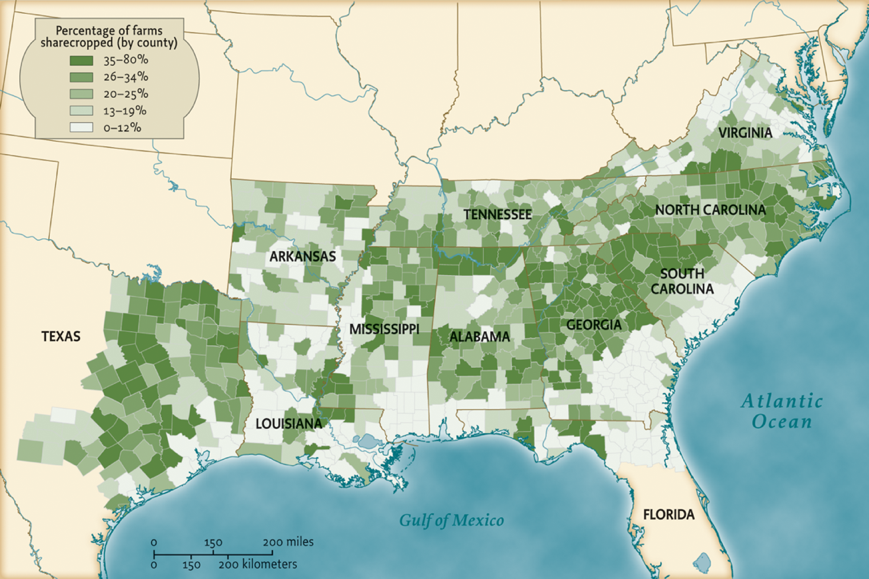
SHARECROPPING IN THE SOUTH, 1880 By 1880, sharecropping had become the dominant form of agricultural labor in large parts of the South. The system involved both white and black farmers. Shown are the states of Virginia, North Carolina, South Carolina, Georgia, Alabama, Florida, Tennessee, Mississippi, Arkansas, Louisiana, and Texas. Each state is shown divided into counties. A key shows a gradient from dark to light of the percentages of farms sharecropped. The darkest color shows thirty-five to eighty percent, the next darkest color shows twenty-six to thirty-four percent. The middle color shows twenty to twenty-five percent. The next lightest color shows thirteen to nineteen percent, and the lightest color shows zero to twelve percent. The greatest percentage of sharecropped farms is shown in the states of North Carolina, western South Carolina, northern Georgia, Tennessee, and eastern Texas. Lighter percentages of sharecropping are shown in Virginia, Alabama, Arkansas, and Mississippi. The states with the lightest percentage of sharecropped farms are Florida, eastern South Carolina, southern Georgia, southern Mississippi, and Louisiana.Toward a New South
Out of the conflict on the plantations, new systems of labor emerged in the different regions of the South. The task system, under which workers were assigned daily tasks, completion of which ended their responsibilities for that day, survived in the rice kingdom of South Carolina and Georgia. Closely supervised wage labor predominated on the sugar plantations of southern Louisiana. Sharecropping came to dominate the Cotton Belt and much of the Tobacco Belt of Virginia and North Carolina.
More information
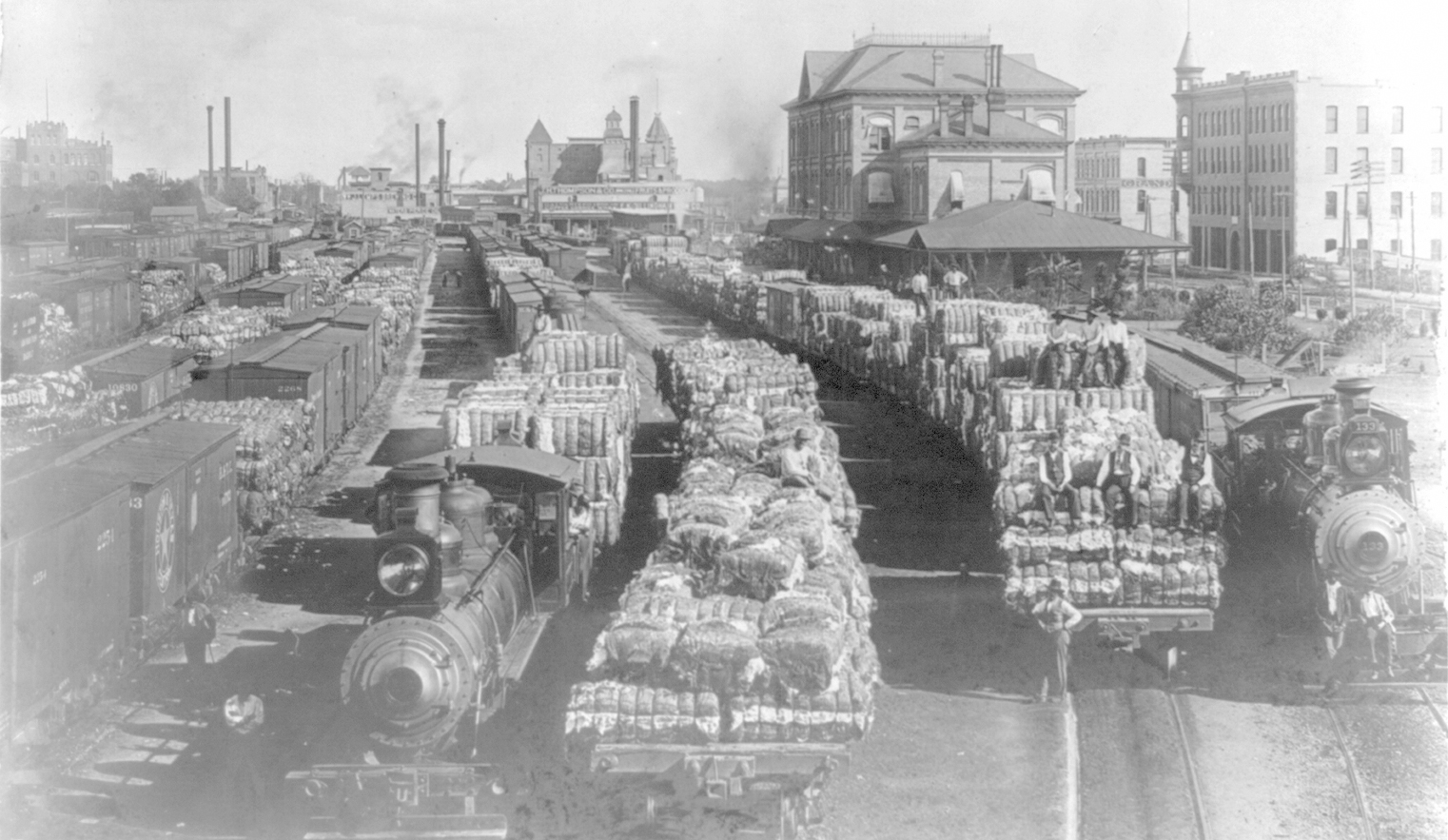
The cotton depot at Guthrie, Texas. Bales of cotton have been loaded onto trains for shipment. After the Civil War, more and more white farmers began growing cotton to support their families, permanently altering their formerly self-sufficient way of life.Sharecropping initially arose as a compromise between blacks’ desire for land and planters’ demand for labor discipline. The system allowed each black family to rent a part of a plantation, with the crop divided between worker and owner at the end of the year. Sharecropping guaranteed the planters a stable resident labor force. Former slaves preferred it to gang labor because it offered them the prospect of working without day-to-day white supervision. But as the years went on, sharecropping became more and more oppressive. Sharecroppers’ economic opportunities were severely limited by a world market in which the price of farm products suffered a prolonged decline.
The White Farmer
The plight of the small farmer was not confined to blacks in the postwar South. Wartime devastation set in motion a train of events that permanently altered the independent way of life of white yeomen, leading to what they considered a loss of freedom. Before the war, most small farmers had concentrated on raising food for their families and grew little cotton. With much of their property destroyed, many yeomen saw their economic condition worsened by successive crop failures after the war. To obtain supplies from merchants, farmers were forced to take up the growing of cotton and pledge a part of the crop as collateral (property the creditor can seize if a debt is not paid). This system became known as the crop lien. Since interest rates were extremely high and the price of cotton fell steadily, many farmers found themselves still in debt after marketing their portion of the crop at year’s end. They had no choice but to continue to plant cotton to obtain new loans. By the mid-1870s, white farmers, who cultivated only 10 percent of the South’s cotton crop in 1860, were growing 40 percent, and many who had owned their land had fallen into dependency as sharecroppers, who now rented land owned by others.
Both black and white farmers found themselves caught in the sharecropping and crop-lien systems. A far higher percentage of black than white farmers in the South rented land rather than owned it. But every census from 1880 to 1940 counted more white than black sharecroppers. The workings of sharecropping and the crop-lien system are illustrated by the case of Matt Brown, a Mississippi farmer who borrowed money each year from a local merchant. He began 1892 with a debt of $226 held over from the previous year. By 1893, although he produced cotton worth $171, Brown’s debt had increased to $402, because he had borrowed $33 for food, $29 for clothing, $173 for supplies, and $112 for other items. Brown never succeeded in getting out of debt. He died in 1905; the last entry under his name in the merchant’s account book is a coffin.
The Urban South
Even as the rural South stagnated economically, southern cities experienced remarkable growth after the Civil War. As railroads penetrated the interior, they enabled merchants in market centers like Atlanta to trade directly with the North, bypassing coastal cities that had traditionally monopolized southern commerce. A new urban middle class of merchants, railroad promoters, and bankers reaped the benefits of the spread of cotton production in the postwar South.
Thus, Reconstruction brought about profound changes in the lives of southerners, black and white, rich and poor. In place of the prewar world of master, slave, and self-sufficient yeoman, the postwar South was peopled by new social classes—landowning employers, black and white sharecroppers, cotton-producing white farmers, wage-earning black laborers, and urban entrepreneurs. Each of these groups turned to Reconstruction politics in an attempt to shape to its own advantage the aftermath of emancipation.
Aftermath of Slavery
Aftermath of Slavery
The United States, of course, was not the only society to confront the transition from slavery to freedom. Indeed, many parallels exist between the debates during Reconstruction and struggles that followed slavery in other parts of the Western Hemisphere over the same issues of land, control of labor, and political power. In every case, former planters (or, in Haiti, where the planter class had been destroyed, the government itself) tried to encourage or require former slaves to go back to work on plantations to grow the same crops as under slavery. Planters elsewhere held the same stereotypical views of black laborers as were voiced by their counterparts in the United States—former slaves were supposedly lazy, were lacking in ambition, and thought that freedom meant an absence of labor.
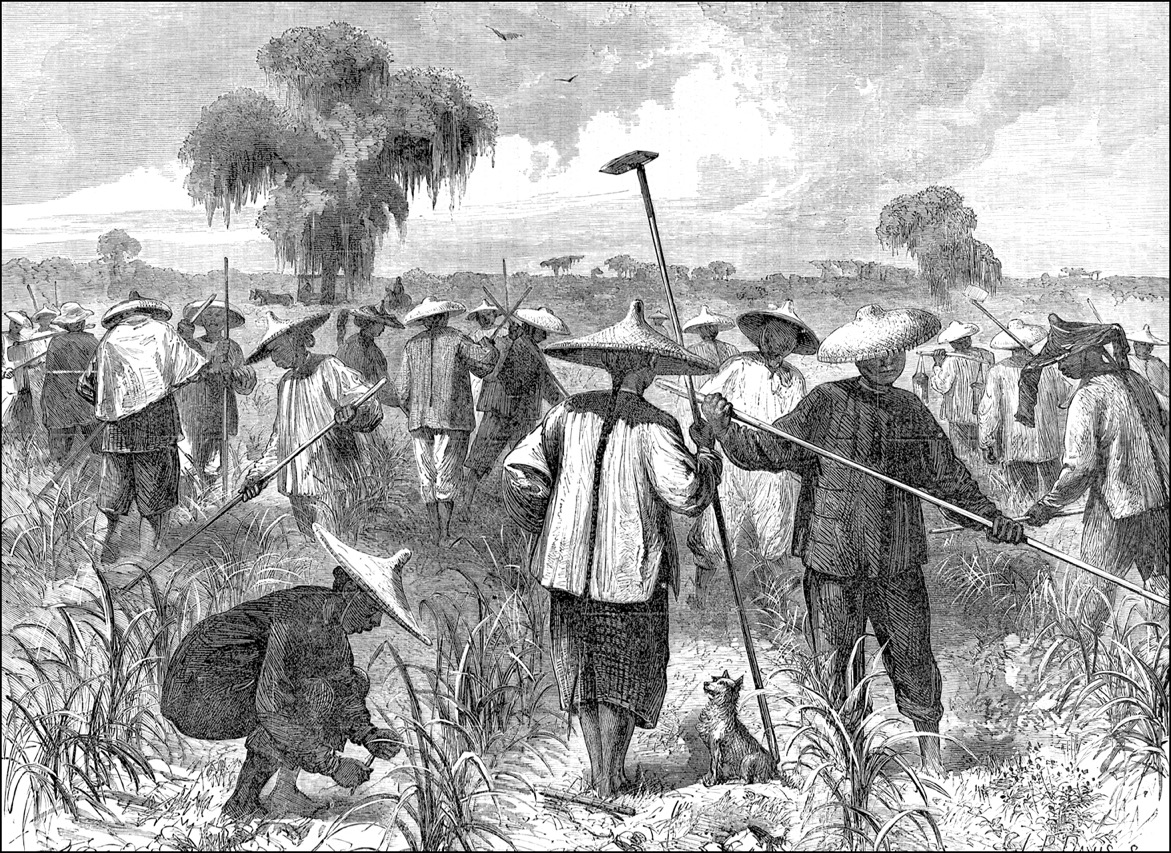
For their part, former slaves throughout the hemisphere tried to carve out as much independence as possible, both in their daily lives and in their labor. They attempted to reconstruct family life by withdrawing women and children from field labor (in the West Indies, women turned to marketing their families’ crops to earn income). Wherever possible, former slaves acquired land of their own and devoted more time to growing food for their families than to growing crops for the international market. In many places, the plantations either fell to pieces, as in Haiti, or continued operating with a new labor force composed of indentured servants from India and China, as in Jamaica, Trinidad, and British Guiana. Southern planters in the United States brought in a few Chinese laborers in an attempt to replace freedmen, but since the federal government opposed such efforts, the Chinese remained only a tiny proportion of the southern workforce.
VOICES OF FREEDOM
From PETITION OF COMMITTEE IN BEHALF OF THE FREEDMEN TO ANDREW JOHNSON (1865)
In the summer of 1865, President Andrew Johnson ordered land that had been distributed to freed slaves in South Carolina and Georgia returned to its former owners. A committee of freedmen drafted a petition asking for the right to obtain land. Johnson did not, however, change his policy.
We the freedmen of Edisto Island, South Carolina, have learned from you through Major General O. O. Howard . . . with deep sorrow and painful hearts of the possibility of [the] government restoring these lands to the former owners. We are well aware of the many perplexing and trying questions that burden your mind, and therefore pray to god (the preserver of all, and who has through our late and beloved President [Lincoln’s] proclamation and the war made us a free people) that he may guide you in making your decisions and give you that wisdom that cometh from above to settle these great and important questions for the best interests of the country and the colored race.
Here is where secession was born and nurtured. Here is where we have toiled nearly all our lives as slaves and treated like dumb driven cattle. This is our home, we have made these lands what they were, we are the only true and loyal people that were found in possession of these lands. We have been always ready to strike for liberty and humanity, yea to fight if need be to preserve this glorious Union. Shall not we who are freedmen and have always been true to this Union have the same rights as are enjoyed by others? . . . Are not our rights as a free people and good citizens of these United States to be considered before those who were found in rebellion against this good and just government? . . .
[Are] we who have been abused and oppressed for many long years not to be allowed the privilege of purchasing land but be subject to the will of these large land owners? God forbid. Land monopoly is injurious to the advancement of the course of freedom, and if government does not make some provision by which we as freedmen can obtain a homestead, we have not bettered our condition. . . .
We look to you . . . for protection and equal rights with the privilege of purchasing a homestead—a homestead right here in the heart of South Carolina.
More information
Chinese laborers at work on a Louisiana plantation during Reconstruction.But if struggles over land and labor united its postemancipation experience with that of other societies, in one respect the United States was unique. Only in the United States were former slaves, within two years of the end of slavery, granted the right to vote and, thus, given a major share of political power. Few anticipated this development when the Civil War ended. It came about as the result of one of the greatest political crises of American history—the battle between President Andrew Johnson and Congress over Reconstruction. The struggle resulted in profound changes in the nature of citizenship, the structure of constitutional authority, and the meaning of American freedom.
Glossary
-
Reconstruction agency established in 1865 to protect the legal rights of former slaves and to assist with their education, jobs, health care, and landowning.
-
Credit extended by merchants to tenants based on their future crops; under this system, high interest rates and the uncertainties of farming often led to inescapable debts.