 Origin of North American Slavery
ENTRENCHMENT OF AMERICAN SLAVERY
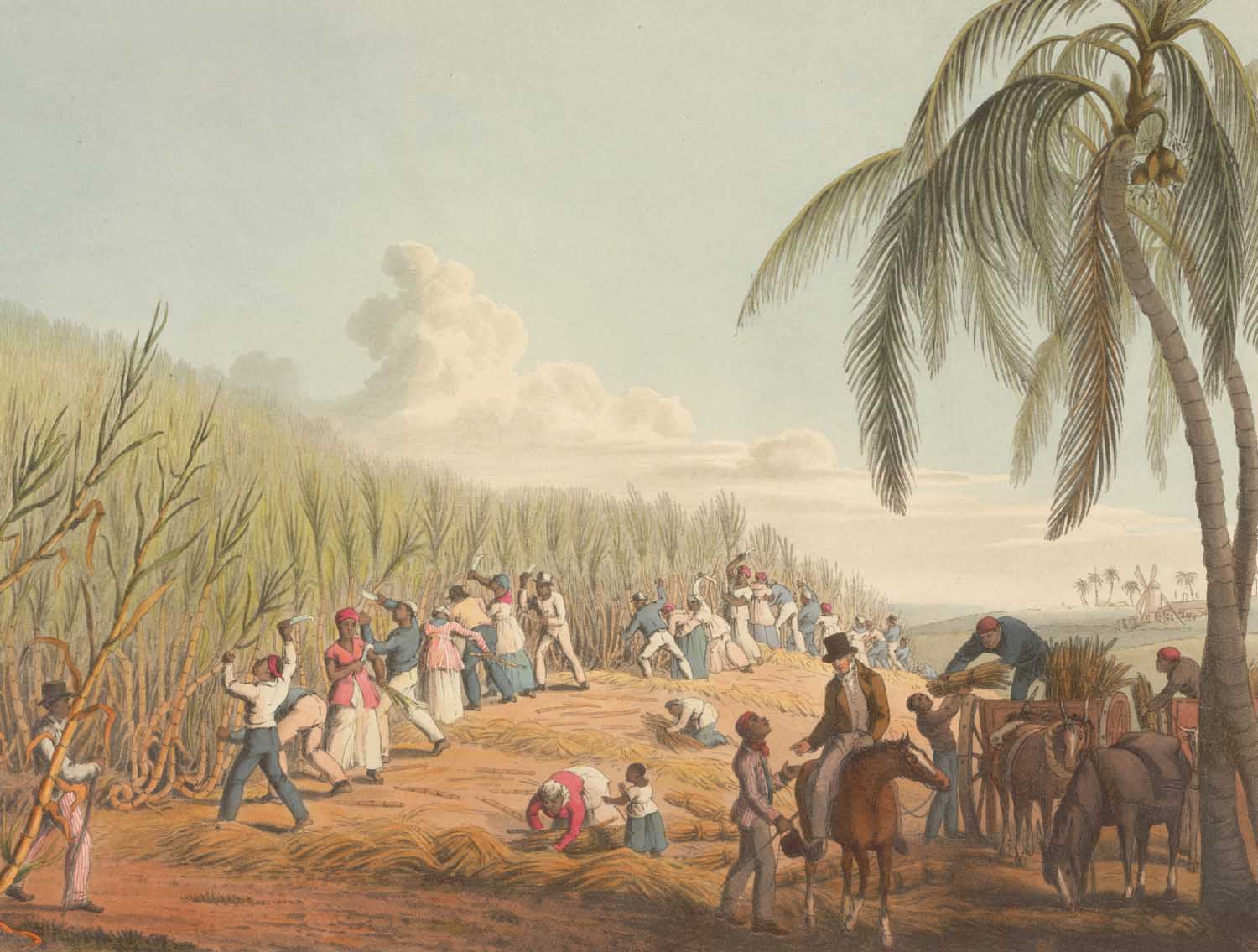
In the mid-1600s, slavery in mainland North America was a small-scale form of labor that existed alongside indentured and free laborers doing similar work. By the 1800s, it would become a deeply entrenched institution that touched every part of American life. Gradually, starting in the second half of the 1600s, some colonies developed plantations worked by hundreds of enslaved men and women and legalized their permanent oppression through severe legal codes. Colonies less dependent on slave labor began to benefit from the Atlantic trade that enslavement of Africans made possible.

VISIONS OF FREEDOM
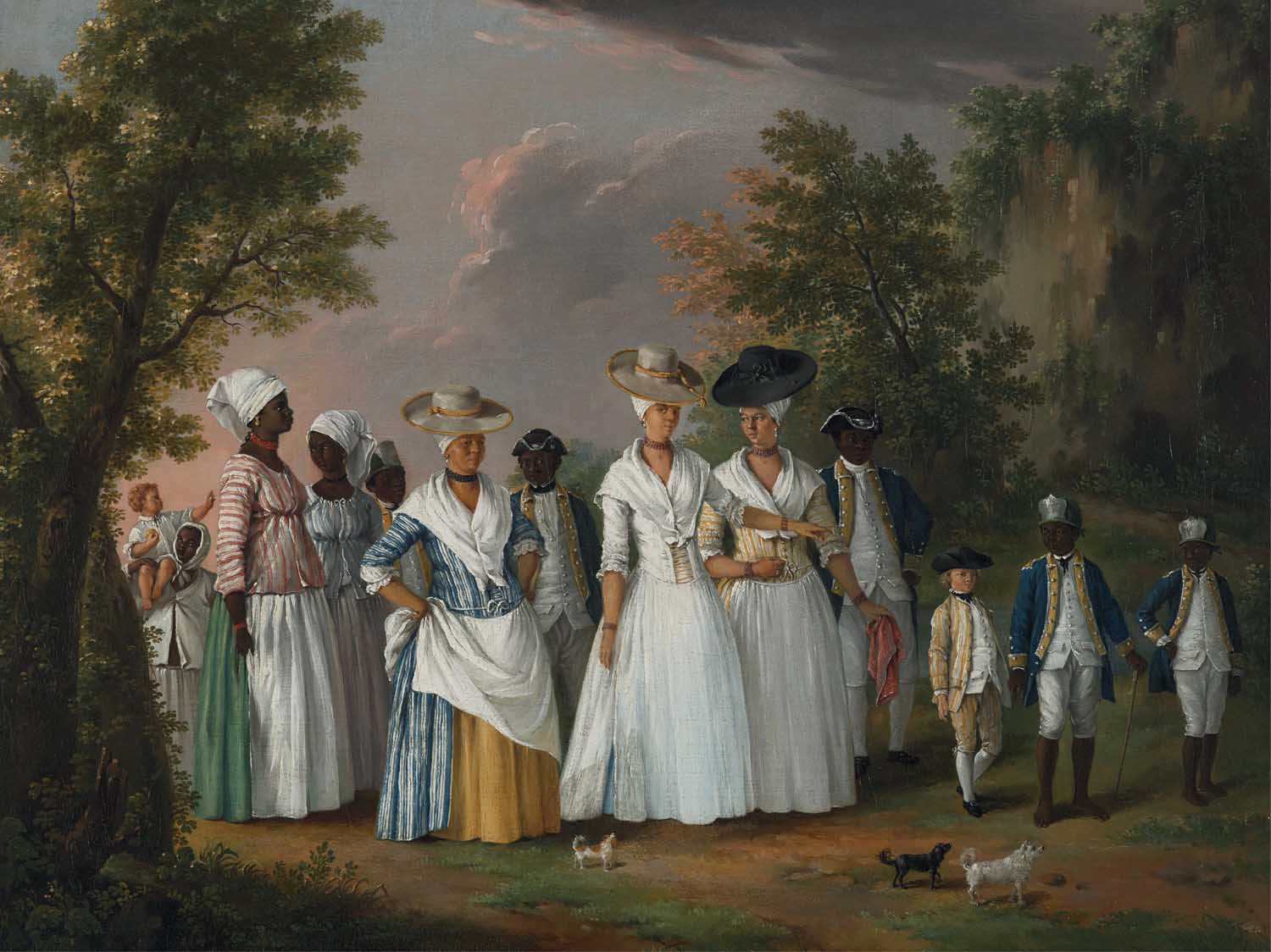
Free Women of Color with Their Children and Servants in a Landscape

Slavery and the Law
Eighteenth-Century Slaves’ Rights
Centuries before the voyages of Columbus, Spain had enacted Las Siete Partidas, a series of laws granting enslaved people certain rights relating to marriage, the holding of property, and access to freedom. These laws were transferred to Spain’s American empire. They were often violated, but nonetheless enslaved people used them to claim rights under the law. Moreover, the Catholic Church often encouraged slaveholders to free individual slaves, and military service was at times a route to freedom for enslaved men. The law of slavery in English North America would become far more repressive than in the Spanish empire, especially on the all-important question of whether avenues existed by which slaves could obtain freedom.
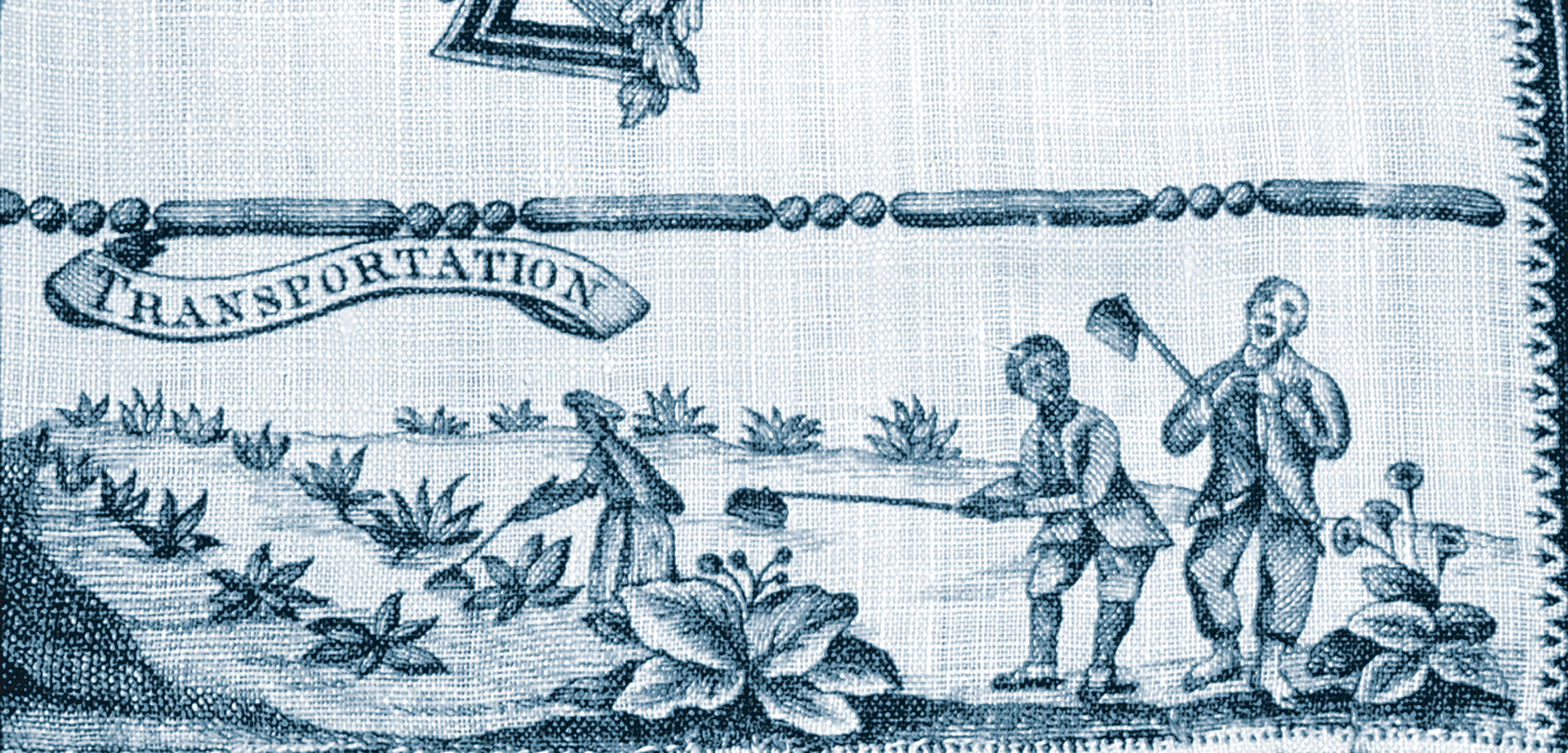
For much of the seventeenth century, however, the line between slavery and freedom in the English mainland colonies was more permeable than it would later become. Although seventeenth-century Black arrivals were treated as slaves, at least some managed to become free after serving a term of years. To be sure, racial distinctions were enacted into law from the outset and generally were stricter than in French, Spanish, and Dutch colonies. As early as the 1620s, the law barred Black men from serving in the Virginia militia. The government punished sexual relations outside of marriage between Africans and Europeans more severely than the same acts involving two white persons. In 1643, a poll tax (a tax levied on individuals) was imposed on African but not white women. In both Virginia and Maryland, however, free Black men could sue and testify in court, and some even managed to acquire land and purchase white servants or African slaves. Anthony Johnson, who apparently arrived in Virginia as a slave during the 1620s, obtained his freedom and by the 1640s was the owner of slaves and of several hundred acres of land on Virginia’s eastern shore. Blacks and whites labored side by side in the tobacco fields, sometimes ran away together, and established intimate relationships.
The Rise of Chesapeake Slavery
Evidence of Blacks being enslaved for life appears in the historical record of the 1640s. In registers of property, for example, white servants are listed by the number of years of labor, while Blacks, with higher valuations, have no terms of service associated with their names. Not until the 1660s, however, did the laws of Virginia and Maryland refer explicitly to slavery. As tobacco planting spread and the demand for labor increased, the condition of Black and white servants diverged sharply. Authorities sought to improve the status of white servants, hoping to counteract the widespread impression in England that Virginia was a death trap. At the same time, access to freedom for Blacks receded.
A Virginia law of 1662 provided that in the case of a child of a free person and a slave, the status of the offspring followed that of the mother. This provision not only reversed the European practice of defining a child’s status through the father but also made the sexual abuse of enslaved women profitable for slaveholders, since any children that resulted remained the owner’s property. In 1667, the Virginia House of Burgesses decreed that religious conversion did not release a slave from bondage. Thus, Christians could own other Christians as slaves. Moreover, authorities sought to prevent the growth of the free Black population by defining all offspring of interracial relationships as illegitimate, severely punishing white women who begat children with Black men, and prohibiting the freeing of any slave unless he or she was transported out of the colony. By 1680, even though the Black population was still small, notions of racial difference were well entrenched in the law. In England’s American empire, wrote one contemporary, “these two words, Negro and Slave [have] by custom grown homogenous and convertible.” In British North America, unlike the Spanish empire, no distinctive mixed-race class existed; the law treated everyone with African ancestry as Black.
Bacon’s Rebellion: Land and Labor in Virginia
Virginia’s shift from white indentured servants to African slaves as the main plantation labor force was accelerated by one of the most dramatic confrontations of this era, Bacon’s Rebellion of 1676. Governor William Berkeley had for thirty years run a corrupt regime in alliance with an inner circle of the colony’s wealthiest tobacco planters. He rewarded his followers with land grants and lucrative offices. At first, Virginia’s tobacco boom had benefited not only planters but also smaller farmers, some of them former servants who managed to acquire farms. But as tobacco farming spread inland, planters connected with the governor engrossed the best lands, leaving freed servants (a growing population, since Virginia’s death rate was finally falling) with no options but to work as tenants or to move to the frontier. At the same time, heavy taxes on tobacco and falling prices because of overproduction reduced the prospects of small farmers. By the 1670s, poverty among whites had reached levels reminiscent of England. In addition, the right to vote, previously enjoyed by all adult men, was confined to landowners in 1670. Governor Berkeley maintained peaceful relations with Virginia’s Native population. His refusal to encourage white settlement on Native land bordering Virginia angered many land-hungry colonists.
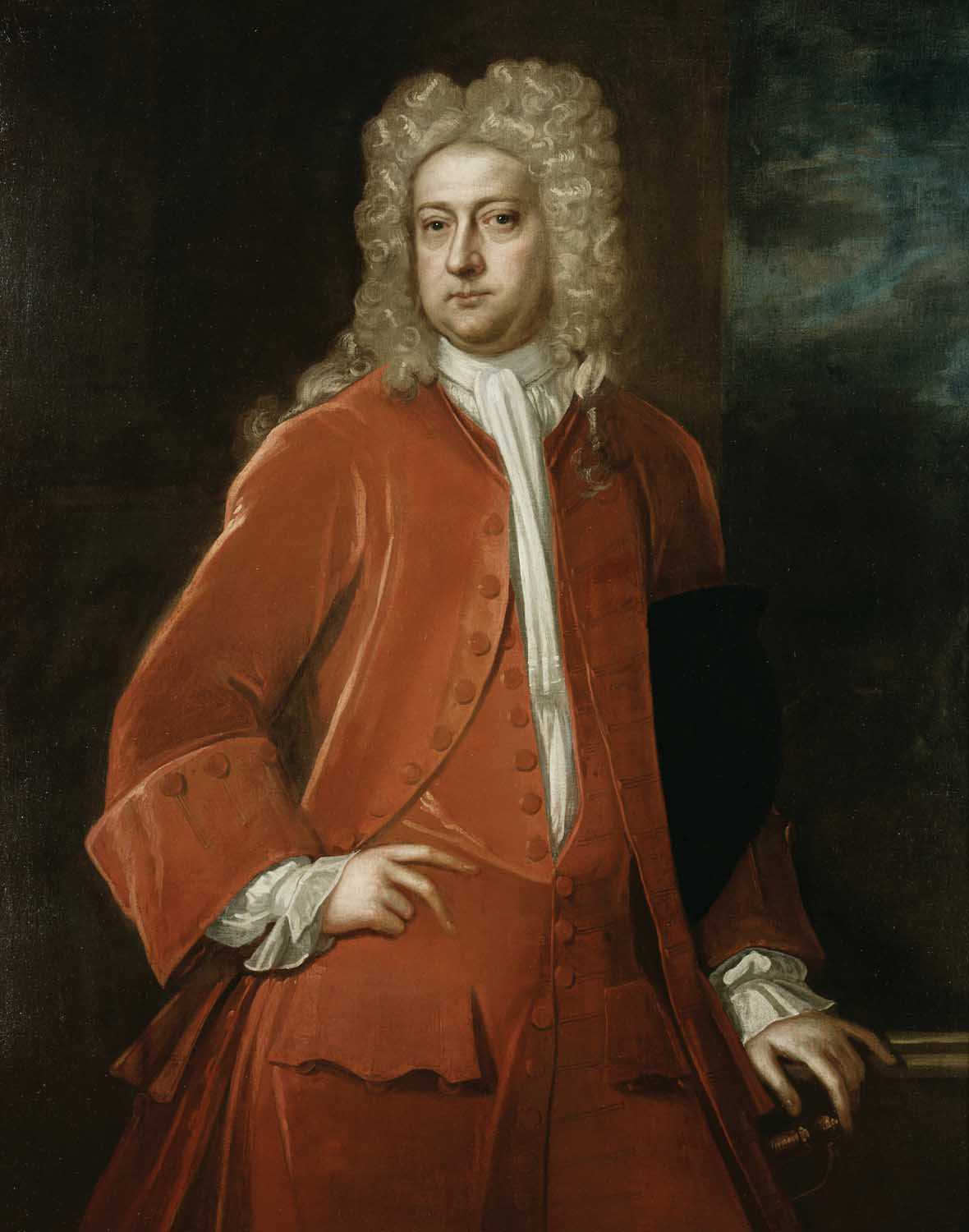
In 1676, long-simmering social tensions coupled with widespread resentment against the Berkeley regime erupted in Bacon’s Rebellion. The spark was a confrontation between colonists and Doeg and Susquehannock Indians. Settlers demanded that the governor authorize the extermination or removal of Indians on the colony’s borders to open more land for whites. Fearing all-out warfare and continuing to profit from the deerskin trade, Berkeley refused. An uprising followed, beginning with Bacon’s unauthorized and shocking massacre of Occaneechi allies of Virginia. It quickly grew into a full-fledged rebellion against Berkeley and his system of rule.
To some extent, Bacon’s Rebellion was a conflict within the Virginia elite. The leader, Nathaniel Bacon, a wealthy and ambitious planter who had arrived in Virginia in 1673, disdained Berkeley’s coterie as men of “mean education and employments.” His backers included men of wealth outside the governor’s circle of cronies. But Bacon’s call for the removal of all Indians from the colony, a reduction of taxes at a time of economic recession, and an end to rule by “grandees” rapidly gained support from small farmers, landless men, indentured servants, and even some Africans. The bulk of his army consisted of discontented men who had recently been servants.
VOICES OF FREEDOM
MARYLAND ACT CONCERNING NEGROES AND OTHER SLAVES (1664)
Like Virginia, Maryland in the 1660s enacted laws to clarify questions arising from the growing importance of slavery. This law made all Black servants in the colony slaves for life, and required a white woman who married an enslaved man to serve her husband’s owner.
Listen as you read
Be it enacted by the Right Honorable the Lord Proprietary by the advice and consent of the upper and lower house of this present General Assembly, that all Negroes or other slaves already within the province, and all Negroes and other slaves to be hereafter imported into the province, shall serve durante vita [for life]. And all children born of any Negro or other slave shall be slaves as their fathers were, for the term of their lives.
And forasmuch as divers freeborn English women, forgetful of their free condition and to the disgrace of our nation, marry Negro slaves, by which also divers suits may arise touching the issue [children] of such women, and a great damage befalls the masters of such Negroes for prevention whereof, for deterring such freeborn women from such shameful matches. Be it further enacted by the authority, advice, and consent aforesaid, that whatsoever freeborn woman shall marry any slave from and after the last day of this present Assembly shall serve the master of such slave during the life of her husband. And that all the issue of such freeborn women so married shall be slaves as their fathers were. And be it further enacted, that all the issues of English or other freeborn women that have already married Negroes shall serve the masters of their parents till they be thirty years of age and no longer.
LETTER BY AN INDENTURED SERVANT (March 20, 1623)
Only a minority of emigrants from Europe to the English colonies were fully free. Indentured servants were men and women who surrendered their freedom for a specified period of time in exchange for passage to the Americas. This letter that Richard Frethorne sent from Virginia to his parents in England expresses complaints voiced by many indentured servants.
Listen as you read
LOVING AND KIND FATHER AND MOTHER:
My most humble duty remembered to you, hoping in god of your good health, as I myself am. . . . This is to let you understand that I your child am in a most heavy case by reason of the country, [which] is such that it causeth much sickness, [such] as the scurvy and the bloody flux and divers [many] other diseases, which maketh the body very poor and weak. And when we are sick there is nothing to comfort us; for since I came out of the ship I never ate anything but peas, and loblollie (that is, water gruel). As for deer or venison I never saw any since I came into this land. . . . And I have nothing to comfort me, nor is there nothing to be gotten here but sickness and death, except [in the event] that one had money to lay out in some things for profit. But I have nothing at all—no, not a shirt to my back but two rags, nor clothes but one poor suit, nor but one pair of shoes, but one pair of stockings, but one cap, [and] but two bands [collars]. . . . And indeed so I find it now, to my great grief and misery; and [I] saith that if you love me you will redeem me suddenly, for which I do entreat and beg. And if you cannot get the merchants to redeem me for some little money . . . Wherefore, for God’s sake, pity me. I pray you to remember my love to all my friends and kindred. I hope all my brothers and sisters are in good health, and as for my part I have set down my resolution that certainly will be; that is, that the answer of this letter will be life or death to me.
ROT
Richard Frethorne
The End of the Rebellion and Its Consequences
Bacon promised freedom (including access to Indian lands) to all who joined his ranks. His supporters invoked the tradition of “English liberties” and spoke of the poor being “robbed” and “cheated” by their social superiors. In 1676, Bacon gathered an armed force for an unauthorized and indiscriminate campaign against those he called the governor’s “protected and darling Indians.” He refused Berkeley’s order to disband and marched on Jamestown, burning it to the ground. The governor fled, and Bacon became the ruler of Virginia. His forces plundered the estates of Berkeley’s supporters. Only the arrival of a squadron of warships from England restored order. Bacon’s Rebellion was over. Twenty-three of his supporters were hanged (Bacon himself had taken ill and died shortly after Berkeley’s departure).
The specter of a civil war among whites greatly frightened Virginia’s ruling elite, who took dramatic steps to consolidate their power and improve their image. They restored property qualifications for voting, which Bacon had rescinded. At the same time, planters developed a new political style in which they cultivated the support of poorer neighbors. Meanwhile, the authorities reduced taxes and began granting fifty acres of land to servants who completed their indentures.
English colonists united to expand their own freedoms at the expense of others. A more aggressive Indian policy took lands from Native peoples on Virginia’s borders and gave them to landless white Virginians, many of whom prospered from a rise in tobacco prices after 1680. To avert the further growth of a rebellious population of landless former indentured servants, Virginia’s authorities accelerated the shift to slaves (who would never become free) on the tobacco plantations.
A Slave Society
Between 1680 and 1700, slave labor began to supplant indentured servitude on Chesapeake plantations. Bacon’s Rebellion was only one among several factors that contributed to this development. As the death rate finally began to fall, it became more economical to purchase a laborer for life. Improving conditions in England reduced the number of transatlantic migrants, and the opening of Pennsylvania, where land was readily available, attracted those who still chose to leave for America. Finally, the ending of a monopoly on the English slave trade previously held by the Royal African Company opened the door to other traders and reduced the price of imported African slaves.
By 1700, Blacks constituted more than 10 percent of Virginia’s population. Fifty years later, they made up nearly half. Recognizing the growing importance of slavery, the House of Burgesses in 1705 enacted a new slave code, bringing together the scattered legislation of the previous century and adding new provisions that embedded the principle of white supremacy in the law. Slaves were property, completely subject to the will of their enslavers and, more generally, of the white community. They could be bought and sold, leased, fought over in court, and passed on to descendants. Henceforth, Blacks and whites were tried in separate courts. No Black person, free or enslaved, could own arms, strike a white man, or employ a white servant. Any white person could stop any Black to demand a certificate of freedom or a pass giving permission to be off the plantation. Virginia had changed from a “society with slaves,” in which slavery was one system of labor among others, to a “slave society,” where slavery stood at the center of the economic process.
Notions of Freedom
Throughout history, enslaved men and women have run away and in other ways resisted bondage. They did the same in the colonial Chesapeake. Colonial newspapers were filled with advertisements for runaway slaves. These notices described the appearance and skills of the person and included such comments as “ran away without any cause” or “he has great notions of freedom.” Some of the Blacks brought to the region during the seventeenth century were the offspring of sex between European traders and Africans on the western coast of Africa or the Caribbean. Familiar with European culture and fluent in English, they turned to the colonial legal system in their quest for freedom. Throughout the seventeenth century, Blacks appeared in court claiming their liberty, at first on the basis of conversion to Christianity or having a white father. This was one reason Virginia in the 1660s closed these pathways to freedom. But although legal avenues to liberty receded, the desire for freedom did not. After the suppression of a slave conspiracy in 1709, Alexander Spotswood, the governor of Virginia, warned planters to be vigilant. The desire for freedom, he reminded them, can “call together all those who long to shake off the fetters of slavery.”
Glossary
- Bacon’s Rebellion
- Unsuccessful 1676 revolt led by planter Nathaniel Bacon against British Governor of Virginia William Berkeley’s administration.
- divers
- The archaic word for “some” or “various.” Close in meaning to our word, “diverse.”
- forgetful of their free condition
- Of course, this wasn’t a literal use of “forgetful,” but rather a way to refer to women whom the law accused of “disgrace” and to shame a white woman who was in a relationship with a Black man to remember her place in society.
- as their fathers were
- Children of a previously free woman who married an enslaved man would also be enslaved. Compare this to the Virginia law that stated that the condition of the mother would define the condition of the child.
- scurvy and the bloody flux
- Both scurvy and the “bloody flux” (dysentery) were experienced by people without access to a healthy diet. Scurvy is caused by a lack of vitamin C for an extended period. However, many indentured servants often ate a nutrient-deficient diet as Frethorne described. Dysentery is a bacterial disease usually spread through contaminated food or water.
- lay out
- Frethorne means “items to sell.”
- redeem me suddenly
- As an indentured servant, Frethorne’s labor and liberty were sold to another for a period of time, usually seven years. Here he is asking his parents to pay the cost of the rest of his indenture so that he is free of the obligation to continue the arrangement.
- life or death
- It’s quite likely that Frethorne is not exaggerating here. Many indentured servants died from the harsh conditions and diseases of the era before their terms expired.
- durante vita
- This is in contrast to indentured servants who had a term of indenture (usually seven years), rather than a lifetime of enslavement.