How did Native American and European ideas of freedom differ on the eve of contact?
AN OLD WORLD: WEST AFRICA
Politics and Power in West Africa
Like Native Americans and Europeans, West Africans did not consider themselves all one people. West Africans spoke dozens of different languages and hundreds of dialects. They lived under a variety of different political systems. In the late medieval and early modern eras, most West Africans lived in towns centered on kinship and run by elders. As in Native America, women in many parts of West Africa were responsible for farming and land management.
Some parts of West Africa were ruled by large empires. Gaining power in the thirteenth century, the Mali empire became the largest in West Africa, with major cities at Jenne, Gao, and Timbuktu. To the south was the smaller kingdom of Benin, in what is now Nigeria. Its capital, Edo, was an imposing city whose craftspeople produced bronze sculptures that still inspire admiration for their artistic beauty and superb casting techniques.
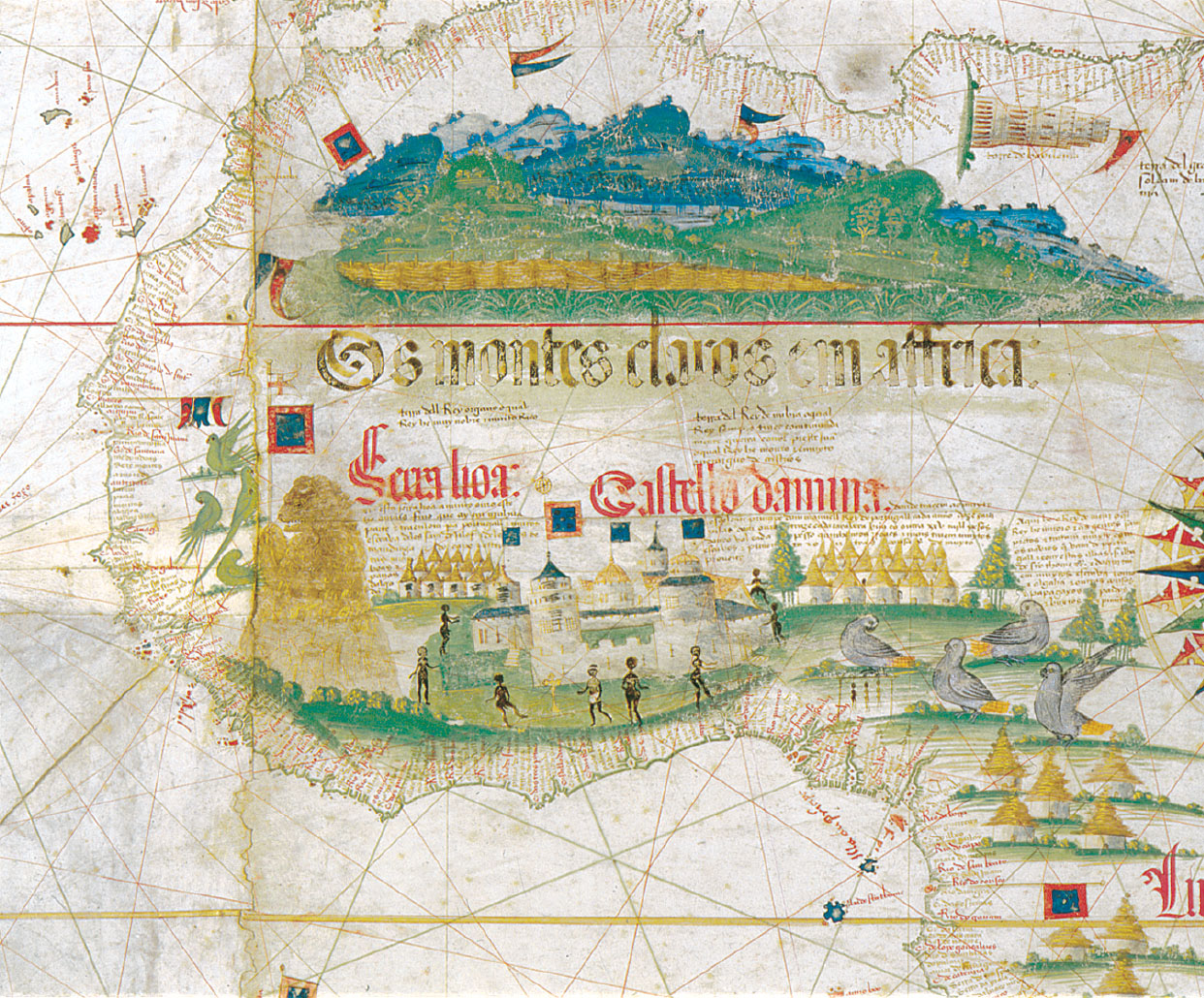
A detail from the Cantino World Map depicting the western coast of Africa at the beginning of the Atlantic slave trade. Created by an anonymous Portuguese mapmaker in 1502, the map included Europe, Africa, and a small part of the Western Hemisphere, described as “the islands lately discovered in the parts of India.” It was smuggled out of Portugal by Alberto Cantino, a diplomat representing an Italian city-state.
Economics and Trade in West Africa
The wealth of West African empires was built on trans-Saharan trade. Starting around the year 1000, Muslim traders from North Africa and the Middle East crossed the Sahara to trade with West Africa. Camel caravans carried spices, silks, and cotton south to exchange for West African products, including textiles, gold, copper, grains, nuts, and art. From North Africa, West African products reached markets in the Middle East, Asia, and Western Europe, inspiring interest among the Portuguese in establishing direct trade by sailing to West Africa.
Although connected to trading networks and regional politics, most West Africans farmed, herded, and fished locally for their living. The rice, millet, peas, okra, melons, and yams that they cultivated would spread around the world in the coming centuries, along with the products of the Americas, Europe, and Asia.
Religion in West Africa
North African traders also brought Islam to West Africa. The native religions of West Africa were well established and, like those in North America, inclusivist. Over time, many West Africans converted to Islam, in many cases blending older beliefs, practices, and rituals of planting and harvesting with Islamic doctrine. Leaders who converted to Islam built grand mosques in cities like Jenne.
Slavery and Freedom in West Africa
In addition to such products as textiles and gold, trans-Saharan trade also included enslaved people, usually war captives, criminals, or debtors. Slaves in West Africa generally worked within the households of their owners or on public works projects. They had well-defined rights, such as owning property and marrying free persons. It was not uncommon for African slaves to acquire their freedom. As in most parts of the world, slavery was one of several forms of labor, not the basis of the economy, as it would become in large parts of the Americas under colonization.
Many of West Africa’s rulers were converts to Islam, which forbade enslaving fellow Muslims. It allowed the enslavement of non-Muslims taken in war as long as the owner provided religious instruction to the slave. Thus, slavery was war-based and religion-based, but not race-based and not necessarily inherited.