 Three "Worlds" Meeting
What happened when the peoples of the Americas came in contact with Europeans?
CONTACT
Portugal and West Africa
The development of the caravel, a ship capable of long-distance travel, and of the compass and quadrant, devices that enabled sailors to determine their location and direction with greater accuracy than in the past, made it possible to sail down the coast of Africa and return to Portugal. In 1434, a Portuguese ship brought a sprig of rosemary from West Africa, proof that one could sail beyond the desert and return. Little by little, Portuguese ships moved farther down the coast, in 1485 reaching Benin. The Portuguese and their African trading partners established fortified trading posts on the coast. Their profits inspired other European powers to follow in their footsteps.
Portugal also began to colonize islands in the Atlantic off the African coast. Sugar plantations worked by Muslim captives and slaves from Eastern Europe had flourished in the Middle Ages on Mediterranean islands. Now, the Portuguese established plantations on the Atlantic islands, eventually replacing the Native populations with thousands of enslaved men and women from Africa, setting an ominous precedent.
The coming of the Portuguese, soon followed by traders from other European nations, accelerated the buying and selling of captives within West Africa. At least 100,000 Africans were transported to Spain and Portugal between 1450 and 1500. In 1502, the first Africans were shipped to islands in the Caribbean. The transatlantic slave trade will be discussed in Chapter 4.
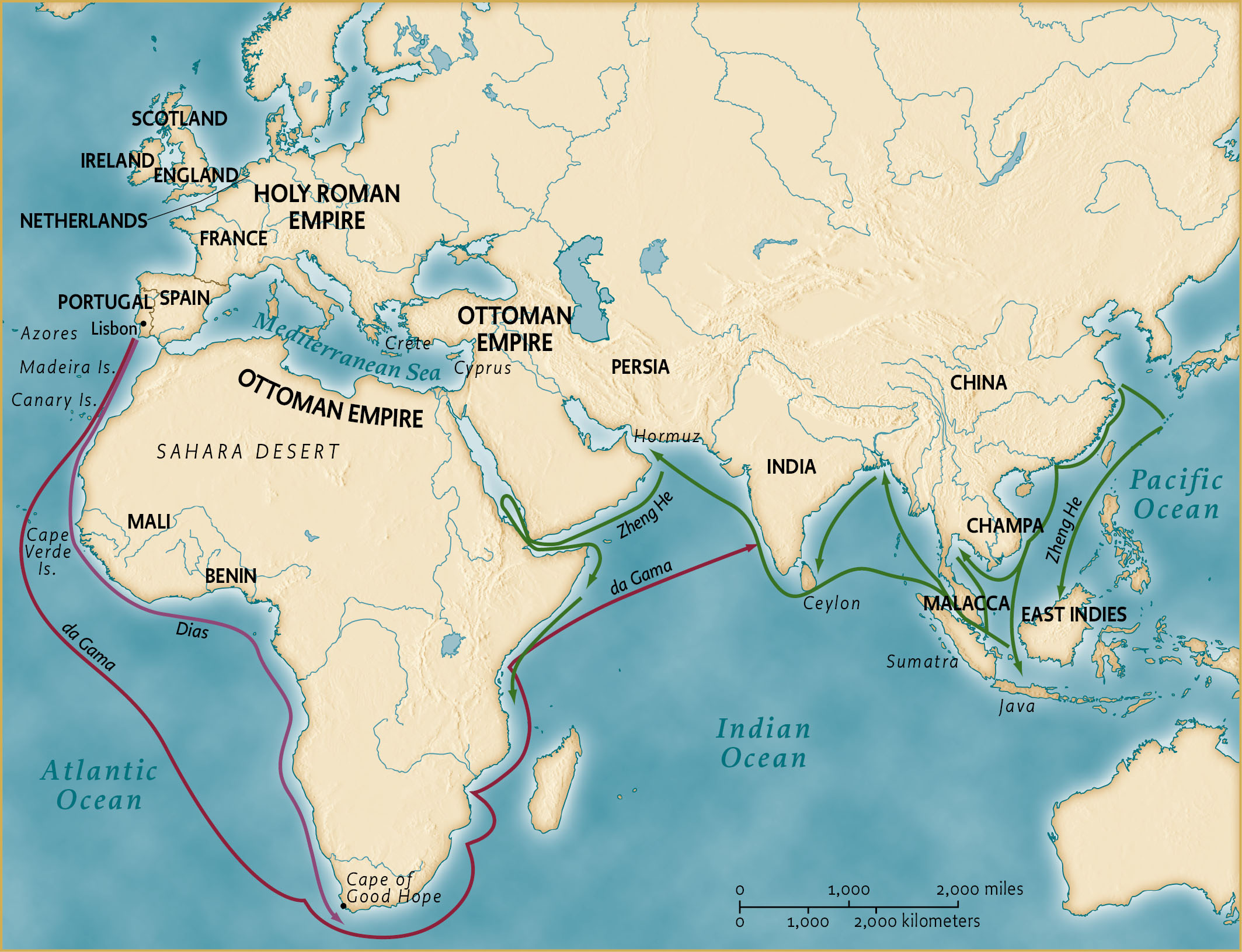
EXPLORATION IN THE ATLANTIC, INDIAN, AND PACIFIC OCEANS, 1400s
More information
“Exploration in the Atlantic, Indian, and Pacific Oceans, 1400s. In the fifteenth century, the world known to Europeans was limited to Europe, parts of Africa, and Asia. Explorers from Portugal sought to find a sea route to the East in order to circumvent the Italian city-states and Middle Eastern rulers who controlled the overland trade. Major areas include the Holy Roman Empire in Europe and the Ottoman Empire in northern Africa and the Middle East. Several exploration routes are shown. One, labeled Dias, starts in Portugal and hugs the western coast of Africa before stopping in the Cape of Good Hope. Another, labeled da Gama, starts in Portugal, goes around the Cape of Good Hope, hugs the eastern coast of Africa, and crosses the Indian Ocean toward India. Other, shorter routes attributed to Zheng He go along the coasts of Africa, Saudi Arabia, India, China, and the East Indies.”
In the fifteenth century, the world known to Europeans was limited to Europe and parts of Africa and Asia. Explorers from Portugal sought to find a sea route to the East in order to circumvent the Mediterranean and especially the Ottoman Empire.
Having reached West Africa, Portuguese mariners pushed their explorations southward. Bartholomeu Dias reached the Cape of Good Hope at the continent’s southern tip in 1487. In 1498, Vasco da Gama sailed around it to India, demonstrating the feasibility of a sea route to the East. With a population of under 1 million, Portugal established a vast trading empire, with bases in India, southern China, and Indonesia. It replaced the Italian city-states as the major European commercial partner of the East. But six years before da Gama’s voyage, Christopher Columbus had, he believed, discovered a new route to China and India by sailing west.
The Voyages of Columbus
On October 12, 1492, the Taíno (Arawak) people on one of the islands that today are called the Bahamas saw a strange sight. They were accustomed to vessels approaching from far away, but these ships were built in an unusual shape and had sails. The men wore armor made of metal and spoke in an unfamiliar language. These strangers did seem at least to know how to trade, and their needles and other pieces of metal seemed interesting and useful.

VISIONS OF FREEDOM
Columbus’s Landfall
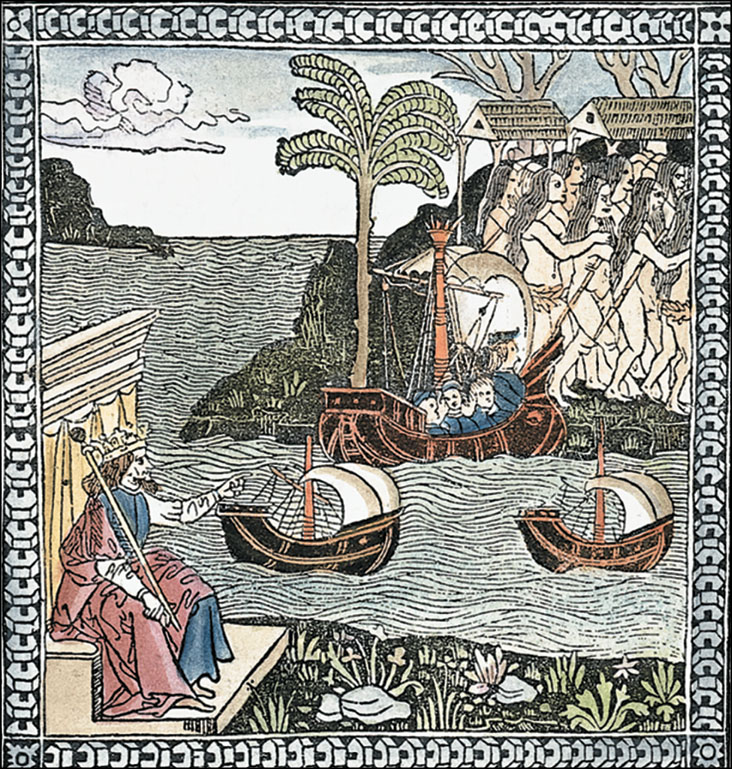

The expedition’s leader, Christopher Columbus, was a seasoned mariner from Genoa, a major port in northern Italy. Columbus had sailed the Mediterranean and North Atlantic, studying ocean currents and wind patterns. Like nearly all navigators of the time, Columbus knew the earth was round. But he drastically underestimated its size. He believed that by sailing westward he could relatively quickly cross the Atlantic and reach Asia. No one in Europe knew that two giant continents lay 3,000 miles to the west. Vikings had sailed from Greenland to Newfoundland around the year 1000 and established a settlement, Vinland, at a site now known as L’Anse aux Meadows. But this outpost was abandoned after a few years and had been forgotten, except in Norse legends.
Columbus relied on a number of sources for his estimate of the size of the globe, including Marco Polo’s account of his visit by land to China in the thirteenth century and, as a devout Catholic, the Bible. Most of Columbus’s contemporaries, however, knew that he considerably underestimated the earth’s size. Eventually, King Ferdinand and Queen Isabella of Spain agreed to become his sponsors, hoping to circumvent the Muslim stranglehold on Eastern trade. Columbus set sail with royal letters of introduction to Asian rulers, authorizing him to negotiate trade agreements.
After exploring the islands of the Bahamas, Hispaniola (today the site of Haiti and the Dominican Republic), and Cuba in 1492, Columbus returned the following year with seventeen ships and more than 1,000 men to establish a Spanish outpost. He went to his grave believing that he had discovered a westward route to Asia. The explorations of another Italian, Amerigo Vespucci, along the coast of South America between 1499 and 1502 made plain that a continent entirely unknown to Europeans had been encountered. These lands would come to bear a name based on Vespucci’s—America. The name “Indians,” applied to Indigenous people by Columbus, has endured.
Exploration and Conquest
More information
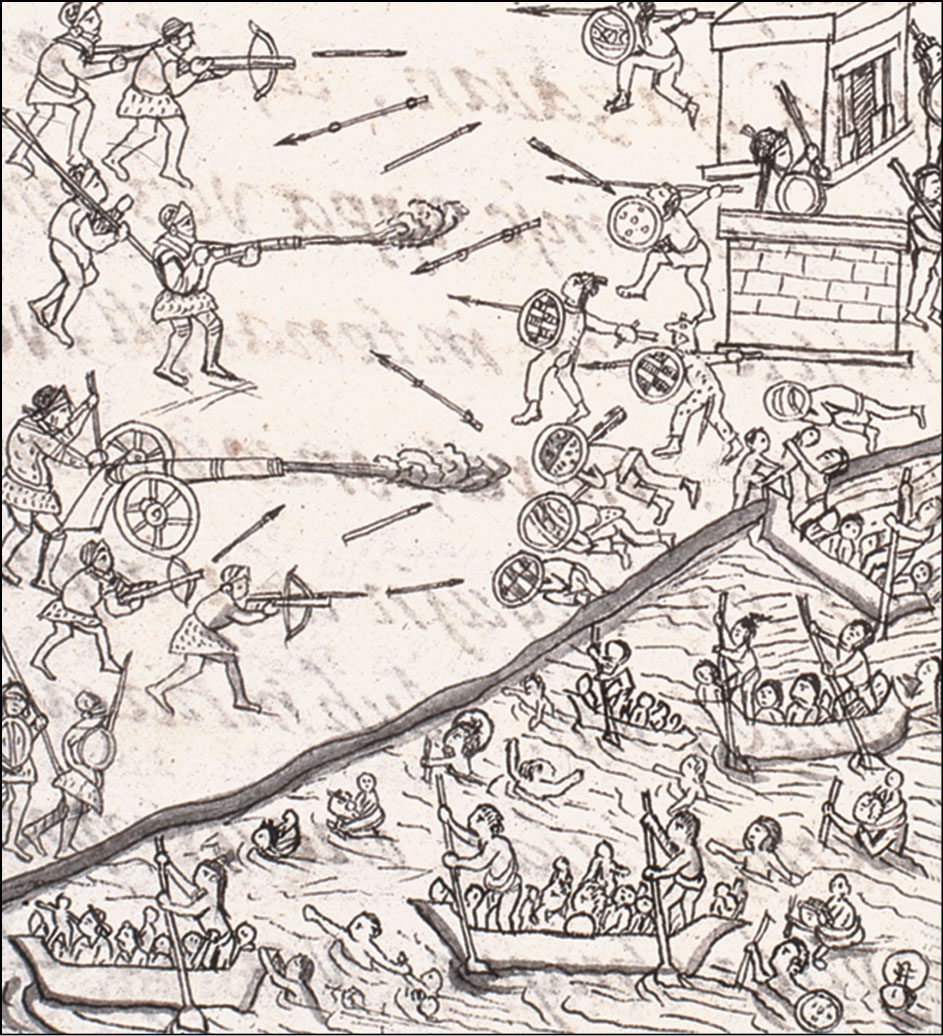
“Engravings, from the Florentine Codex, of the forces of Cortés marching on Tenochtitlán and assaulting the city with cannon fire. The difference in military technology between the Spanish and Aztecs is evident. Indians who allied with Cort�s had helped him build vessels and carry them in pieces over mountains to the city. The codex (a volume formed by stitching together manuscript pages) was prepared under the supervision of a Spanish missionary in sixteenth-century Mexico.”
Engraving from the Florentine Codex of the forces of Cortés marching on Tenochtitlán and assaulting the city with cannon fire. The difference in military technology between the Spanish and Aztecs is evident. The codex (a volume formed by stitching together manuscript pages) was prepared under the supervision of a Spanish missionary in sixteenth-century Mexico.
The technique of printing with movable type, invented in the 1450s by the German craftsman Johannes Gutenberg, allowed news of Columbus’s achievement to travel quickly. Others were inspired to follow. John Cabot, a Genoese merchant who had settled in England, reached Newfoundland in 1497. Soon, scores of fishing boats from France, Spain, and England were active in the region. Pedro Cabral claimed Brazil for Portugal in 1500.
The Spanish took the lead in exploration and conquest. Inspired by a search for wealth, national glory, and the desire to spread Catholicism, Spanish conquistadores, often accompanied by religious missionaries, radiated outward from Hispaniola. In 1513, Vasco Núñez de Balboa trekked across the isthmus of Panama and became the first European to gaze upon the Pacific Ocean from the Americas. Between 1519 and 1522, Ferdinand Magellan led the first expedition to sail around the world. Magellan was killed in the Philippines, but his fleet completed the journey.
In 1519, Hernán Cortés landed on the coast of mainland Mexico and, at the urging of people he met there, decided to march on the great city of Tenochtitlán, the capital of the Aztec (Mexica) empire, whose wealth and power rested on the domination of numerous subordinate peoples nearby.
These peoples’ thousands of warriors joined forces with the several hundred heavily armed Spaniards, plus horses, giant mastiffs, and smallpox, which spread from the Spaniards into the crowded city of Tenochtitlán. A few years later, Francisco Pizarro conquered the great Inca kingdom centered in modern-day Peru, similarly using brute force and taking advantage of rivalries within the kingdom. Soon, treasure fleets carrying cargoes of gold and silver from the mines of Mexico and Peru were traversing the Atlantic to enrich the Spanish crown.
The Columbian Exchange
The transatlantic flow of goods and people, sometimes called the Columbian Exchange, altered millions of years of evolution. Plants, animals, and cultures that had evolved independently on separate continents were now thrown together. Products introduced to Europe, Africa, and Asia from the Americas included corn, tomatoes, potatoes, tobacco, and chili peppers, while people brought to the Americas wheat, rice, watermelons, and horses and other livestock.
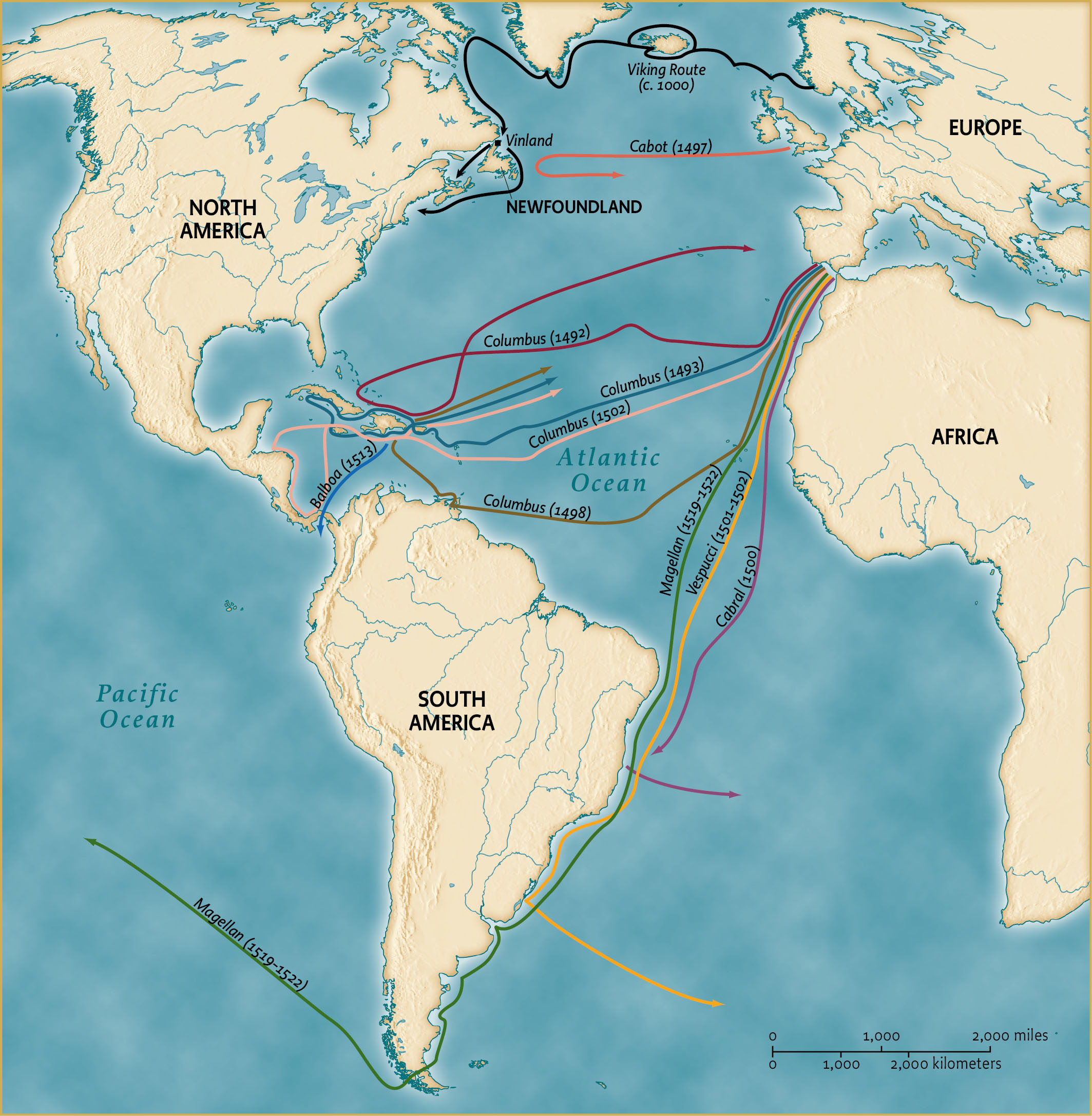
EARLY EUROPEAN VOYAGES
More information
“Early European Voyages Christopher Columbus’s first Atlantic crossing, in 1492, was soon followed by voyages of discovery by English, Portuguese, Spanish, and Italian explorers. Cabot’s route begins in England, goes across the upper Atlantic almost to Newfoundland, and then turns back. Columbus’s first route from 1492 begins in Spain, goes across the center of the Atlantic to the Eastern Caribbean islands, and returns across the Atlantic. Columbus’s second route from 1493 goes from Spain, across the mid-Atlantic to the southern and western islands of the Caribbean and returns across the Atlantic. Columbus’s third route from 1492 goes from Spain across the lower mid-Atlantic, reaches the upper tip of South America, continues on to the southern Caribbean islands, and then returns across the Atlantic. Columbus’s fourth route from 1502 goes across the mid-Atlantic to the southern islands of the Caribbean and the eastern coast of Central America, and then returns across the Atlantic. Magellan’s route from 1519 to 1522 goes from Portugal down through the lower mid-Atlantic, hugs the coast of South America, and continues through the southern tip of South America and into the Pacific Ocean. Vespucci’s route from 1501 to 1502 goes from Spain across the lower mid-Atlantic to hug the coast of South America until it reaches the southern tip of Brazil, where it turns and heads southeast into the lower Atlantic. Cabral’s route from 1500 goes from Portugal across the lower mid-Atlantic to the coast of Brazil. Cabral’s route from 1500 goes from Europe to South America. Balboa’s route from 1513 goes from Haiti and the Dominican Republic to Panama. Cabot’s route from 1497 goes from Europe to Newfoundland. The Viking route from c. 1000 goes from northern Europe to North America.”
Christopher Columbus’s first Atlantic crossing, in 1492, was soon followed by voyages of exploration by English, Portuguese, Spanish, and Italian explorers.
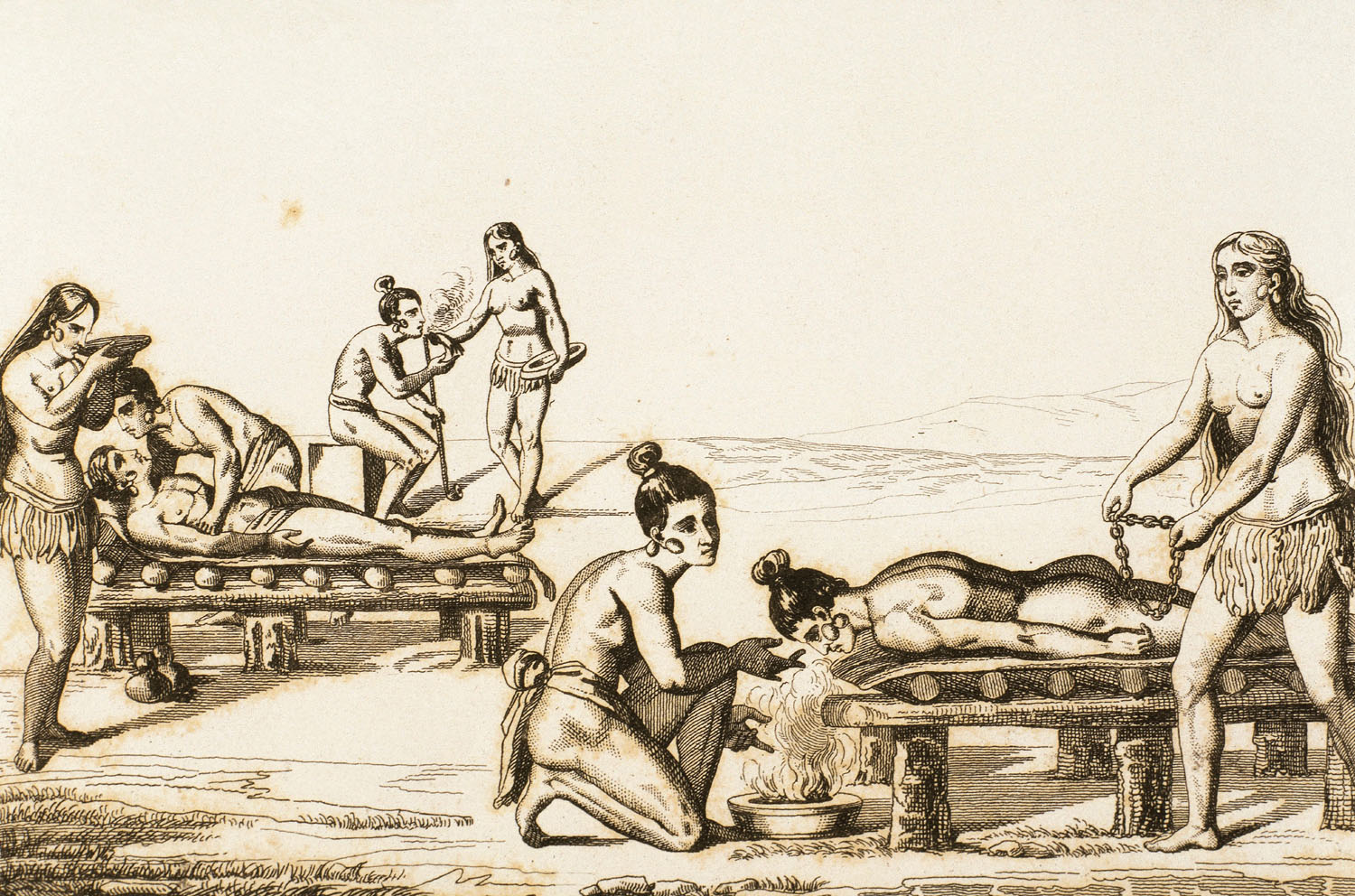
Sixteenth-century Native Americans in Florida practice several healing techniques, including smoking tobacco.
Europeans also carried germs previously unknown in the Americas. It is impossible to know the extent of the damage of these diseases. Smallpox helped Cortés take Tenochtitlán, and diseases assisted Europeans in their conquests of North America. But trying to determine the pre-1492 population of the Americas—or even the population in the following two centuries—yields wildly different estimates. Disease hit the hardest when colonizers were simultaneously cutting off access to food and water, driving people from their homes, or forcing people into slavery or missions. Importantly, Native people actively responded to illness and attempted to curb its spread. Many instituted quarantines, isolated themselves from colonial settlements, and treated patients with basic nursing—remedies that were as effective as anything Europeans had in the same era.
Glossary
- caravel
- A fifteenth-century European ship capable of long-distance travel.
- conquistadores
- Spanish term for “conquerors,” applied to Spanish and Portuguese soldiers who conquered lands held by Indigenous peoples in central and southern America as well as the current states of Florida, Texas, New Mexico, Arizona, and California.
- Tenochtitlán
- The capital city of the Aztec empire; the city was built on marshy islands on the western side of Lake Tetzcoco, which is the site of present-day Mexico City.
- Columbian Exchange
- The transatlantic flow of goods and people that began with Columbus’s voyages in 1492.
- Aztec
- The Mesoamerican empire ruled by the Mexica people that was defeated by the Spanish under Hernán Cortés and his Native allies, 1519–1528.