 William Penn
How did the English empire in America expand in the mid-seventeenth century?
GLOBAL COMPETITION AND THE EXPANSION OF ENGLAND’S EMPIRE
The Mercantilist System
By the middle of the seventeenth century, it was apparent that the colonies could be an important source of wealth for England. According to the prevailing theory known as mercantilism, governments should regulate economic activity so as to promote national power. They should encourage manufacturing and commerce by special bounties, monopolies, and other measures. Above all, trade should be controlled so that more gold and silver flowed into countries than left them. That is, exports of goods, which generated revenue from abroad, should exceed imports, which required paying foreigners for their products. In the mercantilist outlook, the role of colonies was to serve the interests of the home country by producing marketable raw materials and importing manufactured goods from home. “Foreign trade,” declared an influential work written in 1664 by a London merchant, formed the basis of “England’s treasure.” Commerce was to be the foundation of empire.
Parliament in 1651 passed the first Navigation Act, which aimed to wrest control of world trade from the Dutch, whose merchants profited from free trade with all parts of the world and all existing empires. Additional measures followed in 1660 and 1663. According to the Navigation laws, certain “enumerated” goods—essentially, the most valuable colonial products, such as tobacco and sugar—had to be transported in English ships and sold initially in English ports, although they could then be re-exported to foreign markets. Similarly, most European goods imported into the colonies had to be shipped through England, where customs duties were paid. This enabled English merchants, manufacturers, shipbuilders, and sailors to reap the benefits of colonial trade and the government to enjoy added income from taxes. As members of the empire, American colonies would profit as well, since their ships were considered English. Indeed, the Navigation Acts stimulated the rise of New England’s shipbuilding industry.
The Conquest of New Netherland
The restoration of the English monarchy when Charles II assumed the throne in 1660 sparked a new period of colonial expansion. The government chartered new trading ventures, notably the Royal African Company, which was given a monopoly of the slave trade. Within a generation, the number of English colonies in North America doubled.
First to come under English control was New Netherland, seized during a series of Anglo-Dutch Wars between 1664 and 1674 that also saw England gain control of Dutch trading posts in Africa. Charles II awarded the colony to his younger brother James, the duke of York, with “full and absolute power” to govern as he pleased. (Hence the colony’s name became New York.) English rule transformed this minor military and trading base into an important imperial outpost, a seaport trading with the Caribbean and Europe, and a launching pad for military operations against the French. New York’s European population, around 9,000 when the English assumed control, rose to 20,000 by 1685.
EASTERN NORTH AMERICA IN THE SEVENTEENTH AND EARLY EIGHTEENTH CENTURIES
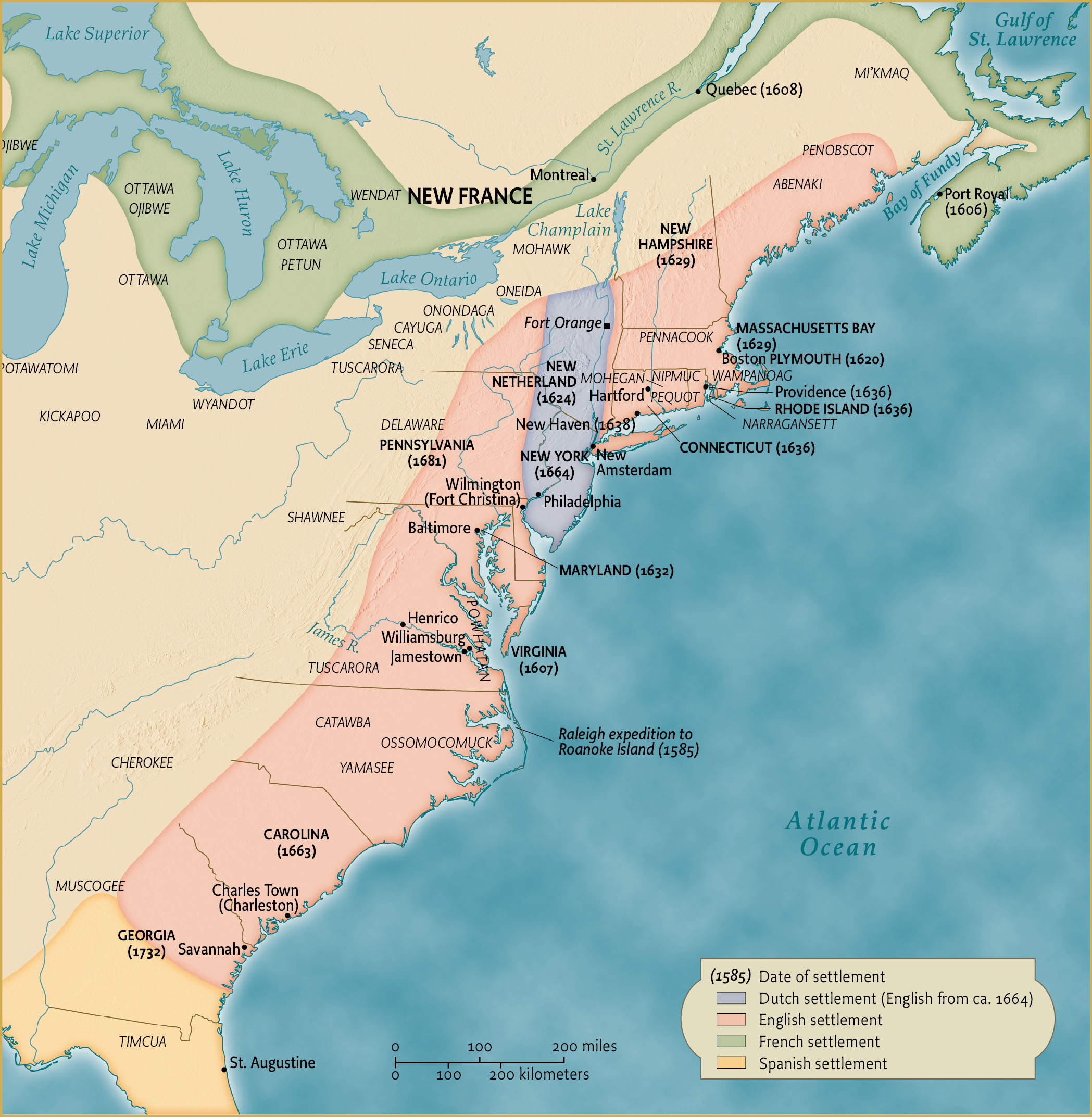
By the early eighteenth century, numerous English colonies populated eastern North America, while the French had established their own presence to the north and west. Native nations still ruled the vast interior.
English rule expanded the freedom of some New Yorkers while reducing that of others. The terms of surrender guaranteed that the English would respect the religious beliefs and property holdings of the colony’s many ethnic communities. But that guarantee did not extend to women’s legal rights. The English law of coverture ended the Dutch tradition by which married women conducted business in their own name. There had been many female traders and business owners in New Amsterdam, but few remained by the end of the seventeenth century. The English increased the slave trade into New York City and issued the colony’s first slave code, similar to that of Virginia and other southern colonies. In a reversal of Dutch practice, the English also expelled free Blacks from many skilled jobs.
A few families benefited enormously from English rule. The duke of York and his appointed governors continued the Dutch practice of awarding immense land grants to favorites. By 1700, nearly 2 million acres of land were owned by only five New York families who intermarried regularly, exerted considerable political influence, and formed one of colonial America’s most tightly knit landed elites.
New York and the Haudenosaunee
Initially, English rule also strengthened the position of the Haudenosaunee (Iroquois) League. After a complex series of negotiations in the mid-1670s, Sir Edmund Andros, who had been appointed governor of New York after fighting the French in the Caribbean, linked New York with the Haudenosaunee League in an alliance known as the Covenant Chain, in which the imperial ambitions of the English and Haudenosaunee reinforced one another. The Five (later Six) Haudenosaunee Nations and New York joined together to fight Native rivals and the French. Andros, for his part, accepted the Haudenosaunee claim to authority over Native communities in the vast area stretching to the Ohio River. But beginning in the 1680s, Indians around the Great Lakes and Ohio Valley regrouped and with French aid attacked the Haudenosaunee, pushing them back east. By the end of the century, the Haudenosaunee adopted a policy of neutrality with the European empires while continuing to profit from the fur trade.
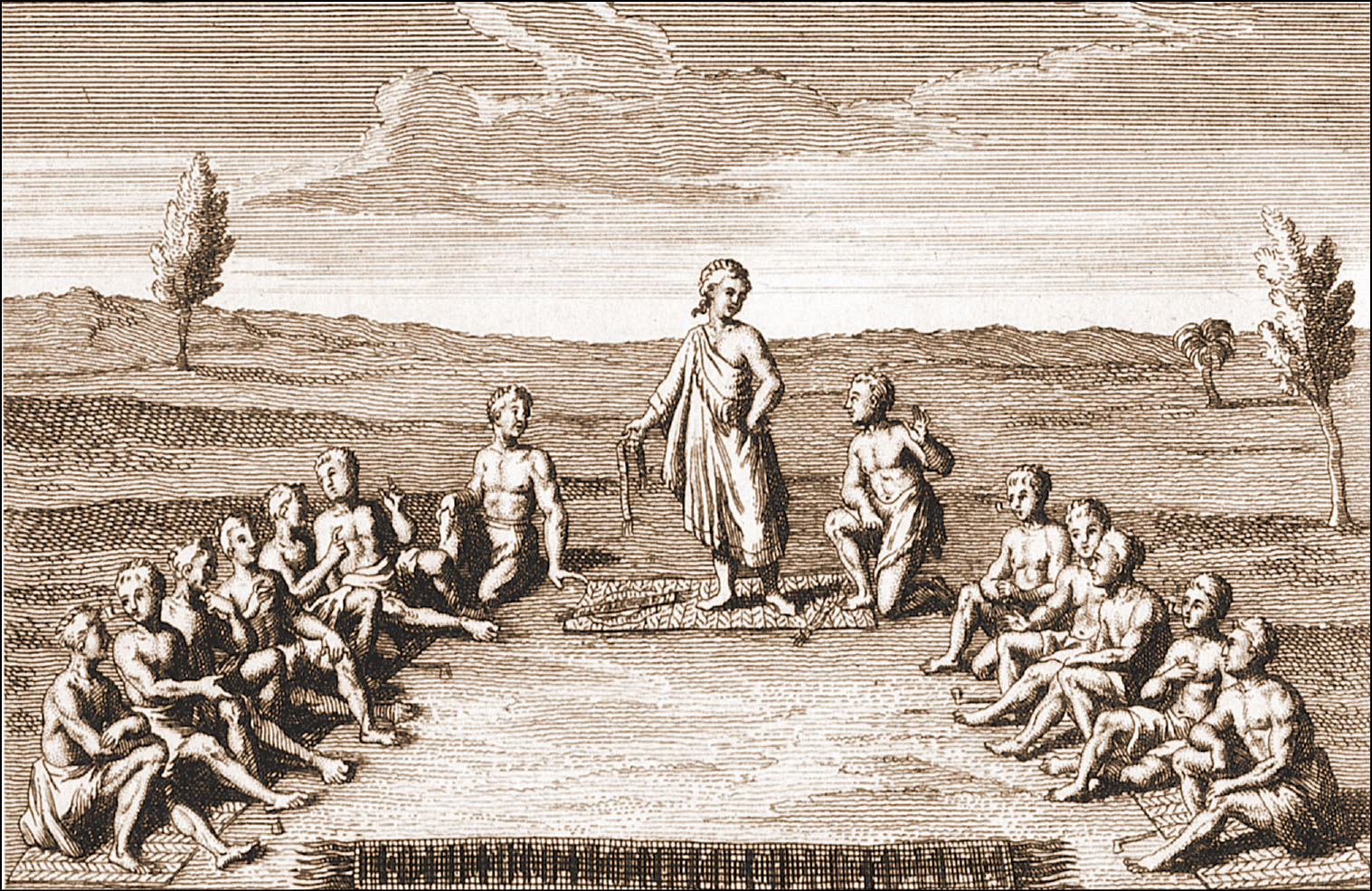
An engraving representing the Grand Council of the Haudenosaunee League of present-day upstate New York. From a book about American Indians published in Paris by a Jesuit missionary, who showed his admiration for Haudenosaunee governance and diplomacy by depicting them in the attire of ancient Romans. Note the prevalence of wampum belts in the image, in the foreground and in the hand and at the feet of the central figure. Wampum was used to certify and symbolize treaties and other agreements.
The Charter of Liberties
Many New York colonists, meanwhile, began to complain that they were being denied the “liberties of Englishmen,” especially the right to consent to taxation. In 1683, the duke of York agreed to call an elected assembly, whose first act was to draft a Charter of Liberties and Privileges. The charter required that elections be held every three years among male property owners and the freemen of New York City; it also reaffirmed traditional English rights such as trial by jury and security of property, as well as religious toleration for all Protestants.
The Founding of Carolina
In 1663, Charles II awarded to eight proprietors the right to establish a colony north of Florida, as a barrier to Spanish expansion. In 1670, the first settlers arrived. Carolina began as an offshoot of the tiny island of Barbados, the Caribbean’s richest plantation economy, where a shortage of land led wealthy planters to seek other opportunities for their sons. The early settlers of Carolina sought Native allies by offering guns for deer hides and captives, a policy that unleashed widespread raiding. Yamasee, Muscogee (Creek), and allied raiders traded some 10,000 Indians to Carolinians, who shipped most of them to other mainland colonies and the West Indies as slaves. Indeed, between 1670 and 1720, the number of Indian slaves exported from Charleston was larger than the number of African slaves imported.
In 1715, the Yamasees, alarmed by the debts they had incurred in trade with the settlers, the lower prices Englishmen had begun paying for captives, and slave traders’ raids into their own territory, decided to fight the English in what became known as the Yamasee War. The Yamasees recruited their Muscogee allies to join them, and they persuaded the Spanish to provide them with weapons. The Yamasees and Muscogees slew nearly 100 English traders, attacked plantations, and killed settlers. But the English recruited the Cherokees to join the war on their side, and their combined force defeated the Yamasees and Muscogees. Most of the surviving Yamasees were enslaved or driven out of the colony into Spanish Florida. As a result of the Yamasee War, the Carolina colonists decided that the Indian slave trade was too dangerous. From then on, they would buy almost exclusively enslaved Africans.
The Fundamental Constitutions of Carolina, issued by the proprietors in 1669, proposed to establish a feudal society with a hereditary nobility, serfs, and slaves. Needing to attract settlers quickly, however, the proprietors also provided for an elected assembly and religious toleration. They also instituted a generous headright system, offering 150 acres for each member of an arriving family and 100 acres to male servants who completed their terms.
Intending to replicate the plantation economy of Barbados, the proprietors promised slaveowners “absolute power and authority” over their human property and granted each slaveholder an additional 150 acres for each enslaved person brought to the colony. Thus, anyone who brought slaves, including planters from Barbados, instantly acquired large new landholdings. Carolina grew slowly until planters discovered the staple—rice—that would make them the wealthiest elite in the mainland English colonies and deeply entrench slavery in the future United States.
The Holy Experiment
The last English colony to be established in the seventeenth century was Pennsylvania in 1681. The proprietor, William Penn, envisioned it as a place where those facing religious persecution in Europe could enjoy spiritual freedom, and colonists and Native Americans would coexist in harmony.
A devout member of the Society of Friends (Quakers), Penn was particularly concerned with establishing a refuge for his coreligionists, who faced increasing persecution in England. He had already assisted a group of English Quakers in purchasing half of what became the colony of New Jersey from Lord John Berkeley, who had received a land grant from the duke of York. Penn was largely responsible for the frame of government announced in 1677, the West Jersey Concessions, which created an elected assembly with a broad suffrage and established religious liberty.
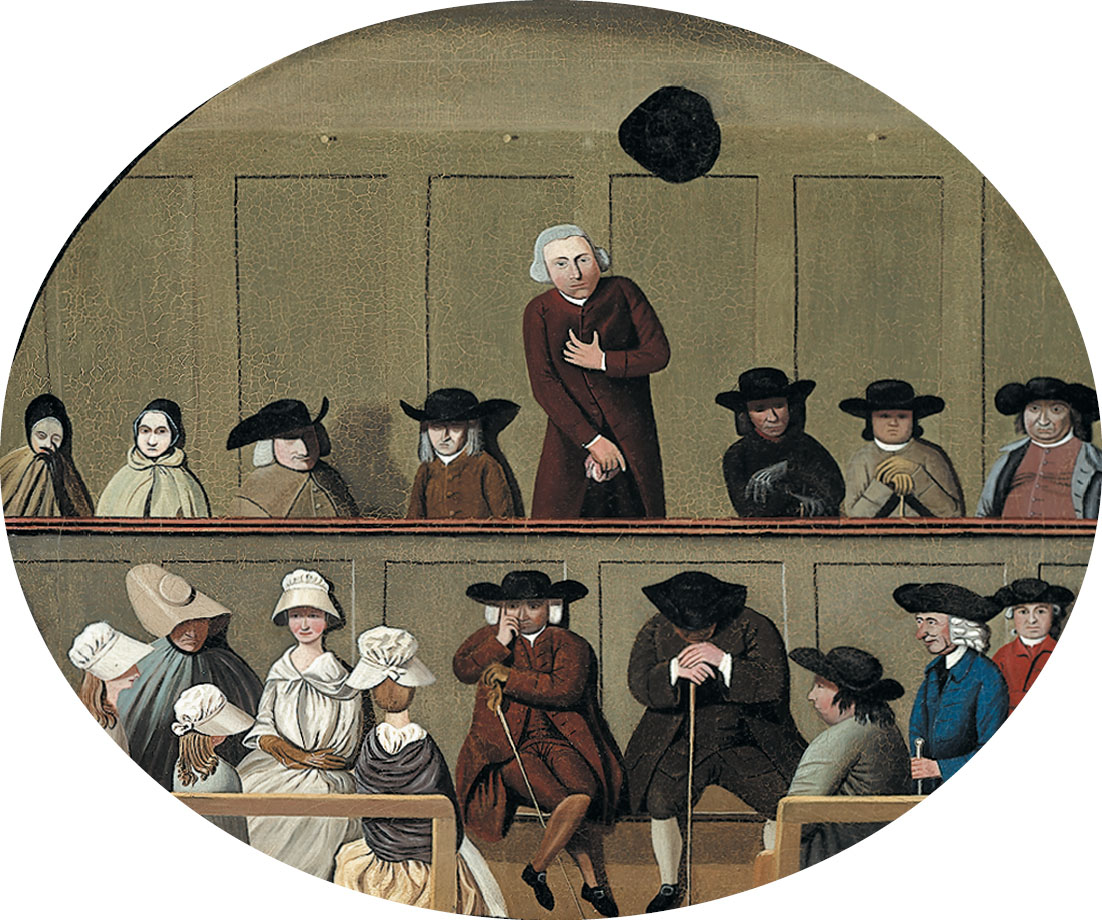
A Quaker Meeting, a painting by an unidentified British artist, dating from the late eighteenth or early nineteenth century. It illustrates the prominent place of women in Quaker gatherings.
Like the Puritans, Penn considered his colony a “holy experiment,” but of a different kind—“a free colony for all mankind that should go hither.” He hoped that Pennsylvania could be governed according to Quaker principles, among them the equality of all persons (including women, Blacks, and Indians) before God and the primacy of the individual conscience. To Quakers, liberty was a universal entitlement, not the possession of any single people—a position that would eventually make them the first group of whites to repudiate slavery. Penn also treated Indians with a respect unique in the English colonial experience, purchasing land before reselling it to colonists and offering refuge to Native communities driven out of other colonies by warfare. Since Quakers were pacifists who came to America unarmed and did not even organize a militia until the 1740s, peace with Pennsylvania’s Native neighbors was essential.
Religious freedom was Penn’s most fundamental principle. His Charter of Liberty, approved by the assembly in 1682, offered “Christian liberty” to all who affirmed a belief in God and did not use their freedom to promote “licentiousness.” There was no established church in Pennsylvania, and attendance at religious services was entirely voluntary, although Jews were barred from office by a required oath affirming belief in the divinity of Jesus Christ. At the same time, the Quakers upheld a strict code of personal morality. Penn’s Frame of Government prohibited swearing, drunkenness, and adultery. Not religious uniformity but a virtuous citizenry would be the foundation of Penn’s social order.
Land in Pennsylvania
Given the power to determine the colony’s form of government, Penn established an appointed council to originate legislation and an assembly elected by male taxpayers and “freemen” (owners of 100 acres of land for free immigrants and 50 acres for former indentured servants). These rules made a majority of the male population eligible to vote. Penn owned all the colony’s land and sold it to settlers at low prices, which helped the colony prosper. Pennsylvania’s religious toleration, healthy climate, and inexpensive land, along with Penn’s aggressive efforts to publicize the colony’s advantages, soon attracted immigrants from all over western Europe.
Ironically, the freedoms Pennsylvania offered to European immigrants contributed to the deterioration of freedom for others. The colony’s successful efforts to attract settlers would eventually come into conflict with Penn’s benevolent Indian policy. And the opening of Pennsylvania caused fewer indentured servants to choose Virginia and Maryland, a development that did much to shift those colonies toward reliance on slave labor.
Glossary
- mercantilism
- Policy of Great Britain and other imperial powers of regulating the economies of colonies to benefit the mother country.
- Covenant Chain
- Alliance formed in the 1670s between the English colony of New York and the Haudenosaunee League and eventually other colonies and Native nations.
- Yamasee War
- War between South Carolina and Yamasee and Muscogee Indians, aggravated by rising debts and slave traders’ raids; although the Yamasee lost, the war resulted in the end of South Carolina’s Indian slave trade.
- Society of Friends (Quakers)
- Religious group in England and America whose members believed all persons possessed the “inner light” or spirit of God; they were early proponents of abolition of slavery and equal rights for women.