 Andrew Johnson
What were the competing visions of Reconstruction?
THE MAKING OF RADICAL RECONSTRUCTION
Andrew Johnson
To Lincoln’s successor, Andrew Johnson, fell the task of overseeing the restoration of the Union. Born in poverty in North Carolina, as a youth Johnson worked as a tailor’s apprentice. Becoming a successful politician after moving to Tennessee, Johnson identified himself as the champion of his state’s “honest yeomen” and a foe of large planters, whom he described as a “bloated, corrupted aristocracy.” A strong defender of the Union, he became the only senator from a seceding state to remain at his post in Washington, D.C., when the Civil War began. When northern forces occupied Tennessee, Abraham Lincoln named him military governor. In 1864, Republicans nominated him to run for vice president as a symbol of the party’s hope of extending its organization into the South.
In personality and outlook, Johnson proved unsuited for the responsibilities he shouldered after Lincoln’s death. A lonely, stubborn man, he was intolerant of criticism and unable to compromise. He lacked Lincoln’s political skills and keen sense of public opinion. Moreover, while Johnson had supported emancipation once Lincoln made it a goal of the war effort, he held deeply racist views. African Americans, Johnson believed, had no role to play in Reconstruction.
The Failure of Presidential Reconstruction
A little over a month after Lee’s surrender at Appomattox, and with Congress out of session until December, Johnson in May 1865 outlined his plan for reuniting the nation. He issued a series of proclamations that began the period of Presidential Reconstruction (1865–1867). Johnson offered a pardon (which restored political and property rights, except for slaves) to nearly all white southerners who took an oath of allegiance to the Union. He excluded Confederate leaders and wealthy planters whose prewar property had been valued at more than $20,000. Most of those exempted, however, soon received individual pardons from the president.Johnson also appointed provisional governors and ordered them to call state conventions, elected by whites alone, that would establish loyal governments in the South. Apart from the requirement that they abolish slavery, repudiate secession, and refuse to pay the Confederate debt—all unavoidable consequences of southern defeat—he granted the new governments a free hand in managing local affairs.
The conduct of the southern governments elected under Johnson’s program turned most of the Republican North against the president. By and large, white southern voters returned prominent Confederates and members of the old elite to power. Reports of violence directed against former slaves and northern visitors in the South further alarmed Republicans.
The Black Codes
But what aroused the most opposition to Johnson’s Reconstruction policy were the Black Codes, laws passed by the new southern governments that attempted to regulate the lives of the former slaves. These laws granted Blacks certain rights, such as legalized marriage, ownership of property, and limited access to the courts. But they denied them the rights to testify against whites, to serve on juries or in state militias, or to vote. And in response to planters’ demands that the freedpeople be required to work on the plantations, the Black Codes declared that those who failed to sign yearly labor contracts could be arrested and hired out to white landowners.
Clearly, the death of slavery did not automatically mean the birth of freedom. But the Black Codes so completely violated free labor principles that they called forth a vigorous response from the Republican North.Few groups of rebels in history have been treated more leniently than the defeated Confederates. A handful of southern leaders were arrested, but most were quickly released. Only one was executed—Henry Wirz, the commander of Andersonville prison, where thousands of Union prisoners of war had died. What motivated the North’s turn against Johnson’s policies was not a desire to “punish” the white South, but the inability of the South’s political leaders to accept the reality of emancipation.
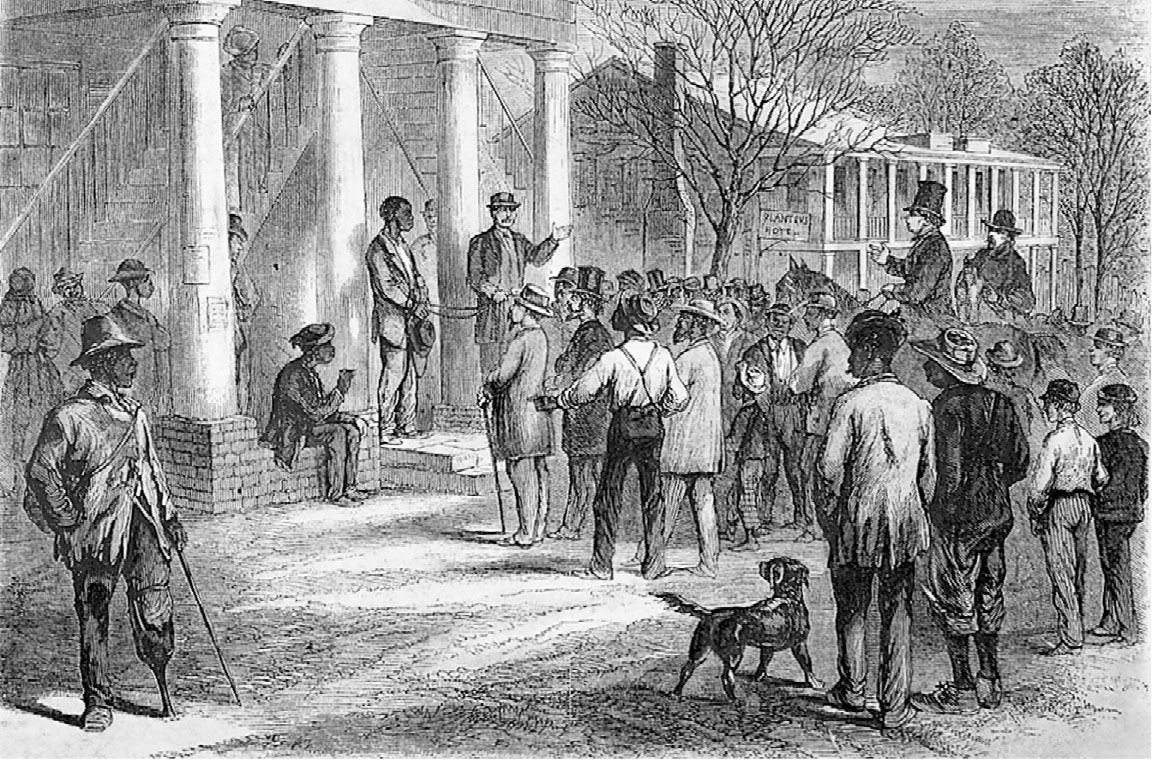
More information
“Selling a Freedman to Pay His Fine at Monticello, Florida, an engraving from Frank Leslie’s Illustrated Newspaper, January 19, 1867. Under the Black Codes enacted by southern legislatures immediately after the Civil War, blacks convicted of “vagrancy”�often because they refused to sign contracts to work on plantations�were fined and, if unable to pay, auctioned off to work for the person who paid the fine.”
Selling a Freedman to Pay His Fine at Monticello, Florida, an engraving from Frank Leslie’s Illustrated Newspaper, January 19, 1867. Under the Black Codes enacted by southern legislatures immediately after the Civil War, Blacks convicted of “vagrancy”—often because they refused to sign contracts to work on plantations—were fined and, if unable to pay, auctioned off to work for the person who paid the fine.
More information
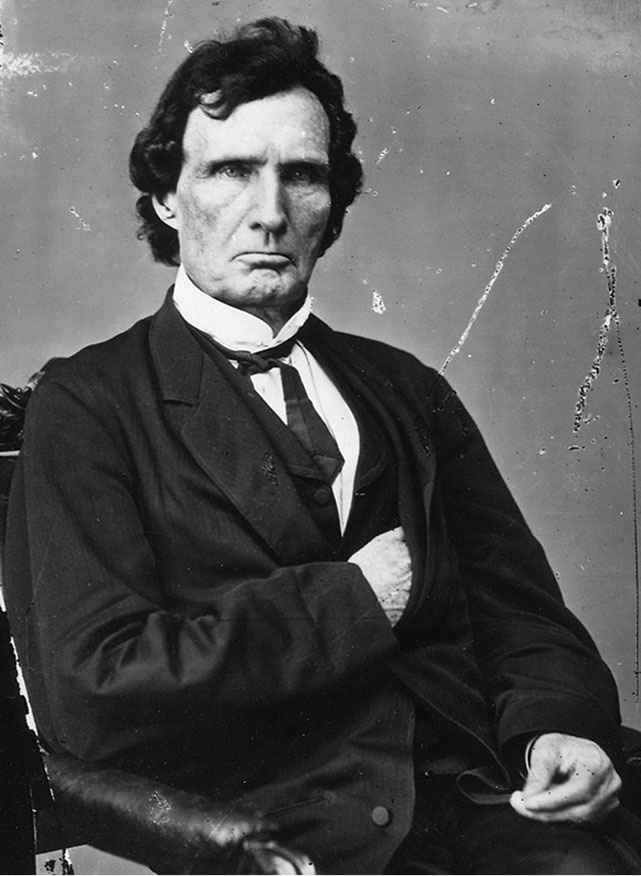
“Thaddeus Stevens, leader of the Radical Republicans in the House of Representatives during Reconstruction.”
Thaddeus Stevens, leader of the Radical Republicans in the House of Representatives during Reconstruction.
The Radical Republicans
When Congress assembled in December 1865, Johnson announced that with loyal governments functioning in all the southern states, the nation had been reunited. In response, Radical Republicans, who had grown increasingly disenchanted with Johnson during the summer and fall, called for the dissolution of these governments and the establishment of new ones with “rebels” excluded from power and Black men guaranteed the right to vote. Radicals shared the conviction that Union victory created a golden opportunity to institutionalize the principle of equal rights for all, regardless of race.
The most prominent Radicals in Congress were Charles Sumner, a senator from Massachusetts, and Thaddeus Stevens, a lawyer and iron manufacturer who represented Pennsylvania in the House of Representatives. Before the Civil War, both had been outspoken foes of slavery and defenders of Black rights. Stevens’s most cherished aim was to confiscate the land of disloyal planters and divide it among emancipated slaves and northern migrants to the South. But his plan to make “small independent landholders” of the former slaves proved too radical even for many of his Radical colleagues and failed to pass.
The Origins of Civil Rights
The Civil Rights Bill of 1866
With the South unrepresented, Republicans enjoyed an overwhelming majority in Congress. Most Republicans were moderates, not Radicals. Moderates believed that Johnson’s plan was flawed, but they desired to work with the president to modify it. They feared that neither northern nor southern whites would accept Black suffrage. Moderates and Radicals joined in refusing to seat the southerners recently elected to Congress, but moderates broke with the Radicals by leaving the Johnson governments in place.
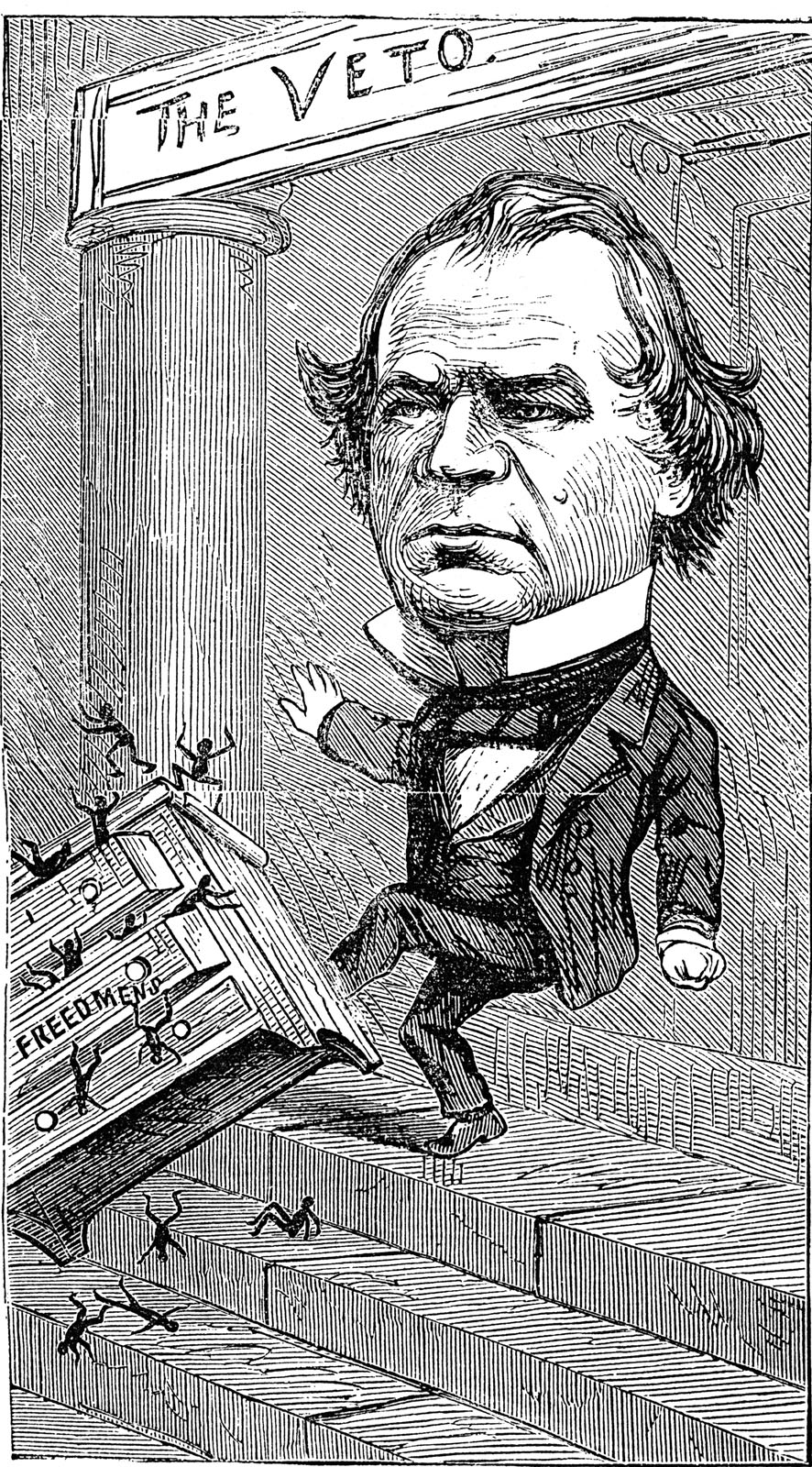
A cartoon by Thomas Nast celebrates Andrew Johnson’s 1866 veto to prevent the extension of the life of the Freedmen’s Bureau. Black officeholders fall out of the drawers as Johnson kicks a bureau (a chest of drawers) down the stairs. Later that year, however, Congress overrode Johnson’s veto of another bill, which extended the life of the agency until 1870.
Early in 1866, Senator Lyman Trumbull of Illinois proposed two bills that reflected the moderates’ belief that Johnson’s policy required modification. The first extended the life of the Freedmen’s Bureau, which had originally been established for only one year. The second, the Civil Rights Bill of 1866, was described by one congressman as “one of the most important bills ever presented to the House for its action.” It defined all persons born in the United States as citizens and spelled out rights they were to enjoy without regard to race. No longer could states enact laws like the Black Codes discriminating between white and Black citizens. According to the law, no state could deprive any citizen of the right to make contracts, bring lawsuits, or enjoy equal protection of one’s person and property. These, said Trumbull, were the “fundamental rights belonging to every man as a free man.” The bill made no mention of the right to vote for Blacks. The Civil Rights Bill represented the first attempt to define in law the essence of freedom.
To the surprise of Congress, Johnson vetoed both bills. Both, he said, would centralize power in the national government and deprive the states of the authority to regulate their own affairs. Moreover, he argued, Blacks did not deserve the rights of citizenship. Congress failed by a single vote to muster the two-thirds majority necessary to override the veto of the Freedmen’s Bureau Bill (although later in 1866, it did extend the bureau’s life to 1870). But in April 1866, the Civil Rights Bill became the first major law in American history to be passed over a presidential veto.
The Fourteenth Amendment
The Fourteenth Amendment
Congress now proceeded to adopt its own plan of Reconstruction. In June, it approved and sent to the states for ratification the Fourteenth Amendment, which placed in the Constitution the principle of birthright citizenship, except for Native Americans subject to tribal authority, and which empowered the federal government to protect the rights of all Americans. The amendment prohibited the states from abridging the “privileges or immunities” of citizens or denying to any person the “equal protection of the laws.” This broad language opened the door for future Congresses and the federal courts to breathe meaning into the guarantee of legal equality.
In a compromise between the radical and moderate positions on Black suffrage, the amendment did not grant Blacks the right to vote. But it did provide that if a state denied the vote to any group of men, that state’s representation in Congress would be reduced. (This penalty did not apply when states barred women from voting.) The abolition of slavery threatened to increase southern political power, since now all Blacks, not merely three-fifths as in the case of slaves, would be counted in determining a state’s representation in Congress. The Fourteenth Amendment offered the leaders of the white South a choice—allow Black men to vote and keep their state’s full representation in the House of Representatives, or limit the vote to whites and sacrifice part of their political power.
By writing into the Constitution the principle that equality before the law regardless of race is a fundamental right of all Americans, the amendment made the most important change in that document since the adoption of the Bill of Rights.
The Reconstruction Act
The Fourteenth Amendment became the central issue of the political campaign of 1866. Johnson embarked on a speaking tour of the North. Denouncing his critics, the president made wild accusations that the Radicals were plotting to assassinate him. His behavior further undermined public support for his policies, as did riots that broke out in Memphis and New Orleans, in which white policemen and citizens killed dozens of Blacks.
In the northern congressional elections that fall, Republicans opposed to Johnson’s policies won a sweeping victory. Nonetheless, at the president’s urging, every southern state but Tennessee refused to ratify the Fourteenth Amendment. The intransigence of Johnson and the bulk of the white South pushed moderate Republicans toward the Radicals. In March 1867, over Johnson’s veto, Congress adopted the Reconstruction Act, which temporarily divided the South into five military districts and called for the creation of new state governments, with Black men given the right to vote. Thus began the period of Radical Reconstruction, which lasted until 1877.
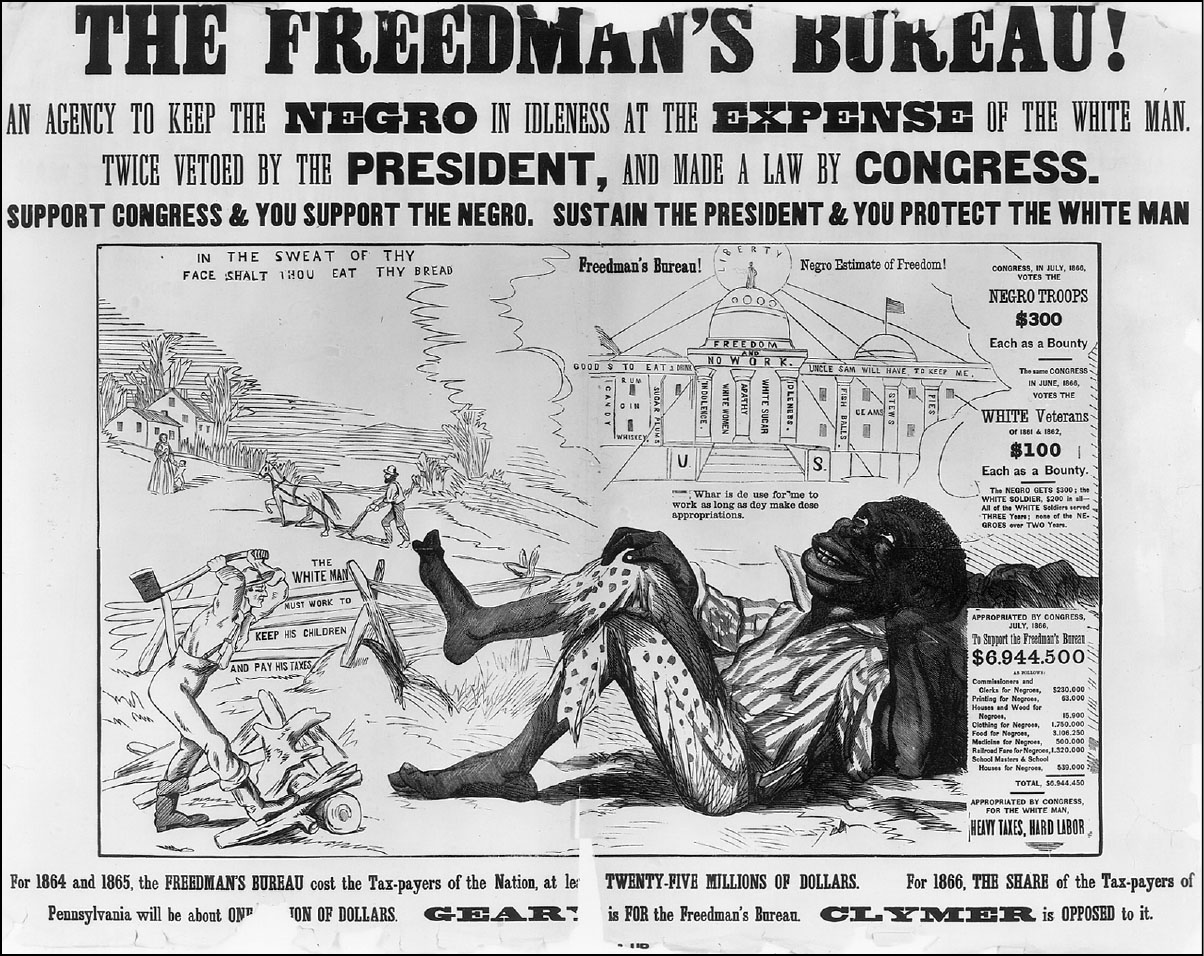
More information
“A Democratic Party broadside from the election of 1866 in Pennsylvania uses racist imagery to argue that government assistance aids lazy former slaves at the expense of hardworking whites.”
A Democratic Party broadside from the election of 1866 in Pennsylvania uses racist imagery to argue that government assistance aids lazy former slaves at the expense of hardworking whites.
Impeachment and the Election of Grant
In March 1867, Congress adopted the Tenure of Office Act, barring the president from removing certain officeholders, including cabinet members, without the consent of the Senate. Johnson considered this an unconstitutional restriction on his authority. In February 1868, he dismissed Secretary of War Edwin M. Stanton, an ally of the Radicals. The House of Representatives responded by approving articles of impeachment—that is, it presented charges against Johnson to the Senate, which had to decide whether to remove him from office.
That spring, for the first time in American history, a president was placed on trial before the Senate for “high crimes and misdemeanors.” By this point, virtually all Republicans considered Johnson a failure as president. But some moderates feared that conviction would damage the constitutional separation of powers between Congress and the executive. The final tally was 35–19 to convict Johnson, one vote short of the two-thirds necessary to remove him. Seven Republicans joined the Democrats in voting to acquit the president.
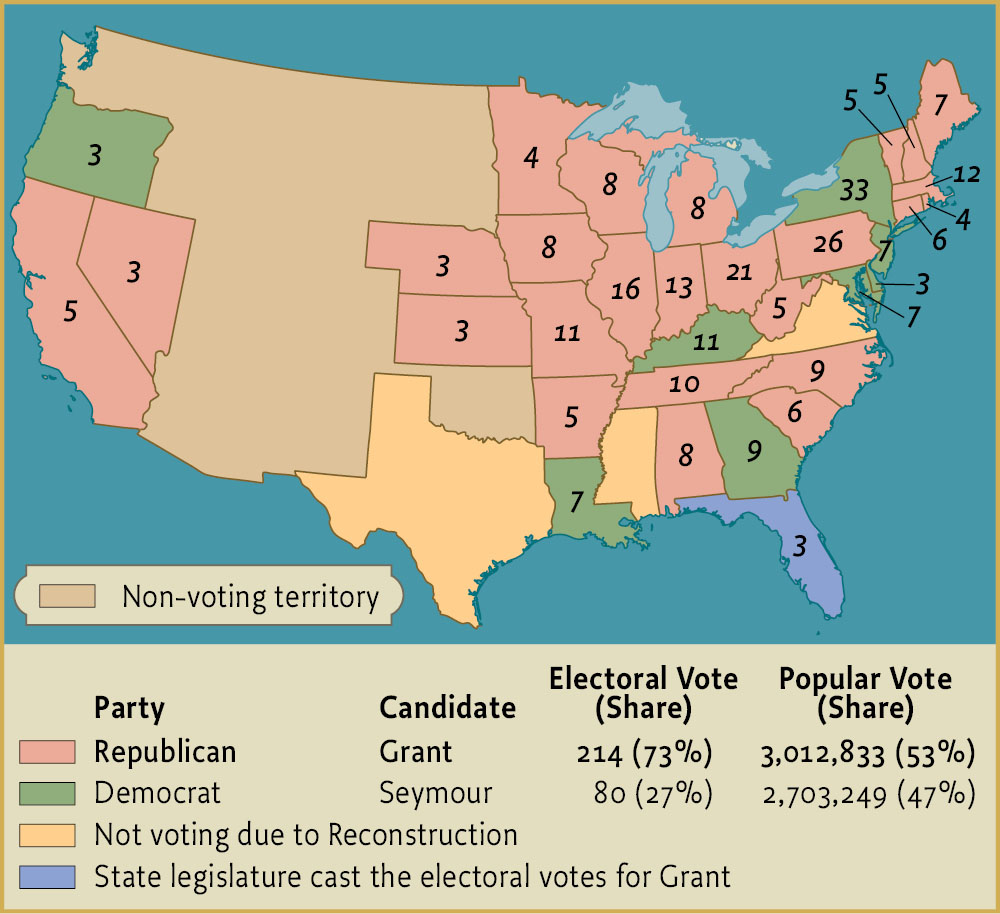
A few days after the vote, Republicans nominated Ulysses S. Grant, the Union’s most prominent military hero, as their candidate for president.Grant’s Democratic opponent was Horatio Seymour, the former governor of New York. Reconstruction became the central issue of the bitterly fought 1868 campaign. Democrats denounced Reconstruction as unconstitutional and condemned Black suffrage as a violation of America’s political traditions. They appealed openly to racism. Seymour’s running mate, Francis P. Blair Jr., charged Republicans with placing the South under the rule of “a semi-barbarous race” who longed to “subject the white women to their unbridled lust.”

VISIONS OF FREEDOM
Reconstruction

THE PRESIDENTIAL ELECTION OF 1868
More information
THE PRESIDENTIAL ELECTION OF 1868, The map shows Maine, New Hampshire, Vermont, Massachusetts, Rhode Island, Connecticut, Pennsylvania, West Virginia, Ohio, Michigan, Indiana, Illinois, Wisconsin, Minnesota, Iowa, Missouri, Arkansas, Nebraska, Kansas, Tennessee, North Carolina, South Carolina, Alabama, California, and Nevada all voted for the Republican Party candidate, Grant. Grant received 214 electoral votes, or seventy-three percent, and 3,012,833 popular votes, or fifty-three percent. The map shows New York, New Jersey, Delaware, Maryland, Kentucky, Georgia, Louisiana, and Oregon voted for the Southern Democrat Party candidate Seymour. Seymour received 80 electoral votes, or twenty-seven percent, and 2,703,249 popular votes, or forty-seven percent. Texas, Virginia, and Mississippi are shown as not voting due to Reconstruction. In Florida, the state Legislature cast the electoral votes for Grant.
The Fifteenth Amendment
Grant won the election of 1868, although by a margin—300,000 of 6 million votes cast—that many Republicans found uncomfortably slim. The result led Congress to adopt the Fifteenth Amendment, which prohibited the federal and state governments from denying any citizen the right to vote because of race. Bitterly opposed by the Democratic Party, it was ratified in 1870.
Although the Fifteenth Amendment left the door open to suffrage restrictions not explicitly based on race—literacy tests, property qualifications, and poll taxes—and did not extend the right to vote to women, it marked the culmination of four decades of abolitionist agitation. “Nothing in all history,” exclaimed veteran abolitionist William Lloyd Garrison, equaled “this wonderful, quiet, sudden transformation of four millions of human beings from . . . the auction-block to the ballot-box.”
The Second Founding
Reconstruction: Amendments
The laws and amendments of Reconstruction reflected the intersection of two products of the Civil War era—a newly empowered national state, and the idea of a national citizenry enjoying equality before the law. What Republican leader Carl Schurz called the “great Constitutional revolution” of Reconstruction transformed the federal system and with it, the language of freedom. As one congressman noted, the amendments expanded the liberty of whites as well as Blacks, including “the millions of people of foreign birth who will flock to our shores.”
WHO IS AN AMERICAN?
From Frederick Douglass, “The Composite Nation” (1869)
Who Is an American?: Frederick Douglass
In a remarkable speech delivered in Boston, Frederick Douglass condemned anti-Asian discrimination and called for giving Chinese immigrants all the rights of other Americans, including the right to vote. Douglass’s vision of a country made up of people of all races and national origins enjoying equal rights was too radical for the time and remains controversial today.
We are a country of all extremes, ends and opposites; the most conspicuous example of composite nationality in the world. Our people defy all the ethnological and logical classifications. In races we range all the way from black to white, with intermediate shades which . . . no man can name a number. . . . Our land is capable of supporting one fifth of all the globe. Here, labor is abundant and here labor is better remunerated that anywhere else. All moral, social and geographical causes conspire to bring to us the peoples of all other overpopulated countries.
Europe and Africa are already here, and the Indian was here before either. . . . Heretofore the policy of our government has been governed by race pride, rather than by wisdom. . . . Before the relations of [blacks and Indians] are satisfactorily settled, and in spite of all opposition, a new race is making its appearance within our borders, and claiming attention [the Chinese]. . . . Do you ask, if I favor such immigration. I answer I would. Would you have them naturalized, and have them invested with all the rights of American citizenship? I would. Would you allow them to hold office? I would. . . .
There are such things in the world as human rights. They rest upon no conventional foundation, but are external, universal, and indestructible. Among these, is the right of locomotion; the right of migration; the right which belongs to no particular race, but belongs alike to all. . . . We shall mold them all . . . into Americans; Indian and Celt, Negro and Saxon, Latin and Teuton, Mongolian and Caucasian, Jew and Gentile, all shall here bow to the same law, speak the same language, support the same government, enjoy the same liberty.
QUESTIONS
- What is Douglass’s answer to the question, Who is an American?
- Why does he believe that being able to move freely from one country to another should be considered a universal human right?
The new amendments also transformed the relationship between the federal government and the states. The Bill of Rights had linked civil liberties to the autonomy of the states. Its language—“Congress shall make no law”—reflected the belief that concentrated national power posed the greatest threat to freedom. The authors of the Reconstruction amendments assumed that rights required national power to enforce them. Rather than a threat to liberty, the federal government, in Charles Sumner’s words, had become “the custodian of freedom.”
The Reconstruction amendments transformed the Constitution from a document primarily concerned with federal-state relations and the rights of property into a vehicle through which members of vulnerable minorities could stake a claim to freedom and seek protection against misconduct by all levels of government. In the twentieth century, many of the Supreme Court’s most important decisions expanding the rights of citizens were based on the Fourteenth Amendment, including the 1954 ruling that outlawed school segregation and the decision in 2015 preventing states from discriminating against gay Americans in the right to marry.
Together with far-reaching congressional legislation meant to secure for former slaves access to the courts, ballot box, and public accommodations and to protect them against violence, the Reconstruction amendments transferred much of the authority to define citizens’ rights from the states to the nation. They were crucial in creating the world’s first biracial democracy, in which people only a few years removed from slavery exercised significant political power. Introducing into the Constitution for the first time the words “equal protection of the law” and “the right to vote” (along with “male,” to the outrage of the era’s advocates of women’s rights), the amendments both reflected and reinforced a new era of individual rights consciousness among Americans of all races and backgrounds.
Today, most countries, including every one in Europe, limit automatic access to citizenship via ethnicity, culture, or religion. Birthright citizenship remains an eloquent statement about the nature of American society, and a repudiation of a long history of equating citizenship with whiteness.
The amendments are frequently seen not simply as an alteration of an existing structure but as a second founding, which created a fundamentally new document with a new definition of both the status of Blacks and the rights of all Americans.
Reconstruction in Indian Territory
Even though they had not been part of the Union, enjoying their own sovereignty, Indian nations that had sided with the Confederacy were treated after the Civil War as secessionists. During Reconstruction, federal agents negotiated new treaties with pro-Confederate Native American nations in Indian Territory. They included provisions for the abolition of slavery and, in some cases, citizenship and equal rights for former slaves of Native Americans. They required tribes to cede much of their land to the federal government and provided for the construction of railroads through Indian Territory. In some cases, Native nations were forced to provide land to their former slaves—the only slaveholders anywhere in the United States who were required to do so. Like many southern whites, former Indian slaveholders for generations rejected the equality of their emancipated slaves. Indeed, the status of the descendants of Native Americans’ slaves remains a source of controversy to this day. The Cherokee constitution was recently amended to exclude them from citizenship, leading to lawsuits that have yet to be resolved.
The Rights of Women
“The contest with the South that destroyed slavery,” wrote the Philadelphia lawyer Sidney George Fisher in his diary, “has caused an immense increase in the popular passion for liberty and equality.” But advocates of women’s rights encountered the limits of the Reconstruction commitment to equality. Women activists saw Reconstruction as the moment to claim their own emancipation. The rewriting of the Constitution, declared suffrage leader Olympia Brown, offered the opportunity to sever the blessings of freedom from sex as well as race and to “bury the Black man and the woman in the citizen.”
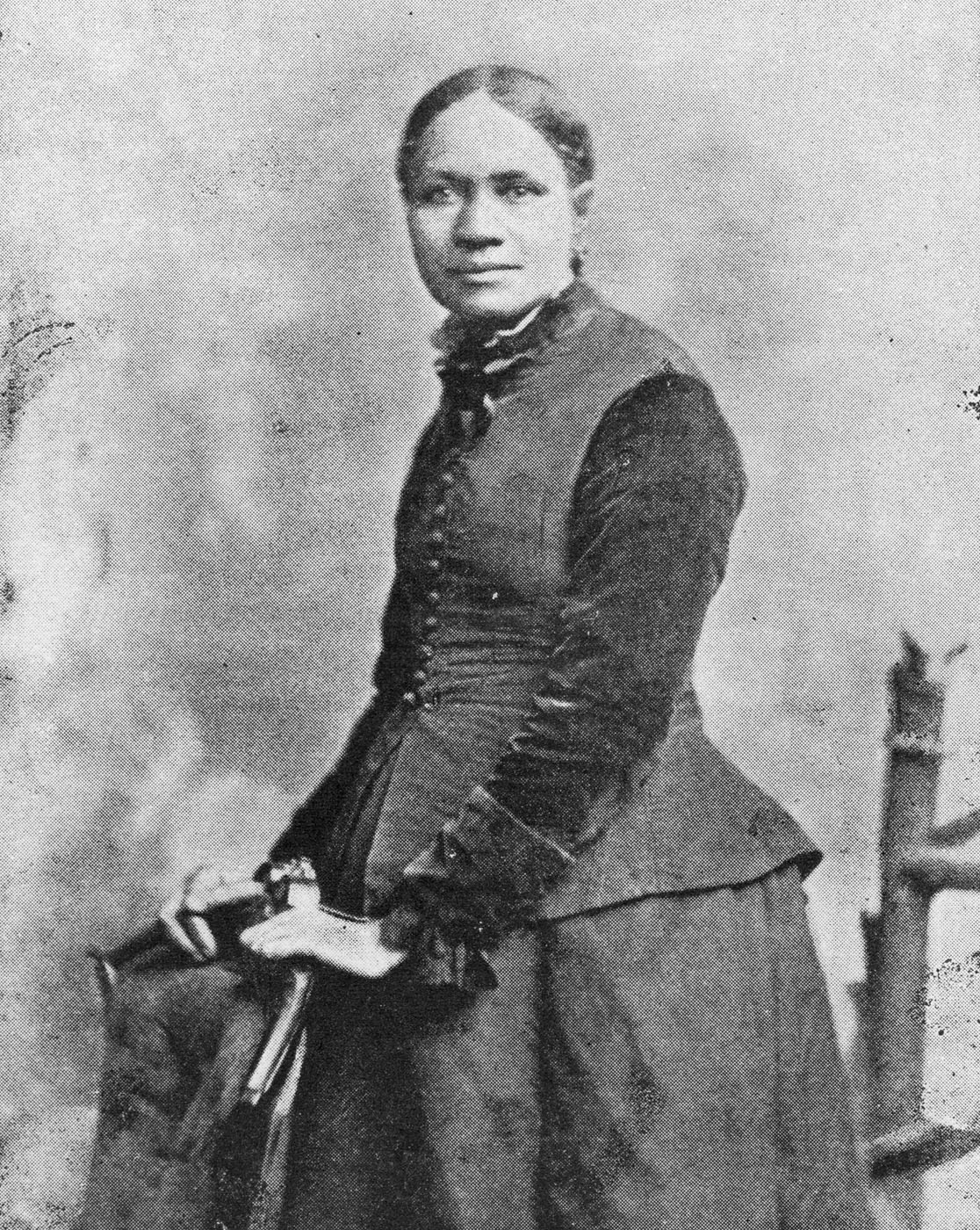
Frances Ellen Watkins Harper, poet, abolitionist, and campaigner for racial justice and women’s rights.
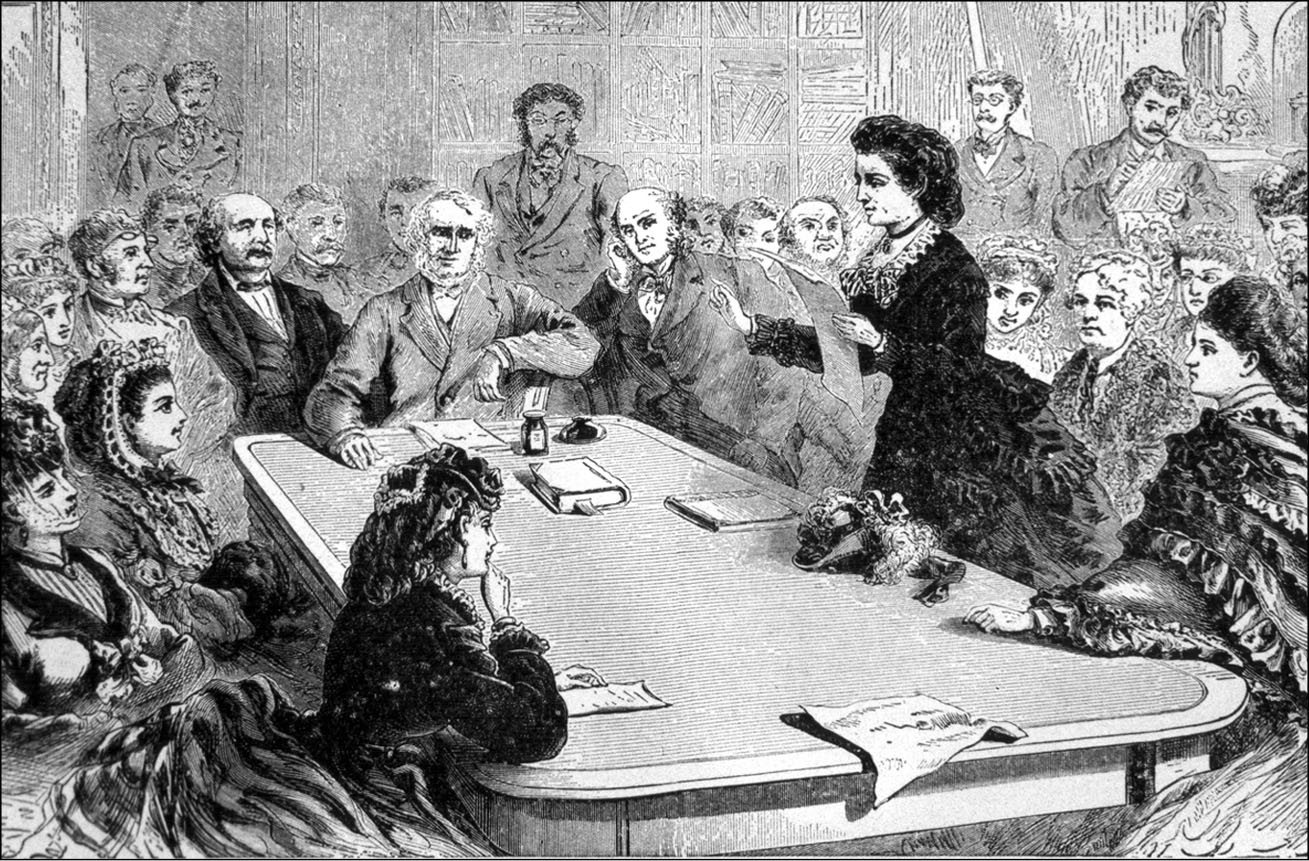
Even Radical Republicans insisted that Reconstruction was the “Negro’s hour” (the hour, that is, of the Black male). The Fourteenth Amendment for the first time introduced the word “male” into the Constitution, in its clause penalizing a state for denying any group of men the right to vote. The Fifteenth Amendment outlawed discrimination in voting based on race but not gender. These measures produced a bitter split both between feminists and Radical Republicans, and within feminist circles. Some leaders, like Elizabeth Cady Stanton and Susan B. Anthony, denounced their former abolitionist allies and moved to sever the women’s rights movement from its earlier moorings in the antislavery tradition. Even though the Fifteenth Amendment did nothing to secure their right to vote, most Black women activists felt that the enfranchisement of Black men was necessary for the advancement of the entire race. Black women created their own local clubs and associations, often based in Black churches, to press not only for the right to vote but also for the ability to travel freely without encountering harassment, as well as action against lynching.
More information
“A Delegation of Advocates of Woman Suffrage Addressing the House Judiciary Committee, an engraving from Frank Leslie’s Illustrated Newspaper, February 4, 1871. The group includes Elizabeth Cady Stanton, seated just to the right of the speaker, and Susan B. Anthony, at the table on the extreme right.”
A Delegation of Advocates of Woman Suffrage Addressing the House Judiciary Committee, an engraving from Frank Leslie’s Illustrated Newspaper, February 4, 1871. The group includes Elizabeth Cady Stanton, seated just to the right of the speaker, and Susan B. Anthony, at the table on the extreme right.
Thus, even as it rejected the racial definition of freedom that had emerged in the first half of the nineteenth century, Reconstruction left the gender boundary largely intact. When women tried to use the rewritten legal code and Constitution to claim equal rights, they found the courts unreceptive. Myra Bradwell invoked the idea of free labor in challenging an Illinois rule limiting the practice of law to men, but the Supreme Court in 1873 rebuffed her claim. Free labor principles, the justices declared, did not apply to women, since “the law of the Creator” had assigned them to “the domestic sphere.”
Despite their limitations, the Fourteenth and Fifteenth Amendments and the Reconstruction Act of 1867 marked a radical departure in American history. The Reconstruction Act of 1867 inaugurated America’s first real experiment in interracial democracy.
Glossary
- Black Codes
- Laws passed from 1865 to 1866 in southern states to restrict the rights of former slaves; to nullify the codes, Congress passed the Civil Rights Act of 1866 and the Fourteenth Amendment.
- Civil Rights Bill of 1866
- Along with the Fourteenth Amendment, legislation that guaranteed the rights of citizenship to former slaves.
- Fourteenth Amendment
- 1868 constitutional amendment that guaranteed rights of citizenship to former slaves, in words similar to those of the Civil Rights Act of 1866.
- Reconstruction Act
- 1867 law that established temporary military governments in ten Confederate states—except Tennessee—and required that the states ratify the Fourteenth Amendment and permit freedmen to vote.
- Tenure of Office Act
- 1867 law that required the president to obtain Senate approval to remove any official whose appointment had also required Senate approval; President Andrew Johnson’s violation of the law by firing Secretary of War Edwin Stanton led to Johnson’s impeachment.
- impeachment
- Bringing charges against a public official; for example, the House of Representatives can impeach a president for “treason, bribery, or other high crimes and misdemeanors” by majority vote, and after the trial the Senate can remove the president by a vote of two-thirds. Although three presidents, Andrew Johnson, Bill Clinton, and Donald Trump, were impeached and tried before the Senate, none were convicted.
- Fifteenth Amendment
- Constitutional amendment ratified in 1870, which prohibited states from discriminating in voting privileges on the basis of race.